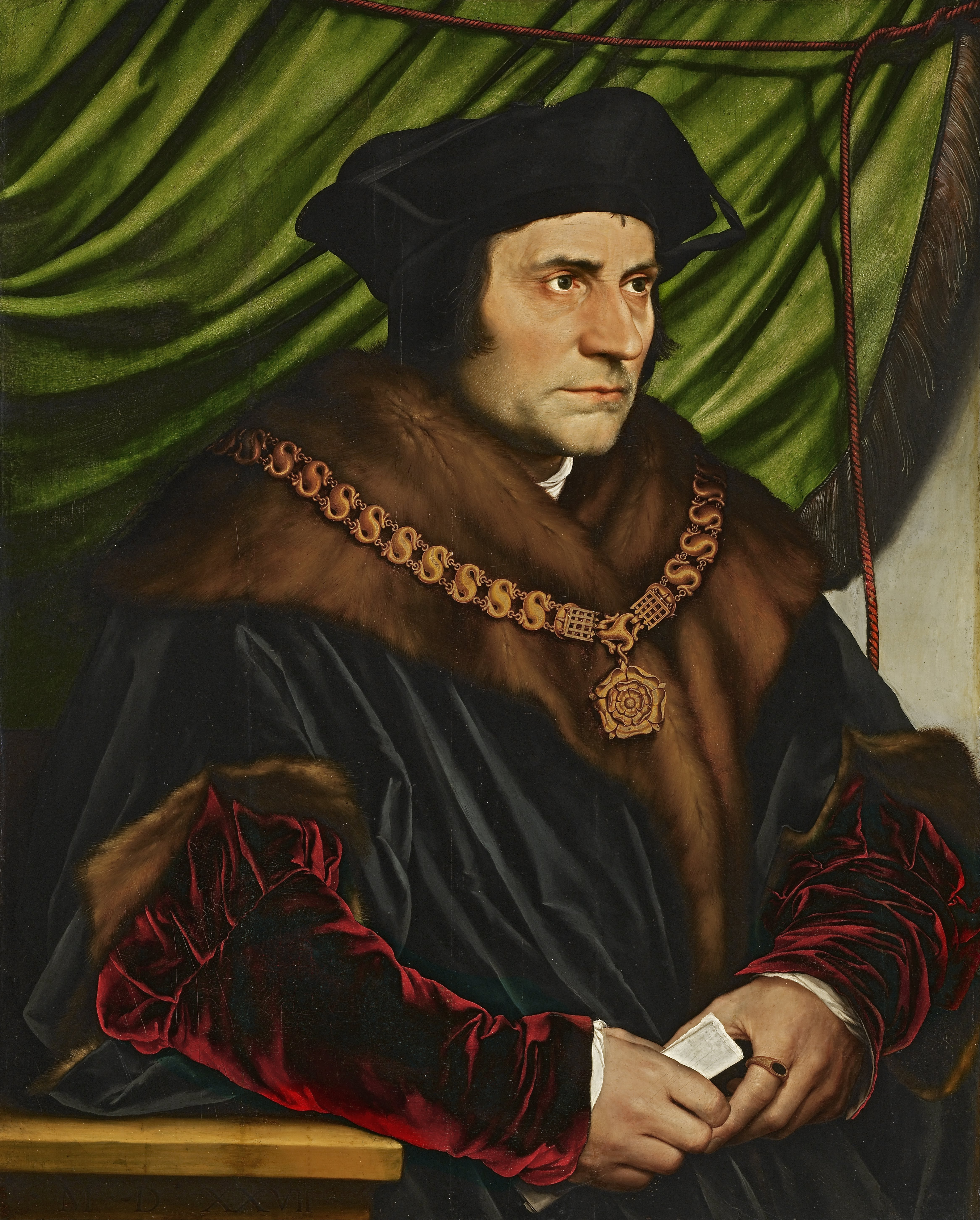
Thomas More, the Lord Chancellor of England under Henry VIII until the king had him executed for high treason, published "Utopia" in 1516. The title means "The land of nowhere", but due to the book's fame and popularity, "Utopia" has become a common byword for something good but unrealistic. Something utopian, in short!
As all utopian novels, "Utopia" can be interpreted in all kinds of
ways. Was it a serious description of how a perfect society should really look
like? Was it a veiled criticism of the conditions in 16th century Britain and
Europe? Or was it some kind of frivolous joke? After all, the people and places
in the story have names such as "Raphael the talker of nonsense",
"The City of Shadows" or "The River without Water". As
already noticed, Utopia actually means "The land of nowhere".
My guess is that "Utopia" is a sharp and witty criticism of More's
own time. The point of the work is not really to describe the best society or
propose far reaching reforms, but rather to parody Renaissance Europe. This
would explain why Utopia looks like a strange inversion of early modern Europe.
It would also explain why More's book gives such a humorous impression. But
yes, there are serious scholars who believe otherwise, suggesting that
"Utopia" is not simply a criticism of 16th century conditions, but
also a real utopia, a serious description of how the best society should
actually be like. Indeed, this seems to be the most common interpretation. Even
so, More cannot have believed that his ideal commonwealth was ever going to be
implemented. He strikes a pessimistic note in the book. In real life, More was
one of the highest officials in Britain, the very society he was condemning in
the novel! Some people see More as a caged socialist far ahead of his time. In
a sense, everyone agrees that "Utopia" really was utopian.
The setting of "Utopia" is a series of fictitious conversations
between More and a certain Raphael Hythlodaeus, who claims to have visited the
splendid island of Utopia, somewhere beyond the equator. Hythlodaeus begins on
a Socratic note, by explaining why philosophers should stay away from politics.
He continues by describing and sharply criticizing the social transformations
in 16th century England, especially the enclosures who turned the peasants into
a landless and destitute mass with no prospect for productive employment.
Raphael also attacks the constant wars for sheer territorial aggrandizement
waged by various European powers, the rampant corruption and greed of the
rulers, and the ridiculous behaviour of their sycophantic "advisors"
and servants.
The second part of "Utopia" describes the Utopian Commonwealth in
some detail. As many have noticed, More's description of Utopia is very
contradictory. Some of these contradictions can be explained by assuming that
the author was criticizing and parodying his own society. For instance, all
Utopians, despite social station, work in agriculture for a fixed period of
time, indicating that they are not above manual labour. Yet, they consider
hunting and waging war below their dignity, and these tasks are therefore
assigned to slaves or mercenaries. The denizens of Utopia seem somewhat
hypocritical! However, the point is presumably to lampoon Renaissance Europe
where the nobility considered manual labour below their dignity, while pursuing
honour and glory in hunting parties and wars... In Utopia, the
"glorious" hunting is done by slaves, while the presumably honourable
wars are fought by hired soldiers explicitly described as lowlives lacking any
concept of honour!
In the same manner, More describes how the Utopians make gold chains for their
slaves, to show how much they despise fake wealth. I don't think this is really
a comment on slavery per se, neither pro nor con. Once again, it's probably a
device used to expose More's own time, perhaps by suggesting that his
contemporaries were slaves to gold? Note also the strangely Christian habits of
the Utopians, and the fact that they don't seem to know about real
Christianity. This is another ironic inversion of Early Modern Europe, where
everyone knows about it, but nobody practices it! I was also struck by More's
statement that since all Utopians wear the same kind of clothes, they don't
need that much wool. Is this another attack on the enclosures and their sheep?
So why do many readers take "Utopia" as a serious (if utopian) blue
print for a real society? The reason, I assume, is "really existing
socialism". The island of Utopia is said to be egalitarian and democratic,
yet there is a ruling elite and tight regimentation. This certainly sounds like
a caricature of the Soviet Union and its propaganda. Other traits, however, are
more akin to Nazi Germany. The Utopians have slaves and believe in eugenics:
they let the scum of the earth fight their wars, the better to get rid of them.
There are also traits that strike me as typically Western, such as the contrast
between enlightened tolerance and endless wars...
Perhaps this is what makes "Utopia" such a great work. It's a work of
many dimensions, a work that is just as relevant today as it was 500 years ago.
More's novel is a utopia for all seasons.

No comments:
Post a Comment