Showing posts with label Crabronidae. Show all posts

Friday, August 3, 2018

The bizarre world of solitary wasps


"Solitary Wasps. Behavior and Natural History" is a look at the bizarre underworld of solitary wasps, a group of insects distantly related to ants, bees and "real" wasps. The solitary wasps covered in this book all belong to the suborder Aculeata. They include the cuckoo wasps, the velvet ants or "cow killers", digger wasps, pollen wasps, beewolves and others.

Their world is lawless land. Solitary wasps spend most of their time killing other insects (or each other) in various ingenious ways. Parasitism seems to be the favoured method. The only "nice" bugs in this book are the strictly vegetarian pollen wasps! But yes, even they sting...

"Solitary Wasps" cover all aspects of the behaviour and natural history of these varied and tiny creatures. There are chapters on foraging, nest provisioning, nest building, natural enemies and mating. One chapter attempts to explain the taxonomy of this group. Unfortunately, it's badly edited and calls sawflies "aculeates" at one point. (They are "symphytans", actually.) Got it?

The text is relatively easy to read, but can be "heavy" unless you have an enduring interest in wasps. The book is therefore mostly suited for students of entomology, and perhaps more advanced amateur entomologists. It's not a bad book, but it gives a somewhat boring impression, since the few illustrations are all in black and white. There are no colour plates or colour photos. Since many solitary wasps are pretty conspicuous, this would have been a plus!

Despite this little shortcoming, I nevertheless give this (somewhat scary) book five stars. Whatever you do, don't be reborn as an aculeate solitary wasp!

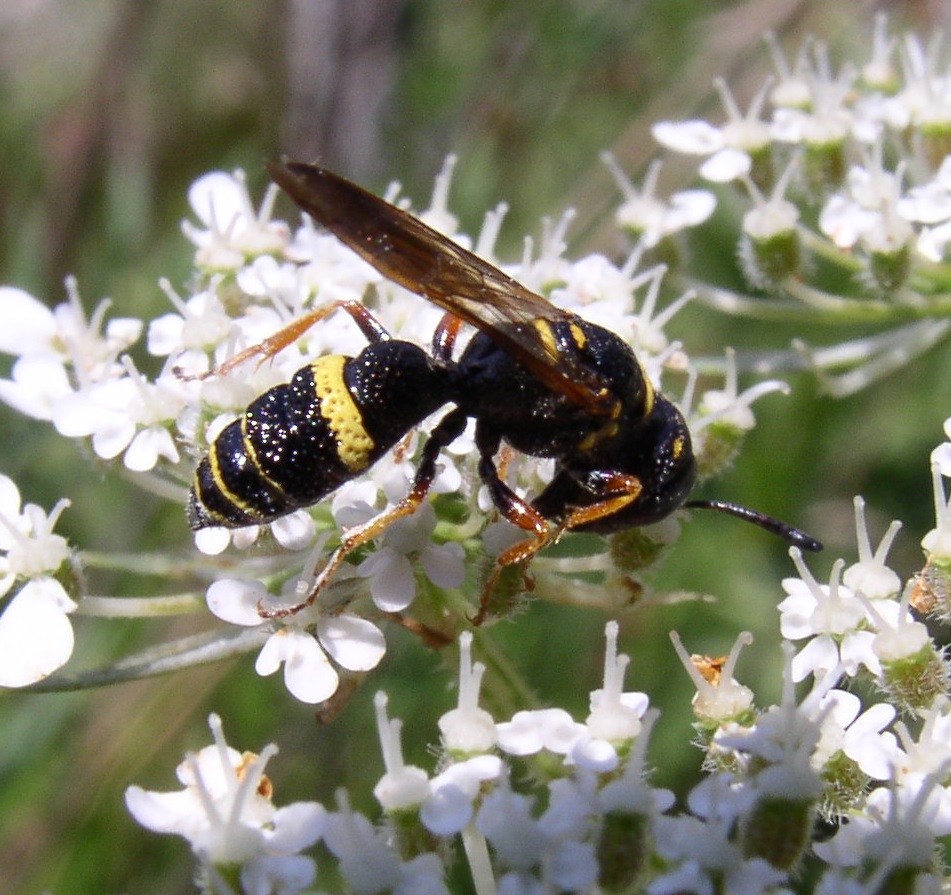
Don´t cry beewolf


The beewolves are a group of ground-nesting, solitary wasps. They belong to the genus Philantus of the family Sphecidae. The name "beewolf" refers to their habit of preying on bees (including honeybees). The bees are killed, taken to the beewolf nest and later eaten by their larvae.

In some regions of Europe and North Africa, beewolves are a threat to commercial beekeeping. A beewolf population of about 3000 can capture 30,000 honeybees daily! In the Dakhla oasis of Egypt, around 24,000 beewolves were exterminated in one season, but they were just as abundant the next year. Needless to say, the beekeepers were not.

As behoves a wasp, beewolves are pests in most other respects as well. In the United States, a large species known as bumblebee-wolf attack and kills bumblebees, an important pollinator. Beewolves also kill beneficial wasps, i.e. wasps that eat grasshoppers, caterpillars and aphids. Should we be crying beewolf, I wonder?

"The Natural History and Behavior of North American Beewolves" is a relatively detailed description of 34 North American species. A short chapter on the European beewolf is also included. Male behaviour, nesting behaviour, mating, provisioning and natural enemies are all covered. Beekeepers (and bees) might be happy to learn that even beewolves have enemies, including robberflies, satellite flies and cuckoo wasps. Interestingly, beewolves can tell the difference between bees and bee mimics, and decline to attack the latter. The book never explains why. Too little meat?

This probably isn't a book for the general reader. I mean, beewolves? Please come on. However, it's relatively easy to read and might be of interest to amateur entomologists and, of course, students of the subject. Please note, however, that the book isn't a field guide, but rather a natural history.