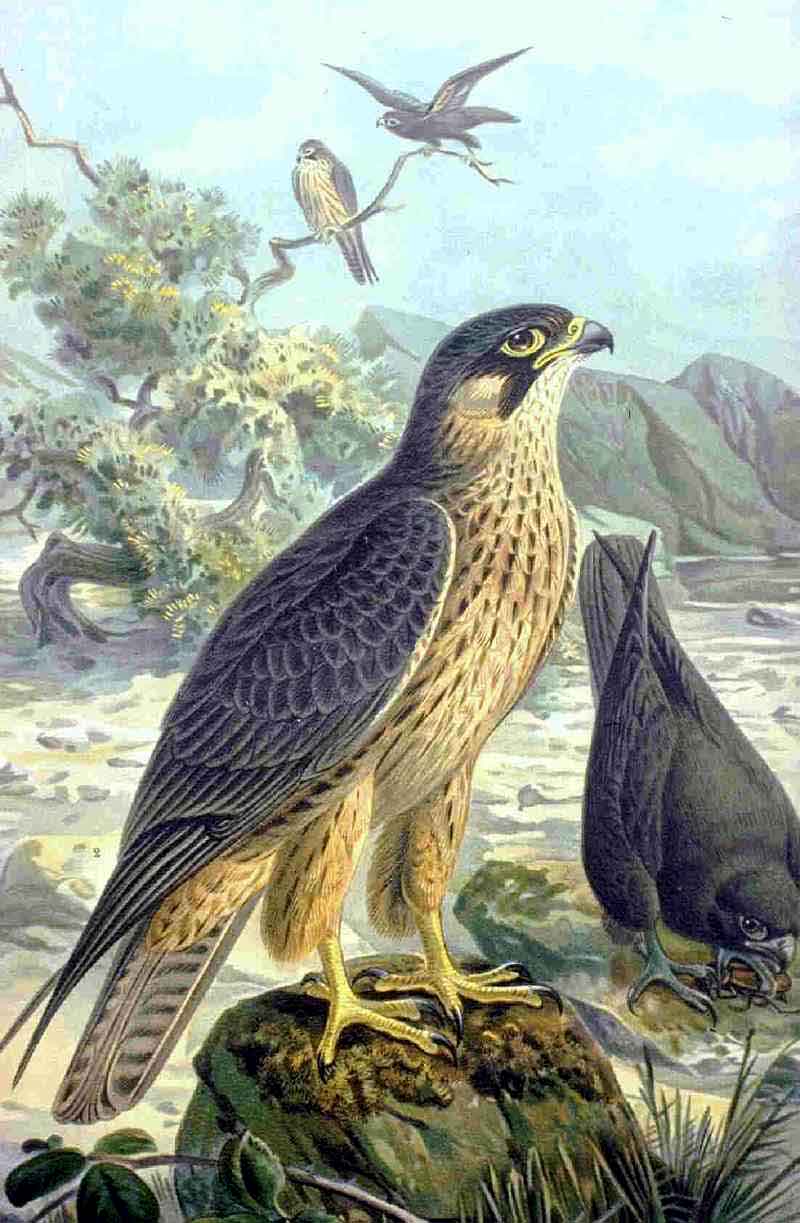
Showing posts with label Eufalconimorphae. Show all posts

Thursday, April 3, 2025

Terrorbirds


So I just learned that seriemas aren´t really gruiforms, but belong to an order all their own closer on the evolutionary tree to falcons, parrots and passerines. Does that matter? Not really...except that the seriemas are the only surviving cariamiforms. The order was once more diverse and also included, ahem, terrorbirds...

I never really thought about it, but it *is* funny that terrorbirds are closer on the evolutionary tree to the songbirds in your backyard than they are to cassowaries (the modern birds they superficially resemble). It´s also really, really funny that they have been extinct for quite some time, LOL.

Saturday, September 7, 2024

Wisdom


- Yes, my dear raven, the humans are denying direct realism again. They apparently think we don´t exist, or that we can´t see them.

- Nor do they know that we´re not really dinosaurs at all, but descendants from the Great Eufalconid in Asgard, which only *we* can directly perceive!

- Exactly, my dear raven, exactly. 

Sunday, March 24, 2024

Sheer evil


Is sheer evil on the loose in the Mogador archipelago off the coast of Morocco?! 

The local population of Eleonora´s falcon is said to hunt smaller birds, strip them of their flight feathers, and then imprisoning them in rock fissures or deep holes. Presumably with the intention of coming back later, the flesh of the live bird still being tender, and kill it then...

This bizarre behavior, known to the local fishermen for a long time, was only recently documented by scientists. Which is what counts. Except that some scientists are skeptical, no doubt because falcons aren´t supposed to be *that* clever.

Well, thank you. Now I can go back to sleep in the knowledge that Eufalconimorphae isn´t completely TAINTED!  

Eleonora´s falcon: The raptor that imprisons birds live

Tuesday, March 19, 2024

Next cousins


- So we are cousins then, my dear Sir Bustard...
- Humpf, I don´t think so, you cuckoo clock trash!


So a 2014 genetic study shows that bustards are more related to cuckoos and turacos than to cranes and other gruids?! HA HA HA. But sure, it does make sense in some really bizarre way. Come to think of it, the bustard does look like a truly monstrous cuckoo. 

The falcons have already been outed as closer to passerines than to other raptors. Sure wonder what other surprises awaits us out there...

Otidimorphae


Saturday, March 27, 2021

Called it


I know this is highly subjective, but I´m beginning to like cladistics. You know, that annoying shit which has created havoc in the evolutionary tree we all learned in senior high science class circa 1985. With some help, I might add, from the phylogenetic species concept (still don´t like that one) and the Sibley-Ahlquist taxonomy of birds (which does make sense). 

I always suspected that starlings were really a kind of petty crows, and yepp, you guessed it, Sibley and my man Jon did prove that sturnids and corvids should really be treated as the same family. Indeed, if Anatomically Modern Man disappears, the next intelligent (and highly destructive) ruler of this space rock will probably be...Sturnus vulgaris, hell bent on a campaign of extermination against crows, gulls and, I suppose, anatomically less modern men. Of course it´s a bloody corvid. 

As for cladistix, one clade that certainly makes sense is the Eufalconimorphae, within which falcons are grouped with passerines and parrots, meaning (of course) that falcons are *not* closely related to hawks, eagles or the highly aberrant stork known as "California condor". No surprise there, I always thought falcons looked more similar to said parrots, rather than to raptors of the diurnal persuasion. 

Now, it has come to my quality attention that some prominent cladisticians have proposed the existence of a *huge* clade known as Pancrustacea, regrouping both insects and crustaceans. Bingo! All my life, I wondered about the sinister similarity between the half-dead crayfish at my parents´ dinner table and the Insecta in our backyard, now I know the reason why, thank you. 

I have stopped worrying, and learned how to love cladograms. Yeah, really. 


Wednesday, March 4, 2020

Yes, storks

A highly abberant stork? Only in California!


“Handbook of the Birds of the World” (HBW for short) is a gargantuan encyclopedia in 17 volumes describing all living species of birds known to science. That´s about 9,000 of them! The first volume was published in 1992, the last one just a few years ago. There are also two extra volumes containing extensive checklists of…well, all the birds previously described. This is a review of the second volume, published in 1994. It seems I missed to comment it during my illicit reviewing spree at Amazon.com, which ended in Jeff Bezos personally purging me in 2018. OK, not really, but it seems it wasn´t on sale in Bezosland and therefore couldn´t be properly fake-reviewed by yours truly, so here I go on my blog instead!

Somewhat surprisingly, Vol 2 only covers two orders, the “classical” Falconiformes (diurnal birds of prey a.k.a. ditto raptors) and Galliformes (chicken and their allies a.k.a. gamefowl and half a dozen other aliases). I admit that I didn´t dig *that* deeply into the section on the galliforms, but it doesn´t seem to mention the bantam breeds, so perhaps that´s a plus for chicken fanciers, who often positively hate the poor little things, or so I´ve been reliably informed. Instead, I went straight for the main course, the Falconiformes. In HBW´s version, or rather their 1994 version, the raptor order consist of New World vultures, the Osprey, Hawks & Eagles (presumably including the Old World vultures), the Secretarybird, and Falcons & Caracaras (called “falconids” in this work). That being said, all wasn´t well in raptor space back in the 1990´s. The exact taxonomic position of the New World vultures was especially contentious.

HBW argues that New World vultures may actually be closer to storks (yes, storks) than to other birds of prey. The idea of a Californian Condor really being a highly aberrant stork does have a certain intrinsic appeal. Some of the similarities between Cathartidae and Ciconiiformes are absolutely stunning: “For example, both groups of birds keep cool by squirting their legs with urine, which then evaporates off to leave the legs sometimes looking as if they have been white washed”. The genera within Cathartidae may not be closely related either. We also learn that there used to be Old World vultures in the New World until 10,000 years ago and New World vultures in the Old World 20 million years ago (not sure what made them leave). Even on the species level there is confusion. Or was back in ´94. The good ol´ Turkey Vulture, well known from spaghetti western flicks, might actually be several different species. It´s difficult to know since all museum specimens look the same – the skin color (a distinguishing mark for subspecies and species) fades after death!

In this volume, the “falconids” are relatively firmly anchored in Falconiformes (as the diurnal birds of prey are called when they do include them – otherwise it´s Accipitriformes) due to their “external morphology, internal anatomy, behaviour, feather parasites, and moult patterns”. DNA studies suggested the same thing, but today scientists believe on the basis of new research that falconids aren´t closely related to accipitrid raptors at all, rather they are a sister group to parrots and passerines! Interestingly, one M Jollie suggested already in 1977 on non-genetic morphological grounds that falconids are polyphyletic (google it!) and are closer to owls, cuckoos, plantain-eaters and indeed parrots than to other diurnal birds of prey.

Otherwise, everything is pretty much as usual as far as HBW volumes are concerned: detailed family presentations followed by species presentations and range maps, and a lot of color illustrations and ditto photos – one of the reasons why these books are so prohibitively expensive. Yes, I looked it up in a library, thank you! That being said, the species presentations are quite short compared to later volumes in the series with their complete information overload on every small and obscure tropical songbird. Nor are there any additional chapters on mostly unrelated topics, also a feature of later volumes.

Perhaps transcended by current research?

Tuesday, December 31, 2019

Falcons for full employment


America´s strangest job? Yes, falcons are used to scare away "nuisance birds" from valuable crops. This short clip features an abatement falconer at work. Interesting!  

Saturday, December 28, 2019

Meeting with gyrfalcons


Sigurdur Aegisson is an Icelandic ethnologist. I haven´t  been able to find his book on Icelandic monster lore, “Meeting with monsters”, and therefore had to rest contented with a small work on very real animals, “Icelandic trade with gyrfalcons: From medieval times to the modern era”, published in 2015. I readily admit that the book is very narrow, and of interest only to gyrfalcon aficionados, or perhaps hardcore history buffs suffering from an enduring obsession with the West Scandinavian theatre. But then, I know that at least one gyrfalcon aficionado is reading my blog on a semi-regular basis, so here we go… ;-)

The gyrfalcon (Falco rusticolus) is the largest falcon in the world, and the diurnal raptor with the northernmost geographic distribution, living in the Arctic and Sub-Arctic regions of North America and Eurasia, including Iceland and Greenland. Due to its large size, the gyrfalcon has long been popular among falconers – we are talking about a sturdy raptor that can attack and kill even swans and herons! The gyrfalcon is famous for its many color morphs, with the Icelandic birds being grey, while many “Greenland falcons” are white. White gyrs in particular were highly prized by European and Muslim royals and aristocrats.

Aegisson has probably read every book on the topic of Icelandic gyrs and the trade in them. When Iceland was an independent “republic”, every landowner could freely catch and sell gyrfalcons which lived on his own land. As Iceland became more integrated into the Norwegian and Danish kingdoms, however, this gradually changed until the catching and trade in gyrs became a royal monopoly. Gyrs were taken to a gigantic aviary at Bessastadir, from which they were taken to Denmark onboard ships. The local peasants were forced to hand over cows and other livestock to feed the birds. This can´t have contributed to the bird´s popularity – indeed, most Icelanders regarded gyrfalcons as an annoying competitor (they often killed eiders), and as the international interest in falconry dropped during the 19th century, the falcons became fair game. At the same time that Iceland adopted the gyrfalcon as its national symbol, the actual birds were threatened with extinction!

Judging by Aegisson´s account, this extremely negative attitude to “Falco rusticolus” can´t have been the original one. During the Middle Ages, Icelandic imports were often paid in money earned by selling gyrfalcons to enterprising European traders. The author believes that huge amounts of flour, timber and wax could be imported by the Icelandic settlers in this manner, making the bird an extremely valuable commodity. This is interesting for another reasons, too. Note that the settlers weren´t self-sufficient, at least not during the High Middle Ages, and actually survived on their desolate island only thanks to large scale trade with the rest of Europe! Somehow, this isn´t the romantic view we all have of rugged Vikings living off the land (and the loot) in their own independent state… My guess is that later, as the gyrfalcon trade became a Danish royal prerogative, the locals developed very different feelings towards the unfortunate birds.

Aegisson believes that most Greenland falcons owned by European and Mideast falconers weren´t caught in Greenland but in Iceland. The white Greenland color morphs regularly migrated to Iceland, following icebergs which in turn attracted enormous flocks of seabirds.

Today, gyrfalcons are protected by law and their Icelandic population is relatively stable at around 2,000 birds. One fun fact not mentioned by the author is that DNA tests apparently show that falcons aren´t closely related to eagles, hawks, vultures and other raptors. Rather, they are on the same line of evolution as – wait for it – parrots and passerines! The idea of a gyrfalcon being an Arctic badass parakeet (or is it psittacoid) does have a certain intrinsic appeal, at least in my intellectual neighborhood…

With that, I leave you for now.

Sunday, September 29, 2019

Eufalconimorphae: Finally, a clade that makes some sense!

If this idiot blogger calls me chicken one more time, I´m gonna go ultra-rogue on him!

So DNA research suggests that falcons are more closely related to parrots and passerines than to eagles, hawks, vultures and other Accipitriformes. 

Makes sense.

My amateur biological side always thought there was something strange about falcons. I mean, they *look* differently, don´t they? For all I know, they could be parrots gone ultra-rogue. And what about the caracaras? They look like chicken evolving into birds of prey! 

Next, I want a thorough taxonomical revision of cuckoos. I´m pretty sure there´s something fishy about them, too. And what´s this shit about swifts and hummingbirds being related??? Not to mention the supposed dino-bird connexion, not sure about that one either. 

Maybe we should also take a closer look at the old discarded theory that flying foxes are really primates and hence related to humans... Always missed that one!

Wtf, I love falcons now


“Europas rovfåglar” by Gunnar Pettersson is Swedish book about raptors or birds of prey. Published in 1984, it includes the falcons alongside hawks, eagles, vultures and other Accipitriformes. Apparently, the falcons are no longer regarded as raptors in good standing, rather being a dramatic example of convergent evolution. Or so the nerd who writes on Wiki tells me. Until the pendulum swings back again, presumably… Sorting out these birds have long been a problem for biologists!

The book includes all European raptor species. The species presentations are rather short. The book is above all a work of art. And yes, the illustrations are made by Gunnar Pettersson himself. He, or perhaps the editor, seems more fascinated by some species than by others. Peregrine falcons, gyrfalcons and white-tailed eagles are prominently featured. So are some vultures. The author is “pro-raptor” and the concluding chapter attacks humanity as we know it for “persecuting” raptors. I didn´t know that birds of prey were themselves prey for humans just a few centuries ago. In Sweden, the common buzzard was verily food, and in southern Italy and Sicily, the locals feasted on sea eagles and the lammergeier! The author also writes about falconry – I find it fascinating that falcons can actually be trained or tamed.

But no, I´m not particularly raptor-friendly. If it´s between us and them, I´d say kill´em before they multiply (and eat´em). Perhaps I imbibed too much romantic shit about Nature as a kid from books like “Europas rovfåglar”, so this is the counter-reaction. Still, I like parrots and magpies, so the idea that falcons are more closely related to Psittaciformes and Passeriformes than to some ugly buzzard or vulture made me slightly more positive to the fate of the Peregrine…

Saturday, September 8, 2018

Sociable weavers


What can I say? This is vol. 15 of "Handbook of the Birds of the World", a 16-volume encyclopaedia describing and illustrating all known, living species of birds. Those familiar with these books know that they are extremely expensive, very difficult to read due to heavy scientific terminology, but also singularly well-produced, with full-colour photos and plates.

This volume covers eight passerine families, including Finches, Weavers and New World Warblers. One chapter deals with the brood-parasitic Whydahs and Indigobirds. There is also a special chapter entitled "Conservation of the world's birds: the view from 2010". I admit that I didn't read it. I hope it's positive!

As usual, HBW contain a veritable overload of facts, including in the extensive photo captions. Here's a fascinating example of interaction between two unrelated birds and humans: the Sociable Weaver nests on electricity pylons and telephone poles, and have therefore extended its range into tree-less regions. The African Pygmy Falcon, which in South Africa is entirely dependent for roosting and breeding on the huge communal nests of the Sociable Weaver, has also been able to extend its range. Breeding raptors can't be disturbed without a licence, so the weavers have also benefited from the arrangement. The South African phone company can't destroy weaver nests which include one of the falcons!

"Handbook of the Birds of the World" isn't really intended for the general reader but it deserves all its five stars, as usual.