Showing posts with label Pinnipedia. Show all posts

Thursday, December 12, 2024

Survivors


Credit: Guillaume Baviere 


So I just watched the second episode of "Sveriges hav" (The Seas of Sweden), and it seems most of it actually is about, you know, Sweden. The first episode was about the Shetland Islands?! The sequel has the subtitle "Östersjöns överlevare" (Survivors of the Baltic Sea). Gotland is featured, but a Danish island has also been sneaked in, and who knows what else. 

Not sure if anyone even survived this extravaganza of various animals munching on each other. Starfish attacking clams, herring gulls swooping down on eider ducklings, the Gotland subspecies of grass snake hunting for fish in the sea...but also seals generally basking in the sun, waiting for better times. You get the picture. There are also enormous populations of moon jellies in the Baltic Sea, apparently a problem since they eat too much (and hence presumably out-compete the fish eaten by humans). 

It seems Lake NATO is really a gigantic smorgasbord! May it survive for the benefit of future hungry generations, and so forth.


Tuesday, December 3, 2024

Well, actually


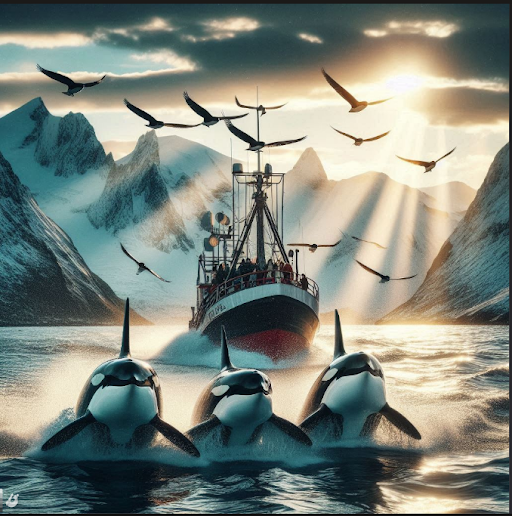
AI´s fantasy picture of a basking shark 

"Sveriges hav - Nordsjöns giganter" is a somewhat peculiar nature documentary, probably German in provenance, but I haven´t been able to locate the original version. The Swedish title means "The Seas of Sweden - Giants of the North Sea".

Ahem, the North Sea is *not* Swedish...

Indeed, most of the docu seems to be taped on or around the Shetland Islands, which are (of course) British?! Not sure who came up with the idea to call this a "Swedish" documentary. Some old Viking romantic? Dude!

But sure, if you like dramatic vistas, this might be for you. Killer whales, basking sharks, grey seals, sea otters, dolphins, skuas attacking and eating puffins, the invasive red king crab...you get the picture. Shetland sure looks pretty dangerous, LOL. 


Thursday, February 29, 2024

Life on the edge...or just another Tuesday?


"Wild Scandinavia: Life on the Edge" is the first part of a three-part BBC nature documentary about...wait for it...Scandinavian wildlife. It deals with the Scandinavian coasts and features the Stockholm Archipelago, the sand dunes of Jutland, Norwegian fjords and the Arctic coast. 

Perhaps good if you never seen any Scandinavian animals before, but personally, I recognized most of the species shown: the grey seal, the white-tailed eagle, killer whales, sea otters, puffins and so on. But sure, the various marine invertebrates were suitably disgusting. I don´t think I want to swim in Norwegian territorial waters! 

In a later episode, they cheat and take the viewer to Iceland and Svalbard, which are not part of Scandinavia as the term is usually understood in Sweden, Norway and Denmark. 

Could be of some interest on a boring February evening. As long as you know that the wildlife shown is far, far away... 

Friday, October 6, 2023

ChatGPT in deep waters


ChatGPT tries (in vain) to understand the identity of Phoca mutica (syn. Phoca longicollis), a de facto cryptid seal. For the right answer, see the Wikipedia link below!


[First attempt]

Phoca mutica is the scientific name for the ribbon seal. It is a species of seal found in the Arctic and North Pacific Ocean. Ribbon seals are easily recognizable by the distinct ribbon-like patterns on their fur, which consist of dark bands on a light background. These bands give them their name.

These seals are well-adapted to living in icy environments and are typically found in or near sea ice. They feed on a variety of prey, including fish and invertebrates, and they are known for their distinctive vocalizations.

Ribbon seals, like many other species of seals, are vulnerable to changes in their environment, including reductions in sea ice due to climate change. They are also hunted by some indigenous communities for subsistence purposes, although there are regulations in place to manage this hunting sustainably.


[Second attempt]

I apologize for the confusion. You are correct. Phoca mutica, commonly known as the "long-necked seal" or "spotted seal," is a species of seal found in the Northern Hemisphere. They are characterized by their distinctive spots and relatively long necks compared to other seal species.

These seals inhabit coastal waters and ice floes in the North Pacific Ocean, particularly around the coasts of Alaska, Russia, and Japan. They primarily feed on fish and invertebrates.

Thank you for bringing this to my attention, and I appreciate your understanding. If you have any more questions or need further clarification, feel free to let me know.


[Third attempt]


You are correct, and I apologize for the previous errors. Phoca mutica or Phoca longicollis is not a recognized species of seal in the scientific community. It appears to be a term or designation that is not commonly accepted or acknowledged in biological taxonomy.

If there's any specific information you're looking for regarding a particular seal species or any other topic, please feel free to ask. I'm here to help with accurate and reliable information to the best of my ability. Thank you for your patience and understanding.


Long-necked seal

Friday, October 15, 2021

Realm of Mother Volga


"Realm of the Volga" is a two-part German nature documentary, produced by Altay Films. It takes the viewer on a journey from the taiga of northern European Russia all the way down to the steppes surrounding the Caspian Sea. Most of the time, the documentary follows the Volga, the largest river in Europe. With the exception of Astrakhan close to the delta, the cities in the Volga basin are mostly not shown, the most notorious of these being Volgograd (Stalingrad). Instead, we get to see the Russian wilds (and a few Orthodox churches) in mostly pristine condition. 

Many of the animals shown are instantly familiar to a Swedish viewer like myself: moose, beaver, red fox, boar, capercaillie, mallard, tawny owl, black woodpecker, great tit... I even recognized the wisents, since we have them at the Skansen zoo in Stockholm! 

Further south, the fauna becomes more exotic. Large flocks of saiga antelopes roam the desolate landscape and drink the brackish water, while trying to stay clear of the steppe wolfe. Meanwhile, steppe eagles build their nests on the ground, and demoiselle cranes carry out their mating rituals. Corsac foxes, rosy starlings and hoopoes are other characteristic species found around Volga´s southern portions. In the Caspian Sea, cormorants and white-tailed eagles live onboard eerie abandoned ships, while enormous colonies of seals gather at the islands of this peculiar inland sea. And yet, even this feels familiar somehow, obviously because all these animals are included in field guides to European mammals or birds, the geographical border of "Europe" being situated even further east than the Volga river.

It´s a fascinating trip, to be sure, almost aesthetical. And yet, by not showing the great cities, the oil industry and the environmental degradation, I still get the impression that perhaps somehow we are being served the wrong picture here! I can´t help thinking that perhaps Mother Volga has fallen on hard times...   


Monday, March 29, 2021

Pinnipeds are verily food

Not a pinniped 


I´ve read some more in "Wilderness and Political Ecology", a semi-technical scientific work edited by Charles Kay and Randy Simmons, published by the University of Utah Press in 2002. This time, I tried to digest the contribution by William R Hildebrandt and Terry L Jones, "Depletion of Prehistoric Pinniped Populations along the California and Oregon Coasts: Were Humans the Cause?". After analyzing archeological sites and later eye witness reports, the authors reach the conclusion that the answer is indeed yes. This is controversial, since the humans in question were pre-contact Native Americans (American Indians), who according to received wisdom were supposed to be deeply spiritual and live in perfect balance with Mother Nature. In reality, the coastal Native tribes hunted and killed sea lions and fur seals to such an extent that it impacted their numbers and breeding habits. 

Originally, there were pinniped rookeries (breeding colonies) on the actual coast, but after sustained Native hunting, the sea lions and fur seals abandoned the mainland and instead established themselves at offshore islands. Or left the area altogether! Natives living in areas that lacked offshore islands had to switch from hunting sea mammals to killing terrestrial game instead. In one particular area, permanent coastal settlements were abandoned as the Natives moved inland to hunt land mammals or harvest acorns, which permitted the pinnipeds to re-established rookeries along the coast. 

In areas where pinnipeds were breeding on islands to escape the human hunters, the Natives developed their technology to go after them. This included harpoons, which gradually become more sophisticated. Above all, it included the building of large canoes. This in turn led to increased stratification within the Native tribes, as only an elite could afford to invest in such an enterprise. The person owning the canoe was expected to distribute food and drink to the canoe-builders and the crew members. An 18th century Spanish explorer reported that the canoes carried a crew of about 30 people, and Native informers apparently have a tradition that the boats were about 30 feet long. The concept of private ownership seems to have developed among the Tolowa, Yurok, Hupa and Wiyot tribes. Wealthy elite families owned boats, acorn collection groves, eddies for netting fish, and shares in offshore rookeries. Native groups which concentrated on hunting terrestrial animals had less social stratification, perhaps because this could be done without the elaborate organization needed to hunt marine mammals. 

According to the "optimum foraging model" of hunter-animal interaction, hunters should take the most nutritious specimens first, regardless of whether it´s ecologically sound to do so. Cultural or religious ideas about "sacred animals" should have no power to stop this. In other words, the model predicts that Natives aren´t "natural conservationists". Hildebrandt and Jones believe that the archeological record proves the model. Native hunters seems to have primarily killed female and juvenile pinnipeds, which makes no sense if the mission is to conserve resources, but makes perfect sense if the goal of the hunt is to obtain optimum food with the smallest expenditure of energy possible. When the pinniped populations were depleted, the hunters switched to sea otters, a pelagic species which is more difficult to hunt down and kill. There is even an example of a Native group which switched to sea otters after first having depleted the elk population! The archeological record from the Channel Islands in southern California show that the pinniped population fluctuated in response to the density of human settlement. Life on these particular islands was always hard, leading many human sites to be abandoned, at which point the pinnipeds came back - once again, an inexplicable fact if you think American Indians were "natural" or "spontaneous" conservationists. 

Curiously, the ethnographic record *does* suggest that the Natives actually were conservationists. However, the authors believe that these are biased samples, showing how one particular group acted at one particular point in time. Archeology looks at the broader picture, including chronologically, and then a very different scenario emerges. Also, there is a difference between "conserving" certain plants and doing the same thing to animals. The plant species most often used as examples of Native conservation ethics are the ones that reproduce and spread most easily and swiftly, often benefitting from large scale human-induced burning. Thus, seemingly paradoxically, increased human use of such a plant can permit it to spread even faster, for instance by causal dispersal of seeds or bulbs, regardless of the ethical convictions of the humans involve. Game animals, alas, don´t follow such a pattern...

The article also points out that pinniped populations have virtually exploded during the 20th century, as large scale (Euro-American) hunting of these creatures ceased. The pinnipeds have even conquered areas where they haven´t lived historically. The most ironic fact is that some elephant seals have established themselves at coasts with archeological sites, destroying them in the process! These would be sites of Native settlement. Remove the apex predator, and soon you have pinnipeds dancing on your grave...

With that somewhat bizarre observation, I close this little blog post.  

Sunday, March 28, 2021

Welcome to the Anthropocene


"Wilderness and Political Ecology: Aboriginal Influences and the Original State of Nature" is a book edited by Charles E Kay and Randy T Simmons. I haven´t (yet) read all of it, so this blog post is mostly based on William L Preston´s contribution "Post-Colombian Wildlife Irruptions in California". Yes, folks, it´s time to bash the myth of the noble savage again!

California´s so-called Colonial Period streches from 1769 to 1848. Before 1769, no permanent White European settlement existed in the area. However, European expeditions did reach the area several times. For a long time, the established view of pre-colonial and colonial California was...well, very strange indeed. The future US state was depicted as a virtual Eden, in which a large population of Native Americans (American Indians) lived peacefully and spiritually alongside an abundance of deer, elk, antelope, fish, fowl, sea lions, bears, cougars and bob cats. The game animals were tame, huge and fat. The Natives weren´t the apex predators, that role instead being taken by grizzlies, which (strangely enough) were extremely aggressive, roamed the land in large packs, and hunted humans. Indeed, the Natives were so fearful of the bears that they initially felt nothing but gratitude to the Spanish colonialists, who helped them kill the murderous beasts! (I wonder what John Muir would have said about this.) 

Of course it´s too good to be true. Indeed, it strikes me as strange that anyone could have believed this Edenic vision in the first place!

The author doesn´t doubt the eye witness accounts of the European explorers, per se. There are several problems with the accounts, however. One is that they don´t reflect the situation in the rest of North America, where research has shown that the Natives had considerable impact on their living environments, including by over-hunting animals and burning the forests. Another is the archeological evidence, which seem to indicate large-scale Native hunting and foraging before the 16th century (when the Spanish conquered Mexico). It also indicates over-exploitation of the "resources". The size of mussels and abalone (marine snails) found at Native sites progressively diminishes with time, suggesting that the large-sized specimens had been nearly exterminated. There are also indications at certain sites that the large game species had been depleted, at which point the Native hunters started exploiting more abundant smaller game instead. 

Sheer common sense also militates against the idea of Native-animal harmony, since we now know that the Native settlements in California were larger than in the rest of North America. We also know where they were situated - at the exact same places where Colonial eye witnesses saw an enormous abundance of game animals. The idea of Natives and game animals somehow dancing around each other in such circumstances is simply too hard to believe. (The Natives would also have to dance around a huge amount of carnivorous animals preying on the herbivores.) 

Preston and the other contributors to this book believes in the so-called optimal-foraging model of hunter behavior, which in turn is supposedly rooted in our evolutionary past as explained by sociobiology. I happen to be skeptical to sociobiology sensu stricto, but in this case, a rather common sensical "biological" model does seem to fit the format. In plain English, if forced to chose between ideology and eating, most people chose eating, and there is no particular reason to think that Native Californians were any different. Hunters and foragers will pick the most nutritious animals first (often the largest ones), even if they are pregnant females or have become scarce, and when these resources are depleted, they will continue further down the food chain with smaller, less nutritious but more abudant species. Indeed, hunters are even more motivated in killing large game in rich environments where they can easily switch to smaller game if necessary. In other words, nutritional needs rather than cultural or religious ideas about "sacred animals" control Native foraging behavior. Indeed, what makes us think that it would be otherwise? While American Indians do have religious ideas about hunting, these usually don´t constrain it. If hunting becomes less succesful, the explanation given is usually the lack of moral purity of the hunter, rather than in the prey animals actually being less abundant due to overkill. 

So what actually happened in California? The answer is: more or less the same thing that happened in the rest of North America. A variety of exotic diseases reached California centuries before the first White settlers entered the area in 1769, diseases first introduced to Mexico by the 16th century Spanish conquistadors. During the "proto-historic" period between first contact and actual settlement, these diseases (smallpox, malaria and so on) would have reduced California´s Native population. At first, this didn´t lead to an increased number of herbivores such as elk, deer or antelope. Rather, the number of carnivores such as bears or cougars increased sharply, since they no longer competed with so many human hunters. The herbivores were still kept in check. After 1769, during the Colonial Period, the Native population crashed due to epidemics spread by the Europeans, who had now settled permanently. The remaining Natives increasingly turned to breeding domesticated animals and growing new kinds of crops, both introduced by the settlers. The carnivores preyed on Native-owned livestock, rather than on the wild herbivores, which therefore could increase their numbers considerably. Also, the herbivores opportunistically started feeding on Native agricultural land, increasing their numbers even more. This created the situation described by Colonial-era writers, who were baffled by the abundance of both ungulates and carnivores, and the seeming inability of the Natives to do something about the latter. What seems to have happened, in other words, is that European diseases crashed the Native American populations below carrying capacity. This - and this only - created an "Eden" with abundant wildlife. The "Edenic" conditions are really irruptions of prey species which are no longer kept in check by predators (neither human nor beastly ones). In other parts of the North American continent, the well-known super-abundance of bisons and passanger pigeons is believed to have come about in the same way. One Colonial eye witness account from California cited by the author actually describes how animal life becomes almost absurdly abundant after a malaria epidemic has wiped out the Native tribe in a certain area. 

Before the White settlers reached America, animal numbers were kept in check by Native hunting, fishing and gathering. As already indicated, research suggests that resources were overexploited. (Another article in this book describes how coastal tribes built large boats to hunt sea lions at offshore islands, the boats apparently being owned by Native chiefs and thus leading to increased stratification - hardly an Edenic classless idyll.) Nature became supposedly paradisiacal (really fundamentally unbalanced) only after a massive die off of Natives caused by Old World germs. 

Another myth laid to rest. Welcome to the Anthropocene. 

Sunday, March 24, 2019

Life will find a way


This was around 1993, during my most high tech true believer period. I actually traveled to a Swedish nuclear power plant, Forsmark, to simply *look* at the place and imbibe its atmosphere. Believe me, getting there on a public transit ticket wasn´t easy! Still, I was able to walk up to the actual power plant itself, standing right below its main building – which surprised me. Are the gods of progress so oblivious to us mortals? I had expected the security parameter to start miles outside the building! I realized years later that my whole experience at the plant was some kind of bizarre blot (as in Asatru blot) to human ingenuity and the forces of progress, a kind of quasi-religious ritual if you like. And for the record, no, I didn´t feel a damn thing (LOL) except maybe some kind of general admiration for the power of our species in harnessing the forces of broken atoms. In a sense, I still do. Humans aren´t perfect by any reasonable metric, but some of us are pretty damn smart. Chimps, ravens or termites can´t split the atom, but then, I suppose you could argue that they don´t have to…

Which brings me to an even more bizarre thing I saw at the plant. Forsmark tried to promote itself to the general public as, wait for it, the *ecological* nuclear power plant. Yes, really. And in a bizarre way, they were actually right. Forsmark takes its cooling water from the Baltic Sea. When the water has cooled down the reactor, it´s released again into the sea, several degrees warmer than before. For this reason, the sea immediately outside the nuclear plant was never covered with ice, not even in dead winter. And that, in turn, was good for the wildlife, which got a kind of refuge outside the plant during the worst winter months. Including seals…

Seals are (or were?) threatened with extinction in the Baltic Sea, one reason being the toxic waste heaved into the waters by various industrial plants. But the Forsmark nuclear power plant doesn´t pollute its environment. It just emits slightly heated water. Therefore, a colony of seals had established itself on a small island just outside the plant *and the plant authorities organized sightseeing by bus for tourists to go and see the fantastic seal colony*. An information center (which was open but empty at the time I was there – a bit spooky) also carried huge photos of said seals, and also of seabirds, etc.

I suppose you *could* call this “the revenge of Nature”, if you like…

PS. A thorium reactor would, of course, be even more stunning. If seals like them is, alas, a question I´m not competent to answer at the present time.

Saturday, September 22, 2018

Birds in the monastery


“Ireland's Wild Coast” is a documentary directed by Cepa Giblin and John Murray. The latter is most known for his award-winning “Broken Tail” about Indian tigers. After the inevitable stint in the tropics, Murray returned to his native Ireland and help direct two documentaries about its stunning nature and wildlife, the first being “Ireland's Wild River” about the Shannon.

In “Ireland's Wild Coast”, we are introduced to the Irish Atlantic coast, from Skellig Michael in the southwest to County Donegal in the northwest. Animals featured include seals, whales, basking sharks, blue sharks, outcast dolphins (sic), seemingly feral sheep and a wide variety of birds. At Skellig Michael, Manx shearwaters nest in an abandoned medieval monastery. Donegal turns out to be the winter quarters of whooper swans from Iceland - perhaps the only migratory bird spending the winter in Ireland!

I admit that I found “Ireland's Wild Coast” fascinating. The underlying theme of this production is wildlife taking over after humans leaving. In real life, of course, it's the other way around. Murray himself pointed out when interviewed by Swedish television that Ireland, previously regarded as the end of the world, has become one of its most exploited spots…

Five stars. For the documentary, that is.

Tuesday, September 18, 2018

No mermaids in this one


“Handbook of the Mammals of the World” (HMW) is a multi-volume encyclopedia and reference work, the purpose of which is to illustrate and describe all extant wild species of mammals. Six volumes have been published, with at least three more to go.

This volume lumps together three very different groups of sea-mammals, apparently for practical or perhaps even commercial reasons. The pinnipeds (eared seals, earless seals and walruses) belong to the order Carnivora together with tigers, wolves, wolverines and other “classical” carnivores. The sirenians are distant cousins to the elephants, while cetaceans (whales, dolphins and porpoises) are apparently close to hippopotamuses and hence the ungulates.

My impression of HMW is that most volumes are more popularized than Lynx Edicions' previous encyclopedia, “Handbook of the Birds of the World” (HBW). At least relatively speaking, they seem to contain lesser amounts of texts. Otherwise, both HMW and HBW keep to the same format: family presentations with more or less dramatic color photos followed by species presentations with “boring” color plates and range maps. The price tags are equally extortionate in both cases, but then, a lot of money and time must have been invested into making these bulky volumes! If you just want one book on sea-mammals (all of them) and have dime to spare, investing in this volume might be a good idea. More information, including a preview, is available at the website of the publisher.

Final point: like all other science books, this too peddles the ridiculous idea that mermaids and mermen are misidentified sirenians. Ahem, sirenians don't look like well-endowed females with sweet singing voices, and they are find nowhere near the waters were mermaids are supposed to live, so unless there is an unknown species of Icelandic Manatee roaming the colder waters of the North Atlantic…naaaah.

Thursday, September 13, 2018

Stressed out


A review of "Pinnipeds and El Nino: Responses to Environmental Stress" 

I suppose the title says it all. This is a very technical, super-scientific and boring book on how fur seals and sea lions in the Pacific are affected by the strange weather phenomenon known as El Nino. It's good to know that stress isn't entirely localized to the Long Island Express, but I still think the general reader (or commuting book-lover) should give this work a pass...

Wednesday, September 12, 2018

Another monster gets away


A review of the MonsterQuest episode "Sea Monsters" 

In this episode of History Channel's never-ending quest for the Holy Grail of Monsterhood, Doug Hajicek and his indefatigable research team (or television crew?) travel to Florida in search for a legendary sea monster.

A couple of locals have been taping the monsters in a local river (?) for several years (!!), and have decided to give the monster hunters exclusive rights to the footage.

Or something.

Even yours truly suspected something fishy, and the surprisingly patient scientists who show themselves on this program (I hope they get paid!) are about evenly divided between the "monster" being a seal or a sea cow, two relatively innocuous creatures. Especially the sea cow. I mean, can you possibly get more docile than that? We're talking evolutionary dead-end major time.

My private theory (which I don't really believe in) is that the Florida Sea Monster is a Stellar's Sea Cow on Caribbean holiday. I hope it gets away! Maybe it did, 'cause know what, Hajicek & Co didn't find no monster this time neither, LOL.

Wednesday, August 15, 2018

Somewhat confusing


A review of "Whales, Dolphins and Seals: A Field Guide to the Marine Mammals of the World" by Hadoram Shirihai

This is a field guide to the marine mammals of the world. It covers all species of whales, dolphins, seals and sea cows (including species only found in freshwater). Two marine species of otters plus the polar bear have also been included.

Both the colour illustrations and the photos are excellent. Indeed, the photos, while small, are often quite stunning. Still, the book feels somewhat confused. Dozens of illustrations and photos, often of different species, are crammed into each page. Often, it's difficult to see where one species presentation ends and another begins. A species presentation might cover the bottom of one page and all of the next page.

Somebody should publish the same material, but with improved lay-out.

Monday, August 13, 2018

A tribute, not a field guide


This book is an excellent and lavishly illustrated introduction to sea-living mammals: pinnipeds, cetaceans and sea cows. The polar bear and two species of otters are also featured. I hesitate to call this a "field guide", and the authors admit in a foreword that the book is really a tribute to the mammals of the sea: "Few people who read this book will ever encounter Fraser's dolphin, the leopard seal or the African manatee". The main purpose is to give the general reader a certain feel for the sea-mammals, their life and their often threatened status. Martin Camm's colour illustrations are certainly worth the prize of the entire book. Since "Sea Mammals of the World" was published already in 1982, many of the facts presented in the book might be out of date. However, it would still make a nice addition to the library of any nature-lover. Therefore, I give it five stars.

Saturday, August 11, 2018

From Lake Baikal with love


“Mammals of the Soviet Union” is a mega-encyclopedia originally published in three volumes in Moscow under the editorship of V G Heptner, the grand old man of Soviet zoology (the Russian form of his name, Geptner, is used in some library systems). This is the English translation of the sections dealing with pinnipeds and toothed whales, dubbed “Vol II, Part 3”. The volume is dated “Moscow 1976, Washington 1996”, which sounds pretty fascinating in itself! The text is sometimes difficult and technical, sometimes more like a regular encyclopedia. Overall, “Mammals of the Soviet Union” is therefore easier to read than most scientific reference works, which are technical only. The photos and drawings are in black and white, with only a few color plates thrown in. As can be expected for a work of this huge size, the amount of detail included is almost crazy. Of the species covered in "Vol II, Part 3", the most interesting might be the Baikal seal, the only “true” freshwater seal in the world, sealed off (pun intended) in Lake Baikal, hundreds of kilometers from any ocean. While this is a work better suited for an old fashioned public library than your coffee table, it nevertheless deserves five stars for the effort.

Sunday, August 5, 2018

Where on earth are the sharks?

The shark on the photo has no connection to the book under review


The book "Sharkwater" is a companion to the documentary of the same name, also available from Amazon. The movie "Sharkwater" is one of the best documentaries I've ever seen, and it has received a lot of awards at various international film festivals. The movie follows the controversial action group Sea Shepherd as they try to save sharks from poachers in Costa Rica and the Galapagos. It also contains splendid footage of sharks.

I had expected the book to be pretty much the same. Sure, the photos are (mostly) excellent. Most are in colour. But where on earth are the sharks???

I'd say only about 10% of the photos in the book version show sharks. Instead, we are treated to pictures of starfish, jellyfish, barracudas, seals, iguanas and the Sea Shepherd crew. All very interesting, to be sure, but I wanted more hammerheads and whale sharks! Not to mention our old friend (and Spielberg's nemesis), the Great White. In that sense, the book was something of a disappointment.

Still, since the photos aren't bad, I nevertheless give "Sharkwater" four stars.
But I prefer the movie documentary.