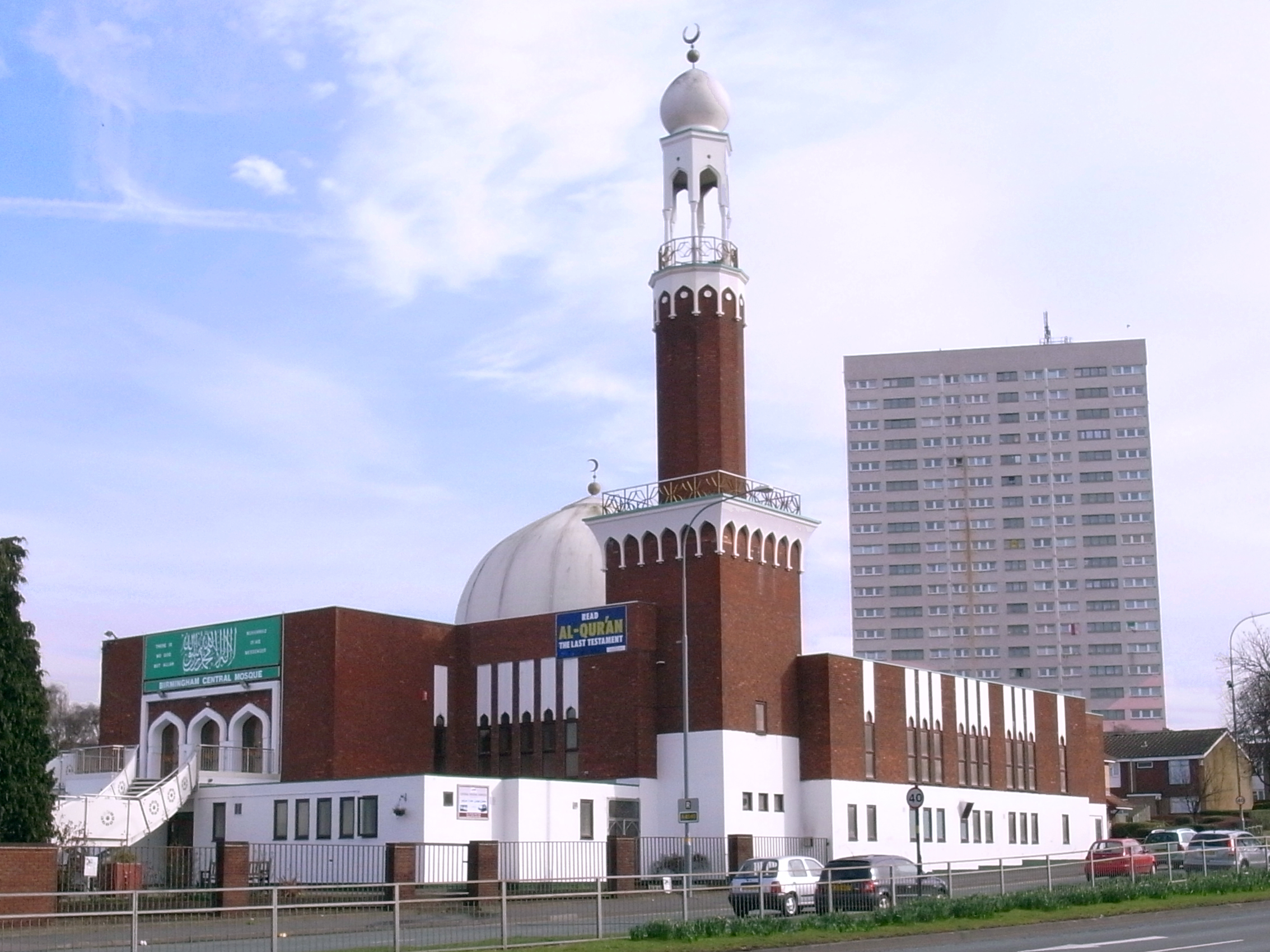
"Medina in Birmingham,
Najaf in Brent" is an overview of the Muslim scene in Britain, written by
a BBC reporter. The book is very easy to read, and hence suitable for the
general reader. My only problem with it is that it sometimes reads more like a
catalogue or directory, than an actual book. The book is refreshingly
objective, and stays clear from the usual Islamophobia-Islamophilia conflict.
But yes, it does raise some disturbing questions.
The main Muslim groups in Britain are the Deobandis and the Barelwis, two Sunni
groups dominated by East Indians. The Deobandis control 44% of all British
mosques, while the Barelwis control 25%. In terms of "mosque
capacity", both groups are about equal.
The Deobandis are purist and "scriptural", and are often confused
with Salafis (Wahhabites). The Taliban in Afghanistan are a militant offshoot
of the Deobandi movement. Most Deobandis in Britain are apolitical, strongly
conservative, patriarchal and separatist. Their goal is to live apart from
mainstream society in Muslim enclaves. The Deobandi missionary movement is
known as the Tablighi Jamaat. Its main purpose is to strengthen the faith of
Muslims, rather than winning new converts. Occasionally, Deobandis have made
forays into politics, either through the Labour Party or the Respect Party.
Deobandi events are sometimes infiltrated by jihadists, who seek to politicize
Deobandis who are disaffected by the "passivity" of their elders. The
main problem (at least if you believe in a secular or fairly homogenous
society) with the Deobandis, however, is their previously mentioned refusal to
assimilate or even integrate into wider British society. The ultra-conservative
attitude of the Deobandis (which sometimes make even Salafis look slightly subversive!)
should be a concern for liberals and leftists, too.
The book reveals that the more political groups actually represent tiny
minorities of the Muslim population in Britain. Inevitably, however, these are
the very people British politicians or activists usually deal with. The
Jamaat-e-Islami only controls 3% of British mosques, but the Jamaat-dominated
Muslim Council of Britain (MCB) was nevertheless considered a quasi-official
representative of the Muslim community by the British government! The Jamaat-e-Islami
is an Islamist political party active in Pakistan and Bangladesh. In the
aftermath of the 2005 London bombings, the MCB and their affiliates came under
closer scrutiny, and it was revealed that their "moderate" and
"assimilated" image was mostly for show. The British government more
or less disowned the MCB after its refusal to break with Hamas. A leader of the
MCB had signed a declaration supporting armed attacks against any naval forces
aiding Israel. This was viewed as a veiled threat to attack British ships,
since Prime Minister Gordon Brown had promised to aid Israel's blockade of arms
shipments to Gaza. After the MCB fiasco, the British authorities began to
promote a Barelwi-dominated and more apolitical Sufi council instead.
Another influential player is the Muslim Brotherhood, which only controls 0.4%
of British mosques (seven in total). Of course, the Brotherhood is one of the
strongest opposition movements in the Middle East, so in one sense their
influence in Britain is understandable. The Muslim Association of Britain (MAB)
is a Brotherhood front which cultivates good relations with British
governments. The only exception to the rule came during the initial phase of
the Iraqi war, when the MAB joined the anti-war protests in London and entered
an alliance with the Socialist Workers' Party and similar groups on the left.
MAB also expressed strong support for the Palestinians (Hamas describes itself
as a section of the Muslim Brotherhood). The Brotherhood's strength among
Muslim students and exiled activists probably explains their appeal to British
leftists. After an internal faction fight, the more radical activists left MAB,
which then managed to repair its relations with the establishment. (Note that
the Western powers flirt with the Brotherhood in Syria and perhaps Libya, and
for a while also in Egypt.)
The Salafis (they don't like being called Wahhabites) are also relatively small
in Britain, controlling only about 6% of the mosques. They are split in several
different factions, some emphasizing Muslim piety and clean living, while
others are jihadist. The book shows that returned veterans from the Afghan war
against the Soviets played an important role in the emergence of a jihadist
milieu in the West during the 1990's. The Muslim war against the
secular-Communist regime in Kabul was, of course, backed (and funded) by the
United States, with British support. The ease with which the Afghan veterans
turned against the hands that fed them shows that they had their own
(anti-Western) agendas all along.
The chapter on the Twelver Shia milieu is interesting. According to the author,
most Shia in Britain don't follow Iran's supreme leader Ali Khamenei, but a
more moderate faction around Grand Ayatollah Sistani based in the Iraqi city of
Najaf. Sistani, while conservative, believes that a theocracy will only be
established at the end of time, when the "Hidden Imam" reveals
himself. Khamenei, of course, follows Khomeini, the original leader of the
Islamic revolution in Iran, who argued for a worldly theocracy here and now.
This confirms my suspicion that Khomeini turned originally quietist Shia Islam
into a revolutionary movement. Another more moderate Shia group active in
Britain is the Dawa Party, the dominant political organization in post-Saddam
Iraq. The British government, for obvious reasons, prefer Sistani and Dawa to
the Khamenei supporters. Yet, there seems to be a certain overlap between the
various factions. Many Iranians are said to follow Sistani as a spiritual
leader, while still supporting Khamenei's Islamic regime. The Dawa Party in
Iraq, especially former prime minister Al-Maliki, has been accused of receiving
support from Iran.
One of the more curious groups mentioned in the book are the Nizari Ismailis,
who are pro-British, modernist and fairly liberal. Their leader the Aga Khan is
a high society socialite, and one of his rare interviews were given to the
magazine Vanity Fair! The Nizaris, most of whom are Indians, are also one of
the smallest Muslim groups, both in Britain and internationally. Another
pro-British group, albeit of a more conservative bent, is the Ahmadiyya. They
are not mentioned in the book, however, due to their insignificant size. In
Britain, the Ahmadis are mostly known for selling poppies at Remembrance Day.
Interestingly, I got to know about "Medina in Birmingham, Najaf in
Brent" after reading a positive review at the AWL website. The AWL is one
of the few British leftist groups which supports Israel and oppose Islamism
(except, ahem, during the war in Afghanistan, when they sided with the
Islamists against the "Stalinist" Russians, which they apparently
hated even more). The political positions of author Innes Bowen are less clear,
but the book is sufficiently objective to make the reader draw his or her own
conclusions...
It seems Islam in Britain has finally been unveiled. Pun intended!


.jpg)