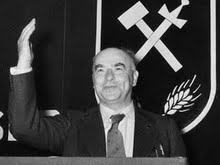
Otto Strasser was a dissident Nazi who eventually left
the NSDAP and formed the Black Front, a competing organization. When Hitler
grabbed power in Germany in 1933, Strasser was forced to flee for his life, and
eventually settled in North America. Several books by this intractable thinker
have been published in English. Of these, "Flight from terror" and
"Germany Tomorrow" are the most interesting and well written.
"Germany Tomorrow" contains Strasser's proposals for a peace
agreement between Germany and the Allies, and his thoughts about the future of
both Germany, Europe and the world. The book was published in 1940, i.e. before
the Nazi attack on the Soviet Union and the entry of the United States into the
war. Strasser in effect proposes an alliance between Germany, Britain and
France to fight the Soviet Union and "liberate" the Ukraine, Belarus
and the Transcaucasus. Strasser even says that Europe needs these areas as
internal colonies.
At the same time, Strasser believed that Germany should make major concessions
to its European adversaries: the independence of Austria, reparations to
Czechoslovakia and Poland, the re-establishment of the Maginot Line, and the
ceding of Heligoland to Britain. He does want to keep the Polish corridor and
East Prussia, but proposes that Poland in return gets effective control of the
Baltic republics. A German federation, the internal partition of Prussia and a
volunteer army rather than a conscript army are other proposals to appease the
Western powers. Jews should be permitted to leave for Palestine or get minority
rights within a new Germany.
Small wonder Hitler considered Strasser a traitor and wanted him dead!
Strasser's proposals for the internal re-organization of Germany are somewhat
disingenuous. Despite his calls for a German federation, it's pretty obvious
that the "federation" would really be centralized, with state-owned
banks and companies, a national insurance system and a state monopoly on
foreign trade. The German president would be elected for life, and thus really
act as a king or emperor, and he would also appoint the state presidents. It's
equally obvious that New Germany wouldn't be particularly democratic. In
Strasser's scheme, all political parties are abolished in favour of a
corporatist system based on estates, in which the two largest estates (workers
and peasants) are underrepresented. For symbolic reasons, Strasser wanted
Ratisbon (Regensburg), the erstwhile capital of the Holy Roman Empire, to
become the new federal capital. Naturally, the new nation should be based on
Christianity, which the author regards as somehow quintessentially Western.
However, Strasser was also something of a bon vivant, for which Hitler sharply
rebuked him, so presumably his Christianity would be of the more beer-swilling
type. (But then, I suppose both G.K. Chesterton and C.S. Lewis liked good food
and drink!)
More interesting, perhaps, are Strasser's economic proposals, which are similar
to those of Distributism, albeit perhaps more collectivist. All land should be
held in common and administered by local councils, which parcel out the land to
individual farmers based on a system similar to usufruct. The land can be
inherited but not sold. Also, townspeople should move out to the countryside
and become peasants (a back-to-the-land movement). Various guilds and
cooperatives are also part of the new economic system, which Strasser actually
calls "socialism" and "planned economy".
Strasser further advocates a European Federation. There is some tension between
his peace proposals and the idea of a European Federation, since the peace
proposals presuppose that Britain and France remain strong military powers,
while the European Federation would rather have a joint army, while the
individual nations would only keep militia units. (At least I think that's what
the author has in mind.) There is also some tension between the notion of
German autarky, the idea of European autarky with free trade within Europe, and
various colonial schemes proposed by the author, both in Africa and at least
implicitly on territories wrested or "liberated" from the Soviet
Union. "Germany Tomorrow" also contains a number of appendices, in
which Otto Strasser pays frequent tributes to his brother, the "left
wing" Nazi Gregor Strasser, who was murdered on Hitler's orders in 1934.
When I read "Flight from terror" and "Hitler and I",
Strasser's political program struck me as extremely eclectic. However, this
book reveals Strasser to have been eclectic in word only. If the rhetoric about
federation, socialism and "people's state" is stripped away, it's
obvious that Strasser simply proposed another version of the fascist program, a
kind of paternalistic, conservative and seemingly benign fascism. Perhaps a
fascism with a human face? In reality, I suspect that a Strasserite New Germany
would eventually have resembled Mussolini's Italy or Franco's Spain. Or is it
really Austro-Fascism in Lesser German disguise? As for the human face, the
European Federation would presumably have started another world war against the
USSR and continued the exploitation of the Third World.
I'm sure Britain and France would have loved somebody like Otto Strasser as
president for life of Germany. In the event, they were stuck with Hitler, and
eventually had to fight Nazi Germany to the death...alongside Roosevelt and
Stalin.
Which, in the final analysis, might have been the lesser evil.