Showing posts with label Tasmania. Show all posts

Wednesday, August 14, 2024

Thylacines among us


A mildly skeptical YouTube video about supposed post-extinction reports of thylacines on New Guinea (from where the thylacine disappeared thousands of years ago). It seems people still se them here and there, often in the hills. While the animal´s existence sounds plausible enough, there are some problems with the idea, too. 

For instance, tribal hunters don´t wear thylacine skins - and they seem to hunt virtually all large mammals on the island. Another problem is that thylacines resemble large dogs, and such a breed actually exists on New Guinea: the so-called "singing dog", a distant relative to the dingo. Feral and wild(?) populations exist in the highlands.

Surviving thylacines on Papua (singing or not) would be fascinating, but misidentification with said doggie can´t be ruled out. The YouTuber suggests that it could also be a kind of cope, since we haven´t been able to find any surviving thylacines on Tasmania, and not for want of trying...

Sunday, March 24, 2024

Speculation, speculation...


A lot of speculation in this one. Or rather in the list the content-creator is commenting, a list of the ten most likely cryptids to be discovered during the 21st century. 

The list sounds like wish-fulfillment. 

From the top of my head (which is considerable - both the top and the head), the thylacine, the giant eel and the giant octopus seem to be the three most likely candidates. Since the other cryptids might not exist at all, their discovery - this century or the next - is *highly* unlikely...

Here´s a more certain prediction: there will still be enthusiasts in 2100 hunting the Gugu, the Megalenia or whatever cryptids will be on the top ten!

Saturday, February 24, 2024

Gone forever?


Bing AI´s version of a thylacine


Darren Naish (a science blogger) is skeptical of claims about the survival of the thylacine in Tasmania. 

The hunt for persisting thylacines, an interview 


Friday, December 8, 2023

The singing thylacine


The thylacine is a large Australian marsupial believed to be extinct since 1936, but enthusiasts claim (or hope) that it has survived somewhere in the Tasmanian wilderness. The short piece linked to below argues that thylacines may have survived in New Guinea instead. 

Unfortunately, misidentification cannot be ruled out in this case, since there is a similar-looking placental mammal on the island: the New Guinea "singing dog". The animal also seems ecologically impossible, according to some scientists. 

That being said, the eye witness accounts don´t sound entirely far fetched either, so perhaps thylacine-hunters should bribe the proper Indonesian authorities and aim straight for the Jajawijaya Mountains...  

Dobsegna

Thylacines in Indonesian New Guinea?

Crying Wolf in Irian Jaya?

Tuesday, September 19, 2023

What happened to feminism?


This is what happened. And it aint pretty. Is this the fourth wave feminism everyone was talking about ten years ago, or so?

Note also the bizarre interruption at the beginning of the Senator´s speech. Not the most important topic, perhaps, but I couldn´t help noticing... 

Sunday, January 31, 2021

Hunting the thylacine


Or rather modeling. I have no idea how they did it, or whether there's something to it, but these researchers claim that the thylacine (a predatory marsupial believed to be extinct since the 1930's) might have been alive in Tasmania until very recently.

It's always fun when main-stream science takes cryptozoology seriously.

Dog-like predator with kangaroo pouch believed extinct since 1930's possibly lived till 2000s

Sunday, April 12, 2020

Australia with a twist


"Tasmania: Weird and Wonderful" is a fascinating nature documentary narrated by David Attenborough. It´s presently available at YouTube. Many of the species on the island are similar to those on the Australian mainland, but their size and behavior often differ markedly. The local platypus is much larger than its mainland form, there is a thriving population of mutant white wallabies, and the Tasmanian giant lobster takes 40 years to grow to a size of one meter. By contrast, the local penguins are diminutive (and nocturnal, to avoid being attacked by hungry gulls). There is also the dangerous "jack jumper ant", a large ant that can jump and the venom of which can on rare occasions kill humans! 

Of course, the main character is the so-called Tasmanian Devil (a marsupial mammal), with its bizarre calls and equally weird habits. For starters, the Devils are scavangers. I´m not even going to comment on their mating rituals! Western Tasmania has a climate almost the exact opposite of Eastern Tasmania. The western part is humid - in fact, it rains most of the year, while the eastern section is extremely dry.

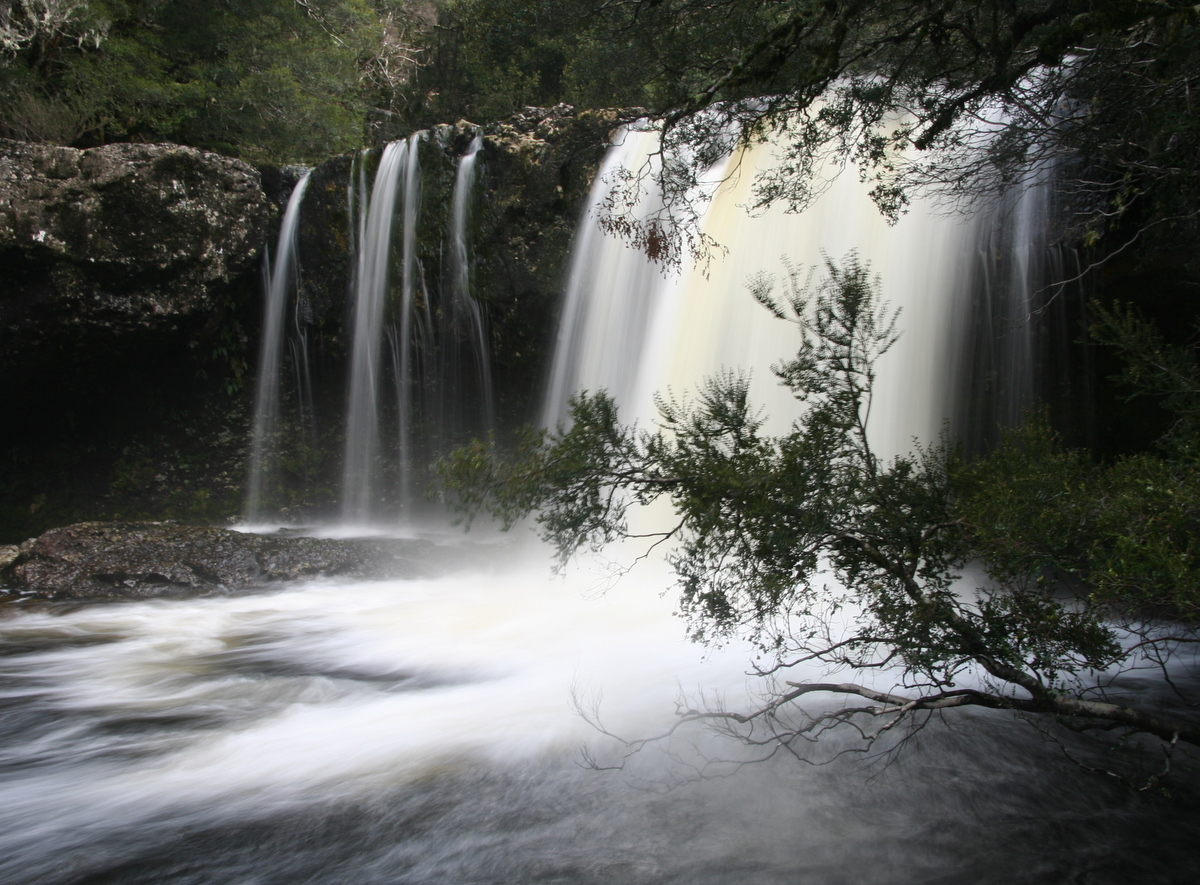
The most fascinating organism mentioned in the documentary is Mountain Ash, really a species of eucalyptus tree (Eucalyptus regnans). The tree reproduces in a curious manner: its seeds are only released during bush fires, which may kill all other plants (including the Mountain Ash itself), but make it possible for the seedlings to sprout and grow without competition. But in western Tasmania, bush fires are rare due to the constant rains. Therefore, the eucalyptus trees simply continue growing - in one area of the island, all trees are 400 years old and reach a hight of 100 meters! In effect, this means that the latest bush fire took place at some point during around the year 1600... 

One species never shown in this production is our very own Homo sapiens. The viewer gets the impression that Tasmania is pure and pristine wilderness. Actually, the island is an Australian state, the home of about half a milliion people, and an economy partially based on mining and logging. And yes, the White settlers completely exterminated the local Aborigines during the 1830´s. Somehow, I feel that needs to pointed out for context.

That being said, "Tasmania: Weird and Wonderful" nevertheless deserves a closer look or two. This really is Australia with a twist.

Wednesday, September 19, 2018

Austral-avian microcosm


I recently find this little gem in “my” local library. It’s a kind of Australian version of Heinzel-Fitter-Parslow, which in my opinion is a commendation.

Color plates and species presentations (including range maps) are on facing pages. The plates also show eggs, something I haven't seen in a bird guide before. Many petrels and share weathers are shown both in flying and nesting position. Presumably, you can use this guide even if you climb steep cliffs at offshore islands! The main drawback is the same as in Heinzel-Fitter-Parslow: many of the illustrations are rather small.

“The Slater Field Guide” (attributed to Peter Slater, Pat Slater and Raoul Slater) covers mainland Australia, Tasmania and other islands off the Australian coast, Ashmore Reef, Lord Howe Island, Norfolk Island, Christmas Island, Cocos-Keeling Islands, Saibai and Boigu (the two latter are popular among Australian bird-watchers due to their proximity to New Guinea and its unique avifauna). All these territories are ultimately controlled by the Commonwealth of Australia. The field guide doesn't cover Australian territories in the Antarctic region. Nor does it cover New Guinea or New Zealand.

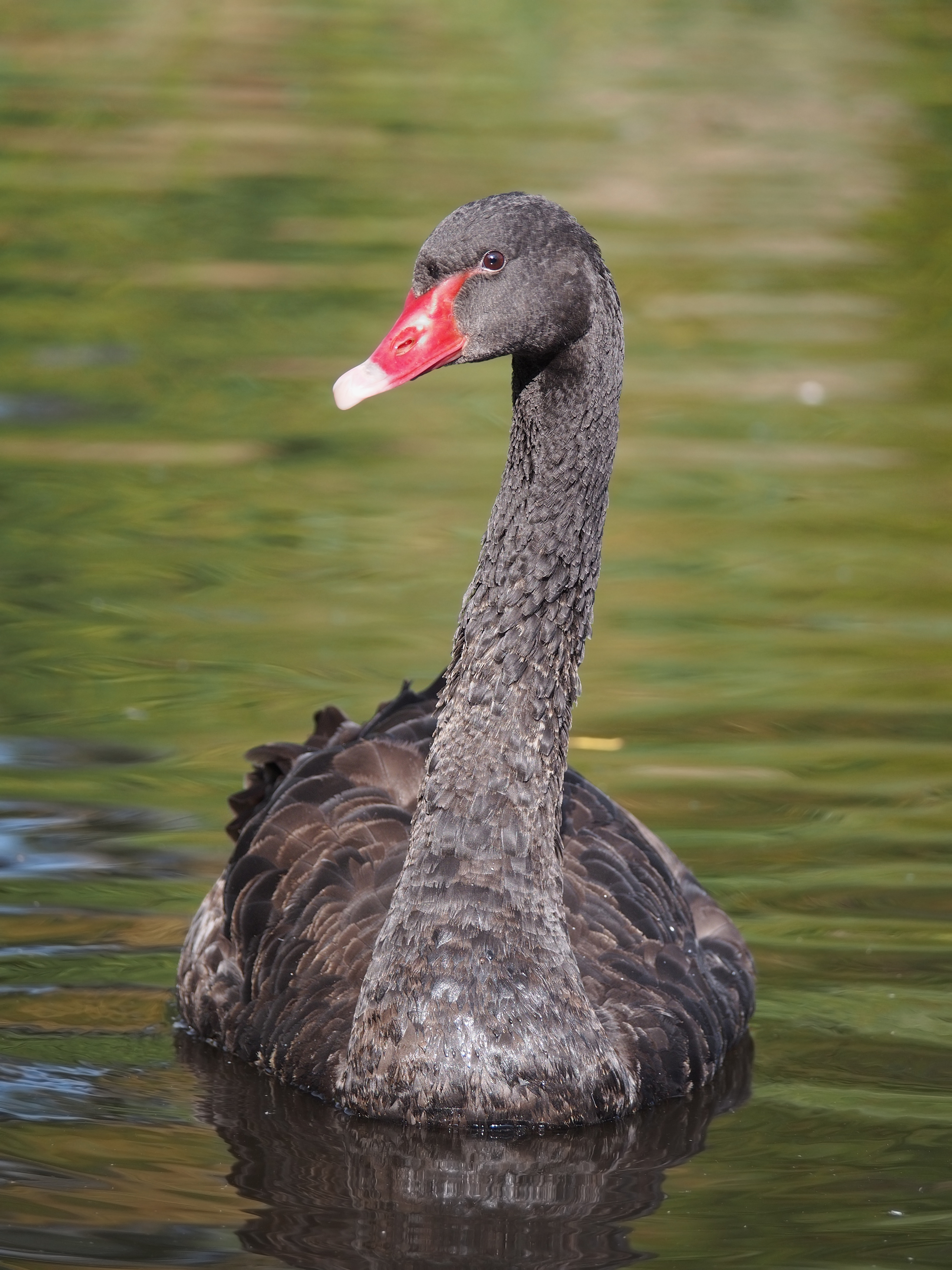
Leafing through Slater-Slater-Slater was fascinating. Australia is a veritable microcosm of the bird universe. If you travel diligently across the island-continent, there's probably no bird you *won't* encounter at some point. Starlings, European Blackbirds and House Sparrows have been introduced. More local celebrities include Kookaburras and Currawongs. If you're lucky, you can see vagrant Adélie Penguins from Antarctica or Magellanic Penguins from the Falkland Islands (sic). If you're less lucky, you might run into a Cassowary or Ostrich! (Or a taipan, but that's another field guide.) And yes, the almost proverbial Black Swan lives free and wild down under…

I think SlaterX3 deserves five stars.

Saturday, September 8, 2018

Thylacine terror down under


A review of the MonsterQuest episode "Isle of the Lost Tiger"

Geezus. Has that perennial failure of a monster show, "MonsterQuest", better known as "Wild Goose Chase - Washington State edition", FINALLY FIND AY MONSTER???

It's not Bigfoot, Nessie, the Texas mega-hog or the gator in the sewer, however. It is...wait for it...the Thylacine??!!

Of all creepy, lurking creatures that might still be out there (or "out there"), Doug Hajicek and his indefatigable investigators just have to prove the possible existence of *that* one. The Thylacine (a carnivorous Australian mammal) was very real until it was hunted to extinction in the 1930's. It was a vicious killing-machine the size of a wolf, with large and flexible jaws and a penchant for devouring livestock. I'm sure it would have gotten a taste for people, as well, had it lived long enough to be protected by the bleeding-heart UN liberals that currently man our environmental agencies. THE BOUNTY HUNTERS DID US A FAVOUR BY EXTERMINATING IT FOR $ 750 A PIECE!!!

But are we to believe TerrorQuest, pardon, MonsterQuest, the Thylacine (a.k.a. Tasmanian tiger) is still alive, well, kicking and eating somewhere in the Tasmanian rain forests. After the usual boring intro (about 40 minutes long), the producers finally reveal that their little expedition into the god-forsaken backwoods of Australia was successful. Something mysterious was caught on camera, and a footprint matching that of a Thylacine was found nearby.

I can't say I like this sudden turn of events. Suddenly, I like the rest of the series better, where the knights on a quest fail to find, say, the Jersey Devil or the Feejee Mermaid. At the same time, I'm not entirely surprised. I mean, can anything good ever come out of *Tasmania*? Next year, they will probably find evidence for the Bunyip, as well!

:P

The yawn of the Thylacine


"Animal X Natural Mystery Unit" is an American edition of an Australian series dealing with crypto-zoology and the paranormal. In this episode, the "unit" travels home to Australia in search of the Thylacine, a carnivorous marsupial extinct since the 1930's. Yet, people still see them - not just on the island of Tasmania (their former native habitat) but also on the Australian mainland.

As usual, the physical evidence is scanty, but the Tasmanian authorities admit that *some* witness reports sound credible. However, the animal is still officially extinct, and conspiracy theorists claim that the Tasmanian logging industry is behind it all. Logging might be threatened if the "Tasmanian Tiger" is still out there, awaiting legal protection...

The Natural Mystery Unit interviews witnesses, environmental activists, a representative of the logging industry and crypto-zoologists who believe that the spooky creature is still out there. One researcher claims that an "ark" was built at some point during the 1930's by local enthusiasts who saved a few Thylacines and implanted them on the Australian mainland!

Interesting. Unfortunately Daniel and Nathalie (the two unit members) are extremely uncharismatic and even somewhat embarrassing. By contrast, the so-called mission controller Bill Kerr is less "out there" than usually, and actually sounds quite normal in this episode. These guys have a way of making a genuine mystery seem boring! The yawn of the Thylacine? Geezus, can't they send Josh Gates or Bobo to Tasmania?! They'll flush the creature out...or throw a big party, LOL.

Two stars.

Friday, August 17, 2018

Mixed emotions


“Tasmania: Paradise at the End of the World” is a nature documentary about wildlife and conservation in Tasmania, the island-state of Australia. It also deals with colonial history.

I got mixed feelings watching this production, since it literally *never* mention the genocidal war of the settlers against the Aboriginal population. This makes the romantic angle about “preserving nature as it originally was” look more absurd than usual. 19th century loggers and miners are painted as heroes, which is surely unusual in a nature documentary, but the viewer is given the impression that Tasmanian history started with these heroic settler-proletarians, when in reality Tasmania has been inhabited for 40,000 years by the Aboriginals!

That being said, the documentary is nevertheless interesting, with a good overview of the exotic animals and plants of the island. Wallabies, wombats, echidnas, the platypus and Tasmanian devils are featured. So is the extinct Tasmanian tiger or thylacine. The producers take the rumor about the possible survival of the thylacine seriously. So do I. On the plant side, there are tree-ferns, white gum trees and Eucalyptus regnans, said to be the largest flowering plant in the world. Sometimes, “Paradise at the End of the World” comes close to comic relief, as when a group of crow-like currawongs help themselves to the tourists' fast food below a huge sign saying “Don't feed the birds”! Since this is originally an ORF production, there is also an unintentionally comic Austrian angle, with constant mentions of one Gustav Weindorfer, no doubt a brave explorer but hardly a household name.

Had the documentary not tried to hide the darkest chapter in Tasmanian history, I would have given it five stars. As it is, I give it four. It *is* a good documentary with great footage of animals in various situations, and part of me wants to believe the romanticized John Muir-esque atmosphere, but I suppose I'm too cynical to entirely buy this "Whitewash"…

Sunday, August 5, 2018

Diamond or charcoal?


A real reviewer once wrote: "Jared Diamond is suspected to be a pseudonym for a committee of experts". He (or she) had a point. Jared Diamond's book "Guns, germs and steel" could very well be re-titled The Book About Everything. It's a very ambitious undertaking. Essentially, the author wants to explain the main lines of human history for the past 15,000 years!

The book is very interesting, and I don't doubt that Diamond is right on many points. However, I also suspect that he is just as wrong on many others. Indeed, I found myself agreeing with the author all the way until the epilogue, where he fell flat to his face. Diamond became charcoal, as it were. Still, Jared Diamond should be commended for at least trying to analyze the big issues of human history and prehistory. In that sense, "Guns, germs and steel" is a must read. (Incidentally, I know that Jared Diamond is a high-ranking professor. That just makes it more fun disagreeing with him, don't you think?)

[THE QUESTIONS ADRESSED BY THE BOOK]

"Guns, germs and steel" addresses the following questions. First, why did most high cultures appear in Eurasia and North Africa? Indeed, why did the first high cultures appear in these regions? Second, why where the Eurasian and North African high cultures more technologically advanced, and developed faster, than the high cultures that did appear in sub-Saharan Africa and the Americas? Third, why did no high culture ever appear in pre-colonial Australia? (I'm using the term "high culture" in a neutral sense. It's simply a culture with cities, an advanced division of labour, technology, etc.)

Diamond believes that the reasons are geographical and environmental, rather than genetic or "racial". He often explicitly argues against racist arguments. This may strike a sophisticated European reader as somewhat strange, until one remembers that the racist work "The Bell Curve" was a best seller in the United States only a few years before "Guns, germs and steel" was published. Diamond doesn't like to be called an environmental determinist, but it's hard to resist the temptation to call him precisely that. At the very least, he is strongly influenced by such ideas.

[THE ROLE OF DOMESTICATED ANIMALS AND PLANTS]

Diamond points out that many species of animals and plants in Eurasia could be domesticated. This was not true in America, Africa and Australia. There were no large mammals in America and Australia at all. Africa is teeming with large mammals but, by a curious accident, virtually none can be domesticated. Attempts to domesticate zebras or antelopes have all failed. This means that Eurasia got a head start in developing agriculture and the kind of massive food production necessary to sustain a high culture.

Eurasia also got the better deal in terms of technology. Large domesticated animals are needed to pull wagons. The wheel was therefore invented in Eurasia. The Aztec empire didn't have such animals (none were available), so naturally they never used wheels. In the same way, domestication of animals also paved the way for military success. Europeans and Asians had a cavalry. The Aztecs and Incas had none, and where thus quickly overwhelmed by the Spanish. Diamond points out, somewhat sarcastically, that if rhinos could be domesticated, Africans would have conquered the world!

Another factor is germs. Many epidemic diseases originally comes from "our" animals. Europeans therefore had a certain immunity against diseases such as smallpox, whereas American Indians had none. The Aztecs and the Incas were defeated in part because of smallpox epidemics, to which the Spaniards had a higher immunity. (Conversely, one of the reasons why it took Europeans so long to conquer Africa or reach the interior of New Guinea, was European non-resistance to malaria.)

[GEOGRAPHICAL FACTORS FAVOURING DIFFUSION, etc]

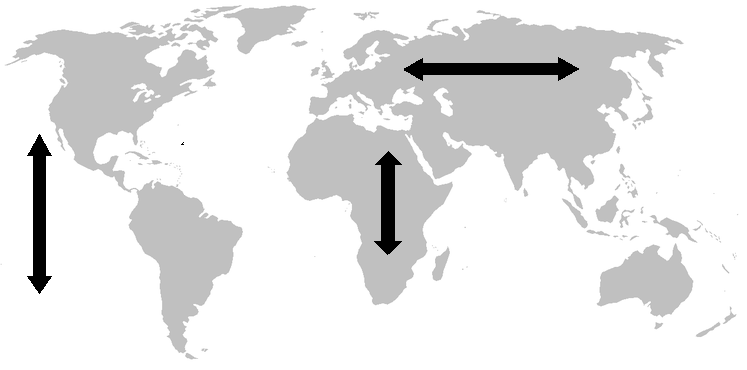
Another factor favouring Eurasia is the east-west orientation of the vast Eurasian landmass. This made it easy for domesticated plants from the Middle East to be introduced into southern Europe, India or China. All these areas have basically the same climate. It's also (relatively) easy to travel between Europe and Asia, facilitating cultural diffusion. America, by contrast, has a north-south orientation. Also, the various parts of the Americas used to be more isolated from each other due to various geographical factors. This made cultural diffusion more difficult. When the Spanish landed in Peru and attacked the Inca empire, the Incas apparently had no idea that Mexico had already been conquered by Spain! The Inca ruler Atahuallpa naively assumed that Pizarro was just a raider who could be bought off with gold. He never realized that the conquistadors were there to stay.

Diamond also points out that Australia and some parts of North America were unsuitable for agriculture, or at least for advanced agriculture. This explains why the Aborigines never developed a high culture. The hunter-gatherer lifestyle was the only feasible one under Australian conditions. Unless, of course, you have *already* developed a high culture, which could then simply be transplanted to Australia, as the English eventually did. But even with such a culture, surviving in Australia wasn't easy. The White explorers who attempted to cross Australia's hinterland fared less well than the Aborigines, since Western technology didn't do much good in the outback. As for the Tasmanians, their extremely low level of technology is due to Tasmania's isolation from the rest of the world. Other isolated cultures also regressed technologically. The Chapham Islands is another example.

But what about cultural factors? Diamond believes that some cultures are indeed more conservative, while others are more innovative. Here, he strays from "environmental determinism", since he attributes these factors to local idiosyncrasies. However, the sheer number of cultures that can be reached by cultural diffusion was higher in Eurasia than in America or Australia. Therefore, cultural innovation nevertheless became more likely in the Eurasian context.

[A PROBLEMATIC EPILOGUE]

So far, I think Diamond has made an eloquent case. The problem comes in the epilogue, where he tries to wrap up his theory, and connect the broad geographic-environmental perspective with questions about contingency, the role of individuals in world history, etc. He never really succeeds in this. In this last section of the book, Diamond also attempts to answer a fourth question: Why did the western part of the Eurasian landmass, the backwater known as Europe, eventually overtake not only America, Africa and Australia, but also Asia? After all, China, India and the Muslim world had an enormous head start compared to Europe. Then, something happened, around AD 1500.

To Diamond, Europe's eventual dominance over Asia can also be explained by environmental and geographic factors. This is not convincing at all. Diamond is right to point out that the decentralized character of 15th century Europe actually worked in Columbus' favour, since the Italian adventurer could lobby a large amount of kings and princes with his proposal for a westward voyage to "India". In China, by contrast, the centralized form of government proved disadvantageous to Chinese expansionism - when the emperor ordered that China shouldn't expand, that was it. The problem is that Diamond explains the centralization of China and the decentralization of Europe as inevitable consequences of geography. I beg to disagree. I consider it a contingent fact.

Europe was united for centuries by the Romans. Diamond writes that "only" half of Europe was under Roman control. True, but surely it was the better half! What if the Muslims had defeated Charles Martell or (much later) conquered Vienna? Then, large parts of Europe would once again have become "united". Diamond also writes that Napoleon and Hitler never united Europe. I don't know much about the Napoleonic wars, but Hitler *did* come very close to winning World War Two. There simply aren't any major geographical obstacles to uniting the important parts of Europe. Conversely, there have been periods in Chinese history when China was divided in many small states. That decentralization worked in Colombus' favour was also a contingent fact. After all, the Catholic monarchs of Spain almost rejected him as well. And what if the Europeans had decided to appease the Ottomans instead of fighting them? Then, Europe would have lost interest in westward journeys. Another curious argument put forward by the author is that deforestation in the Middle East made the centre of power move westward, to Greece and Rome, and then to northern Europe. This is a blatantly Euro-centric argument: in reality, Persia was just as strong as the Roman Empire, the Arabs were stronger than the "empires" of medieval Europe, and the Ottoman Empire was strongest during the 16th century, and it was still quite powerful two centuries later, i.e. during the same time as the European powers expanded internationally.

Thus, I can't see how "macroevolutionary" factors of geography or environment can explain why Europe managed to get ahead of the Muslims, Indians and Chinese.

Finally, there seems to be a curious tendency in Jared Diamond's later book "Collapse" to reverse environmental determinism in favour of a different perspective, zooming in on various idiosyncratic cultural factors.

Still, I regard Professor Diamond (or should I call him Jared?) as a highly erudite and stimulating author, and recommend his books to everyone interested in world history.