As a
child, I was very upset when first learning about cuckoos and their brood
parasitism. I considered cuckoos to be EVIL. Later, I was relieved to hear that
all cuckoos aren't parasitic. At least the Cuculiformes as a whole weren't
TAINTED. Naturally, I cheered inwardly when I read that Great Reed Warblers
sometimes attack cuckoos, force them under water, and make them DROWN.
LOL!
OK, after this introduction, written just to get your attention, let's say
something about the book...
Scientific works written for a narrow audience are often dry, technical and
incomprehensible for out-siders (and sometimes you wonder whether even insiders
understand them - J.F. Haldon's scholarly tomes on the Byzantine Empire comes
to mind. Does *anyone* understand Haldon?). This book, while certainly not
"popularized" in the traditional sense of the term, is one of the few
exceptions. It's surprisingly easy to read, well-organized, comprehensive, and
interesting. There's even something uncannily catchy about it. Had I read a
book like this while in high school, I might have ended up as an ornithologist!
Or at least a natural science writer for some magazine (my math grades were,
well, bad).
"Cuckoos, Cowbirds and other cheats" by N.B. Davies is a
comprehensive, scientific survey of brood parasitic birds, with emphasis on how
co-evolution between parasites and hosts have shaped their respective
behavioral patterns. Many other aspects of brood parasitism are covered as
well. I found the historical overviews particularly fascinating. Did you know
that the first known record of birds parasitizing other birds of the same
species can be found in the Biblical prophecies of Jeremiah? Or that the first
record of parasitic cuckoos comes from the Vedic scriptures of India? That the
Common Cuckoo is a brood parasite was known by Aristotle, and modern biologists
who want information on how fast cuckoos can change host species, might do well
to study Chaucer and Shakespeare! Incidentally, it's obvious that Davies is
British. Would American ornithologists feel at home in the world of British
literature? I don't think so.
For those less literary inclined, the book contain informative and extensive
chapters on the Common Cuckoo, Bronze-Cuckoos of Africa and Australia, the
Great Spotted Cuckoo, honeyguides, cowbirds, parasitic finches, and conspecific
brood parasitism. Thank god I didn't read this book as a kid: it seems everyone
in the bird world parasitizes everyone else!
As already indicated, the main theme of the book are the evolutionary puzzles
laid out by the phenomenon of brood parasitism. Many birds recognize their own
eggs, and may therefore reject eggs laid by cuckoos or other brood parasites.
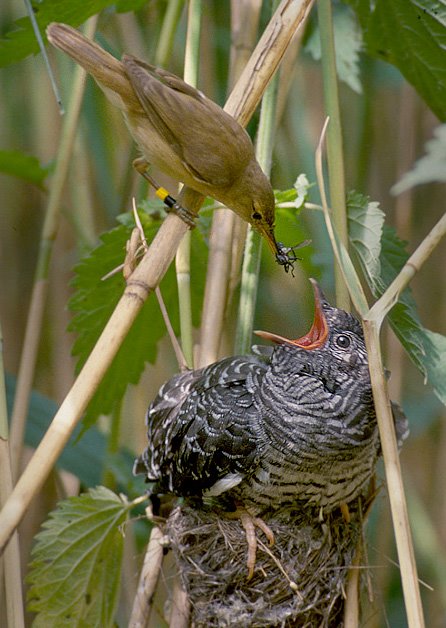
To cope with this, cuckoos have evolved mimetic eggs, i.e. eggs that look like
the eggs of their host species. However, very few birds seem to recognize their
own chicks! Thus, cuckoo chicks usually don't have to mimick the young of their
host species. This creates a rather uncanny situation: the host species may
attack cuckoos flying across their territory, and evict cuckoo eggs that are
markedly different from their own, but if they are fooled by a mimetic egg,
they will uncritically accept the cuckoo chick, even when it's obviously
different from their own chicks. How is it possible for birds to recognize
obviously foreign eggs, but not obviously foreign chicks? This is one of the
mysteries adressed by this book.
The plot thickens further, when we realize that there are cases where birds
*can* tell the difference between their own chicks and foreign chicks. In South
America, the Screaming Cowbird parasitizes the Baywinged Cowbird. Chicks of
both species look identical, presumably an evolutionary response by the
parasite to avoid being evicted by the host species. But the cowbirds are
"stupid" small passerines. Why can a Baywinged Cowbird tell the
difference between its own chicks and foreign chicks (unless the latter has
evolved perfect mimicry), while the more intelligent corvids, parasitized by
the Great Spotted Cuckoo, don't evict the parasite, although they look
different from corvid chicks? Another mystery. One intriguing theory discussed
by Davies is that the Great Spotted Cuckoo might use "Mafia tactics"
to force Magpies into accepting their chicks. The Magpies do recognize the
cuckoo chicks as foreign, but tolerate them anyway, since the adult cuckoo
might otherwise attack and kill the Magpie chicks! (In contrast to the Common
Cuckoo, the chick of the Great Spotted Cuckoo doesn't evict the chicks of the
host species, but is raised together with them.)
To the American reader, perhaps the section on cowbirds is the most interesting
(and disturbing). Above, I mentioned my childish teleological notions about
cuckoos. It seems many adult Americans consider cowbirds to be even more evil
than cuckoos! The Brown-Headed Cowbird is a small passerine that
indiscriminately lay its eggs in the nests of over 100 other species of birds.
Due to habitat change, the Brown-Headed Cowbird has become more and more
abundant the last century or so, not giving its new hosts time to develop egg
or chick discrimination. In some parts of the USA, cowbird parasitism have
almost driven other passerines to extinction! The Kirtland's Warbler, endemic
to a small part of Michigan, was almost exterminated by cowbird parasitism,
until the proper authorities trapped and removed over 90,000 cowbirds (during a
period of almost 20 years) from its breeding area. Other birds threatened by
the Brown-Headed Cowbird include the Black-Capped Vireo, the Least Bell's
Vireo, and the Southwestern Willow Flycatcher. A similar problem exists on
Puerto Rico, where another parasitic passerine, the Shiny Cowbird, have
established itself, threatening an endemic blackbird. Small wonder a certain US
ornithologist recommend that any cowbird that reaches Europe should be
immidiately shot on sight, no further questions asked!
But, as the author points out, the main culprit in the sad story of the
cowbirds isn't the little bird itself, but humans. The Brown-Headed Cowbird was
originally a bird of the great plains, where it followed the buffalo. With the
near-extinction of the buffalo, the cowbirds switched to follow human-raised
cattle, becoming even more abundant, and the turning of forests into farmland
have exposed other passerines to cowbird parasitism, apart from the ususal
problems associated with habitat destruction.
Perhaps inevitably, the most interesting chapter in the entire book is also one
of the shortest: "Cheating on your own kind", about conspecific brood
parasitism. The natural world is truly bizarre, filled with mysteries, wonders
and plain absurdities, and some of these are recorded in this chapter. Snow
Geese parasitize each other on a semi-regular basis. The parasitic female lays
her egg on the ground, close to the nest of another female, and absconds. Then
something spectacular happens: the nesting female accepts the foreign egg and gently
rolls it into her own nest, despite the fact that she has seen the parasitic
female laying it, and thus knows that the egg is foreign! The reason: a visible
egg just outside a nest might help predators, such as skuas and gulls, to find
the nest, attack it, and eat *all* the eggs. Thus, the only alternative open to
the Snow Goose is to quickly accept the egg of the parasitic female, and treat
it as one of her own. Even more sensational is the behavior of Ostriches. It
seems that Ostriches voluntarily accept eggs of other, parasitic, Ostriches.
The reason is selfish: if the Ostrich nest is attacked by predators, and
contain both eggs of the resident female, and eggs of other females, there is a
fifty-fifty chance that the predators eat the foreign eggs, thus saving at
least some of the "native" eggs. To top it all off, there is even a
bird, the White-winged Chough, that wants to have foreign fledglings, and
actively tries to kidnap them from other families of the same species!
The final chapter of "Cuckoos, cowbirds and other cheats" discusses
how and why brood parasitism might have evolved in the first place. The author
takes issue with a British theologian, Charles Raven, who questioned whether
brood parasitism could have evolved in a gradual, piecemeal fashion. Davies
believes that this is perfectly feasible. He points out that many non-parasitic
birds behave in a manner similar to parasitic birds.
For instance, young Kittiwakes, egrets, boobies and Cactus Wrens habitually
evict their own siblings from the nest, often quite brutally. The chicks of the
Blue-throated Bee-eater in Malaysia have hooks on their beaks, and if food is
scarce, the older chicks attack and kill the younger ones. The same phenomenon
can be observed among brood parasitic honeyguides and the Striped Cuckoo. There
simply isn't any family harmony among the non-parasitic species, and plenty of
behavioral patterns that natural selection can mould into all-out parasitism.
Another interesting observation in this regard concerns the cowbirds. The only
non-parasitic cowbird, the Bay-wing, habitually attacks and takes over occupied
nests of other species, while the parasitic Shiny Cowbird occasionally attempts
to build nests, perhaps suggesting that parasitism have evolved from
nest-building through an intermediary stage where the cowbirds nested, but in
nests stolen from others. The parasitic finches in Africa are also closely
related to species that take over nests of others, or species where only the
males are involved in nest-building, with the females roaming at large. There
are also many examples of nesting birds that occasionally parasitize other
species to enhance their reproductive success, which could lead to all-out
parasitism given enough time and selection pressure.
This book is WARMLY recommended.