Showing posts with label Piciformes. Show all posts

Tuesday, February 20, 2024

Eavesdropping on Bigfoot


A sneak peek (or rather eavesdropping) into the weird and wonderful world of cryptid *audio*. I´m not an expert on this niche topic, but from the top of my head, the Sierra sounds are frankly ridiculous. 

The most fascinating recording could be a Blue Jay (a known and extant species) mimicking an Ivory-Billed Woodpecker (an extinct species)! Either the jumbo-sized woodpecker is still around, or Blue Jays have been mimicking it for generations after it went extinct...

I also wonder what´s up with the Japanese Wolf, claimed to be extinct for over 100 years. Yet, freakin´ close-range photos of the beast exist?! With apologies to C S Lewis: Really, we are hard to please! If the Honshu Wolf is tojour vivant, that would be fascinating since they are believed to be the last surviving lineage of the Pleistocene Wolf, the direct ancestor of domestic dogs (the Grey Wolf apparently being a side lineage).

Of course, we have to kill the wolves anyway, LOL. Just make sure to send a frozen specimen to your local bio-lab for closer inspection...


Wednesday, June 28, 2023

What is the Grail?


Credit: Birding Memes (Facebook)

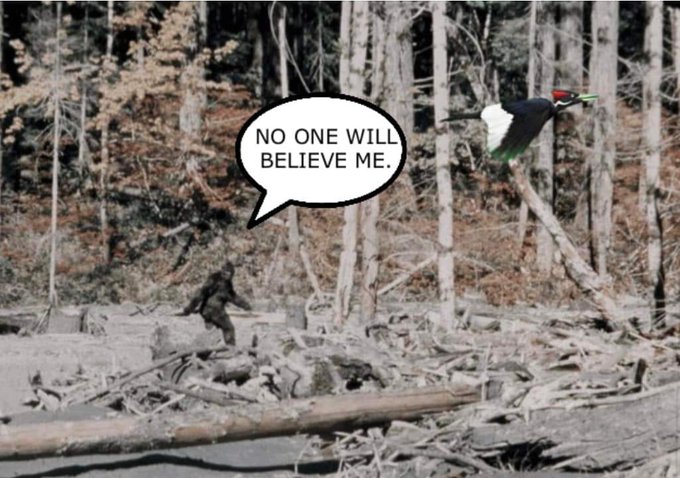
In case you don´t get it, the meme shows a Bigfoot (a mythological creature) looking at an ivory-billed woodpecker, a real North American bird believed to be extinct. 

Many bird-watchers hope that the flamboyant avian is still out there somewhere. The ivory-bill has therefore been dubbed "the Grail bird" and is still included in US field guides just in case it´s still around! 

Scientists are apparently very skeptical of its continued existence, hence the funny meme above of a Bigfoot complaining that nobody will believe her if she reports a sighting...

Wednesday, September 8, 2021

Honeyguide don´t give shit

Where the damn killer bees at?

A comment by another use triggered this somewhat bizarre nerd extravaganza, but that´s one of the good things with having your own troll blog, I mean, you can post whatever whenever. 

Is the story of the honeyguide (a bird related to the woodpeckers) guiding honeybadgers to the bee colonies in Africa just folklore? The sources below strongly suggests so! There is a small chance that it *could* happen, since people (for obvious reasons) don´t usually hang around hives of killer bees to see what´s shaking and so forth, but apparently the behavior has never been observed by trained Western scientists. The nature documentaries supposedly showing this activity may have been staged! 

Honeyguides do guide humans to beehives, however. Nor do they give a damn about the entire controversy... 

Link number one

Link number two

Link number three (the longest one)

Link number four

Link number five

Tuesday, September 18, 2018

For woodpecker geeks only?


A review of "Life of the Woodpecker"

This is a somewhat peculiar, coffee-table sized book. I'm not sure how to describe its genre. Popular science book doesn't entirely cut it. It seems to be some kind of “geek” book. Of course, you need to be a woodpecker-loving geek to appreciate it! It contains good color illustrations in the form of paintings by Dana Gardner. The text, by Alexander F Skutch, deals with all aspects of woodpecker behavior. Ironically, “Life of the Woodpecker” is brought to us by the Ibis Publishing Company! The ibis is, ahem, a wading bird…

Thursday, September 13, 2018

Nice try, Doc


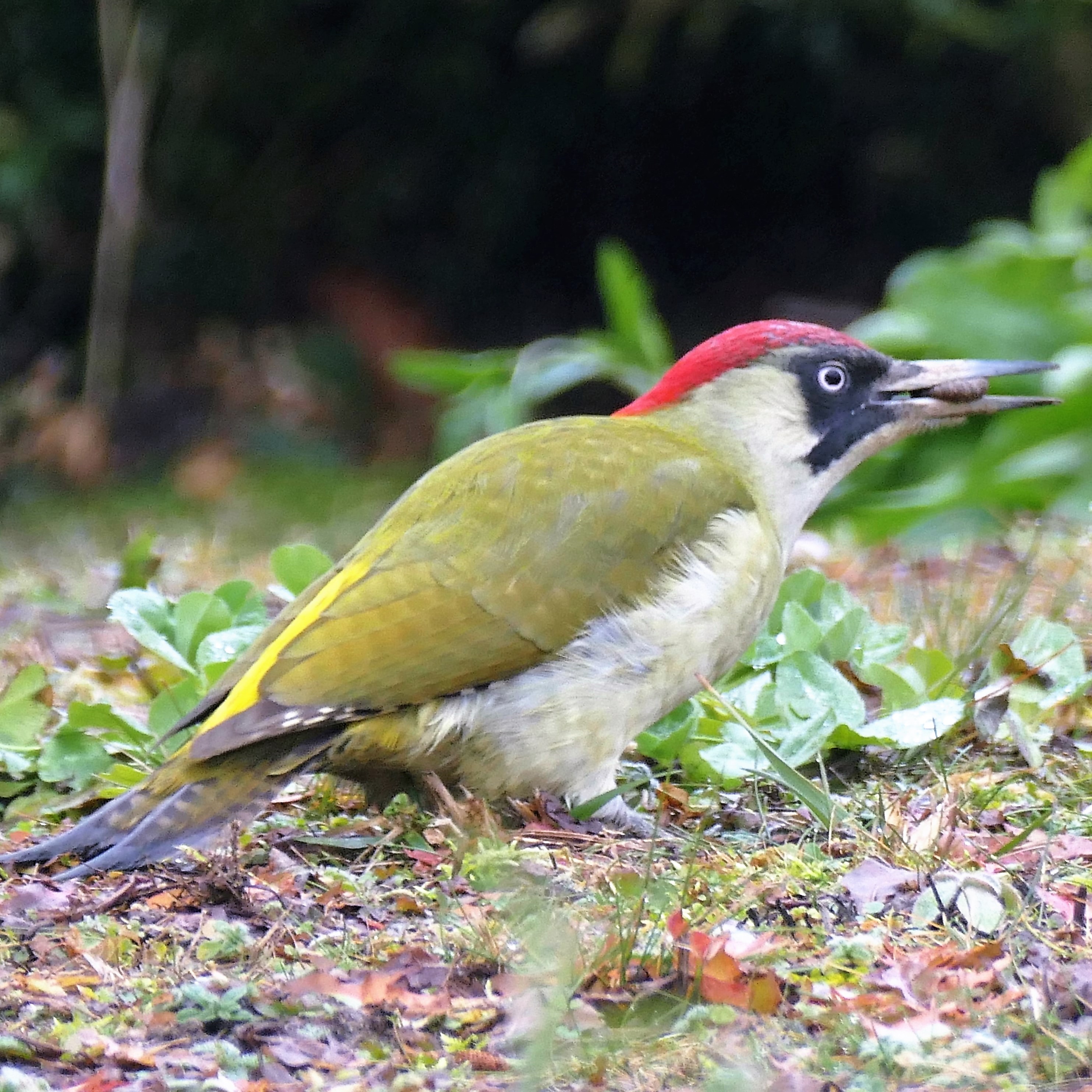
So just because "Paul Devereux" (really a pseudonym for Doc Shiels) can't tell the difference between a military flare and the planet Venus, we are supposed to believe that flying saucers are archetypes on the run from Stonehenge? Nice try, Doc. Some of the purported "contact" cases in this bad excuse of a book are ridiculously easy to debunk. For instance, the green UFO that stalked a plane from the British Airways. Come on, everyone knows that was a Green Woodpecker suffering from a severe bout of gigantism. 1 out of 10,000 mutations are beneficial. This was that mutation. Yeah, really. You don't have to be Menzel, Klass or Randi to realize this.

Kidding... :D

Saturday, September 1, 2018

The Bigfoot Bird


Pssst...don't say anything, keep your voices down, BUT I THINK THAT'S AN IVORY-BILLED WOODPECKER!!! Whatever you do, don't tell Audubon. Knowing that awful man, he'll probably blast the poor bird from the trees with a 19th century flint-lock gun or something, just to be able to paint it later?! Time for somebody to change the "collective representation" around here, it seems. I mean, can you imagine what the man would do if an Archaeopteryx would appear in his backyard apple trees..? Well, I can (clue: he's got a 18th century hunting rifle, too) so....pssst....keep your voices down...

Monday, August 13, 2018

Lars Jonsson´s boring birds


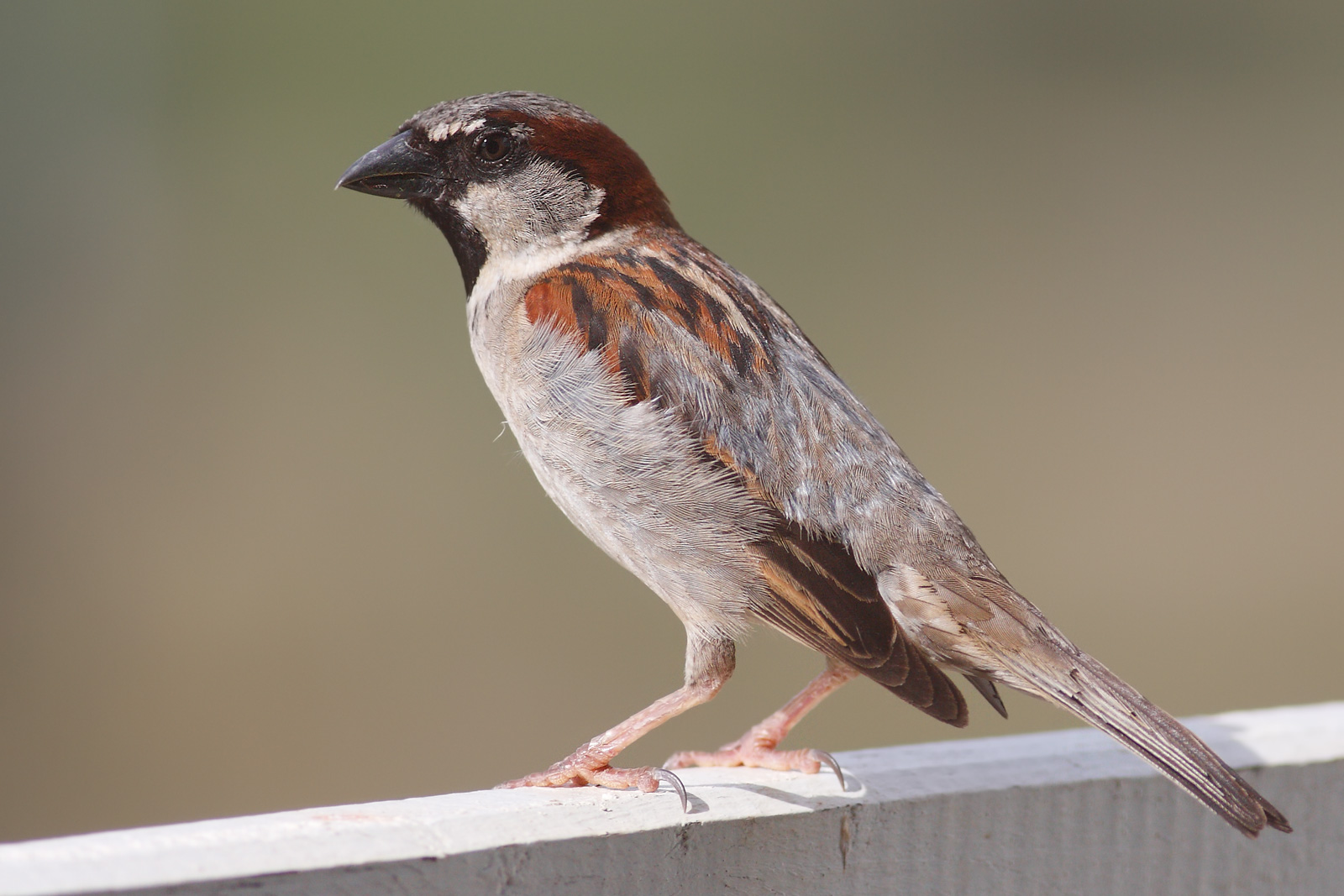
"Birds of Wood, Park and Garden" is the first volume of a five-volume work, covering all birds of Europe. This volume is intended as a field guide to the birds of woodlands and parklands in Europe north of the Alps but south of the boreal forest zone. In other words, the usual boring feathered critters hopping around outside my window...or at least further out in "my" strolling area. They are all in there: house sparrow, tree sparrow, fieldfare, blackbird, green woodpecker, wood pigeon and the super-abundant corvids. Gee, I constantly have to remind myself that these are supposed to be close evolutionary cousins of the T-rex, lest I surely die of boredom! Only the bluecrow and the hoopoe stand out but, alas, they never seem to show up outside my apartment building...

The Swedish edition of this book was the first thing ever published by Lars Jonsson, the famous Swedish bird painter. He was only 24 years old! The text, penned by Jonsson himself, sounds extremely mature, so I always assumed the author was at least in his fifties... Jonsson's illustrations are, of course, excellent but still feel "rough" compared to his later forages into bird painting. I don't wish to sound ungrateful to the Master, but this basic-basic bird guide somehow didn't rock my world in the way Jonsson's later works tend to do. Therefore, I only give it three stars. Still, it is strange that Jonsson was flunked by the Swedish Art Academy. What did they want him to do, a Pollock?!

Lars Jonsson´s first book


Believe it or not, but this is Lars Jonsson's first book, the original Swedish edition of "Birds of Wood, Park and Garden". It was published in Sweden in 1976, and is both written and illustrated by Jonsson himself. At the time, the young painter was only 24 years old. A few years earlier, his application to the Art Academy in Stockholm had been turned down! Considering that Jonsson went on to become the Audubon of the 20th century, I sure wonder why? Even in this early book, his genius is clearly visible...

My main problem with "Fåglar i naturen: Skog, park, trädgård" is that the birds featured in it are so, well, damn boring. These are the birds every Swede sees outside his window from childhood onwards: sparrows, finches, crows, magpies, thrushes... OK, magpies are quite cool (they are the parrots of the North!), but otherwise, I long to see some stray albatross or thunderbird gently circling around my local shopping mold, LOL.

Unfortunately, it seems that Jonsson's first book is unavailable at the present time from our favourite vendor, Amazon. Don't worry, the sparrows will be here next year as well...

Thursday, July 26, 2018

One of the living


"Handbook of the Birds of the World. Volume 7: Jacamars to Woodpeckers" is the full title of this gigantic, 600-page book. Its part of a 16-volume series covering all living species of birds. This particular volume covers Jacamars, Puffbirds, Barbets, Toucans, Honeyguides and Woodpeckers. Just in case, it even includes a detailed description of the legendary Ivory-Billed Woodpecker - in the section on still living birds.

The most interesting part of this volume, however, is a specially-written chapter on extinct birds by Errol Fuller. Apart from the iconic extinct species (Dodo, Passenger Pigeon, Great Auk and so on), it includes information on a lot of lesser known extinction tragedies. Thus, we meet the almost flightless Spectacled Cormorant which used to live on Bering Island and adjacent areas in the Arctic. It met the same fate as the Dodo - it was good for the pot. A similar destiny affected the White Gallinule, a large flightless rail at Lord Howe Island.

Fuller also tells the bizarre story of the Stephen Wren, a miniscule flightless passerine endemic to Stephen Island. According to legend, this species was so rare that it was exterminated by one single creature - the lighthouse keeper's cat. The keeper was named Mr. Lyell, but Fuller doesn't mention that the cat's name was Tibbles. According to Wikipedia, however, new research (published just two years after Fuller's article in this volume) shows this story to be an over-exaggeration. The wren was indeed driven to extinction by cats, but rapacious Tibbles wasn't the sole culprit. Well, good to get that cleared out!

On a more serious note, although I'm not an animal rights activists, I nevertheless consider extinctions to be somehow unworthy of our human dignity. As Aldo Leopold put it: The difference between the passenger pigeon and man, is that man can mourn the passing of the pigeon, while the pigeon would hardly notice the passing of man! Hopefully, the Ivory-billed Woodpecker will one day turn out to be one of the living species. It would have an obvious symbolic significance...

Fuller also mentions a number of extremely rare birds, so rare that we hardly know anything about them - except that they are probably long gone. The Bay Thrush is known only from a painting by Georg Forster. It used to live at the Pacific island of Raiatea. The Mystery Double-banded Argus is known only from a single feather found at an unknown location at some time before 1871. Something tells me finding this bird would be even more difficult than spotting an Ivory-billed Woodpecker! A tip: try Indochina or Indonesia. Its closest living relatives thrive there. Further, there is the Rodrigues Night-heron, an aggressive heron harassing Huguenot refugees who made a temporary landfall at this distant island. Finally, there is the White Dodo and Leguat's Giant, the first probably being an artistic fantasy (Fuller's arguments on this point are quite clever), while the second may have been a stray flamingo.

As you might have imagined, I considered Errol Fuller's article to be the most interesting section of this volume. But sure, if jacamars or woodpeckers are more to your liking, don't you worry, you'll get your treat! Each volume of the HBW is literally stashed with scientific information on every described species, including extensive introductory chapters on each family. The whole thing is topped off by excellent color plates and a lot of full-color photos. However, this series isn't really intended for the general reader, which is why I found the chapter on extinct birds so interesting. It was written in a more popularized style, quite unlike the rest of this work. HBW is primarily intended for the scientific reference or research library.

That being said, I nevertheless award this volume the customary five stars.