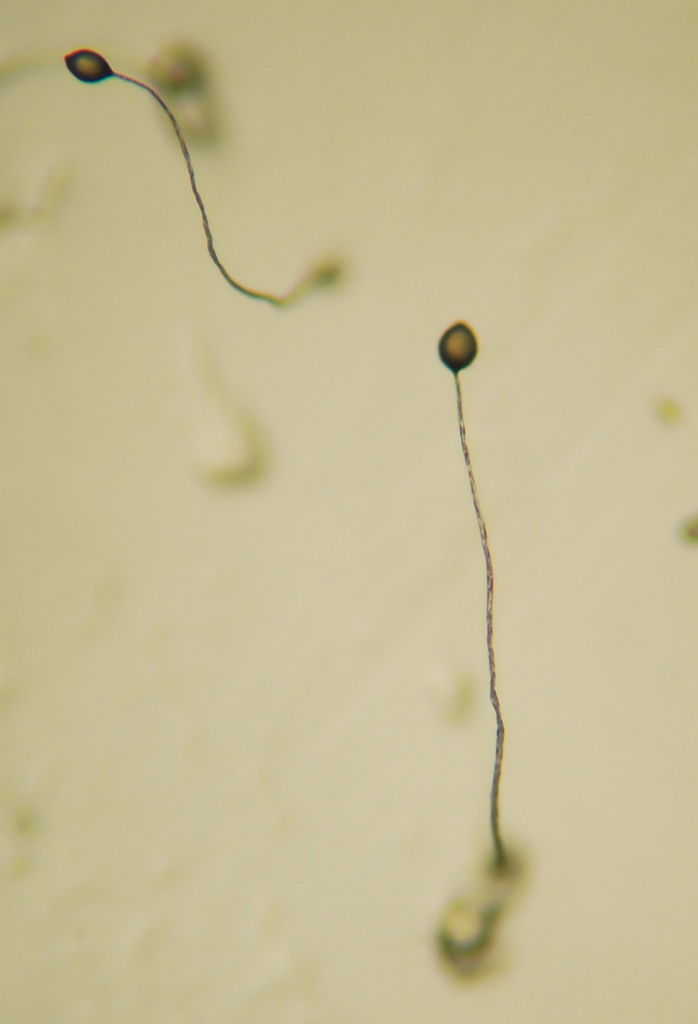
A review of "Myxomycetes: A Handbook of Slime Molds".
Did you know that the classic horror movie "The
Blob" is freely based on a true story?
Well, *very* freely...
Slime molds are a curious and often overlooked group of organisms, defying all
attempts at classification. Are they fungi? Are they animals? Or something else
entirely? Currently, most slime molds are believed to be related to amoebae.
But then, what on earth is an amoeba? Previously classified as animals, they
are now an independent "kingdom".
Slime molds have a complicated life cycle. Their most notorious phase is the
plasmodium, actually a multinucleate cell. The plasmodium is bloblike, slimy
and can become quite large (the size, say, of a mushroom). Also, it can move
around. Often, the plasmodia are brightly coloured as well. This created quite
a panic in a suburb of Dallas, Texas in 1973. The yellow plasmodia of the slime
mold species Fuligo septica suddenly appeared on people's lawns, and when
blasted with water, broke apart - with the parts continuing to slowly creep
around, even getting somewhat bigger! Naturally, people panicked and assumed
UFOs had something to do with it. Or had they just been watching "The
Blob" too much? Eventually, the plasmodium settles down and becomes a
fruiting body with spores. It's this strange life cycle, combining an
amoeba-like stage and a fungus-like stage, which has long baffled researchers.
"Myxomycetes" is a good introduction to these organisms. The book is
intended as a field guide to 175 species of slime molds found in eastern North
America, but since most species are cosmopolitan, the book can probably be used
in Europe as well. It should be noted that all illustrations are in black and
white. Many of these creatures are extremely small, and found only in decaying
wood or litter. Still, it's a pity that no colour plates of the more dramatic
species have been included (such as the previously mentioned Fuligo septica).
Apart from the species presentations, "Myxomycetes" contain chapters
on how to collect and study slime molds, their geographical distribution, and
their ecology. There is also a reference section.
Apparently, slime molds prefer the temperate region, being less abundant in the
tropics. They can be found in deserts and in the hills, but they prefer woods
where they grow on bark, litter or dung. Some insects have specialized in
attacking slime molds, including the slime mold beetles and the slime mold fly
(which, however, may help them spread the spores). In the Mexican state of
Veracruz, some of the natives actually eat our old friend Fuligo septica! They
call it "moon feces", while the preferred English term is "dog
vomit".
Personally, I just call it The Blob...
Finally, a word of warning. This is a typical book for nerds. If you don't
already have a strong interest in slime molds, fungi or perhaps amoebae, I
don't think you will appreciate it. Buy a more popularized book on mushrooms
first! However, if you are one of those nature-lovers who just love to poke
around in the litter, or look under the bark of trees, "Myxomycetes"
might come in handy.