Showing posts with label Indochina. Show all posts

Saturday, April 25, 2026

Dragon Family


A footnote of sorts to the previous blog post on David Wilcock. So who was Neil Keenan, then? 

Is there a conspiracy theorist named Neil Keenan who tried to sue an alleged international banking cartel?

Yes, Neil Keenan is a central figure in one of the most sprawling and elaborate conspiracy theories in the world of "alternative finance" and exopolitics.

In November 2011, Keenan filed a legal complaint in the U.S. District Court for the Southern District of New York (Case No. 11-cv-8500), claiming that a staggering $1 trillion (and later trillions more) in financial instruments had been stolen from him and a group known as the "Dragon Family."

1. The Core Narrative

Keenan’s story reads like a high-stakes thriller involving ancient Asian wealth and modern banking corruption:

  • The Bonds: He claimed he was entrusted by the "Dragon Family" (an alleged ancient, wealthy group in Asia) with Federal Reserve bonds and other financial instruments worth billions.

  • The Theft: He alleged these were stolen/seized in 2009 at the Italian-Swiss border (the "Chiasso incident") by individuals linked to the Office of International Treasury Control (OITC) and the World Economic Forum.

  • The Cartel: Keenan sued a massive list of entities including the United Nations, the World Economic Forum, the Italian government, and various international banks, claiming they were part of a "banking cartel" or "cabal" using these stolen assets to fund a secret global government.

2. Connection to "The Alliance"

Keenan's narrative is a direct ancestor to the "Alliance" theories we discussed earlier:

  • He often spoke of Global Collateral Accounts—vast reserves of gold and wealth supposedly hidden in bunkers across Southeast Asia (particularly Indonesia).

  • He claimed he was working to "free" these accounts to provide humanity with free energy, debt jubilees, and new technologies, all while being protected by a secret "Alliance" of military and spiritual leaders.

3. The Outcome of the Lawsuit

Like many of these conspiracy-related legal challenges, the court case did not result in a trial or a payout:

  • The original lawsuit was voluntarily dismissed by Keenan in 2012, reportedly so he could refile it with "stronger evidence" and more defendants.

  • It never successfully moved forward in a traditional court of law, but in the world of online discourse, it became a foundational myth. For his followers, the dismissal wasn't a failure, but proof of how "deep" the conspiracy went.

Tuesday, January 20, 2026

Impossible ecologies


This is kind of obvious, but since ChatGPT said it, it´s now Revealed Truth as well. Bigfoot (at least if taken to be a flesh-and-blood animal or manimal) simply *can´t* exist. It´s ecologically impossible. Nor can they hide from modern science (or hunters) for centuries. Especially not if they are supposed to live pretty much everywhere! 

Explain why large mammals are hard to hide.

Large mammals are hard to hide not because scientists are unimaginative, but because biology leaves unavoidable, cumulative traces. Once an animal passes a certain size and population threshold, its existence becomes ecologically loud, even if it is shy, nocturnal, or lives in remote terrain.

Here’s the logic step by step.


1. Large mammals require breeding populations

A single animal proves nothing biologically. For a species to persist:

  • You need hundreds to thousands of individuals (minimum viable population)

  • They must reproduce continuously

  • They must be distributed across suitable habitat

This immediately multiplies evidence:

  • Births

  • Deaths

  • Dispersal

  • Genetic diversity

A hidden species would still leave many bodies over time.


2. Bodies don’t vanish: bones, teeth, DNA

Large mammals inevitably leave:

  • Skeletons

  • Teeth (the most durable mammalian tissue)

  • Hair

  • Scat

  • Environmental DNA (eDNA) in soil and water

Key point:

We routinely find bones of rare, elusive animals — even those thought extinct.

Examples:

  • Wolverine remains in low-density populations

  • Snow leopard bones in extreme terrain

  • Saola remains before live sightings were common

For Bigfoot-scale mammals:
❌ No verified bones
❌ No teeth
❌ No uncontested DNA

This is decisive.


3. Large mammals alter ecosystems

Big animals reshape environments simply by living:

  • They consume large quantities of food

  • They trample vegetation

  • They create trails

  • They compete with other species

  • They influence predator–prey dynamics

Ecologists detect species indirectly all the time:

  • Through browse lines

  • Through prey population changes

  • Through parasite networks

A North American hominid would dramatically affect:

  • Deer populations

  • Plant communities

  • Carnivore competition

None of this is observed.


4. Energy economics: big bodies are expensive

Large mammals need:

  • Lots of calories

  • Large home ranges

  • Reliable food sources

This forces:

  • Repeated visits to feeding areas

  • Predictable patterns

  • Detectable impact

Even animals that actively avoid humans (e.g., grizzlies, mountain gorillas) are still:

  • Regularly photographed

  • Killed accidentally

  • Found dead

  • Sampled genetically

You can’t “ghost” your way around thermodynamics.


5. Human detection is now overwhelming

Modern landscapes are saturated with detection:

  • Trail cameras (millions worldwide)

  • Drones

  • Satellites

  • Hunters

  • Hikers

  • Road networks

  • Forestry and mining

  • eDNA surveys

Even extremely rare species are detected:

  • Amur leopards (~100 individuals)

  • Javan rhinos (~70)

  • Cross River gorillas (~300)

All are better documented than Bigfoot.


6. “But forests are vast” — a scale illusion

Yes, forests are large. But:

  • They are fragmented

  • Heavily monitored

  • Ecologically mapped

  • Regularly entered by humans

Large mammals don’t need to be seen often — just once, clearly.

Bigfoot has had:

  • ~70 years

  • Tens of thousands of observers

  • Zero conclusive biological specimens

That’s not a mystery; it’s a negative result.


7. Historical pattern: how real discoveries happen

When genuinely unknown large mammals are found:

  • Local people already hunt them

  • Physical remains exist

  • Western science is late, not clueless

Examples:

  • Mountain gorillas (bones known before live study)

  • Okapi (skins and skulls first)

  • Saola (skulls found before camera footage)

Bigfoot has skipped every step of this pattern.


Bottom line

Large mammals are hard to hide because life leaves evidence.

Not just sightings — but bones, DNA, ecological footprints, and population dynamics.

Bigfoot fails not because it’s implausible in principle, but because it is ecologically impossible in practice given modern detection and 70+ years of searching.


If you want, I can:

  • Compare Bigfoot to plausible undiscovered species (small, aquatic, subterranean)

  • Explain why marine cryptids are more plausible than terrestrial ones

  • Analyze Bigfoot belief using cognitive science or religious phenomenology

Just tell me where you want to go next.

Thursday, February 22, 2024

Dandy Number One


"Röda khmererna: Pol Pots revolution i Kambodja" is a Swedish book from 2022 by Peter Fröberg Idling. It´s published by Historiska Media, a press with a wide assortement of popularized but still surprisingly informative books written by various authors. The topic this time: the Khmer Rouge and their reign of terror in Cambodia 1975-79. 

The bulk of the story is well known by now: how the Khmer Rouge forcibly evacuated the capital of Phnom Penh after a bloody civil war, how they subsequently turned the entire country into a enormous labor camp, and how the regime was finally overthrown by a Vietnamese invasion. The Khmer Rouge genocide may have claimed the lives of over one million people. Few people would have missed the name of the crazed dictator behind it all: Pol Pot. Since the Khmer Rouge were Communists, their depradations are placed in the same ball park as those of Stalin or Mao. 

While none of the above is "wrong", there is also a wider context: a brutal colonial history, constant conflicts between Vietnam and Cambodia that go back centuries, and Richard Nixon´s "secret" war (including carpet bombings). At their peak, a large proprotion of the Cambodian peasant population must have supported the Khmer Rouge. Pol Pot´s bizarre regime was overthrown by another Communist government and his movement kept afloat as a "contra" force by the United States and Thailand. Add to this the constant scheming of Prince (or King) Sihanouk, and the story suddenly gets more complicated...and arguably even more brutal. All of this is covered by the author.

The book also contains more unexpected information. For instance, that Pol Pot (whose real name was Saloth Sar) was something of a dandy and bon vivant in his younger days. Somewhat ironically given later developments, Saloth Sar came from a kulak background and had a family connection to the royal Cambodian court. He seems to have been a charismatic, smiling and jovial man...well, until he wasn´t, although I suppose he kept his charisma. He flunked both high school and college, first due to his bohemian lifestyle, later because of his revolutionary pastimes. In other words: another intellectual mediocrity who fancies himself the Messiah. It´s not even clear if he had any real grounding in Marxism-Leninism. Fröberg Idling believes that his main source of inspiration was the French revolution, including its most radical and terroristic phase. Pol Pot´s source? A work by Peter Kropotkin! 

Another new piece of information is that Cambodian nationalism was a by-product of French colonialism. Not just in the trivial sense that colonialism breeds resistance, but also in a more "ideological" sense. It was the French that made the Cambodians interested in Angkor Wat. The old temple complex had been in ruins for centuries and nobody much cared about it (except maybe a few Buddhist monks) before the French became fascinated by it and the ancient Khmer Empire in general. This prompted Cambodians to turn Angkor Wat into a potent symbol of Cambodian nationalism. Indeed, even the ultra-Communist Khmer Rouge had the silhoutte of Angkor Wat on their flag. (If Wikipedia is to be believed, the author makes two factual errors about Cambodian flags. The first flag showing Angkor was adopted in 1863 by the French-dominated puppet kingdom of Cambodia, while the flag used by the nationalist Khmer Issarak was re-used by the pro-Vietnamese Hun Sen regime, not by the Khmer Rouge. Perhaps a vexillology nerd could weigh in on this?) Note also that both the ideals of the French revolution and Marxism are, of course, Western. 

A constant theme in the book is Pol Pot´s weird and quasi-Masonic secrecy, unique among Communist parties. The very existence of the Communist Party of Kampuchea was a secret, the party using the cover name "The Organization" (Angkar). Its leadership was just as secret. It took several years after the "revolution" before the Khmer Rouge revealed that the leader of their regime was a certain Pol Pot. But that´s really a pseudonym (the exact meaning of which is unknown) and Brother Number One was given an entirely fictitious biography. At this point, he was paranoid and strongly xenophobic, constantly moving his HQ around Cambodia. It struck me that even this strange obsession with secrecy (including when actually in power!) could be derived from some kind of Jacobin or Blanquist conspiracy during or after the French revolution. 

Another thing that shines through (despite the author for unclear reasons not liking Michael Vickery) is the weird blend of authoritarianism and decentralization during the Khmer Rouge´s years in power. The decentralization aspect is emphasized in Vickery´s books. Cambodia or "Democratic Kampuchea" was sub-divided into seven "zones", each under its own effective leadership. The conditions in the various zones varied considerably, with the Eastern zone bordering Vietnam being the most lenient, while other zones were under the control of de facto dacoit warlords who really did "hate the cities". At the center, Pol Pot tried to keep control with semi-regular purges left and right. His commands were often contradictory, the production quotas impossible, and the paranoia rampant (but nevertheless "justified", since Vietnam *did* conspire against the Angkar). Most people who died under the Khmer Rouge probably perished due to famine, malnutrition and overwork. For more on Pol Pot´s utter insanity, see my review of the book "Pol Pot Plans the Future", which contains translations of the few internal Angkar documents that have come to light. 

It´s difficult to "explain" any of this in a strictly rational fashion, but the author does point to a few factors. For instance, that violence has long been part and parcel of Cambodian culture. It´s an extreme "honor culture" in which every sleight is punished with over-the-top violence, which in turn leads to new violence. Add to this colonial terror and civil wars. The fact that Cambodia has long been weak and squeezed between its more powerful neighbors Thailand and Vietnam is also part of the picture. Obviously, extreme nationalism can appeal to people in such a situation. As for the Khmer Rouge, the author believes that they are best seen as a kind of cult or sect, which under extraordinary conditions of societal breakdown managed to take power. (The Taliban in Afghanistan could be another example of this.) And yes, the "Communist" mixture of utopian millenarianism and authoritarianism obviously also plays a role here. A trail not explored by the author is that millenarian cults seem to be pretty common in East Asia (and perhaps Southeast Asia?). The Khmer Rouge may be part of a tradition that long pre-dates Communism. Indeed, maybe Communism is seen by many adherents in Asia as a new millenerian cult? The author does speculate that Pol Pot might in some strange sense have been influenced by Buddhism and mysticism.

The book ends with an epilogue, in which it becomes clear that most of the Khmer Rouge were never punished for their crimes. Pol Pot was - somewhat ironically - unseated by his own supporters in 1997 in a remote part of Cambodia after ordering yet another round of purges, this time of fellow guerilla commanders fighting the new Cambodian administration. Pol Pot was placed under house arrest and died of unknown causes in 1998. For some reason, the author strongly dislikes Hun Sen and the pro-Vietnamese ex-Communists, constantly accusing them of being somehow implicated in the genocide, when in fact they were the moderates who tried and succeeded in removing Pol Pot from power. 

With those reflections, I end this review. 


Monday, December 18, 2023

Esotericism in power


- Why are we here, we´re Egyptian vultures
and have no connection to esotericism in power!
- I know, brother, I know, this blogger clearly lost it!

“How public was Shaivism?” is a 2019 essay by British scholar Alexis Sanderson, apparently taken from a volume called “Tantric Communities in Context”. It´s an interesting summary of what we know about Shaivism as a state religion during the early medieval period. At first glance, the Shaiva religious traditions seem unlikely candidates to play such a role, being either “lay” and non-Brahminical, or esoteric in character. Indeed, some of the esoteric groups were extremely ascetic or downright bizarre. But as usual, nothing it what it seems in good ol´ Hindustan!

Sanderson distinguishes four distinct tradition within Shaivism, which he terms lay Shaivism, Atimarga, Mantramarga and Kulamarga. Of these, the two latter are usually considered Tantric, but the author makes the interesting point that the Mantramarga emerged from the Atimarga, and that even the Shakta element within Tantrism was originally taken over from an Atimarga group. Traditions sharply different and divergent on paper were frequently syncretized, making the boundaries less clear cut in practice. The relations between initiatory (esoteric) groups and lay groups were frequently complex, for instance when initiatory Shaivas took control of lay Shaiva institutions with the blessings of the local king. Within lay Shaivism, the Shivadharma literature is directed at a kind of “lay elite” the members of which wish to become more devout and pious. When performed by a king, Shivadharma rituals benefit not only the king personally, but the entire royal family and government, who are all said to be saved and transposed to Shiva´s heaven after death due to the monarch´s observance. Indeed, if the king organizes public spectacles while sacrificing to Shiva in a temple and showing respects to the Shaiva guru and ditto ascetics, the entire kingdom will prosper: no famine or plague will befall it, it will expand territorially, and so on. Here, there can be no doubt that Shaivism was a very public religion indeed. (I assume that the guru and the ascetics mentioned here were initiatory Shaivas who had attached themselves to public places of worship.)

Sanderson then makes an interesting excursus on the Atimarga, often considered one of the most extreme religious traditions, since its practitioners actively try to become outcasts from society, for instance by feigning madness or by seemingly doing penance for murdering a Brahmin. However, it turns out that there were actually two kinds of Atimargins: the ascetic sadhakas and the more moderate acharyas. The latter are said to acquire “infinite merit” by initiating the sadhakas, conversing with laymen, and giving them darshan (a blessing transmitted through gazing). Inscriptions from the Middle Ages prove that acharyas could own property, got married and transferred their positions to their sons, and donated resources on a non-sectarian basis to religious shrines (the sadhakas by contrast were only allowed to worship Rudra). Somnath Patan, a town holy to the Pashupata branch of the Atimarga, was ruled by king-like acharyas in charge of building fortifications and engaging in other building projects. This obviously raises all kinds of awkward questions, such as: are *all* religious traditions essentially fake?! The acharyas could also interact with the king, something forbidden to sadhakas. Sanderson mentions epigraphic evidence showing that a certain Maharaja donated land to a temple for the Mother-Goddesses established by a Pashupata acharya.

While the barking mad Atimargins thus turn out to have a moderate faction, the moderate Right Hand Path Tantrikas of the Shaiva Siddhanta school turn out to have ascetics and monasteries. Indeed, the Saiddhantikas spread throughout the Indian subcontinent precisely by initiating kings and using their lavish initiation fees to found new monasteries as sub-branches of a rapidly expanding organization. Some Saiddhantika gurus had initiated more than one monarch. This alliance with the royal power necessitated a pragmatic change in the teachings of Shaiva Siddhanta. Liberation was originally only possible for those able to regularly carry out the complex rituals associated with this form of the Mantramarga. Since kings evidently couldn´t practice in this exacting way, the doctrine was changed so that initiation itself bestowed liberation. The Tantric rituals were to be observed only by those who had the ability to do so. As if the promise of liberation after death wasn´t enough, the kings were also promised prestige and military might as additional benefits of initiation. Really, we are hard to please! It´s also interesting that while the royal initiation ritual sensu stricto was private, the celebrations surrounding it were very public indeed, making an “esoteric” form of Shaivism highly visible.

But what about the even more esoteric non-Saiddhantika forms of the Mantramarga and the Kulamarga? It turns out that even these traditions have been used by the royal power to carry out magical rituals of protection on behalf of the royal family, the state or the community. Sanderson gives a number of examples, including a medieval cult of Shaiva deities in the Khmer Empire and secretive cults of the transgressive goddess Kubjika in Nepal down to the early 21st century. Indeed, the royal massacre in Nepal in 2001 was attributed by some traditionalists to a failure to carry out certain Tantric rituals. Even non-Shaivas such as the Atharvavedins (Vedic “priests” specializing in the Atharva Veda) coopted some Kulamarga practices, specifically mantras associated with Kali to offer kings protection in battle.

It seems esotericism isn´t always esoteric. No surprise there, tbh. Still, it could be seen as somewhat weird and perhaps even chilling that “problematic” Tantric deities are worshipped at the highest echelons of a warrior-prone royal hierarchy. With that, I close this perhaps somewhat narrow blog post.   


Monday, October 16, 2023

Itsy witsy spider


A short but perhaps representative overview of "giant spider" sightings from all over the world, plus a discussion on how plausible they are. The conclusion reached is: not very. Apart from the fact that spiders simply can´t grow larger than a certain size, I would also argue that giant specimens are ecologically absurd. 

A breeding population of dog-sized spiders (or even larger) would have a dramatic impact on any eco-system in which they live, and simply wouldn´t be able to avoid detection for long. Also, really wild areas are diminishing by the hour, yet no cryptids found anywhere, dangling out of the last unfelled trees in the jungle...

Note the bizarre story about giant "sea spiders" around Greenland. Probably not true either, given the reality of industrial over-fishing! 

Saturday, February 4, 2023

LARP-ing Communism


Bizarre East German/Soviet LARP from Laos. Pseudomorphosis at its "best"! 

Friday, February 25, 2022

The fringe of the surrey


"What the Spartacist League Really Stands For. A Self-Exposure by James Robertson (The Speech the SL Wouldn´t Print)" is a classic pamphlet by the otherwise mostly unknown Communist (T) Cadre (CTC). The pamphlet was probably published in 1977. 

Yes, we are in the murky demimonde of intra-mural Trotskyist polemics. While the CTC must have been an extremely small group, the other groups mentioned in the pamphlet weren´t particularly large or influential either, although the Spartacist League was notorious on the American far left (and occasionally outside it). In January 1977, the leader of the Spartacists, James Robertson, gave a public presentation in New York City titled "Towards the Rebirth of the Fourth International". While most of the speech was frankly boring and very "political" (judging by the excerpts published in this pamphlet), Robertson did say things which raised the eyebrows of two other Trotskyist groups present at the show, the League for the Revolutionary Party (LRP) and the already mentioned CTC. When the Spartacist League refused to publish a transcript of Robertson´s speech, CTC decided to do so themselves (they had tape recorded the presentation and the debate following it). Or rather extended excerpts from it. The LRP had already published their own account of the fracas. For years afterwards, Robertson´s scandalous speech was notorious among small Trotskyist groups all over the world. I´ve heard from an ex-Spartacist in Sweden that Robertson was drunk as a skunk during his presentation, and that he hardly showed himself in public after the 1977 debacle! 

What went wrong? Many things, but what most upset the non-Spartacist auditorium was Robertson´s blatant racism and chauvinism. This from a guy who claimed to be some kind of revolutionary internationalist Marxist. Most blatantly, Robertson referred to Albanians as "goat-fuckers" (strictly speaking, he claimed that Marx had done so) in order to poke fun at the Maoists who believed that Enver Hoxha´s Stalinist regime in Albania had something important to say. 

However, other ethnicities didn´t fare much better. The Greeks survive by "exporting their sons and selling expensive wrist-watches to each other". (However, Robertson believes that Athens is nevertheless "a big step up" compared to Tel Aviv and Jerusalem!) North European workers aren´t revolutionary since "North Europe is dripping with fat". Immigrant guestworkers aren´t revolutionary either. "When they are deported, they scream for the popular front". The US defeat in Vietnam isn´t important, since "not many people live in Indochina" (!). Blacks in the United States (in 1977, the Spartacist leader still calls them "Negroes") are reverse racists and want to kill Jewish shopkeepers, and this attitude is common even among the Black supporters of the Spartacist League. Blacks are also stupid, since they burned down their own ghettoes and now wait for the Jews to come back and rebuild them! 

But then, many White leftists also fall short of Robertson´s high standards. The official Fourth International mostly picks up hippies, and at one point, Robertson even implies that the membership of his own organization is "a big pile of shit". So they must have been, since the Spartacists in the audience laughed and clapped every time Robertson made a disparaging remark about non-Anglo ethnics, most of the roaring laughter coming during his remarks about Albanian bestiality. 

As Communist Cadre points out, Robertson´s remarks weren´t some kind of personal idiosyncrasy, but connected to Spartacist League politics on a deep level. Perhaps uniquely on the left, Spartacist defended the right of national self-determination of *all* peoples, including groups usually considered colonial settlers, such as the Boer in South Africa. They also defended the national self-determination of Israelis and Northern Ireland Protestants (not entirely uniquely, but almost). The Spartacist feared the "genocidal" nationalism of the oppressed, in effect painting the Third World as a gigantic whirlpool of reactionary tribalism, with one ethnicity constantly replacing the other as "the oppressor". Thus, Greeks and Turks were fighting it out on Cyprus, Turks and Armenians in Anatolia, Bengalis and Biharis in East Pakistan, pretty much everyone in Lebanon, and so on. And perhaps Blacks and Jews in the New York City ghetto? 

Rather than drawing the conclusion that *all* nationalism is therefore reactionary (the anarchist and ultraleft take), the Spartacist League de facto took the "right-wing" position that certain currently dominant groups have the right of self-determination already under capitalism, these dominant groups always being the most "Westernized" and "modern" ones. (Nominally, the Spartacist tendency does say that if two peoples are "interpenetrated", none of them can lay claim to national self-determination under capitalism, but their *actual* position is that some of them really can - the ones the Sparts deem rational enough not to go on a killing spree in the ghetto.) 

This went hand in hand with a generally Anglo-centric view of the world and the revolutionary struggle, clearly visible in Robertson´s speech, where all the important action takes place either in the United States or in the United Kingdom (which apparently isn´t "dripping with fat" in the same way as Scandinavia and Germany). The sole exception to the rule is Japan, which Robertson analyzed extensively (in contrast to irrelevant little Indochina), obviously because it´s the most modern Asian nation. Perhaps there is another exception, too, but in the opposite direction: Anglophone Canada, which the Spartacist leader simply writes off as "the fringe of the surrey" (the irony is palpable). Bizarrely, Robertson even asserts that the United States is the only nation in the world with a continuous revolutionary Trotskyist tradition *thanks to stable US bourgeois democracy*! Funny Lenin made it under conditions of Czarist illegality...

On another point, the CTC analysis was soon proven wrong. The CTC identified with the Marcy-Copeland Tendency, something as peculiar as a pro-Stalinist Trotskyist current (you heard me). It´s main organizational expression in the United States was and is the Workers World Party (WWP), founded by Sam Marcy, a defector from the more properly Trotskyist Socialist Workers Party (SWP). Outside the WWP were a couple of small and ultra-obscure groups which tried to be "more Marcyite than Marcy", among them the CTC. Naturally, the CTC attack Robertson for not being pro-Stalinist, even calling him a "neo-Shachtmanite". Max Shachtman was another defector from the SWP, but in the exact opposite direction compared to Marcy, charging the Trotskyist movement for not being anti-Stalinist enough. 

The litmus test for all these groups came in 1956 when the Hungarians rose in rebellion against the local Stalinist regime and the Soviet Union. Marcy supported the Soviets, arguing that the Hungarian uprising was counter-revolutionary. The SWP, Robertson and (unsurprisingly) Shachtman supported the Hungarian rebels. To the CTC, which upheld Marcy´s position, this was Robertson´s original political sin. The CTC thus predicted that Robertson would soon evolve in an even more anti-Stalinist direction. They weren´t *entirely* out of their league, since Robertson´s peculiar speech only mentioned two Communist regimes, Albania and Vietnam, and then only to disparage them. However, Robertson´s actual trajectory turned out to be the exact opposite: around 1980, the Spartacist League became almost as pro-Stalinist as the Marcyites. Still, it´s interesting to note that the object of their Stalinophile appetites was the modern White European-dominated Soviet Union, rather than China, Vietnam, North Korea or Albania (or even Cuba). The LRP, the other small group present at the meeting, believed that the Spartacists were really yearning for a Sovietized America, hence in some sense still being Anglo-chauvinists. 

The Spartacist League and the LRP still exist, but their websites are seldom updated anymore. There is, however, a kind of neo-Spartacist League in the form of the Internationalist Group, led by Robertson´s lieutenant Jan Norden (who had a fall out with the líder maximo circa 1996). The SWP and WWP are still around, too. The CTC has long disappeared. I´ve heard from a reputable source that the "T" in their abbreviation stands for "Trotsky", but usually the group´s name is spelled out "Communist Cadre", although "Communist T Cadre" is actually used at the front page of this pamphlet. I found it intriguing that the CTC, despite their highly sectarian nature, don´t sound completely insane. In fact, they come across as more politically serious than Robertson, whose speech is frequently rambling or just plain weird. 

With that observation, I close this admittedly somewhat esoteric discussion. 


Saturday, April 24, 2021

A broken consensus


"Consensus Buddhism" is a "half-book" written by David Chapman and published in several installments at his blog Vividness. The work is a somewhat eclectic criticism of something the author dubs Consensus Buddhism, by which he means the liberal-modernist new agey mainstream "Buddhism" popular in the United States and other Western nations. While the author doesn´t sound *that* politically incorrect or even particularly hateful, he does offer a de facto broadside against this kind of Buddhism (or "Buddhism"). Interestingly, he believes that the Consensus lost its hegemony around 2015. 

Consensus Buddhism, Chapman believes, is a somewhat contradictory blend of Theravada, Zen and Vajrayana, but all three have been substantially revised compared with the traditional versions before becoming part of the synthesis. The Theravada component comes from "Protestant Buddhism", a 19th century modernist form of Buddhism that emerged in Southeast Asia and Sri Lanka under the threatening impact of Western colonialism and Christian missionary activity. While the Protestant Buddhists were Asian, they were nevertheless inspired by Western scholars to modernize Theravada in a way resembling liberal Christian Protestantism (but still in a distinctly Buddhist garb). Of course, this new Buddhism was supposedly a return to the pure and pristine ideas of the Buddha, distorted by millenia of superstition, priestcraft and backwardness. Note the similarity between this approach and the Christian Protestant criticism of Catholicism! Modernist Buddhists emphasized meditation and individual enlightenment, claimed to be scientific and rational, and studied the ancient Buddhist scriptures to divine their "true" meaning. During the 19th century, this was *not* the standard approach to Buddhism in Southeast Asia and Lanka. Exported to the West, this form of Buddhism became even more modernized. While Western Buddhists often practice vipassana ("mindfulness" is based on this), this particular meditation technique seems to contradict the general ethos of Consensus Buddhism, which isn´t about asceticism, renunciation or "non-mind". Maybe this is why Westernerns sometimes snap when trying out vipassana?

The second component is a modernized form of Zen, including the version associated with Japanese teacher D T Suzuki. Chapman doesn´t mention that Suzuki was affiliated with the Theosophical Society, which is surely significant. Suzuki apparently had a "perennialist" view of Zen, seeing it as the spiritual core of all religions. Also, his view of enlightenment had more in common with something Chapman calls "Romantic Idealism" and "Western monism", rather than with traditional Zen notions. In the United States, Suzuki´s approach could easily influence the new agey alt-spirituality scene. The third component was the Dalai Lama´s modernized and de-Tantricized form of Vajrayana. These three "export" versions of Asian Buddhism have been combined with psychoanalysis, New Age approaches, and a general "niceness" or liberal political correctness similar to liberal forms of Protestant Christianity. The end result: Consensus Buddhism. (Funny detail: at one point, Chapman uses Ken Wilber´s expression "the green meme" to describe political correctness.) 

The reason why Consensus Buddhism became hegemonic in the broader United States Buddhist milieu isn´t entirely clear, but some things do stand out. First, it appeals primarily to "Boomers" who are White and relatively privileged. According to the author, it has almost zero appeal to any other demographic. The Consensus Buddhists control (or used to control) the most important American Buddhist magazines and ditto publishing houses. There was a considerable overlap with the New Age milieu. The scandals surrounding Tantric teachers during the 1980´s made it possible for Consensus Buddhism to push out the Tantrikas from the milieu (I assume the Tantric groups recruited from the same White affluent middle-class Boomer demographic). Tibetan Buddhism or Vajrayana is good for exotic window-dressing, but the wilder strands of the tradition must be actively suppressed, since they aren´t "nice". This is ironic, given the fact that Western Buddhists aren´t interested in anti-sexual asceticism, for instance, so you would think they would embrace Tantric orgies with a gusto! The author also points out that some Buddhist traditions are simply ignored by the Consensus, rather than explicitly attacked. This is the case with Sokka Gakkai, a movement Chapman believes recruits mostly from working-class, immigrant and non-White sectors of the US population. They therefore never appear on the Consensus radar screen.

Chapman´s own alternative isn´t really worked out in the "half-book", but he is a supporter of the Nyingma tradition within Vajrayana, and links to a website about Aro gTér, the specific lineage he belongs to. Very often, he comes across as a near-skeptic. Thus, Chapman questions the claim that mystical experiences are self-validating and that they can somehow "prove" a certain religious tradition. Nor is perennialism correct. The idea that your True Self is also the World-Soul and therefore God (Atman is Brahman) only exist in certain Hindu traditions, and therefore cannot be the inner core of all religions. Chapman even claims that we can´t even know what the Buddha really taught, so why even bother with him when seeking enlightenment! (Perhaps this is a "guru trick" from his part. Compare the Tantric saying "If you see the Buddha on the road, kill him".) I get the impression that the author´s position might be a radical form of pluralism which claims that all religions are true, despite their fundamental differences, since reality is fundamentally "empty" and therefore ever-changing and creative. Which just happens to be the Vajrayana position... 

Who knows, maybe even Consensus Buddhism could become part of Emptiness? 

I will continue my explorations of this author´s content in the near future. 


Friday, April 23, 2021

Why the West is the best


Reading this as we speak. It´s a "half-book" about modern liberal Buddhism, written from a Vajrayana (?) perspective. Will probably review this in the near future. Stay tuned! The link goes to the introduction. You can easily find the rest of the half-book on the site.  

Consensus Buddhism

Thursday, April 22, 2021

And Arctic night came to be


"A Perfect Planet" is a BBC One series, narrated in the original by David Attenborough. Here in Sweden, our very own Henrik Ekman is the mysterious voice in the background. I recently watched the second episode, titled "The Sun". Ostensibly about the impact of sunlight on Earth´s wildlife, it´s really a nature photographer´s extravaganza, showing spectacular images from all over the world. This time, the production team takes us to Southeast Asia, Ellesmere Island during the Arctic night, mainland Canada, the Sahara desert, New Zealand, Alaska, and a few other places besides. We get to see the bizarre life cycle of the fig wasp (which has co-evolved perfectly with the fig trees), the weird mating rituals of the garter snake, hibernating frogs, snow geese fighting it out with Arctic foxes, silver ants in the Sahara, gibbons, and the sooty sharewater (a bird that migrates between New Zealand and Alaska, thereby experiencing "an eternal summer"). 

But the most astounding and frankly scary footage comes from Ellesmere Island north of Greenland. You would think an island in the middle of the Arctic Ocean would be devoid of "higher" wildlife. You would be wrong. Even during the coldest and darkest time of the year (the Arctic night lasts four months here), the island is the scene of an eternal struggle between hords of muskoxen and packs of Arctic wolves. It frankly looks like another planet. In the documentary, the wolves actually fail to kill a muskox, and are forced to chase enormous swarm-like flock of Arctic hares instead! It looks almost comic. Last time I watched a documentary about Ellesmere Island, I waxed philosophical. Somehow, the fate of the animals at this God-forsaken place, being forced to act out their pre-programmed behavioral patterns over and over, made me more appreciative of being born a human...

Finally, two complaints. At least in the Swedish version, the narrator quotes the Bible but garbles its meaning. No, citizen, the Bible doesn´t simply say "And light came to be". It says very explicitly that *God* created the light. But nice try, atheista. Also, the observation that one hour of sunlight contains all the energy humanity needs is irrelevant, since there is no way to harness that large amount of solar power. Funny how the little sound bites tells us more about the Zeitgeist than the big picture...

If Our Lord also created Ellesmere Island after hounding the wolves out of Eden is, alas, less clear!

Still, recommended. Especially in conjunction with the first episode, reviewed by me elsewhere on this blog. 


Wednesday, February 3, 2021

The War *for* Drugs


"Opiumkrigen" is a book in Swedish by Bertil Lintner, a foreign correspondent now living permanently in Thailand. His articles have appeared in Svenska Dagbladet, Far Eastern Economic Review, and Asia Times.

"Opiumkrigen" gives a short (150 pages) overview of Chinese 19th and early 20th century history, with the main chapters dealing with the Opium Wars. While Lintner never takes a side in the Hong Kong conflict, the book as a whole could certainly be used by those who believe that the territory should be an integreted part of China.

Today, opium is mostly associated with China and the Chinese. Lintner points out that the opium poppy probably comes from the Eastern Medditerranean region, and was cultivated there by humans already during the Neolithic. The Muslim invaders introduced it to India. When India was subsequently conquered by the British, they took over the poppy fields and the opium production. There was just one problem: who should they sell it to? For obvious reasons, the British didn't want people in *their* colony to become opium-addicts! Bad for social stability, you see.

The solution was to export (or rather smuggle) the opium to China, where opium had never been used on a massive scale before. This was also good for the British terms of trade, since the mercantilist policy of China had soaked Britain of its precious silver, used to pay for Chinese tea (the Chinese more or less refused to import anything from the British colonies). This sounds vaguely familiar somehow...

By large-scale smuggling operations, aided and abetted by corrupt local officials in southern China, the British gradually turned the Chinese into a nation of opium addicts. When the Manchu emperor in Beijing ordered the illegal opium destroyed, the British got their causus belli and the "Opium Wars" were on.

The First Opium War (1839-1842) and the Second Opium War (1856-1860) were both resounding victories for Britain. The Chinese were essentially massacred by superior British fire power. Hong Kong became a British crown colony, China was "opened up for foreign trade" and other colonial powers saw their chance and started preying on the Chinese. And, of course, the opium trade continued, even more profitable than before.

Colonial wars are seldom moral, but the idea of turning an entire nation into junkies just to adjust the trade balance strikes me as one of the more evil ideas in human history (and let's face it, the competition for that title is pretty stiff).

After opium followed morphine and then heroine, both Western opium-derived products that were dumped on the Chinese market.

Eventually, large scale domestic poppy growing and opium production was established. On the one hand, this lowered the fabulous profits of the Western colonialists, who suddenly became more amenable towards liberal-philantropic demands to suppress the international opium trade. On the other hand, the opium crisis simply continued, now with Chinese warlords and crime gangs as the main culprits.

Lintner clearly knows his Chinese and Asian history, and manages to mention almost everything in this book: Christian missionary activity, the Boxer Rising, the Shanghai International Settlement, opium trade and ditto addiction in French Indochina and the Philippines, and even the recent Hong Kong protests. Ironically, he says relatively little about the Communist Party of China, although he does point out that they clamped down hard on poppy-growing and opium addiction after taking power in 1949.

A very curious oversight is that the Taiping Rebellion (1850-1864) is treated as a mere episode. But surely this was one of the bloodiest conflicts in Chinese and 19th century history?

I also spotted some typos, but that's because I'm a nerd!

Overall, I would rate "Opiumkrigen" very high. The book must have been published in January of this year, and feels very current due to the ongoing conflicts between the People's Republic of China and the United States.

And while it never mentions the opiate crisis in the United States, certain parallels seem to be discernable... 

Wednesday, January 27, 2021

Monday, February 17, 2020

When the weird becomes the new normal


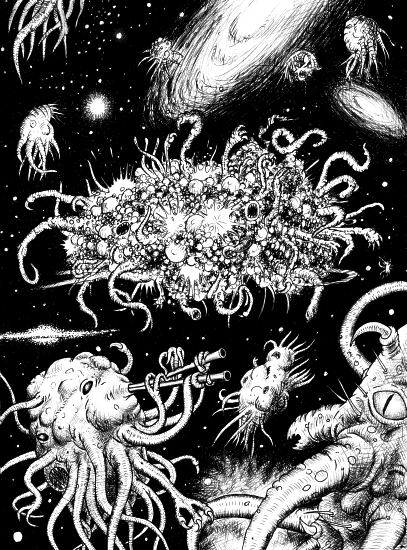
“The Weird of Hali” is a fantasy story, or rather weird tale, in seven books by John Michael Greer. The concept is simple, yet fascinating: what if the monsters from H P Lovecraft´s horror stories (such as Great Cthulhu or the Crawling Chaos) turn out to be the *good* guys? To say that the novels are a wild ride would be to underestimate the case considerably! The last book in the series in particular, “Arkham”, does everything it can to out-weird the weird pulp fiction it´s freely based on. Not a moment goes by without the hero being chased by “negation teams” to the far corners of time, space and (perhaps) New England, encountering creatures you didn´t think existed even in the Old Solar System of Vintage Scy Fy. It´s fun – if you´re in on the joke. And yes, John Michael Greer actually lives in Providence, Rhode Island!

From a purely literary viewpoint, “The Weird of Hali” is very uneven. “Dreamlands” is the best book in the series. “Innsmouth”, “Chorazin” and “Arkham” are somewhere in the middle. “Kingsport”, “Providence” and “Red Hook” are more boring. Especially “Kingsport”. Still, you probably have to devour all seven volumes of this unpredictable saga if you really want to “get it”. One reason for the unevenness is that the author deliberately wants to create a contrast between the everyday life of the characters and their wild adventures in realms monstrous and squamous. Thus, we have to read detailed and frankly boring exchanges over dinner tables between the main protagonistas, with the author describing, again in some detail, what they were eating. Indeed, the food in the Hali in-universe seems to be delicious even in the midst of a great depression and near-apocalyptic ecological crisis! Is Greer secretly a gourmand? The characters have surprisingly normal family and love lives, although some of them are co-habiting with human-monster hybrids! Every time some character does library research (and that´s often), the action is stalled in favor of long laundry lists of usually imaginary books and documents turned up in the dusty corners of some university archive. (I did this kind of research myself when I was younger – of course, I wasn´t attacked by a squamous snake-man afterwards. Also, I usually did it on an empty stomach.)

And now for the positives...

Lovecraft was notorious for his conservative and racist values, something turned on its head in the Hali universe. Many characters on the good side are Black, female, mixed race or immigrant. The human-monster half-breeds of Lovecraft´s stories turn out to be very sympathetic, even somewhat sexy. The cannibalistic Tcho-Tchos are actually a pro-American hill tribe from Laos with perfectly normal feeding habits (their culinary interests are described in some detail). The race of the humans working for the evil Radiance is never explicitly described (I think), suggesting that they are White. Another notable feature is that many of the humans working on the good side are typical outsiders. The story features an asexual witch, a flamboyant homosexual suspended in the Dreamlands, a teenager with Asperger´s syndrome, a man who looks like a sasquatch due to a genetic disorder, and so on. Some of them are nicer versions of characters from Lovecraft´s stories. In the original Lovecraft universe, deviancy was a sure sign of degeneracy, and presumably of sheer evil as well. In Greer´s version, the story is borderline “identity politics”, which is funny, since I happen to know that the author is somewhat skeptical of such things IRL.

The main point of “The Weird of Hali” is, as already mentioned, that the Great Old Ones from Lovecraft´s fiction aren´t really evil. They are simply pagan gods. The dark cults worshipping the Eldritch are not the abominations described by the Providence horror writer, but simply latter day pagans doing what pagans have always done: soothsaying, cartomancy, ritual magic, meditation, idol worship, and so on. The sacrifices offered to Great Cthulhu turn out to be pretty innocuous, such as sea shells! The real evil comes from the Radiance, a “scientific” brotherhood with roots in ancient Babylonia. Exoterically, the Radiance believes in science, enlightenment, rationalism and the need for humans to conquer nature. Esoterically, however, the organization knows that the Great Old Ones exist and seeks to tap their magical powers to further its real goal: the enslavement of all humanity under one robotic hive-mind. In “Arkham”, we learn that the rabbit hole goes even deeper. Just like NICE in C S Lewis´ “That Hideous Strength”, the Babylonian Siblinghood turns out to be controlled by demonic entities and thus very far removed from the “rationalism” it espouses through its public front groups. The Radiance has been taken over by the Mi-Go, a race of fungous crabs from a planet beyond Pluto who is evil in both Lovecraft´s original stories and in Greer´s alternative versions. The goal of the Mi-Go is to harvest human brains for unknown but presumably ulterior purposes…

However, it´s also obvious at several points in the story that the Great Old Ones aren´t “good” in the simplistic “Christian” or secular senses of that term. Nor are they “gods” in any ontological sense. Rather, the Old Ones are powerful cosmic beings as far removed from humans on the evolutionary ladder as humans are from, say, rodents or amphibians. The Old Ones consider Earth their home, and are usually utterly indifferent to the strivings of humanity. Indeed, some of them can´t stand us and might even be dangerous if disturbed. However, many Old Ones can be contacted by humans through appropriate means and then bestow boons on individuals or entire communities. In this sense, and this sense only, are they “gods”. Nor are the Old Ones perfect. One of the plot twists of “The Weird of Hali” is that Great Cthulhu has a conflict with The King in Yellow, a conflict with terrible consequences for the Earth and for the human race. Only by healing this 65 million year old quarrel can balance be restored. It´s also interesting to note that once the Old Ones take possession of Earth, nothing much happens to the planet itself, except that large portions revert to wilderness. The pagan gods aren´t interested in helping humanity create a utopia or a millennium, indeed, humans have to live with the consequences of their environmental destruction in the form of leaking nuclear power plants, flooded and abandoned cities, a sharply reduced population, and so on. (This theme is a constant in both Greer´s “occult” fiction and “secular” non-fiction. About 10 years ago, the author was very active on the peak oil scene.)

Still, if you take this author literally, there seems to be enough to do for 10 lifetimes even in this far corner of the indifferent universe. Earth is really “lesser Earth” and part of a wider world known as “greater Earth”. If you know how to access all its dimensions, you might find yourself in places as far-fetched as they are wonderful. I´m not sure if Greer really believes this, or if it´s just a literary device (or an allegory for the astral world – the author is a Druid Revivalist and Golden Dawn occultist). One really weird thing about these novels is that I found the fantastic and frankly crazy parts *easier* to believe in than the supposedly more realistic parts. As already mentioned, the characters have no trouble filling their stomachs or holding their little family reunions in the midst of a world-wide climate crisis, when widespread famine, rampant crime and the return of the bubonic plague would be more logical. *This* sounds more supernatural than all the fantasy action! Lovecraft being reincarnated as a particularly nice tomcat? A meeting with a resurrected Merlin in the Pine Barrens complete with a flight on the back of a Jersey Devil? A journey two billion years into the future, when the last intelligent species on Earth turn out to be enormous spiders living in underground caverns? Anubis driving a Batmobile around the New England countryside? Been there, seen that, done that…

I mean this quite un-ironically. I didn´t expect the weird tale aspect to be the *least* weird in this magnum opus!

Apparently, John Michael Greer has also published a spin-off to “The Weird of Hali” in two volumes (with a third waiting in the wings, or is it caverns). The spin-off follows a female would-be composer as she is contacted by musical shoggoths! Since Greer is a Freemason, may I venture a guess that said shoggothi love Mozart? Stay tuned (pun intended) for further weird tales with a hidden message…

Saturday, September 22, 2018

I remember Lemuria


“Eden in the East” is a 500+ pages tour de force by British author Stephen Oppenheimer, a former doctor who used to work in Southeast Asia and New Guinea, immersing himself in the local cultures. In his book, Oppenheimer proposes that some of the roots of “Western”, Indian and Chinese civilization are Southeast Asian in origin. He postulates the existence of a relatively advanced founder culture in Sundaland, an ancient landmass connecting the Malay Peninsula, Sumatra, Borneo and Java. Sundaland was flooded at the end of the last Ice Age.

Oppenheimer believes that the ancestors of modern Austronesians and Austro-Asiatics lived in Sundaland (most archeologists place the origins of Austronesians in China). The survivors of the catastrophic floods migrated to present-day Indonesia, the Philippines, parts of New Guinea and the Pacific Islands, but also to Southeast Asia and India. They influenced the budding high cultures in India, Tibet, Sumeria and Egypt through their long-distance trading networks. Indirectly, they also influenced the Uralic peoples, whose languages are distantly related to Asiatic ones. Oppenheimer's scenario entails that most of Southeast Asian and Pacific history/archaeology has to be backdated thousands of years, including the Polynesian expansion, and he spends considerable time attempting to prove his point. In general, Oppenheimer holds that Southeast Asia was more advanced during the Neolithic and the Bronze Age than traditionally assumed, and that these cultures were connected to other high cultures in southern China and Japan (Jomon).

To Oppenheimer, the Deluge legends are about an actual historical event (or events), the previously mentioned floods at the end of the last Ice Age, which affected the whole world. Even more controversially, the author argues that the Biblical narratives of creation and Eden are ultimately derived from Southeast Asian myths, and so are the well-known legends of “world trees” and “the dying and rising gods”. Cain and Abel is also originally a Southeast Asian story. The author doesn't believe that Christian missionary influence can account for all the similarities – some legends were written down by baffled Westerners (including missionaries!) before Christian influence became pervasive. Many of the “Western” legends are most diverse at the Moluccas in Indonesia, suggesting they originated there.

It's interesting to note that the Sumerians had a peculiar legend about “amphibious” culture-heroes who came by sea from the East. Could they have been Austronesian sea-fearers from the lost Sundaland culture? Both Eden and Nod were said to be in the east. In India, there are legends about an ancestral homeland in the east. By contrast, Polynesians have legends about an ancestral homeland in the West, which is no longer accessible to mortals! At the Tonga islands, the homeland is said to be in the northwest specifically. All these geographical references point to Sundaland, east of India (and Mesopotamia) but west or northwest of the Pacific Islands. Apparently, Tongans also believed in a large landmass further east of their islands. America?

To students of occultism, the concept of Sundaland should sound familiar. Yes, it's Lemuria or Mu! Oppenheimer does have a soft spot for “forbidden knowledge”, referencing Graham Hancock, Charles Hapgood and Immanuel Velikovsky. He probably stands in the proud alternative tradition of neo-catastrophism. However, his arguments are not based on occult or alternative sources. Instead, the author tries to argue scientifically on the basis of archaeology, linguistics, genetics and comparative mythology. I admit that I only skimmed most chapters – they are filled with incredible amounts of detailed information! Ironically, this large door-stopper of a book nevertheless feels only half-done. Among subjects *not* touched upon are: the mysterious culture of Easter Island, possible connections between East Asia/Polynesia and America during the Bronze Age, the origin of the Dravidian and Sumerian peoples, and the exact relation between Indo-European mythology (which also includes the World Tree) and that of Southeast Asia. Nor does the author say much about “Lemurian” influence on China. He also seems to have problems with Atlantis, regarding it as a peculiarly erroneous myth, since the real founder culture was in the East. The Atlantis story, of course, places it in the West! But why should this be a problem? Many landmasses were flooded after the Ice Age…

Oppenheimer is mildly uncomfortable with some aspects of the rich mythology he has unearthed. In New Guinea and Tonga, the aliens from across the sea are often depicted as light-skinned, while the natives are dark-skinned. To the author, this suggests relative differences in skin tone, Austronesians being less dark than Papuans (presumably, the Austronesian Tongans were pitted against even less dark Austronesians from a later migration). Even so, it's certainly weird that a negative view of Black skin existed already during this early period! The author believes that the sea-farers from Sundaland were pitted against Austroloids and Negritos in New Guinea, the Malay Peninsula and perhaps India. The identification between fairer skin and higher status was later applied to the White Europeans, for instance in cargo cults.

I was surprised by “Eden in the East”. Oppenheimer may not be a “real” scholar, and he has a tendency to take an idea and run with it, but his ideas certainly deserve a hearing. The book may be “fringe”, but it's not crazy, conspiracist or unduly fanatic. After reading it, I'm convinced that “Lemuria” actually existed, although I can't vouch for every concrete detail in this voluminous work.
Even so, four stars!