L. Ron
Hubbard's "Scientology: A history of man" is just as rambling,
incoherent and frankly bizarre as promised. Promised, that is, by the opponents
of Scientology, the controversial new religion founded by Hubbard and often
regarded as a cult. Scientologists themselves actually believe in this stuff,
claimed by the author to be "a cold-blooded and factual account of your
last 76 trillion years". Weirdly, this screed is publicly available, in
contrast to the notorious material on Xenu, which is kept under wraps despite
sounding much more logical! But then, perhaps it's pointless to understand the
genial mind of Lafayette Ron Hubbard?
"Scientology: A history of man" isn't really directed at the general
public, which makes it even harder to understand why the author decided to have
it published and publicly circulated. Rather, it's a book directed at
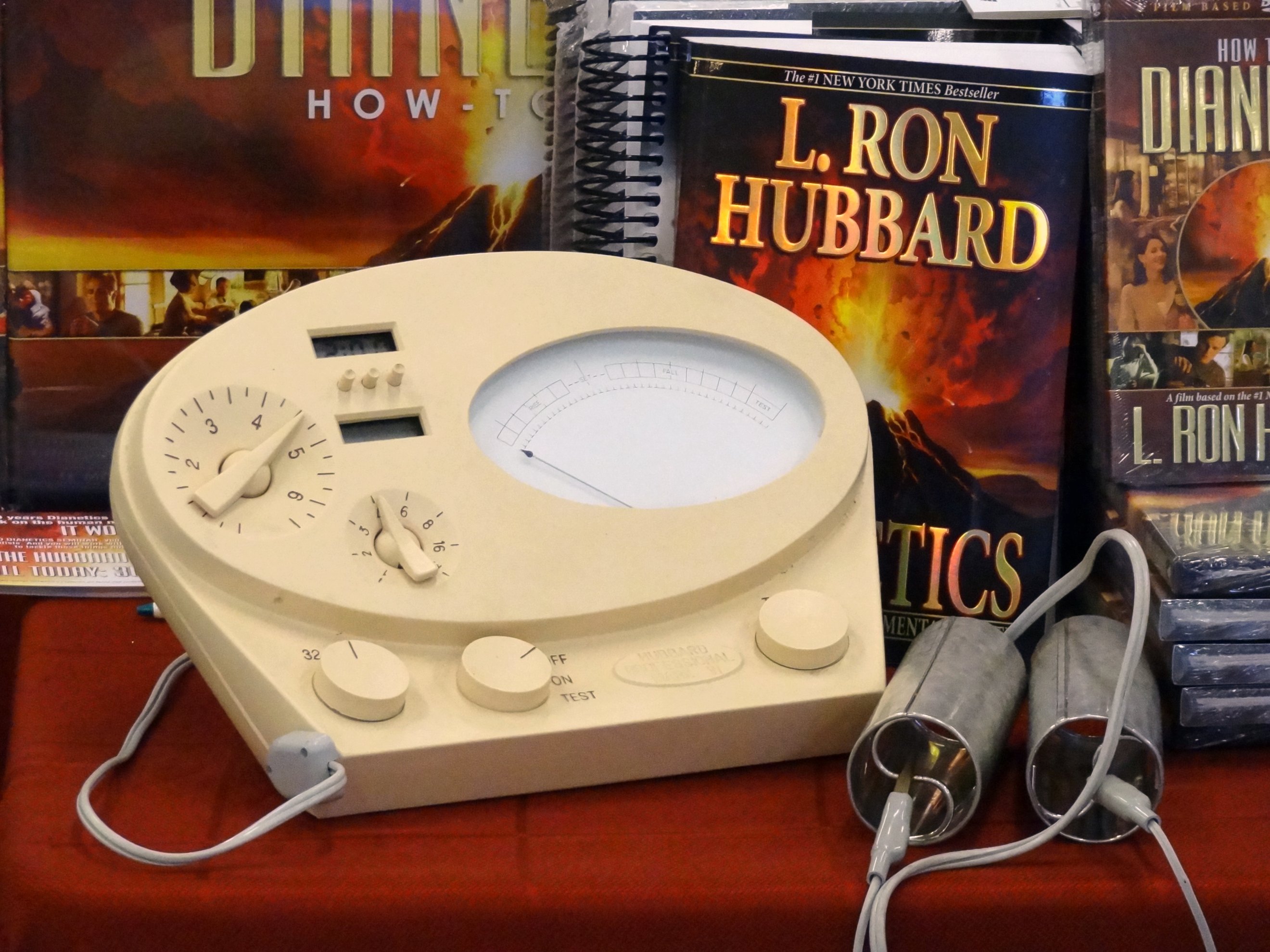
Scientology "auditors", who supposedly have the ability to
"clear" people of their "engrams" with the help of an
"E-meter". The in-house character of the book makes it difficult to
read, due to the large number of neologisms (not always explained in the
glossary) and Hubbard's rambling, occasionally frivolous, style.
My impression is that those subjected to the "E-meter" are somehow
hypnotized, and start to relive their previous lives, including lives on other
planets. In "Dianetics", Hubbard sounds sceptical to people who get
out-of-body experiences or see previous lives while being "audited",
but he clearly changed his mind later on. Indeed, in this book he says that the
"engrams" are more easily destroyed if they are sought out in
previous existences, rather than in this life. Essentially, Hubbard discovered
(or re-discovered?) past-life regression therapy. It's a pity he didn't use it
for more benign ends...
Since Hubbard's book is so "out there", reviewing it aint easy, but
I'm going to give it my best shot. Scholars of religion consider Scientology to
be a modern version of Gnosticism, which seems about right, at least with the
added proviso that we're dealing with a badly distorted version.
There's a dualism between spirit and matter in Hubbard's system, with spirit
being good and matter being (mostly) bad. There doesn't seem to be any personal
god. The physical or material universe is called MEST. Human souls are called
"thetans" or "theta beings". Their ultimate origin is not
spelled out in this particular book, but they seem to have a past in distant
star systems. About 30,000 years ago, the thetans incarnated in primitive human
beings on our planet, turning them into...us. The primitive humans taken over
by the thetans are products of a protracted evolution, which seems panpsychist
in character. This evolutionary process has given rise to something Hubbard
calls the GE or Genetic Entity. This seems to be a kind of subconscious mind,
which reincarnates in rough evolutionary sequence: from micro-organisms to
plants to invertebrates to mammals, ending with cavemen. Each human is
therefore a composite being, consisting of both thetan and GE, with the thetan
being the "real I".
Unfortunately, both the GE and the thetan have been badly battered during their
respective sojourns in MEST. Many human fears and ailments are the result of
the GE having various negative experiences when being a Clam, a Sloth, Piltdown
Man or Caveman (to mention just a few of its incarnations). This part of
Hubbard's book makes for some really entertaining reading! Only space
limitations and Scientology copyright stops me from quoting Hubbard's statements
about the Sloth, Piltdown Man or the Grim Weeper (a.k.a. Boohoo). The thetan is
also something of a crippled veteran. It seems that thetans and MEST beings
(i.e. thetans trapped in physical bodies) wage constant wars against each
other. Thetans also fight other thetans. One of the purposes of Scientology is
to rid humans of the negative psychological imprints haunting the thetans and
the GE. This is done by the previously mentioned "auditing"
procedure.
It's unclear whether the thetans incarnated on our planet voluntarily, or
whether they were forced. Several chapters of the book imply the latter
alternative. Indeed, the worldview of Hubbard occasionally sounds quite
paranoid. Evil beings of unknown provenance are trapping thetans, injecting
them with artificial implants ("Injected Entities" or "demon
circuits") with a quasi-consciousness all their own. Hubbard claims that
all humans have been processed in this manner. The whole thing sounds like a
high-tech version of demon possession. There are entire civilizations whose
rulers control thetans with powerful electromagnetic weapons, turning them into
mindless slaves. Thetans constantly try to steal memories
("facsimiles") from each other. Evil physical beings trap them by
throwing them small boxes containing pictures of small boxes (you heard me).
Thetans like having sex by possessing humans in the dead of night, etc. The
entire MEST seems filled with "trapping stations" to lure thetans
into the material world. New Age fluffiness obviously wasn't Hubbard's thing:
thetans who believe they have a purpose for being on Earth, are simply tricked
and deluded by evil beings. It also seems that thetans can "die", not
literally, but they can be rendered more or less unconscious and hence start to
decay.
Occasionally, the author gets rather nasty. Thus, Hubbard claims that
Scientologists can intentionally harm people by asking them the following
question: "Can you imagine a clam sitting on the beach, opening and
closing its shell very rapidly?" while making a motion with the thumb and
forefinger of a rapid opening and closing. This re-stimulates the GE's memory
of being the Clam, giving the victim a severe toothache, and perhaps even
forces them to pull out some teeth. Hubbard recommends that this method (really
a form of black magic) be used on sceptics who question the veracity of
Scientology! At another point, Hubbard claims that "auditing" might
occasionally be so powerful that the person audited will die?!
Still, it's difficult to take "A history of man" seriously, due to
its many bizarre statements about...well, pretty much everything. I suppose the
later legend about Xenu is supposed to be a more worked-out version of themes
only hinted at in the earlier books. Hubbard, after all, claimed to be a kind
of scientific explorer. He didn't present the message of Scientology all at
once, as special revelation. Rather, he seems to have developed it over a
longer period, during which he came progressively closer to the truth. Or so he
claimed.
I don't believe a word of it, but had I done so, I would have been tempted to
explain Hubbard's explorations as astral travel in some really low,
demon-haunted realm. He, rather than the "thetans", is the real
victim of trickery carried out by evil beings. Or at least highly aberrated
ones.
This is indeed modern Gnosticism. Or perhaps Gnosticism on speed...