It seems "Unidentified Submerged Obejcts" or USOs aren´t as fringe as I assumed. Yes, it´s Richard Nolan again.
Who´s really in control of our oceans, anyway?
It seems "Unidentified Submerged Obejcts" or USOs aren´t as fringe as I assumed. Yes, it´s Richard Nolan again.
Who´s really in control of our oceans, anyway?

Donald Trump is angry at various European nations for not supporting the ongoing military strikes against the Iranian regime. Or not supporting them hard enough. Or something. Or something else.
That the Spanish left-wing government refuses to support Trump is perhaps unsurprising, but even the UK (which is usually subservient to the US even under Labour governments) has tried to wiggle themselves out of the situation.
OK, let´s see...
It´s virtually an official policy of the Trump admin to split the European Union. Trump threatened military action against Denmark (a NATO member-nation) over Greenland. He has imposed tariffs on the EU and its member-nations. He is also trying to appease Russia in Ukraine.
So why exactly should the EU (or the pro-EU government of the UK) support him now? Maybe European alliances also has "interests", rather than "friends", you know. Oh, and as I pointed out in some previous blog post, it´s not as if the European panhandle is unimportant to the "nationalist" United States. Trump apparently needs military bases in Spain and on Cyprus to bomb targets in Iran. Wow, who knew. It´s almost as if a de facto global power needs allies globally or something...
Europe (perhaps minus France?) would probably have supported the strikes against the Iranian regime if the United States had a Democrat or Neo-Con president. Maybe they will, eventually. But as of now, it looks as if Trump may actually be more adventurist than George W Bush!

Hade en väldigt märklig dröm. Den gick ut på att det avslöjades att Grekland vid upprepade tillfällen riggat Eurovision Song Contest. Jag satt på ett tåg när nyheten kom, och ett antal överförfriskade svenska fotbollsfans som satt i kupén bredvid blev oerhört glada när de fick höra den, och bestämde sig för att "informera" resten av tåget i sitt överförfriskade tillstånd.
Fick intrycket att det hela var en slags "profetia" om framtiden. Grekland har ju inte vunnit sedan 2005. Så om "profetian" stämmer kommer grekerna att vinna ESC vid upprepade tillfällen inom en nära framtid...och sedan visar det sig att de alltså fuskade hela tiden!
:D
Har ingen aning om varför jag drömde detta just nu, men det undermedvetna är ju konstigt. Drömmen kanske syftar på att Grekland och Cypern ständigt kompisröstar på varandra. Vilket jag ibland skämtsamt påpekar i diverse sammanhang. Fast det vore ju kul om "profetian" visar sig stämma...
Den kanske kommer från en trojansk gud?
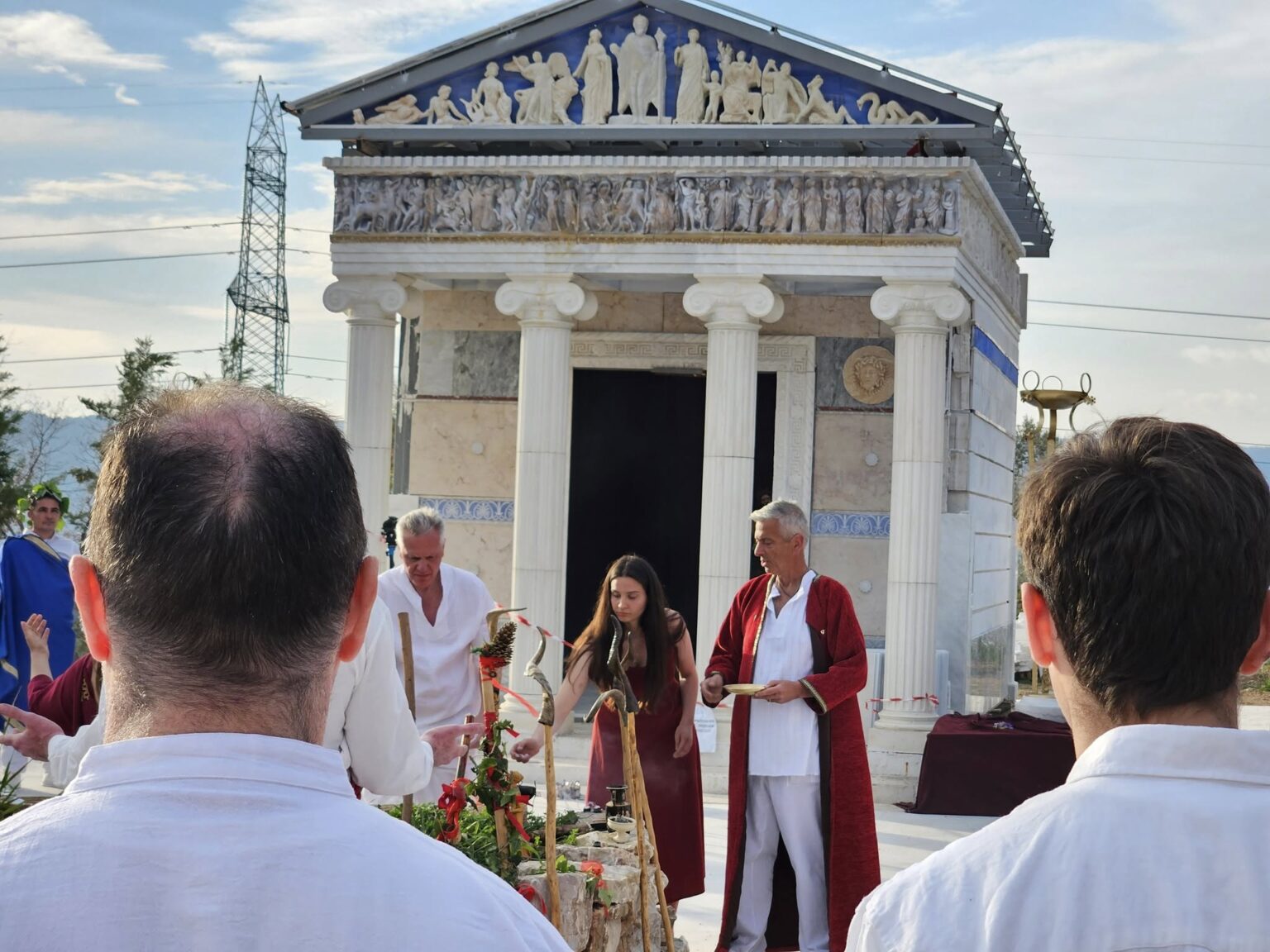 |
| Credit: Stato Magna Grecia - Due Sicilie |
It seems Pan and Zeus aren´t dead, after all. A group of Hellenic Neo-Pagans have built their own temple in Arcadia, Greece. The Greek Orthodox Church and the government authorities aren´t amused. Which is...kind of absurd. But I suppose nobody becomes a prophet in his homeland, right? Maybe Schwärmerei for all things Hellenic (as in pre-Christian Greek) is mostly a non-Greek phenomenon...
 |
| - Yuletide, bro? What on earth is yuletide?! |
Some slightly unedited reflections on the pagan nature of Christmas…
On one level, the question is academic, since virtually all “really
existing” Christmas traditions in the modern Western world seem to be Christian
or secularized, and many regardless of nominal provenance were invented by
enterprising retailers or wholesalers. Some during my lifetime! That being
said, it´s hard not to believe that there is a connection between the Christian
idea that Jesus was born on December 25 (not found in the Bible) and earlier
pagan conceptions.
December 25 was the original date of the winter solstice in the Julian
calendar, adopted in Rome on January 1, 45 BC by order of Julius Caesar
himself. In other words, before Christianity even existed. Later, the winter solstice
became associated with the imperial solar deity Sol Invictus, probably first
worshipped by Emperor Aurelian during the 3rd century AD. Constantine
the Great originally promoted both Christianity and the cult of Sol Invictus,
presumably for reasons of politic, but dropped the solar cult after the Council
of Nicaea. The supposedly super-Christian emperor Theodosius the Great used
pagan imagery (Hercules) to justify his rule, and modeled himself on Trajan showing
that Christian-pagan “syncretism” was a thing. It´s interesting to note that
Macrobius claimed that Sol Invictus was depicted as a small child at the winter
solstice (compare baby Jesus). While Macrobius is a late source (5th
century AD), Plutarch (1st century AD and hence not influenced by
Christianity) said that Harpocrates was born on the winter solstice. This is
the Hellenistic form of the Egyptian god Horus, son of Isis and Osiris. Note
the iconographic similarity between Mary holding baby Jesus and Isis holding
Horus.
Oh, and then there´s the similarities between the Saturnalia and later
Christmas traditions, including the Feast of Fools and the Lord of Misrule. Indeed,
Christmas was long associated with folkish revelry rather than Christian
solemnity (except, I suppose, in church). It´s not a co-incidence that that the
17th century Puritans in both England and New England tried to ban
many customs associated with Christmas!
So why is it far fetched to think that the Christian Church consciously “captured”
December 25 as the birthday of Jesus in order to compete with the pagans? The
alternative “calculation hypothesis” says that the Christians arrived at the
date of December 25 by simply calculating nine months from March 25 (the Roman
date of the spring equinox) since Jesus was believed to have been conceived by
the Holy Ghost on that day. An alternative calculation from April 6 gave January
6 as the date of Christ´s birth instead, long celebrated in the eastern half of
the Roman Empire (today, January 6 is the Christian holiday of Epiphany). However,
it turns out that this seemingly random date is *also* associated with paganism,
making it highly unlikely that the Christians chose it by chance.
Let´s begin with Epiphanius, the somewhat notorious 4th
century AD Christian bishop and heresy-hunter extraordinaire. In his “Panarion”,
Epiphanius claims that Jesus was born on January 6 and that the pagans therefore
celebrate their mystery rites on that date to deceive the faithful. Christian
apologists rather naively assume that Epiphanius is of course telling the truth,
and that the pagans were indeed mimicking the Christian traditions. But we will
see later that this is highly unlikely. First, a short summary of what the
Cypriot bishop writes. At January 6, the pagans in Alexandria celebrate the virgin
birth of Aion from Kore (which, of course, means “The Virgin” or “The Maiden”).
On the same date, the pagans in Petra celebrate of the virgin birth of one Dusares
from Kore. Also, there is a similar celebration in Elusa (presumably the town
in Palestine), but it´s not described by the bishop.
According to pre-Christian Greek sources, Persephone is the mother of
Dionysus Zagreus, who is dismembered by the Titans and then brought to life. Persephone
and Kore is the same goddess, but in this particular myth, Dionysus isn´t born
of a virgin. Rather, Persephone is impregnated by Zeus. The Greeks and Romans
often identified Dionysus with Osiris, another god who was dismembered and
brought back to life. Aion – the miraculous son of Kore in Epiphanius´ account –
was a syncretic deity identified with Dionysus and Osiris! Dusares was
sometimes also associated with Dionysus. Thus, everything points to Dionysus. Could
January 6 somehow have been associated with the god of wine? Indeed, this seems
to be the case.
Pliny the Elder (1st century AD) and Pausanias (2nd
century AD) – both men highly unlikely to have been influenced by Christianity – mention a Dionysiac festival on January 6, known as Theodosia, during
which the water at a holy spring at the island of Andros was turned into wine.
The ability of Dionysus to turn water into wine is of course well attested from
other sources, too. Seneca (1st century AD) associates Dionysus with
a wedding feast. Finally, Dionysus was worshipped in Scythopolis in Palestine,
indeed, the local pagans claimed this was the god´s birthplace. And in the
Gospel of John, Jesus turns water into wine at a wedding at Cana, which is close
to Scythopolis…
It seems difficult to deny that the author of the gospel modelled this
somewhat peculiar miracle of Jesus on Dionysiac traditions. Epiphanius gives
the whole game away when he states that Jesus performed the miracle of turning
water into wine on the same date as his birth – that is, January 6 *which is
also the birthday of Dionysus according to the same author*. Epiphanius also writes
that on January 6, the water in many streams and rivers turn into wine as evidence
of Christ´s miracle at Cana. He mentions the Nile, Cibyre in Caria and Gerasa
in Arabia. *But this is exactly what Pliny and Pausanias claims happened on
January 6 on Andros at the Dionysiac festival of Theodosia*.
It´s therefore obvious what´s going on here. Both December 25 and January
6 were days honoring pagan gods, and both were claimed by the Christian Church after
Christianity had become the state religion of the Roman Empire. At some point, December
25 was fixed as the birthday of Jesus, while January 6 became Epiphany, still
in a sense associated with the Christ´s birth. In the Western Church, Epiphany celebrates the Magi and their adoration of the infant Jesus, while in the
Eastern Church, it celebrates the baptism of Jesus (a symbolic “birth”).
So it seems Christmas is “pagan”, after all. At least after a fashion!

I just finished reading "Turkiets historia" (The History of Turkey) by Ingmar Karlsson. Although the author is a former Swedish diplomat, the book is mostly a popularized account of Ottoman and modern Turkish history, rather than a sensational tell-it-all about Mideast conspiracies. The book was published in 2015, and therefore doesn´t mention the 2016 coup attempt against Erdogan. If the book has a political tendency, it´s "pro-European" and argues that "Turkey is part of Europe". This is ironic, since anyone reading it would surely draw the opposite conclusion: that Ottoman, Turkic or Turkish civilization, whatever else it might be, is very definitely *not* European, but another planet entirely. Karlsson tries to blame France and Germany (and perhaps Cyprus) for the failure of EU to integrate a very willing and pro-EU Turkey, but its obvious from his account that most Turks always opposed secular Kemalism and prefer conservative Islam combined with Turkish nationalism. While Kemal Atatürk, the father of modern Turkey, was indeed very positive towards the latter, he actively opposed the former. The entire history of modern Turkey is really the history of the religious elites and "the silent majority" to break away from all or most of Kemalism´s six founding principles. Erdogan and the AKP are simply the latest example, and the most succesful. Yes, Erdogan used to be pro-EU, but in hindsight, his hybrid of Islamism, Turkish nationalism and "Neo-Ottoman" foreign policy ambitions sound much more politically logical than a Turkey modernized around Northwest European lines (let alone "woke" ones).
Karlsson´s book starts out with several chapters on Ottoman history, unfortunately rather distracted ones, as he jumps back and forth in the chronology, never mentions the Bektashi order, says very little about the slave trade, and at one point writes "Russian" when he really means "Ottoman". He also resurrects Bayezid after his captivity and death at the hands of Timur Lenk! Still, the chapters *are* interesting, especially if you think "Islam" and "Christianity" are necessarily in conflict with each other. Realpolitik (and, shall we say, Real-commerce) frequently trumps both the jihad and the crusading spirit. Both Venetians and the Genoese frequently aided various Ottoman factions in their power struggles. France had an outright military alliance with the Ottoman Empire against the Habsburgs. One of the reasons why the Protestant Reformation succeeded may have been Ottoman pressure on the Habsburg domains in Central Europe, which forced the Catholic emperors to compromise with the Protestant princes. For a long time, Orthodox Christians (outside Russia) preferred the Muslim crescent to the Catholic crusaders. So did the Jews! And yes, our very own warrior-king extraordinaire, Karl XII, tried to ally Sweden with the Porte against Russia.
It´s interesting to note that the conflict between modernizers and traditionalists existed already during Ottoman times, in earnest from the 19th century, but to some extent already during the 15th century. The famous portrait of Mehmed Fatih, the conqueror of Constantinople, was made by an Italian and sold by Mehmed´s successor Bayezid II, who regarded portrait painting as anti-Muslim. That´s how the portrait eventually ended up in the United Kingdom! Another thing that seems to be "same old, same old" is the idea of an imperialist "humanitarian intervention". This wasn´t something invented during the 1990´s (which many leftists seem to think). As early as 1827, the great powers intervened (with the best of intentions, obviously) to aid the Greeks against the Ottomans. Next in line was an intervention to aid the Bulgarians. Karlsson points out that nobody cared much about the Turks ethnically cleansed from the Balkans due to these great power interventions. (Of course, an alternative interpretation - equally unpalatable to modern wokesters - is that *Russia* was the great liberator of the Balkan peoples from the sick man at the Bosphorus.)
While Karlsson (of course) opposes the Armenian Genocide, he also makes a valiant (and perhaps slightly controversial) attempt to place it in context. Armenians were a minority in "Ottoman Armenia", and actively supported the Russians during World War I, while the Ottoman Empire fought on the German side. Karlsson also notes that the Kurds actively supported the Turks in the attacks on the Armenians. Later, the Kurds themselves would be oppressed by the new Turkish regime. Thanks to Kemal Atatürk´s military campaigns, Turkey was the only losing power in World War I that succesfully challenged the diktats of the victorious Entente, which in the Turkish case would have meant near-dismemberment. I can´t help thinking that Karlsson might have *some* kind of pro-Turkish sympathies! His description of the Cyprus conflict is also very "objective".
As for modern Turkey, I have already commented on the Kemalist-Islamist conflicts. It´s interesting to note that Erdogan and other Islamist politicians in Turkey tend to be economically neo-liberal, not left-of-center, while in practice combining neo-liberalism with a kind of crony capitalism. Either way, the Islamists seem to be based on a seemingly unnatural alliance of a neo-liberal bourgeoisie and a vast plebs of religiously conservative peasants or underemployed ex-peasants in the large cities. I´m not entirely sure how this alliance can hold together - Karlsson seems to suggest that the Sufi orders play an important role here as clientelistic networks aiding but also incorporating the poor in the Islamist project (Westerners with an over-romantic view of Sufis may take note here). Erdogan seems to be the Bonaparte or great leader of said project.
The role of the Gülen movement is unclear to me. They claim to stand for a kind of Muslim modernization and democratization of Turkey, and rather obviously seek Western support (Gülen lives in the United States), but how do we really know this? Gülen´s supporters were long allied with Erdogan and strongly oppose Kemalism. Are their modernizing stances just a form of taqyyia? Interestingly, they are strong Turkish nationalists and hence opposed to Kurdish independence.
Personally, I strongly favor secularism and Western modernization (thank you!), but Turkey seems to be another example of the fact that Occidental modernity really isn´t the teleological or otherwise inevitable end point of human political evolution, or even of capitalism. Islam grows stronger, the more capitalist and/or democratic Turkey becomes, not always as a counter-reaction but *in alliance* with the modern forces. Yet, this is not a "modernist Islam", but a conservative form married to a bourgeoisie and even elements of globalization! (In a different way, China is another example of "two, three, many modernities".) While Turkey isn´t "Europe", it is a bridge between East and West, but not in a way easily recognizable by people with a Western mindset. What should be done about this, if anything, is perhaps an interesting question. Above all, Turkey is simply Turkish...


