Showing posts with label Apodiformes. Show all posts

Sunday, January 5, 2025

It´s a niche thing


Overheard on the internets: "The next time you think speculative evolution is weird, remember that hummingbirds are a theropod dinosaur filling the ecological niche of a bee."

Bingo!

Reminds me of Huston Smith, who once opined that maybe the hummingbird is the divine archetype of a bird LARP-ing as a butterfly...

Saturday, February 19, 2022

Huston´s hummingbird


Huston Smith is a "soft" Traditionalist and perennialist who is mostly known for his book "The World´s Religions", a best seller in its day which was also widely used as a school textbook in the United States. "Forgotten Truth: The Common Vision of the World´s Religions" (first published in 1976) has been marketed as a sequel to "The World´s Religions" (at least in its 1992 incarnation), but is really nothing of the kind. Rather, it´s Huston Smith´s personal statement of belief. Nothing wrong with that, per se, but as a good perennialist, Smith of course claims that his take on Traditionalism is the hidden kernel of all religions. 

"Forgotten Truth" comes across as a peculiar combination of standard Trinitarian Christianity and Advaita Vedanta (or something close to it). Buddhism, Taoism, Islam, Platonism and Native American spirituality are also referenced. Without attribution, there are a few borrowings from Theosophy. It´s almost fascinating how seamlessly the author navigates the diverse religious landscape as if it were a unified whole. Of course, he also quotes various Traditionalist writers. The book contains an appendix with the very 1970´s title "The Psychedelic Evidence", discussing Stanislav Grof´s research into LSD as evidence for the objective reality of the soul and the spiritual realm. (It´s a public secret of sorts that Smith was a buddy of Aldous Huxley and probably "tripped" together with him.) Incidentally, this isn´t necessarily intended as criticism. While "Forgotten Truth" is hard to read, it´s also quite interesting...

Summarizing Huston Smith´s points is hard, but much of the book revolves around a criticism of modern science, scientism and something the author calls "prevolution" (progress + evolution). Smith is careful not to repudiate modernity in toto - he believes that the abolition of slavery is a good thing, for instance - but he clearly believes that the modern West have lost something very fundamental when it broke with "tradition" and embraced a fully materialist worldview. It´s time for us to "rejoin the rest of humanity". In the same vein, Smith is careful not to idealize premodern society (although he does have a soft spot for Muhammad and the Muslim empires, but also for Paleolithic hunters and gatherers). What he wants restored isn´t so much the social structures of premodernity, but the mystical religion and the idea that humanity is part of a much vaster cosmos than the physical one, a cosmos crowned by God and Infinity. That´s our true destiny.

In Smith´s theology, both the personal god of theism and the "impersonal" spirit of certain forms of Hinduism are equally real. The Infinite is higher than the personal god, but on his own level, God is equally real. One thing that surprised me when reading the book is Smith´s strong emphasis on bhakti and the love of a personal god, and also the idea that God reciprocates by loving the devotee. Indeed, all love ultimately comes from God, the devotee simply giving God´s love back to him. I had assumed that Smith was more into the Infinite end of things. However, the author believes that there isn´t any contradiction. The mystical unity with the Infinite Spirit necessarily goes through loving devotion of an anthropomorphic deity, since love breaks down the barrier between the lover and the beloved, and hence creates a "unity" already on this level. I assume this is the perspective of some Hindu schools, but I have never seen it spelled out this clearly before.

The weakest part of "Forgotten Truth" is Smith´s rejection of evolution, and he even predicts that most readers will find his musings on the topic downright crazy. Well, he´s right. This is where Smith writes that animals are incarnations of eternal archetypes which simply dropped down from heaven ready made, without any prior evolutionary development. The hummingbird is the Platonic form of a bird pretending to be a butterfly! Er, wut? Since Smith is an "old earth creationist", he is locked in the same contradiction as his evangelical Christian counterparts: why do the Platonic forms drop down from the deep blue sky in a rough evolutionary sequence? At one point, Smith dares to go further, suggesting that perhaps degeneration is present in the fossil series in the form of "prehuman" forms which are really "posthuman". This is probably taken from the Theosophical speculation that apes are degenerate humans, rather than evolutionary cousins of our ancestors. 

Smith freely admits that his non-belief in progress will be just as hard to accept for the modern reader as Gurdjieff´s statement that the Moon eats people. This may have been true in Space Age 1976 and even more in 1992 (when Fukuyama won the Cold War). Today, it´s the easiest part to believe! What´s harder is Brother Huston´s insistence that there is hope, a transcendetal hope to be sure, and that somehow our earthly sufferings will all prove to be a necessary part of a larger perfection...


Tuesday, September 18, 2018

Check out the checklist


Just when you thought the show was over…

“Handbook of the Birds of the World” (HBW) is a 17-volume encyclopedia describing all living species of birds. It seems the editors just can't part with this project, since supplemental works are still being published. This is the first volume of “Illustrated Checklist of the Birds of the World”, covering the non-passerines. A second volume, featuring the passerines, will be published later this year. Despite its name, the “checklist” isn't a traditional, boring, scientists-only textual mass of Latin names. Rather, it's a kind of super-summary of the 17-volume HBW, complete with species presentations (albeit shorter ones than in the original work), range maps and color illustrations. The main reason for rinsing and repeating everything one more time seems to be that it *isn't* a straightforward rehash.

The editors have apparently applied a new method for defining species, associated with Joseph Tobias, to the world's avifauna. Rather than looking at the DNA evidence, the new species concept is based on morphology and bird behavior (including bird song). This has led to substantial changes in the taxonomy. Among non-passerines, there have been 462 splits and only 30 lumps, presumably meaning that 432 new species have been added to the list, all of them described and illustrated in the Checklist. Say hello to the Snow Mountain Tiger Parrot, Butterfly Coquette and Lompobattang Fruit-dove! In an article on the web, the HBW-cum-Checklist editors forthrightly admit that the recognition of many new species has obvious consequences for conservation efforts, including larger amounts of grant money for the scientists involved in the conservation…

Another new feature of the Checklist is that it (finally) describes and illustrates (if at all possible) extinct birds, including the Great Auk and the Dodo. The total number of extant bird species covered in this first volume is 4,372 plus 99 extinct species. It will be interesting to see if Lynx Edicions manages to squeeze all passerines into a second volume as promised, or if yet another jumbo-sized book is waiting in the wings…

I'm not sure who would want to buy “The Illustrated Checklist of the Birds of the World”, but if you found the 17th (index) volume of the HBW incredibly boring, I suppose this could be just what you were looking for.

Five stars!

Thursday, September 6, 2018

Meet the hummers


"Hummingbirds: Magic in the Air" gets four stars for the quite spectacular footage of these small jewels of the avian world. Many of the hummingbirds featured are very, very strange!

My favourite is the species living high in the mountains, where the air is too thin for the bird to hover - which doesn't matter, since all flowers are within reach on the ground. Another classic is the hummingbird who nests close to hawks' nests, since hawks love to eat animals that prey on hummingbird nests. And how many people realize that swifts are evolutionary cousins of hummingbirds? The most spectacular part of the documentary shows the mating ritual of the rare spatuletail, endemic to a small region of Peru.

That being said, I nevertheless get the impression that this documentary is more about nerdy ornithologists doing research on hummingbirds, than about the birds themselves...

But sure, if "hummers" are your first love, this might just indulge you.

Monday, August 13, 2018

Not so ugly ducklings


A review of Lars Jonsson´s "Birds of Lake, River, Marsh and Field" 

This is the third volume in a five-volume series of field guides written and illustrated by Lars Jonsson. This volume covers typical birds found in or around lakes, rivers, marshlands and agricultural landscapes. The geographical range is Northern and Central Europe, north of the Alps but south of the "taiga". Ducks, shorebirds, grebes and rails are prominently featured, as are assorted passerines. We also get to meet the crane, the kingfisher and the swift.

Personally, I think that this series is rather idiosyncratic. Birds are not usually connected to a distinctive biotope, I mean they do fly! I'm pretty sure you can find a lot of birds around the average European lake not included in this slender little volume. Indeed, Jonsson later published a one-in-all volume called "Birds of Europe", covering the entire continent from Iceland to the Bosphorus.

However, as a work of art in its own right or a birthday gift to a bird-lover, even the third volume of the original series works just fine.
These ducklings sure aint ugly! Four stars.

Caprimulgiformes strikes again


The "Handbook of the Birds of the World" is a super-encylopedia spanning 16 volumes, published by Lynx Edicions and BirdLife International. It really does cover all living species of bird known to science. All 9,000 of them! Well, almost all. A supplemental volume with about 60 entirely new species will be published at some point next year.

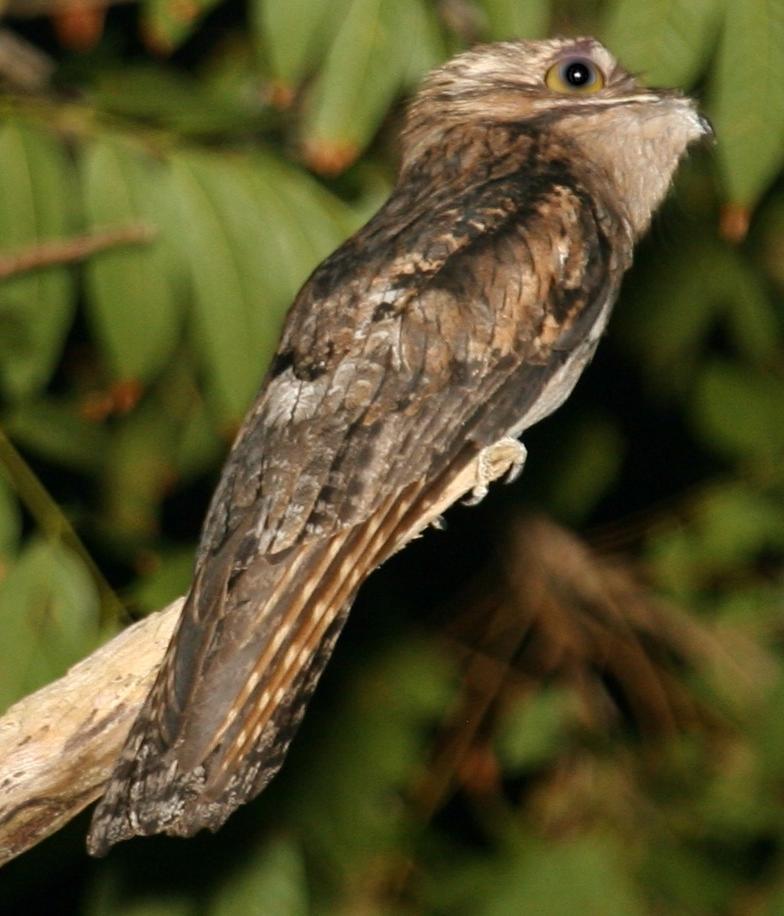
This is the fifth volume of the HBW. It describes three very different orders: the Owls (Strigiformes), the Nightjars and allies (Caprimulgiformes) and the Swifts, Tree-Swifts and Hummingbirds (Apodiformes). I always find it fascinating that the screeching, fast and even somewhat bizarre swifts outside my window are actually related to hummingbirds! But the most absurd birds in this volume are surely the Caprimulgiformes. It includes the Potoos, which are perfect mimics of tree stumps - a large color photo shows this strange ability (try to spot the bird in it!). Further, there are the strictly nocturnal Oilbirds, which communicate in bat-like manner through eco-location. Apparently, scientists who visit the caves where the Oilbirds live have to wear protective masks - the damp caves are a haven for a fungus that causes the lung disease known as histoplasmosis.

The text in the HBW is rather heavy and takes some time to get used to. These books, after all, are primarily intended for ornithologists (with or without protective gear). However, the large amounts of illustrations and color photos might appeal to a more general audience. Unfortunately, these books are extremely expensive, no doubt precisely because of the color (and colorful) photos.

I tend to give these books five stars hands down, and so is the case with volume 5.