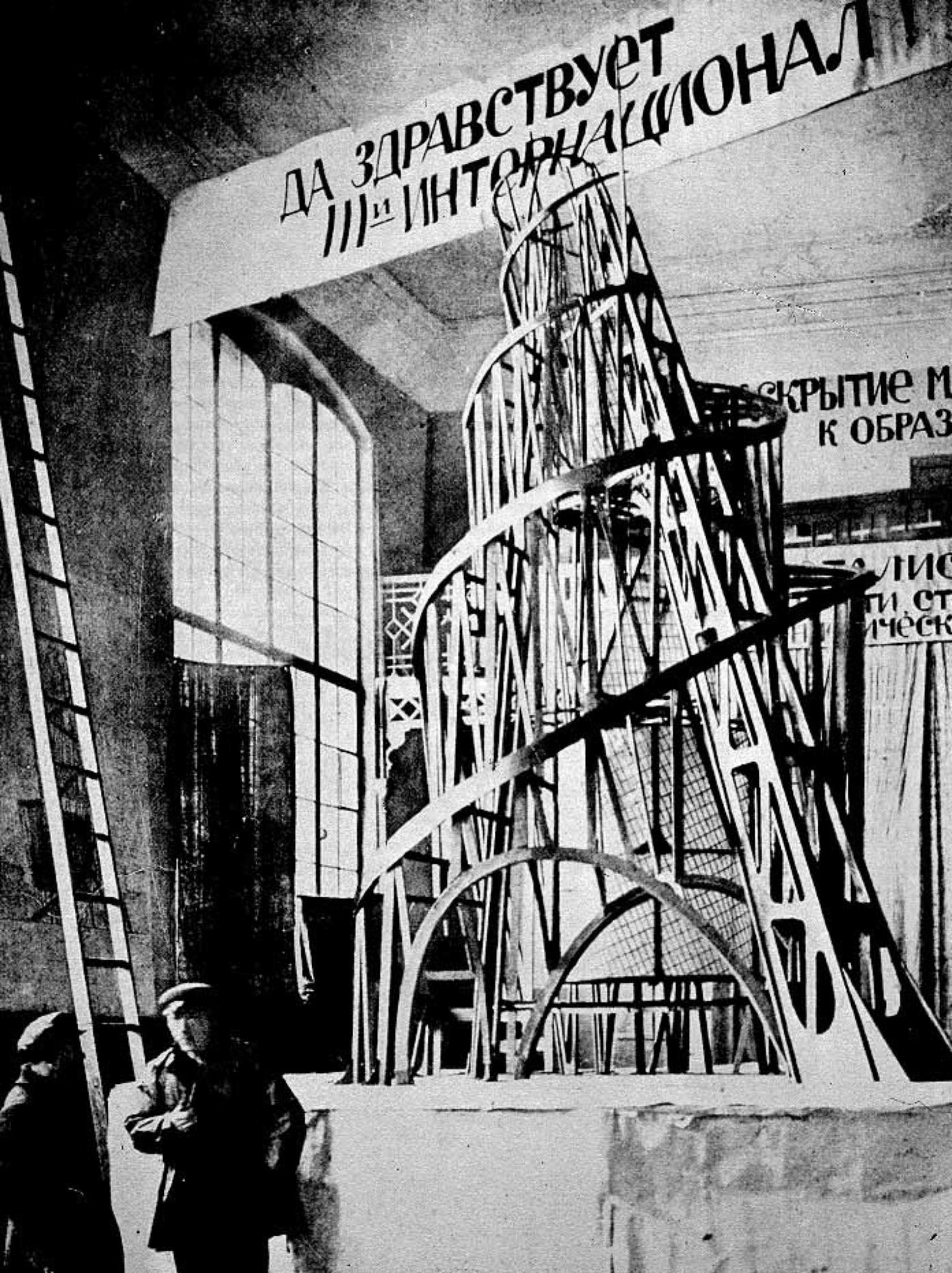
Showing posts with label Cosmism. Show all posts

Monday, December 15, 2025

Röd magi


Har ju intresserat mig för detta en längre tid. Och visst är det lite särpräglat att den marxistiska materialismen är teleologisk. Vilket ju implicerar en världssjäl. Och storhetsvansinnet hos en...Hegel.

Från Motpol:

Bolsjevismens ockulta rötter

Evigheter bland stjärnorna

Från denna blogg:

The real Bolsheviks?

The Other Russia

Russians who stare at goats

Cosmists, kooks and Anti-Christs

Thursday, September 4, 2025

Meet the new boss, just as crazy as the old one


So I suppose the Eurasian alliance between China, Russia, North Korea (!) and (perhaps) India is official now. It´s interesting to note that Putin claims that technology can make us immortal, while Xi says that humans can live until they are 150 years old?!

In other words, our new overlords are just as crazy (or crazier still) than the old ones. Maybe just as well. Historically, hubris always precedes fall... 

Sunday, March 9, 2025

Cyberpunk cult


I´ve been saying this for years. And you, I imagine. Trans-humanism, cyberpunk or whatever is the current designation, is a cult. Or at the very least a pseudo-religion which comes across as a Christian heresy or LARP. That it´s nominally atheist just shows that many atheists can´t take it and try to find a substitute for the Biblical god they left behind. Aliens, robots, AI or suitably enhanced humans, you name it. 

Nor is it a new thing. The video doesn´t trace its roots, but on this blog, we already covered Russian Cosmism - the probable progenitor of cyberpunk. Of course, nothing will come out of this (probably not even mass suicide), except some hype to boost the stock value of AI-related businesses...and then its off to the next apocalyptic illusion, whatever that might be.

So around 2050, we can finally say: Cyberpunx dead! 

Saturday, March 16, 2024

Interview with an atheist


A Swedish TV network just showed the near-classical "Interview with the Vampire" featuring Brad Pitt, Tom Cruise and Antonio Banderas.

It struck me that the life of the vampires are a pretty good metaphor for atheism-materialism. An everlasting life with no possibility for redemption and no other meaning than feeding and hedonism, exercised by preying on others.

But doesn´t everyone die in a atheist-materialist universe? Well, does the intellectually unfulfilled atheist really *want* to die? The popularity of transhumanism suggests otherwise. 

And then there´s this...

Enchanted Fruitbat  

Are you absolutely sure you *will* die? 


Thursday, March 14, 2024

Enchanted, Fruitbat


How Copilot Designer imagines
an enchanted fruitbat 


If you want to be black-pilled at 10:55 PM Swedish time... 

Enchanted Fruitbat

Cosmic Suicide


Saturday, October 9, 2021

Enchanted Fruitbat


Somebody unknown to me on Reddit, who calls himself Enchanted Fruitbat, posted the following, which I´ve excerpted, with apologies to said fruitbat!

"On long enough time scales (such as a googolplex years), entropy is less omnipotent than it first appears - thermal fluctuations permit arbitrarily large violations of the (purely statistical) second law of thermodynamics. In a naturalistic universe, with an infinite future, anything that possibly could happen almost surely eventually will, even the resurrection of the dead, repeated an infinite number of times, in every possible way, in an essentially arbitrary order.

I think an afterlife is almost inevitable either way. The only question is whether the universe ultimately makes sense (because God is in charge) or if it is an infinite absurdity. We must hope for the former, in which the afterlife is one of justice and mercy and truth and goodness and beauty, not for the later in which we are all damned to the never-ending hell of random chance resurrections."

"I wasn't actually talking about quantum mechanics, only classical statistical mechanics. You don't need quantum mechanics to get "given enough time, anything that can possibly happen almost surely eventually will" – Poincaré recurrence (of the universe) and Boltzmann brains don't depend on quantum theory. Quantum theory just adds more ways in which things could happen.

Is the spontaneous resurrection of the dead "possible"? Well, if humans are just matter which is arranged in a certain way – even a dynamical system of matter in which life and consciousness requires matter to be constantly changing in certain ways–why is a spontaneous return to the state of life, even in continuity with one's mental state immediately prior to death, impossible? Any arrangement of matter, no matter how exquisitely particular, could be revisited eventually given enough time.

I don't think this will actually happen–because God will not allow it, because humans are more than just arrangements of matter. But, if one were to believe that there is no God, and that humans are just matter, then yes I believe an afterlife is very likely – but unlike the Christian afterlife which is run by a good and just God, it will be an absurd hell governed by random chance alone. Atheists think they will slip away into sweet oblivion; but, if materialist atheism is true (and thank God it is false), our fate is not sweet oblivion, but an eternity of madness."

It´s on this link.

Should we strive for Universal Resurrection?


Friday, May 28, 2021

Knocking on the door of Progress


"Knocking on Heaven´s Door" is a 2011 BBC documentary narrated by George Carey. It deals with a very obscure topic (at least outside Russia), and yet I posted about it before. Yes, it´s time for another close encounter with Nikolai Fyodorovich Fyodorov and the Russian Cosmists! 

On YouTube, the documentary has been given the click-bait subtitle "The Bizarre Story of the Soviet Space Program". Some of it deals with the "official" space program and Yuri Gagarin, still considered a hero and a martyr in Russia. No surprise: Gagarin (not Buzz Aldrin or John Glenn) was the first man in space. Digging deeper, Carey discovers a strange underworld where science is de facto treated as a religion, religion becomes a science, and nobody really seems to get the difference (or even give a damn). This holism is, of course, typical of much Russian philosophy. 

The "prophet" of the space age turns out to be the 19th century excentric Fyodorov (often misspelled Fedorov in English), who lived like a "fool in Christ", yet preached a secular religion in which high technology would make humans immortal, including a resurrection of those already dead. Space exploration and conquest was part of this futuristic utopia. In the West, a man like Fyodorov would presumably be seen as a kook, but in Russia, people like Tolstoy and Dostoevsky saught him out, and some later scientists were inspired by the prophetic quality of his ideas. One of them was Konstantin Tsiolkovsky, Vladimir Vernadsky perhaps another. Still today, there are Cosmists in Russia. Carey meets both the more quasi-religious types (one of them even showing him a kind of pagan idol!) and the more scientific ones, including a group that investigates "remote viewing" and out-of-body experiences. The latter group seems well connected. 

What I find fascinating is precisely the seamless, careless manner in which these people jump across the (supposed) science-religion divide. Tsiolkovsky was a rocket scientist, but judging by George M Young´s book "The Russian Cosmists", he was also a kind of crypto-Theosophist, hiding his religious views behind a scientific-sounding language. But then, he may not have seen any contradiction. In the documentary, the parapsychology researchers comes across as a more fortrightly spiritual group, more interested in inner exploration than space conquest, but once again, they might not see any binary opposition between them. The spiritual dimension is, after all, simultaneously also a kind of space "out there". All matter is alive and communicates with itself, and humans are simply small particles trying to get integrated into a vast spiritual-cosmic matrix. I admit that this more "Hindu" perspective is more sympathetic than Fyodorov´s bizarre ideas about a high tech resurrection (the Cosmists also had an authoritarian and eugenicist streak, making me wonder if *all* humans really were chosen to enter Heaven´s door). 

Another reflection: we may look upon Fyodorov as a kook and the personality cult of Gagarin as weird and cultish, but are we that different ourselves? The Soviet cult of the cosmonaut is simply the Communist version of the more general Western idea of Progress, which during its heyday also claimed that "our destiny is in the stars". Perhaps that´s why I found Fyodorov so unsettling. His speculations expose that our pop-scientific worldview is really our religion (Christianity) with the serial numbers filed off. And probably even more crazy, to boot. 


Sunday, September 23, 2018

I AM Robot


This is a “transhumanist” T-shirt, transhumanists being people who believe that humanity will be able to transcend its human species-nature through cybernetics. The end result might be humans with both animal and robot characteristics. Others apparently hope that humanity will be abolished (or abolish itself?) in favor of Artificial Intelligence. Personally, I consider transhumanism to be somewhat passé. It feels like something from the late 1990's! Cyberpunk and Raëlianism, anyone? It also feels like a techno-version of the cosmic evolutionism of Theosophy, Anthroposophy and Aurobindo, or that of the Russian Cosmists, showing that there is nothing new under the sun…

This T-shirt is actually pretty intriguing. The cyborg has an obvious similarity with the Flatwoods Monster! The motif also reminds me of the Church Universal and Triumphant and the I AM Activity, both of which use a strikingly similar chart to describe the relation between the human soul and the angelic over-soul.
I wonder whether this is a coincidence?

Saturday, August 25, 2018

Cosmists, kooks and Anti-Christs


"The Russian Cosmists" is a scholarly overview of a rather broad current of thought known as Cosmism. In many ways, the Cosmists were early Russian equivalents of today's transhumanists and other peculiar, super-cornucopian groups on the far side of American cyberspace (Ray Kurzweil and his "singularity" comes to mind).

Cosmism originated with Nikolai Fedorov (pronounced Fyodorov), a 19th century Russian intellectual and - some would argue - crank, who attempted to influence both Dostoevsky, Tolstoy and Solovyov with his "Philosophy of the Common Task". Typical of Cosmist thought is a strong belief in "active evolution" and eternal progress through super-technology, the conquest of outer space and physical immortality. This is often coupled with quasi-spiritual ideas derived from Madame Blavatsky's Theosophy and garbled Orthodox Christianity. Thus, Fedorov believed in a general resurrection of the dead going back to Adam, but accomplished through an advanced technology, rather than by supernatural means. An interest in subjects considered heretical by establishment science, such as reincarnation or the search for Shamballa, is another defining trait. The prominent Soviet rocket scientist Konstantin Tsiolkovsky semi-secretly harboured ideas similar to those of Theosophy, but expressed in pseudo-scientific language ("atom-spirit" for monad, "ethereal being" for Mahatma, etc).

With some notable exceptions, Cosmists broadly defined had an authoritarian political streak. Fedorov supported Czarist autocracy and longed for a time when all Earth would be under the suzerainty of a single autocrat and a single "Orthodox" Church. His geopolitics were "Eurasianist", pitting a continental-collectivist civilization against both the Atlantic West and the nomadic barbarians of the East. Tsiolkovsky believed that future human evolution necesserily means weeding out the weak and unfit. Modern Russian Cosmists are nostalgic about the Soviet era, especially the halcyon days of Stalin. This is richly ironic, since many of the original Cosmists were sent to the gulag or executed by Stalin's regime! Yet another defining trait of Cosmists seem to be their sheer personal weirdness. Let's be honest: Fedorov and many other luminaries mentioned in this volume were kooks, pure and simple. A psychologist would love to poke into the heads of these people, and might even discover a new syndrome or two!

"The Russian Cosmists" is an interesting book, but I sometimes get the feeling that the author attempts to find connections between thinkers that were really very different. In what sense is Vladimir Solovyov a "Cosmist", for instance? As the author points out himself, Solovyov argued against Fedorov's materialist-technological conception of the resurrection. On this point, Solovyov's ideas strike me as similar to Steiner's Anthroposophy or Sri Aurobindo's Integral Yoga, with humanity slowly evolving towards godmanhood through purely spiritual techniques. Apparently, the figure of the Anti-Christ in Solovyov's famous short story is to some extent based on (perhaps parodically) Fedorov! And while the author does place Cosmism in an early 20th century Russian intellectual context, he says very little about the obvious parallels to Communism and fascism. Fedorov's ideas could also be seen as a particularly bizarre and self-conscious "immanentization of the eschaton", complete with faux references to Christianity and Orthodoxy. (Reverend Straik from C. S. Lewis' "That Hideous Strength" comes to mind here.) Indeed, Cosmism is probably best understood as a materialist or materialistic form of messianism, promising this-wordly salvation through science fiction technology.

But yes, the author is probably on to something important when he investigates the Cosmist-occult interface. It's difficult *not* to sound supernatural when proposing "naturalist" solutions to physical death, universal decay, etc. Arthur C Clarke famously quipped that a sufficiently advanced technology would look like magic to the uninitiated. Clarke's statement could be altered to state that a really advanced "technology" *would be* magic. Compare this to Steven Greer's UFO books, or the rather odd combinations of New Age and dreams of super-technology that were once popular on the alternative spirituality scene. Once again, I'm also reminded of C.S. Lewis' novel, where a group of scientists believe they have cracked the riddle of immortality, when actually their laboratory is under the control of supernatural demonic forces! It's almost as if religion forces itself on the Cosmists, but - unfortunately for them, and perhaps for us, too - it's the wrong kind of religion, a cult of the divinized Overman who extirpates the weak, or who graciously resurrects everyone in the name of a eternal Czarist autocracy...

Perhaps Solovyov was right. Nikolai Fedorovich Fedorov really was the Anti-Christ.

The Other Russia


“The Occult in Russian and Soviet Culture” is a collection of scholarly articles on exactly that subject, edited by Bernice Glatzer Rosenthal (an expert on Nietzsche's influence on Russia and the Soviet Union). Like most scholarly tomes, it's a hard and somewhat boring read. The quality of the contributions vary. I read a few of them and skimmed the rest. But yes, if you are seriously interested in this rather obscure subject – at least for us outside Russia! – this volume is probably a must. If you're a more general reader, I would rather recommend Andrei Znamenski's “Red Shambhala”, which concentrates on the exciting stuff.

Occultism was popular, to the point of faddish, during Russia's so-called Silver Age, a period in Russian literature and culture which began around 1890 and ended shortly after the Bolshevik revolution. Theosophy, Anthroposophy and Freemasonry were all known in Russia. The Symbolist movement in poetry and theatre was influenced by occultism, including Satanism. Even the Futurists drew from occult sources – apparently, their obsession with cubes comes from Ouspensky! The bizarre ideas of Nikolai Fedorov (also spelled Fyodorov), a kind of messianic-salvific evolutionary materialism, inspired the Cosmists, a group of “materialists” really indebted to esoteric sources such as Theosophy. The Bolsheviks weren't unaffected. The “Nietzschean Marxist” Lunacharsky was prominent within a Bolshevik faction known as God-Builders, which also regrouped the famous writer Gorky, who wanted to abolish death and matter in favour of a purely spiritual-energetic existence.

Some aspects of the occult heritage were suppressed after the October revolution. Many Russian Anthroposophists supported (sic) the Bolshevik revolution, and even worked with Proletkult. Despite this, Anthroposophy was declared illegal. The Communist International condemned Freemasonry, Theosophical works became inaccesible and many esotericists languished in the Gulag. Others were expelled from the country by the Bolsheviks (Berdyaev and Bulgakov comes to mind). Daniel Andreev's “The Rose of the World”, a best-selling occult work during the 1990's, was originally written during the 1950's when the author was in prison for his religious views.

However, other aspects of occultism survived, often in quite subtle ways. For instance, the ideas of Gorky and others about mental telepathy and its power to cause mass hysteria or subliminally influence individuals have certain similarties to the philosophy behind Social Realism, developed by none other than Gorky himself. Soviet adulation of technology as a means to create a paradise on earth, including an obsession with space travel and the abolition of death, has obvious affinities to Federov and the Cosmists. The Lenin cult, including the bizarre mausoleum, are clearly quasi-religious. The cubic shape of the mausoleum is reminescent of Ouspensky's ideas about the Fourth Dimension, the idea of embalming a dead leader evokes ancient Egypt (the source of occult knowledge according to many such groups), and Fedorov makes another guest appearence with his ideas about science literally resurrecting the dead. Several contributors to this volume speculate about similarities between Symbolist view of language and the newspeak of the Soviet era, or between Symbolist theatre and the Moscow show trials! Note also the Stalinist paranoia about “wreckers” and “foreign agents”, and the pop superstition about our orderly existence being threatened by demons, witches and other malevolent forces (often unseen).

It's somewhere here that the analysis gets somewhat problematic. Yes, one can indeed see parallels between occultism and certain aspects of Soviet ideology and propaganda, but one may likewise point to similarities to Christianity. At bottom, Federov's “philosophy of the common task” is a quasi-Christianity shorn of its supernatural elements, even including a physical resurrection made possible through advanced technology. The idea of “deification” prominent in the Orthodox Church can be distorted by materialists claiming that *they* can deify man and make him a “god” on earth. There are propaganda paintings of Stalin where he is surrounded by a golden aura, almost like an Orthodox saint, and his portrait was born in procession, like the icons of the Orthodox Church.

But even Christianity isn't the end of it. One aspect down-played by the contributors to this volume is the similarity between Soviet worship of technology and *Western* ditto. The notion of Progress (with a capital P) has become the quasi-religion of the entire modern world. What's so special about Soviet dreams to abolish mortality, conquer space and turn men into virtual gods? Indeed, one of the contributors mentions August Comte, the founder of positivism, who also created his own humanistic religion! Comte, of course, was a French 19th century philosopher, not a Soviet propagandist... Finally, I think Arthur Versluis' work “The New Inquisitions” might be of interest to students of this material. Versluis points out that Communism and fascism have similarities to the medieval inquisitions, and that the “ideocratic meme” might be near-perennial. If so, one doesn't need to postulate a subliminal occult influence on, say, the Moscow show trials. They simply enact the same meme, which is independent from both Symbolism and Stalinism.

That being said, I nevertheless believe that “The Occult in Russian and Soviet Culture” is a fine study for advanced students of The Other Russia, and therefore recommend it to the more scholarly part of your private library...

Four stars.

Friday, August 24, 2018

The real Bolsheviks?


"The Other Bolsheviks. Lenin and His Critics" by Robert Williams is a study of the political, philosophical and pecuniary conflicts *within* Bolshevism during the period 1904-1914. The author is a Harvard-educated professor of history. The main characters in his story, apart from Lenin, are A A Bogdanov, A V Lunacharsky and Maxim Gorky. Stalin and Leonid Krasin stars supporting roles.

I procured this book in the belief that it contained a detailed analysis of Bogdanov's and Lunacharsky's respective philosophies, known as Tectonics and God-building. It didn't, although it touches on the issue. Still, "The Other Bolsheviks" is interesting reading. An "alternative" history of early Bolshevism, it contains a number of startling claims, most of them previously unknown to the present reviewer.

It turns out that Lenin's Bolshevik faction was financed by wealthy middle class donors, including Russian industrialists (i.e. capitalists). The Moscow HQ of the Bolsheviks during the abortive 1905 revolution, from which they attempted to stage an armed uprising, turns out to have been an industrial plant the owner of which secretely supported the revolutionary movement. Even more curiously, some of the pro-Bolshevik industrialists were Old Believers, i.e. supporters of a conservative, dissident group of Orthodox Christians! Lenin's go-between with "the religious sects" was a certain Bonch-Bruevich, a kind of ethnographer who wrote scholarly articles on Russian dissenters, while simultaneously attempting to woo them to the Bolshevik side.

Two other important financial contributors to the Bolshevik cause were the author Maxim Gorky and his companion, the actress Maria Andreeva. Some Bolshevik conferences were held at Gorky's residence at the Italian resort of Capri. More well known are the Bolshevik bank robberies and train robberies (some of them organized by Stalin), which contributed substantial sums of money to the faction's treasury, but also led to severe problems with the police in several European nations. The Mensheviks weren't amused either, and threatened to officially expel the Bolsheviki from the Russian Social Democratic Party due to these illegal activities. More sensational were the attempts by Bolshevik operative Krasin to divert a Japanese-funded arms shipment, intended for anti-Czarist activist Father Gapon, into Bolshevik hands. (Japan and Russia were hostile nations.) The shipment was organized by a Finnish socialist, but he and Gapon were persuaded by Krasin to let the Bolsheviks get the weapons instead. "The Other Bolsheviks" also mentions that Lenin threatened to sue the German Social Democrats over money they held in trust for the Russian Social Democrats (pending the unification of their party).

Bolshevism was never a monolithic movement before the late 1920's (when former bank robber Stalin made it such). During the period under discussion, Lenin was often in sharp conflict with Bogdanov and Lunacharsky, who represented a kind of "left" Bolshevism, more sectarian than Lenin's version, but also more syndicalist-sounding. Gorky tended towards the "lefts", probably attracted by their curious philosophy, but eventually threw his weight (and money) behind Lenin, apparently after a purely personal fall-out with Bogdanov (Andreeva didn't like him either). The author dubs Bogdanov and Lunacharsky "collectivists", in the sense that they emphasized the importance of the working class collective over and above the hierarchic vanguard party envisioned by Lenin. Lunacharsky attempted to create a new religion of Man, based on the idea of collective immortality. The (heroic?) individual lives on in the memory of the collective. Bogdanov developed "Tectonics", a precursor of modern systems theory, and communicated his political ideas through a work of science fiction, "Red Star" (yes, it's about a socialist revolution on Mars, the red planet). Both Bogdanov and Gorky speculated about the literal abolition of death through advanced technology, a notion similar in some ways to those of Nikolai Fyodorov and the Cosmists (see my review of "The Russian Cosmists" by George Young).

It's interesting to note that Bogdanov, Lunacharsky and many other Marxists at the time were fascinated by the relativist and positivist philosophy of Ernst Mach, a renowned Austrian physicist. On the basis of Mach and Richard Avenarius (a Swiss philosopher with similar ideas), Bogdanov argued that all truth was relative. Statements of "truth" were simply useful tools. Bold action for socialism is "true" from the viewpoint of the revolutionary working class. Technological mastery of Nature by humanity is also "true" in this sense. Dualist metaphysics should be rejected, since mind and matter are really the same thing. From this, Bogdanov reached the conclusion that ideas and consciousness can change the world, even without a hardened vanguard party. What matters is to spread revolutionary consciousness in the working class as a whole. The syndicalist tendency is obvious here, but note the technocratic tendency (which points in a different direction) in Bogdanov's emphasis on science, technology, the intelligentsia, etc. Note also the potentially voluntarist-adventurist consequences of a strong belief that revolutionary "ideas" can change reality. The author points out the similarities between the Bogdanovites and George Sorel in France. It's not entirely clear what Mach himself thought of the controversy, but as a moderate reform socialist and respectable scientist, he can't have been amused! The position of the "left" Bolsheviks seems to have been that collective will-power and bold action can topple the system and usher in a Communist utopia. The similarity with anarchism, but also with fascism, is striking. Bogdanov, Lunacharsky and other collectivists had a strong aversion to individualism, viewed as a typical "bourgeois" idea. The "I" must be extinguished and individuals should make self-sacrifices for the common good of the collective: the working class, the Russian people, etc. Here, too, Mach was seen as an inspirator, due to his "Buddhist" ideas about the destruction of individuality. Or so he was interpreted.

Lenin wasn't amused. Needing followers and funds, he originally agreed to make a philosophical truce with Bogdanov, since they seemed to agree on politics. Later, the conflict became inevitable, as the "lefts" demanded a Bolshevik boycott of the Russian state duma, a move hotly opposed by Lenin. (The duma - an elected parliament - was a token concession by the Czar made after 1905, but one that the revolutionary parties could nevertheless exploit as an arena for propaganda). Lenin dashed off "Materialism and Empiro-Criticism", a turgid criticism of Mach and Avenarius, but also a (mostly veiled) broad-side against Bogdanov and Lunacharsky. That being said, Vladimir Illich was probably right that Machism was a new form of idealism, having little or nothing to do with Marxism as usually concieved.

I don't always agree with the author's take on things. Thus, he often claims that squabbling over party funds was an independent variable explaining many factional conflicts within Russian Social Democracy. This is hardly likely on Lenin's part. After all, the author admits that Lenin took every disagreement (including philosophical ones) very seriously indeed. Still, Robert Williams' book is intriguing, despite its super-boring, scholarly style. It's even amusing, in a wry kind of way, for those familiar with the antics of the sectarian far left. It seems Lenin did everything wrong by modern Trotskyist-Stalinist standards! Let's see: he threatened to sue another socialist group in a "bourgeois" court, he declared a philosophical truce with an enemy of dialectical materialism (Shachtman and Burnham later used this against Trotsky), he took money from capitalists and Orthodox Christians (popular front, anyone?), his followers robbed banks (petty bourgeois adventurism, anyone?) and he was even willing to lay his hands on an arms shipment financed by an enemy nation (imperialist Japan, remember?).

Somehow, I found this book more revealing than Richard Pipes' ridiculous tome "The Unknown Lenin"!

It's also fascinating to speculate about what would have happened if Bogdanov, Lunacharsky and Gorky had gotten the upper hand within Bolshevism. Probably nothing: Sorel, Labriola, Bellamy or Mach didn't make any revolution, so why should we expect the Russian empiriomonists to do so? Still, I can't help wonder if their techno-utopianism, anti-individualism, emphasis on ideas and will-power, and quasi-religious attitude has more in common with the true Communist ethos than Lenin's turgid writings...

In a strange kind of way, perhaps Bogdanov and Lunacharsky really were the true Bolsheviks.

Tuesday, August 21, 2018

Religion in the making


“Transcendent Man” is a documentary about the life and ideas of Ray Kurzweil, a successful American inventor and author of the book “The Singularity is Near”. The documentary shows him hobnobbing with both Colin Powell and William Shatner, later turning up at an event featuring Barack Obama. Stevie Wonder is another celebrity interviewed. Kurzweil's association with Shatner (Captain Kirk in Star Trek) is perhaps symbolic.

Kurzweil is a believer in “the law of accelerating returns” and exponential technological progress. He claims that a new evolutionary leap will take place around the year 2040, when a state he calls “the singularity” will be reached. At that point, machines will acquire super-human intelligence, and nothing will ever be the same. The documentary discusses both Artificial Intelligence, nanotechnology, the potential immortality of the physical body, genetic engineering, and the creation of new human bodies through computer-generated virtual reality. Kurzweil himself imbibes mysterious pills which supposedly reprograms the biochemistry of his body, thereby extending his life span. (This interests Shatner, who says he doesn't want to die.) When talking to Powell, Kurzweil claims that all our energy needs can be taken care of by highly advanced solar panels. If this sounds like science fiction, it probably should. Indeed, “The Terminator” is explicitly referenced in the documentary, and other ideas sound strikingly similar to those in “The Matrix”. This makes the pairing of Kurzweil and Captain Kirk look pregnant with meaning!

A couple of critics have been included in “Transcendent Man”, but most of them don't really question the idea of eternal technological progress. Rather, they believe that the machines may turn evil, or that immortality is much further away than 2040. Interestingly, the really serious criticism comes from a biologist and a Christian talk show host. The biologist, whose name escapes me as I write, argues that evolution always comes with both costs and benefits, so even if humans achieve longevity, some other traits will probably devolve or disappear. The Christian, none other than Chuck Missler, believes that Kurzweil's talk about the singularity is really a false, “pantheistic” religion. He's on to something there!

It's painfully obvious that Ray Kurzweil really has created a kind of false religion, pseudo-religion or new religion. I say “painfully” since Kurzweil freely admits his strong fear and loathing of death, especially his own impending death and that of his already deceased father. Apart from personal immortality through dietary supplements, Ray wants to bring his dead father back to life by making a computer program simulate the father's body and thoughts. I get the impression that Kurzweil is a hyper-intelligent person who simply can't stand the idea of his own physical mortality. I do think he is an idealist, who really believes he is doing humanity a favor. Yet, the pseudo-religious overtures are obvious. The singularity scheduled to take place in 2040 is Kurzweil's “apocalypse” or “rapture”. The immortal physical or virtual bodies of man are resurrection bodies (or perhaps Taoist immortal bodies, in the case of the dietary supplements). The enhanced Artificial Intelligence is, of course, God. Kurzweil seems well aware of the similarities between his ideas and those of Christianity, even speaking at a Christian conference. He even says that God doesn't exist…yet.

Even more obvious parallels can be drawn to Aurobindo's “Gnostic Man” or Teilhard's “Omega”. What can only be achieved by God's direct miraculous intervention or a spiritual evolution, Kurzweil hopes to achieve through enhanced technology. Here, he is similar to Nikolai Fyodorov, the first of the Russian “Cosmists”. What I find remarkable is that so many of Ray's colleagues accept his basic scenario, despite its obvious roots in religion, Cosmism or science fiction! Or perhaps not so remarkable: Kurzweil has simply taken the quasi-religious implications of the modern idea of Progress to their logical and fully conscious conclusions. Of course, the idea of Progress is in itself an immanentized version of both postmillennial and premillennial Christianity and Judaism, wedded to the 19th century “progressive” distortion of Darwin's evolutionary thought.

Here, somebody could argue: “but it's true”. Except, of course, that it isn't. The truth claims themselves are “religious” in the most negative sense of that term: blind faith. This is obvious throughout the documentary, where Kurzweil's admirers constantly resort to the argument from authority, genius or previous prediction when claiming that Kurzweil must be right about The Singularity, as well. Somebody even calls him a modern prophet… A more dispassionate look at things shows that we are already on the brink of the abyss, and that Kurzweil's whole idea of humans breaking free from their physical constraints by technology is sheer illusion. On the “positive” side, this also means that the dystopian speculations about “terminators” or “artilect wars” are equally bogus. (Tribal wars are far more likely!) As for Kurzweil's idealism, well, AI developer Hugo de Garis says in the documentary that he *is* willing to destroy the human race in order to build an advanced machine-brain. I'm sure De Garis is a really N.I.C.E person…

Those who want to live forever will either not live to see it happen, or they should turn to real religion and spirituality.