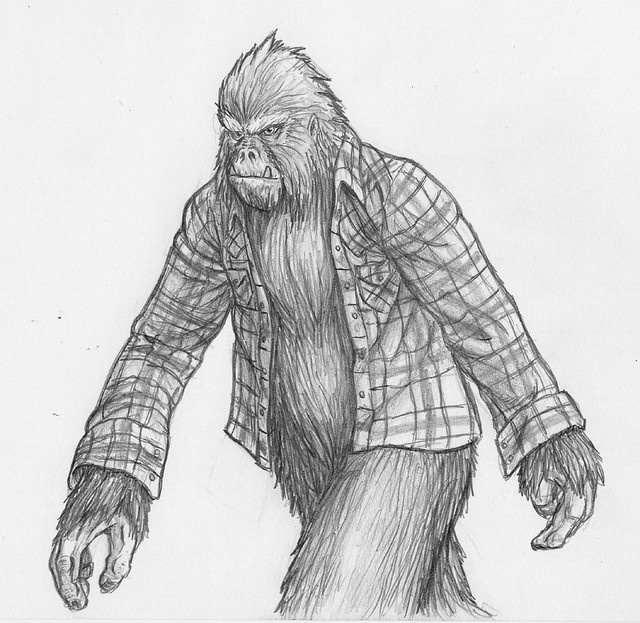
 |
| Credit: Legendary Cryptids@BestCryptids (Twitter) |
Why is
cryptozoology with outmost probability wrong? The main reason is that the cryptids,
after centuries of search, are still unaccounted for. “Absence of evidence is
not evidence of absence” is just a thought-stopper here. Obviously, absence of
evidence very often *is* evidence of absence. It all depends on what we
reasonably can expect to find in the first place. So what *are* we expected to
find in this case? Today, large mammals are only found in small numbers in
remote places, and they are always related to known extant taxa. Thus, the Bili
ape – found in a remote corner of the Congo – is just a subspecies of the chimpanzee.
New species of hoofed animals have been found in the dense jungles of
Indochina, and there are some mysterious crania of unknown beaked whales from
the world´s oceans. So yes, if Bigfoot had been like the Bili ape, it might be
reasonable to assume that this rare species would still linger in some *really*
remote corner of the North American boreal forest.
But that´s
not the claim made for Bigfoot. Quite the contrary, Bigfoot is observed *all
over the United States (except Hawaii) and Canada*, including in people´s
backyards and even on our highways. Apparently, the Bigfeet have even
infiltrated suburbia in places like Connecticut, Rhode Island or Upstate New
York! A huge ape-like creature simply can´t go undetected for centuries under
such conditions. Note also the weird discrepancy between being observed all the
time by humans, and always going under the radar as far as technology is
concerned. There should be tons of evidence by now. Where is it? The 55-year
old Patterson-Gimlin film stands out precisely because it´s the only really
good piece of evidence there is, and it´s probably a hoax anyway (although I hate
to say it).
Despite
their status as purported flesh-and-blood animals, cryptids remain strangely
disconnected from their natural habitats. It´s a common cryptozoological fallacy
to point to a dense forest and exclaim: “Anything could hide here”. But it
can´t. All animals need food and drink. The best way to find an unknown animal
would therefore be to stake out the local water holes, since all large land
mammals and many birds have to go visit them to drink (or to hunt those who
do). If Bigfoot was real, it should be easy for a field biologist to observe
them hunting deer, or their epic struggles with grizzly bears at the salmon
spawning grounds. But, alas, no such things ever seem to happen.
The same
goes for other cryptids. Don´t thunder birds need to eat? Why don´t we see them
in deep winter, gathering around carcasses laid out by the park authorities to
feed regular eagles? Even a very rare thunderbird would have to make its
presence known in this way. Also, what about forest fires? Why do we never see
Bigfoots or other cryptids flee from such natural calamities?
But surely
a gigantic unknown animal could still hide in the oceans? Well, no, they can´t.
Most of the world´s oceans is like a desert. Plankton only exist at certain
places. We know where these places are. Whalers and fishermen have known it for
centuries. A plesiosaur or Zeuglodon would have to gather at the same locations
in the oceans as whales or huge shoals of fish. So how come no such primordial
reptile have been discovered by science vessels or indeed by whalers?
The prying
eyes of Homo sapiens (in his or her modern scientific-military-surveillance
capacity) are everywhere: in the Congolese rain forest, in Antarctica, in Siberia,
in the Gobi desert, even in outer space. While it may still be *possible* to
hide from man, it seems increasingly improbable. And, once again, we are not usually
talking about genuinely rare unknown animals. We are discussing beasts that supposedly
show up in our parking lots, outside our bedrooms peeping inside, at cemeteries
in the heart of town, around popular hiking trails in tourist country…and then just
as promptly disappear. *Cryptids of this kind are biologically impossible*.
There is
also the mythological aspect. While not as decisive as the biological one –
real animals, after all, might be mythologized – it´s nevertheless a striking
aspect of cryptozoology that the cryptids are taken out of their original
context in folklore. Bigfoot looks plausible enough if interpreted as an ape,
less so if seen as a divine giant taller than the pine trees, as a hybrid
between man and otter, or as a member of a highly aggressive tribe waging wars
with the Natives. Bigfoot comes from a rich Native mythology also populated by frogs
the size of school buses and other creatures few if any cryptozoologists would
take seriously. (I mean, what do *they* eat, I wonder? Flies the size of deer?)
Note also that both giants and pygmies are staples of many mythologies, yet the
archeological or paleontological evidence for such creatures in historical
times is extremely slim, perhaps non-existent. Something similar can be said about
lake monsters. The idea of these creatures being plesiosaurs is modern. In
ancient mythology, the lake monsters are often depicted as horses, bulls or humanoids
with explicit supernatural powers (often demonic ones). Where did they go, only
to be replaced by creatures popularized by “King Kong” or museums of natural
history?
What will happen
to cryptozoology in the future? My guess is that it will disappear, as all
other artifacts of modernity, only to be replaced with a more forthrightly
mythological worldview as modernity plunges into terminal crisis. The flesh-and-blood
unknown animals will go back to being specters, ogres and fairies…
.jpg/800px-Mus%C3%A9e_zoologique_de_Strasbourg-Rhinograde_(Rhinogradentia%2C_cropped).jpg)





_alternate.svg/1280px-Flag_of_Tannu_Tuva_(1921-1926)_alternate.svg.png)

