Showing posts with label Wasps. Show all posts

Thursday, February 3, 2022

Friday, October 1, 2021

The Cosmic Eros hard at work


Not sure what the pic above is supposed to be, some kind of creepy wasp attacking an equally creepy spider. Now, how on Earth (pun may be intended) did these critters even *get* here? There are some possibilities...

1. God refashioned the entire world in a truly bizarre manner after the fall of Adam and Eve. However, one day, his Son will return, and then the wasp and the spider will become friendly towards each other.

2. It´s a product of blind evolution, following a bizarre chance event during which "life" emerged just like that, from dead shit. Another line of evolution gave rise to "Homo sapiens".

3. God did it on purpose, and now he´s just laughing at us all. Hard!

Hmmm... 

Thursday, September 27, 2018

Planet of the ants (and gentle giant hornets)


NN or Nationalnyckeln is a Swedish biological encyclopedia. This is one of the most interesting volumes, unfortunately only available in the Swedish language. It covers all Nordic species of ants, scoliid wasps, potter wasps, paper wasps, hornets and yellow jackets. In more scientific terms: Formicidae, Scoliidae, and Vespidae (subfamilies Eumeninae, Polistinae and Vespinae).

The species presentations include sections on identification, behavior and range. It also includes information of primary use to taxonomists only. Thus, we learn that Strongylognathus testaceus was first described by Shenck in 1852 in the venerable publication Jahrbücher des Vereins für Naturkunde im Herzogtum Nassau 8:117. I mean, who knew?

Some species stand out…

There is Technomyrmex difficilis, a “tramp ant” originally from the tropics (the type specimen is from Madagascar) but apparently reported from Swedish greenhouses, too. The black garden ant (Lasius niger) is easily one of the most well known ant species in Sweden, and yes, they really do invade people's homes and literally steal candy and sugar! You can take that from me, I'm a veteran from several wars with these creatures. The European Amazon ant (no relation to Jeff Bezos) is a spectacular “slave-making ant”, while the Pharaoh ant is busy colonizing European hospitals (provided they have a central heating system!) and even slips into syringes… There is also the Shining Guest ant, a small species which forms colonies inside anthills of other, larger species.

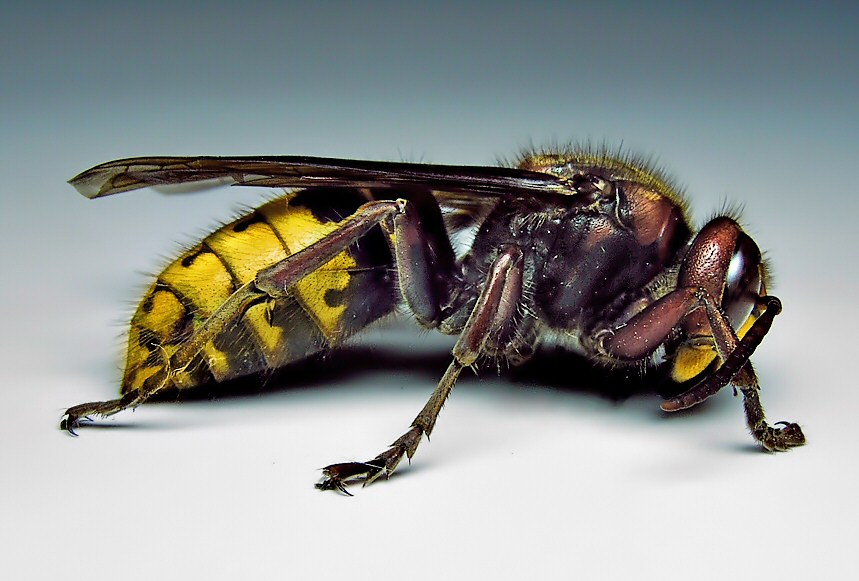
As for the hornets, I note the absurd fact that the authors of this encyclopedia refer to the European hornet (Vespa crabro) as a “gentle giant”. Ahem, the one's I encountered were anything but gentle, although I'm willing to concede that they were indeed gigantic (even for hornets).

Despite the gentle giant gaffe, I'm nevertheless willing to give this volume, believe it or not, five stars. Welcome to the Planet of the Ants, Swedish satrapy.


Wednesday, August 15, 2018

Way over my head

Credit: Ivar Leidus


"The Social Biology of Wasps" is a heavy, technical and scholarly anthology about hornets, yellowjackets and other social wasps.

It's not suited for the general reader.

Chapter headings include "The Function and Evolution of Exocrine Glands", "Population Genetic Structure, Relatedness, and Breeding Systems" and "Evolution of Social Behavior in Sphecid Wasps".

Way over my head, I'm afraid.

But then, I don't like wasps anyway. Especially not sphecid ones. 

Tuesday, August 7, 2018

The boring wasps


Don't get me wrong. I'm sure "The Pollen Wasps" is a very good book...for professional entomologists. However, for a general reader like myself, it was boring, technical and occasionally incomprehensible. This, then, is a book for the scientific research library.

If you want to know what species of pollen wasp visits the flowery plant Wahlenbergia annularis, or what species of Mutillidae are larval ectoparasitoids on which pollen wasps, or are dying to find out about the exact cladistic relationship of Masarinae within Vespoidea, then this is the book for you. If not... Although the book covers the entire subfamily of pollen wasps, there is an obvious bias towards South Africa, where the author has carried out years of research on these insects. Weirdly, a few species of pollen wasps in the Southwestern Cape are actually threatened by extinction.

In a way, it's a real pity that this book isn't more popularized. The very idea of a vegetarian wasp feels inherently appealing. Most wasps, after all, are predators. Pollen wasps, by contrast, provision their larvae with pollen and nectar. But yes, they do sting!

Perhaps Sarah Gess could write a more popular book on this subject in the future? I'm sure pollen wasps don't need to be boring...

Sunday, August 5, 2018

Give the Devil his due


This short remark was originally posted as a "review" of "Behavior and Social Evolution of Wasps: The Communal Aggregation Hypothesis". I just had to troll the bug-collectors one more time, LOL.

Wasps didn't evolve. They were created by the Devil himself. The wasp is the Devil's failed attempt to create a Western honeybee!

Why have this vital information been left out of our King James Bibles?

It's time to give the Devil his due. Who else than Satan (and his grandma) could be behind EVIL-ution?

:D


Friday, August 3, 2018

The bizarre world of solitary wasps


"Solitary Wasps. Behavior and Natural History" is a look at the bizarre underworld of solitary wasps, a group of insects distantly related to ants, bees and "real" wasps. The solitary wasps covered in this book all belong to the suborder Aculeata. They include the cuckoo wasps, the velvet ants or "cow killers", digger wasps, pollen wasps, beewolves and others.

Their world is lawless land. Solitary wasps spend most of their time killing other insects (or each other) in various ingenious ways. Parasitism seems to be the favoured method. The only "nice" bugs in this book are the strictly vegetarian pollen wasps! But yes, even they sting...

"Solitary Wasps" cover all aspects of the behaviour and natural history of these varied and tiny creatures. There are chapters on foraging, nest provisioning, nest building, natural enemies and mating. One chapter attempts to explain the taxonomy of this group. Unfortunately, it's badly edited and calls sawflies "aculeates" at one point. (They are "symphytans", actually.) Got it?

The text is relatively easy to read, but can be "heavy" unless you have an enduring interest in wasps. The book is therefore mostly suited for students of entomology, and perhaps more advanced amateur entomologists. It's not a bad book, but it gives a somewhat boring impression, since the few illustrations are all in black and white. There are no colour plates or colour photos. Since many solitary wasps are pretty conspicuous, this would have been a plus!

Despite this little shortcoming, I nevertheless give this (somewhat scary) book five stars. Whatever you do, don't be reborn as an aculeate solitary wasp!

Don´t cry beewolf


The beewolves are a group of ground-nesting, solitary wasps. They belong to the genus Philantus of the family Sphecidae. The name "beewolf" refers to their habit of preying on bees (including honeybees). The bees are killed, taken to the beewolf nest and later eaten by their larvae.

In some regions of Europe and North Africa, beewolves are a threat to commercial beekeeping. A beewolf population of about 3000 can capture 30,000 honeybees daily! In the Dakhla oasis of Egypt, around 24,000 beewolves were exterminated in one season, but they were just as abundant the next year. Needless to say, the beekeepers were not.

As behoves a wasp, beewolves are pests in most other respects as well. In the United States, a large species known as bumblebee-wolf attack and kills bumblebees, an important pollinator. Beewolves also kill beneficial wasps, i.e. wasps that eat grasshoppers, caterpillars and aphids. Should we be crying beewolf, I wonder?

"The Natural History and Behavior of North American Beewolves" is a relatively detailed description of 34 North American species. A short chapter on the European beewolf is also included. Male behaviour, nesting behaviour, mating, provisioning and natural enemies are all covered. Beekeepers (and bees) might be happy to learn that even beewolves have enemies, including robberflies, satellite flies and cuckoo wasps. Interestingly, beewolves can tell the difference between bees and bee mimics, and decline to attack the latter. The book never explains why. Too little meat?

This probably isn't a book for the general reader. I mean, beewolves? Please come on. However, it's relatively easy to read and might be of interest to amateur entomologists and, of course, students of the subject. Please note, however, that the book isn't a field guide, but rather a natural history.

The Aldo Leopold of wasps


"Wasp Farm" is easy to read, interesting, fascinating, even funny. It's one of the better popularized works on natural history I've read. The book was published already in 1963. My copy used to be the property of the Franklin Public Library in Ohio.

The author, Howard Ensign Evans, bought a farm and eight acres of land in upstate New York with the sole purpose to study wasps. Hence, the name Wasp Farm. His wife was in on it, too. The kids were not. The family eventually had to sell Wasp Farm and move to Suburbia. Personally, I can't stand insects, but I like the author's single-minded determination. I guess Evans is the Aldo Leopold or Thoreau of wasps!

Evans deliberately kept his farm and the adjacent garage in unkempt condition, nor did he remove weeds or brambles from his land. Pruning the apple trees was another no-no. Unsurprisingly, Wasp Farm soon attracted more than its fair share of bugs. That, after all, was the point.

The wasps described in the book belong to the families Vespidae, Sphecidae and Pompilidae. Most are solitary, but one chapter deals with the social wasps, including yellow jackets and the Black Paper Wasp. Among more exotic creatures covered are Isodontia, the only wasp that builds nests of grass, the scavenging Microbembex, and a spider wasp that walks on water and even dives (!). The author also discusses whether or not the wasp known as Ammophila really uses tools.

Since "Wasp Farm" was written in 1963, some of the research may be out of date. Or it may not. A scientific book from 2001, "Solitary Wasps", still quote a research paper written by Evans over 40 years ago! I suppose it's hard to get research grants to study Microbembex.

Reading "Wasp Farm", on the other hand, wasn't hard at all. Recommended for both wasp-lovers (a small minority, I gather) and the general reader.