That´s where you´re wrong, kiddo. Seriously, though, this is a YouTube video narrated by a scholar of religion, dealing with the Buddhist hell-realms. Also note the discussion on Orientalism.
That´s where you´re wrong, kiddo. Seriously, though, this is a YouTube video narrated by a scholar of religion, dealing with the Buddhist hell-realms. Also note the discussion on Orientalism.

"The Creator" is a 2023 science fiction movie. It comes across as a peculiar hybrid between "Blade Runner", "Star Wars" and the US war in Vietnam. The first portion of the film is interesting. In the second half, the Vietnam War analogies and Buddhist savior-complex becomes downright cringey.
The story begins with a technological breakthrough: humanoid robots with Artificial Intelligence. Something goes wrong and the robots detonate a nuclear bomb that wipes out Los Angeles. The United States promptly stops all AI development, but a competing nation known as New Asia refuses. The American military builds a space station called NOMAD to wipe out the Asiatic robots (and all human Asians who stand in the way). This may be an allegory for the fact that China is supposedly a world leader in AI technology. But as already noted, the similarity with the US intervention in Vietnam 1965-73 are also obvious. New Asia is clearly located in Indochina.
The main characters have religiously inspired names: Joshua (compare Joshua or Jesus in the Bible), Maya (compare Buddha´s mother) and the robot "Alpha and Omega" (compare God or Jesus). A mysterious character is named Nirmata, apparently the Nepalese word for creator - according to ChatGPT, the term has no metaphysical connotations, but in the context of this film, it presumably does. New Asia turns out to be a strange place in which humans and robots live in peaceful harmony with each other, both apparently being Buddhists (or something like it). It´s clear that the robots are a stand-in for the Other, the excluded, the marginalized, and their armed rebel movements. The good guys are almost all colored, while the bad guys seem to be exclusively White (including a White female). Naturally, it turns out that the nuclear blast which destroyed LA might not have been the work of the AI, after all.
"Alpha and Omega" (nicknamed Alphie) is a child, but also a Messiah-like savior with paranormal powers. She can control all technology and hence might wipe out NOMAD, which explains why the Americans want to kill/de-activate her. Note again that Alphie´s "mother" or creator is named Maya, suggesting that the child might be the Buddha. Note also that Alphie is artifically engineered by Maya, perhaps a reference to a virgin birth. It further struck me that there could be a weird parallel to the Biblical story of Joshua and the harlot Rahab, since the character Joshua in the film is tasked with infiltrating New Asia before NOMAD (= the nomadic Israelites?) wipes them out (like Jericho?). Note that he meets "Rahab"/Maya in an apparent strip club!
OK, so I´m a nerd...
Despite all the above, "The Creator" nevertheless feels like a self-parodic low budget production. Perhaps because the left-liberal message is too obvious. These days, films apparently *must* be like explicit pamphlets, otherwise the Woke autists don´t get it. Or something. Well, at least the religious allegories were *somewhat* hidden. One intriguing feature of "The Creator" is that the White Evil Empire isn´t really evil. The atomic explosion in California seems to have been an accident, rather than the result of a conspiracy. Thus, the US are misguided rather than actively malevolent. The worldview of the film turns out to be a form of milktoast liberalism in which everyone might at least potentially get along, rather than the hardline Marxism you expect from a "pro-Viet Cong" allegory. It´s all so "unproblematic".
OK, so I didn´t like this production. Or did I simply misunderstand its intended demographic? *Is* it a film for very young middle schoolers? Or for 24-year olds who think like 14-year olds?
Not sure how many stars to give "The Creator". Perhaps two-and-a-half out of five.
Yes, oarfish. That´s the new apocalyptic sign, apparently. From a channel which previously promoted the idea that 3I/ATLAS is alien tech and that the Blood Moon was some kind of doomsday event. And yet, here we are. And how many stranded oarfish are we talking about, anyway? Two? Three??
Here is ChatGPT.

Is it true that the Vietnamese winner of the Russian "Intervision" is LGBT? LOL.

Heh heh heh....look what I asked ChatGPT here. I can´t prove it to you, but I guessed the same thing: Engaged Buddhism. Funny that the AI reacted in the same way. Of course, "current views" here refers to Greta´s pre-Hamas period...
If Greta would join a religion based on her current views, which one do you think it would be?

Monday night I watched Francis Ford Coppola´s classic "Apocalypse Now" in the "Final Cut" version. I won´t attempt a full analysis of this "best film ever made", but one thing struck me when watching it. The film is obviously very critical of the Vietnam War. The crook Colonel Kurtz is a renegade who "went too far" and therefore has to be dispatched - something the main character Willard rather explicitly regards as hypocritical. Kurtz is simply the product of the insane war itself. One of the "good" guys - the officer who loves the smell of napalm in the morning - is just as crazy as Kurtz (although with different symptoms).
But...
In the end, "Apocalypse Now" actually becomes "problematic" (to use Woke terminology). The Montagnards or tribals who follow Kurtz worship him as a god, apparently voluntarily. The American soldiers who join these renegade forces "go native". So does Kurtz, living in a Khmer temple and presiding over pagan sacrifices. So in the end, it´s not really the American war that drives the colonel insane. It´s the jungle, the colored peoples and the pagan rituals. No White man can withstand the evil influence of the colonized environment.
Logically, this means that civilized Whites should leave the Third World because it will inevitably corrupt them. The same theme is also visible in the plantation sub-plot, where an incredulous Willard asks the French settlers why they don´t just return home to France. The old planter who believes that an understanding can be reached with the natives is depicted as senile, while the stalwart colonialist who argues with Willard is obviously "out of touch", spewing absurd conspiracy theories as he babbles on.
Note also that Kurtz hides in Cambodia and that his temple compound is littered with skulls and dead bodies. Could this be a hidden reference to the Cambodian genocide? Maybe it´s a co-incidence, since the film was in production for years before finally released in 1979. Still, the parallels are hard to miss, especially since the worst Khmer Rouge soldiers were tribals.
Maybe our White asses should avoid the heart of colored darkness, but don´t tell me that´s a "progressive" critique of colonialism...
Hardcore Zen strikes again, arguing that suicide by self-immolation isn´t the same thing as enlightenment. Hint: Buddhist monks in Vietnam. Nor are paranormal experiences, since they are just a small part of the *real* mystery: Reality itself. "Chopping wood and carrying water" might be the real "miracle"...
 |
| Credit: Dragfyre |
Vietnam is purging one of its major oligarchs. See also China. Trend?
Female Vietnamese real estate tycoon sentenced to death in 12 billion dollar fraud case

"Röda khmererna: Pol Pots revolution i Kambodja" is a Swedish book from 2022 by Peter Fröberg Idling. It´s published by Historiska Media, a press with a wide assortement of popularized but still surprisingly informative books written by various authors. The topic this time: the Khmer Rouge and their reign of terror in Cambodia 1975-79.
The bulk of the story is well known by now: how the Khmer Rouge forcibly evacuated the capital of Phnom Penh after a bloody civil war, how they subsequently turned the entire country into a enormous labor camp, and how the regime was finally overthrown by a Vietnamese invasion. The Khmer Rouge genocide may have claimed the lives of over one million people. Few people would have missed the name of the crazed dictator behind it all: Pol Pot. Since the Khmer Rouge were Communists, their depradations are placed in the same ball park as those of Stalin or Mao.
While none of the above is "wrong", there is also a wider context: a brutal colonial history, constant conflicts between Vietnam and Cambodia that go back centuries, and Richard Nixon´s "secret" war (including carpet bombings). At their peak, a large proprotion of the Cambodian peasant population must have supported the Khmer Rouge. Pol Pot´s bizarre regime was overthrown by another Communist government and his movement kept afloat as a "contra" force by the United States and Thailand. Add to this the constant scheming of Prince (or King) Sihanouk, and the story suddenly gets more complicated...and arguably even more brutal. All of this is covered by the author.
The book also contains more unexpected information. For instance, that Pol Pot (whose real name was Saloth Sar) was something of a dandy and bon vivant in his younger days. Somewhat ironically given later developments, Saloth Sar came from a kulak background and had a family connection to the royal Cambodian court. He seems to have been a charismatic, smiling and jovial man...well, until he wasn´t, although I suppose he kept his charisma. He flunked both high school and college, first due to his bohemian lifestyle, later because of his revolutionary pastimes. In other words: another intellectual mediocrity who fancies himself the Messiah. It´s not even clear if he had any real grounding in Marxism-Leninism. Fröberg Idling believes that his main source of inspiration was the French revolution, including its most radical and terroristic phase. Pol Pot´s source? A work by Peter Kropotkin!
Another new piece of information is that Cambodian nationalism was a by-product of French colonialism. Not just in the trivial sense that colonialism breeds resistance, but also in a more "ideological" sense. It was the French that made the Cambodians interested in Angkor Wat. The old temple complex had been in ruins for centuries and nobody much cared about it (except maybe a few Buddhist monks) before the French became fascinated by it and the ancient Khmer Empire in general. This prompted Cambodians to turn Angkor Wat into a potent symbol of Cambodian nationalism. Indeed, even the ultra-Communist Khmer Rouge had the silhoutte of Angkor Wat on their flag. (If Wikipedia is to be believed, the author makes two factual errors about Cambodian flags. The first flag showing Angkor was adopted in 1863 by the French-dominated puppet kingdom of Cambodia, while the flag used by the nationalist Khmer Issarak was re-used by the pro-Vietnamese Hun Sen regime, not by the Khmer Rouge. Perhaps a vexillology nerd could weigh in on this?) Note also that both the ideals of the French revolution and Marxism are, of course, Western.
A constant theme in the book is Pol Pot´s weird and quasi-Masonic secrecy, unique among Communist parties. The very existence of the Communist Party of Kampuchea was a secret, the party using the cover name "The Organization" (Angkar). Its leadership was just as secret. It took several years after the "revolution" before the Khmer Rouge revealed that the leader of their regime was a certain Pol Pot. But that´s really a pseudonym (the exact meaning of which is unknown) and Brother Number One was given an entirely fictitious biography. At this point, he was paranoid and strongly xenophobic, constantly moving his HQ around Cambodia. It struck me that even this strange obsession with secrecy (including when actually in power!) could be derived from some kind of Jacobin or Blanquist conspiracy during or after the French revolution.
Another thing that shines through (despite the author for unclear reasons not liking Michael Vickery) is the weird blend of authoritarianism and decentralization during the Khmer Rouge´s years in power. The decentralization aspect is emphasized in Vickery´s books. Cambodia or "Democratic Kampuchea" was sub-divided into seven "zones", each under its own effective leadership. The conditions in the various zones varied considerably, with the Eastern zone bordering Vietnam being the most lenient, while other zones were under the control of de facto dacoit warlords who really did "hate the cities". At the center, Pol Pot tried to keep control with semi-regular purges left and right. His commands were often contradictory, the production quotas impossible, and the paranoia rampant (but nevertheless "justified", since Vietnam *did* conspire against the Angkar). Most people who died under the Khmer Rouge probably perished due to famine, malnutrition and overwork. For more on Pol Pot´s utter insanity, see my review of the book "Pol Pot Plans the Future", which contains translations of the few internal Angkar documents that have come to light.
It´s difficult to "explain" any of this in a strictly rational fashion, but the author does point to a few factors. For instance, that violence has long been part and parcel of Cambodian culture. It´s an extreme "honor culture" in which every sleight is punished with over-the-top violence, which in turn leads to new violence. Add to this colonial terror and civil wars. The fact that Cambodia has long been weak and squeezed between its more powerful neighbors Thailand and Vietnam is also part of the picture. Obviously, extreme nationalism can appeal to people in such a situation. As for the Khmer Rouge, the author believes that they are best seen as a kind of cult or sect, which under extraordinary conditions of societal breakdown managed to take power. (The Taliban in Afghanistan could be another example of this.) And yes, the "Communist" mixture of utopian millenarianism and authoritarianism obviously also plays a role here. A trail not explored by the author is that millenarian cults seem to be pretty common in East Asia (and perhaps Southeast Asia?). The Khmer Rouge may be part of a tradition that long pre-dates Communism. Indeed, maybe Communism is seen by many adherents in Asia as a new millenerian cult? The author does speculate that Pol Pot might in some strange sense have been influenced by Buddhism and mysticism.
The book ends with an epilogue, in which it becomes clear that most of the Khmer Rouge were never punished for their crimes. Pol Pot was - somewhat ironically - unseated by his own supporters in 1997 in a remote part of Cambodia after ordering yet another round of purges, this time of fellow guerilla commanders fighting the new Cambodian administration. Pol Pot was placed under house arrest and died of unknown causes in 1998. For some reason, the author strongly dislikes Hun Sen and the pro-Vietnamese ex-Communists, constantly accusing them of being somehow implicated in the genocide, when in fact they were the moderates who tried and succeeded in removing Pol Pot from power.
With those reflections, I end this review.
 |
| Credit: Darren Naish |
I never bothered with the Minnesota Iceman before, but I admit that super-nerd Darren Naish´s blog posts on the creature are interesting.
The Iceman was a hoax promoted in the United States as a real Neanderthal corpse found somewhere in Siberia. Or so skeptics believe. Prominent cryptozoologists Ivan T Sanderson and Bernard Heuvelmans believed otherwise. The story broke already in 1969 and has been a kind of cryptozoology cause célèbre ever since.
Heuvelmans suspected that the Iceman was a "pongoid man" found in Vietnam and smuggled out of that country in the middle of the Vietnam War. He apparently connected this to the heterodox evolutionary speculation known as "initial bipedalism", which argues that apes are descended from humans, rather than the other way around. (This notion is still extant, or should I say tojour vivant, among Theosophists and Anthroposophists.)
Naish´s articles are written from a skeptical perspective - probably the right take.
The strange case of the Minnesota Iceman (part 1)
The stange case of the Minnesota Iceman (part 2)
More here:

En intressant historia...
Observera förresten att "Charlie" kan tolkas som en förolämpning av vietnameser! Lite ironiskt med tanke på sammanhanget.
 |
| Credit: Erlkonig |
“The Witch of Criswell” is a recent novel by John Michael Greer (JMG), an American blogger and student of the occult. Its exact relation to the author´s previous fantasy novels (the so-called Haliverse) is somewhat unclear, but there are certainly strong similarities. These include folk magic, awkward teenagers, secret societies, plot developments in farm country, and a near-future America slowly but steadfastly running out of steam. And yes, friendly anti-Communist Asians, this time from South Vietnam.
The most obvious difference with “The Weird of Hali” is that the Lovecraftian themes are missing. Indeed, “The Witch of Criswell” feels so in-house that I suspect that two of the characters, Ariel and her grandfather Dr Moravec, are both freely based on John Michael Greer himself! The least important example – but an extremely funny one – is that Dr Moravec is a Slovak-American. Slovak is a language related to Czech. And on his blog, JMG has revealed that he is trying to learn Czech. Another is the only city in the novel, the fictitious Adocentyn, named after an equally fictitious Arabic city in a medieval magical manuscript known as the Picatrix. One of the translators of the Picatrix from Latin to English is none other than JMG. The constant criticisms of Harry Potter novels are also a Greer staple, while the attacks on TV have been replaced by a ditto negative attitude towards I-pods.
The main character of the novel, Ariel Moravec, is an 18-year old high school student with some inner demons and peculiar habits. Although not autistic or extremely socially awkward, she is certainly “nerdy”, uncool and perhaps asexual. Using both wits and determination, this unlikely prodigy manages to become a cross of Sherlock Holmes, Hercules Poirot and a folkish witch. Note the name: Ariel is a nature spirit in Shakespeare´s play “The Tempest”, but perhaps also a symbol for a neophyte in magic. According to all-knowing Wikipedia, Ariel is also a gender-fluid character, which may or may not be significant.
Most of the plot is “realistic” in the sense that it deals with folk magic (or folk superstition, if you´re a Skeptic-TM), including Hoodoo, which I assume is more or less correctly described. It´s a world of farmers cursing each other´s cattle, old ladies reading tea leaves, mojos, hauntings and strong Omerta about the whole thing. One of the witches takes the form of a very large raven! And yes, some cats and barn owls are there, too. Only at the end does it seem that the magic becomes more ritualistic and “properly esoteric”, with Dr Moravec wielding the Trident of Paracelsus (whatever that is exactly) to kill off the evil sorceress once and for all. A more exotic ingredient in the magickal mix is Cao Dai, the Vietnamese Spiritualist religion which supposedly venerate Victor Hugo as a kind of prophet (although that particular detail isn´t mentioned).
If there is any message in “The Witch of Criswell”, it´s that a magician or witch isn´t really “special”, rather it´s a normal person who realizes that *the world* is special (or more special than many ordinary people think). A more subtle point is that God is very distant, and although you can somehow feel his presence during religious services, he stands far above the petty problems of humanity – the Cao Dai ritual of praying to God doesn´t seem to stop the evil witch. Presumably, humans must therefore become more “pagan” and learn magical tricks of trade themselves, perhaps with some input from spiritual beings of a lower order than God. Indeed, everything humans can perceive is really “natural”, although some of it goes unrecognized by modern Science-TM.
With that, I close these reflections on “The Witch of Criswell”. Apparently, a new Moravec mystery will soon be published…and available at your local conjure shop?
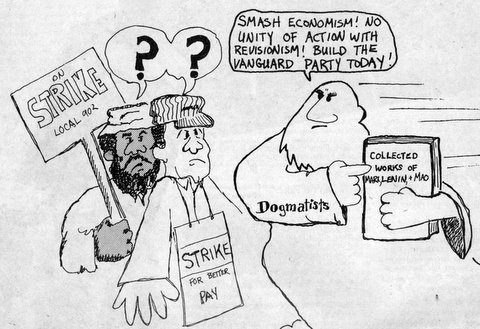
“The Party of Labor of Albania Came to Canada Under a
Stolen Flag” is a publication of the Bolshevik Union, a long-forgotten small
group of Stalinists in Canada. Published in 1979, the pamphlet is strictly
speaking no 13 of the BU´s journal “Lines of Demarcation”. The BU formed an
international current together with the Bolshevik League of the United States
(a fusion of Leninist Core and Demarcation) and some West African groups based
in France. I assume all these organizations disappeared at some point during
the 1980´s.
Originally, the BU and its co-thinkers had supported
Enver Hoxha´s Communist regime in Albania, but by 1979 they had decided that
Hoxha was just another revisionist, not much different from the Chinese and
post-Stalin Soviet versions. Interestingly, the Albanian Communists (known as “Party
of Labor of Albania” or PLA) had tried to recruit the BU to their international
network. When the PLA subsequently recognized the bizarre and cultish Communist
Party of Canada (Marxist-Leninist) as their fraternal organization, the
Bolshevik Union first attempted to convince the Albanians of their mistake and
then broke off all contacts. Presumably, this triggered their political
reevaluation of Hoxha and the PLA.
What attracted many Marxist-Leninists to Hoxha was his attacks on the Maoist “three worlds theory” used by China to justify both a strategic alliance with bourgeois or semi-feudal regimes in the Third World, and its tilt towards the United States in the Cold War. However, the BU believes that the Albanian leader really has a similar perspective (minus the outrightly pro-American geopolitical positioning). Hoxha´s positive view of “non-aligned” nations is said to be similar to the Chinese, Soviet or Yugoslav takes. Hoxha´s regime had relatively good relations with Greece, Turkey and Romania (all broadly “pro-Western” at the time) and hoped to trade with Western Europe and Canada. Hoxha also expressed strong support for Egyptian leader Sadat´s break with the Soviet Union, since this removed a potential military threat to Albania at its southern flank.
The BU believes that the PLA stopped referring to Canada as imperialist shortly after recognizing the CPC (M-L), a group which denied Canada´s imperialist character. While being cozy with Western nations, Albania had also established friendly relations with Vietnam, a pro-Soviet country, no doubt because of shared hostility towards China. Albanian support for Khomeini is also up for criticism. The deeper point is that the PLA calls for unity with the “national” bourgeoisie in the Third World and the imperialist nations of the “second world” (here Western Europe and Canada) just as the Maoist “three worlds theory”. The break between Albania and China has nothing to do with Marxism-Leninism but is simply a conflict between competing national interests.
Even the seemingly radical sloganeering against “both
superpowers” (the US and the Soviet Union), rather than the Chinese line of de
facto uniting with one against the other one, is really a form of “three worlds
theory” and revisionism, since opposition to “superpowers” can come from lesser
imperialist powers or nationalist bourgeois regimes.
The decision of the Albanian Communists to give the
CPC (M-L) their Canadian franchise looms large in the pamphlet. To most people,
CPC (M-L) is the small and crazy cult led by one Hardial Bains. Originally
Maoist, they eventually sided with Albania instead. The Bolshevik Union
couldn´t stand them. In the pamphlet, the CPC (M-L) are accused of being middle
class, lumpen and agent provocateurs. Above all, they are revisionists and
outright reformists. The CPC (M-L) denies that Canada is imperialist and
instead tries to recast it as a nation oppressed by the United States. From
this follows that the Canadian working class must unite with all the people,
including “the middle bourgeoisie”, in a fight against the “rich”. The BU is
opposed to this broad popular front, pointing out that what the CPC (M-L) calls
“the middle bourgeoisie” really encompasses a sizable fraction of the
capitalist class! The BU also complains about Albania not really giving a damn
about who gets their franchise, since the PLA didn´t see it as necessary to
have a single Marxist-Leninist party in each country in the first place. The
important thing is that various Marxist-Leninist groups collaborate to aid
Albania…
By most standards, the BU and the Bolshevik League would count as Stalinists. Yet, they seem to repudiate the popular front, a strategy associated with the very same Stalin. It´s not clear to me after reading some other material from this current whether the BU/BL rejects popular frontism en toto, or see it as a purely temporary tactic best avoided in 1979. Nor is it clear whether these groups are Third Period. In some curious way, these groups sound extremely sectarian and dogmatic, yet not really Third Period.
The BU/BL current believed that a third world war was imminent, a war between the US and Soviet blocs, both being equally imperialist. In this war, all other nations would become proxies for one side or the other, indeed many already were so. This explains why no national bourgeoisie is progressive, the global situation being similar to the European theatre during World War I. Given this background, Albania´s diplomatic maneuvers could be seen as Enver Hoxha probing both sides in the future war to see which one he should join!
BU and their co-thinkers thus had a very bleak view of the general world situation: the Soviet Union became “capitalist” after the death of Stalin, China had always been “capitalist”, and no national liberation struggles are possible except under Communist leadership, but of course, no such leaderships exist anywhere in the world. Apparently, this current disappeared during the mid-1980´s, no doubt because their entire political perspective turned out to be dead wrong.
Bizarrely,
the CPC (M-L) still exists, now led by the widow of Hardial Bains, but that´s
another story!

"What the Spartacist League Really Stands For. A Self-Exposure by James Robertson (The Speech the SL Wouldn´t Print)" is a classic pamphlet by the otherwise mostly unknown Communist (T) Cadre (CTC). The pamphlet was probably published in 1977.
Yes, we are in the murky demimonde of intra-mural Trotskyist polemics. While the CTC must have been an extremely small group, the other groups mentioned in the pamphlet weren´t particularly large or influential either, although the Spartacist League was notorious on the American far left (and occasionally outside it). In January 1977, the leader of the Spartacists, James Robertson, gave a public presentation in New York City titled "Towards the Rebirth of the Fourth International". While most of the speech was frankly boring and very "political" (judging by the excerpts published in this pamphlet), Robertson did say things which raised the eyebrows of two other Trotskyist groups present at the show, the League for the Revolutionary Party (LRP) and the already mentioned CTC. When the Spartacist League refused to publish a transcript of Robertson´s speech, CTC decided to do so themselves (they had tape recorded the presentation and the debate following it). Or rather extended excerpts from it. The LRP had already published their own account of the fracas. For years afterwards, Robertson´s scandalous speech was notorious among small Trotskyist groups all over the world. I´ve heard from an ex-Spartacist in Sweden that Robertson was drunk as a skunk during his presentation, and that he hardly showed himself in public after the 1977 debacle!
What went wrong? Many things, but what most upset the non-Spartacist auditorium was Robertson´s blatant racism and chauvinism. This from a guy who claimed to be some kind of revolutionary internationalist Marxist. Most blatantly, Robertson referred to Albanians as "goat-fuckers" (strictly speaking, he claimed that Marx had done so) in order to poke fun at the Maoists who believed that Enver Hoxha´s Stalinist regime in Albania had something important to say.
However, other ethnicities didn´t fare much better. The Greeks survive by "exporting their sons and selling expensive wrist-watches to each other". (However, Robertson believes that Athens is nevertheless "a big step up" compared to Tel Aviv and Jerusalem!) North European workers aren´t revolutionary since "North Europe is dripping with fat". Immigrant guestworkers aren´t revolutionary either. "When they are deported, they scream for the popular front". The US defeat in Vietnam isn´t important, since "not many people live in Indochina" (!). Blacks in the United States (in 1977, the Spartacist leader still calls them "Negroes") are reverse racists and want to kill Jewish shopkeepers, and this attitude is common even among the Black supporters of the Spartacist League. Blacks are also stupid, since they burned down their own ghettoes and now wait for the Jews to come back and rebuild them!
But then, many White leftists also fall short of Robertson´s high standards. The official Fourth International mostly picks up hippies, and at one point, Robertson even implies that the membership of his own organization is "a big pile of shit". So they must have been, since the Spartacists in the audience laughed and clapped every time Robertson made a disparaging remark about non-Anglo ethnics, most of the roaring laughter coming during his remarks about Albanian bestiality.
As Communist Cadre points out, Robertson´s remarks weren´t some kind of personal idiosyncrasy, but connected to Spartacist League politics on a deep level. Perhaps uniquely on the left, Spartacist defended the right of national self-determination of *all* peoples, including groups usually considered colonial settlers, such as the Boer in South Africa. They also defended the national self-determination of Israelis and Northern Ireland Protestants (not entirely uniquely, but almost). The Spartacist feared the "genocidal" nationalism of the oppressed, in effect painting the Third World as a gigantic whirlpool of reactionary tribalism, with one ethnicity constantly replacing the other as "the oppressor". Thus, Greeks and Turks were fighting it out on Cyprus, Turks and Armenians in Anatolia, Bengalis and Biharis in East Pakistan, pretty much everyone in Lebanon, and so on. And perhaps Blacks and Jews in the New York City ghetto?
Rather than drawing the conclusion that *all* nationalism is therefore reactionary (the anarchist and ultraleft take), the Spartacist League de facto took the "right-wing" position that certain currently dominant groups have the right of self-determination already under capitalism, these dominant groups always being the most "Westernized" and "modern" ones. (Nominally, the Spartacist tendency does say that if two peoples are "interpenetrated", none of them can lay claim to national self-determination under capitalism, but their *actual* position is that some of them really can - the ones the Sparts deem rational enough not to go on a killing spree in the ghetto.)
This went hand in hand with a generally Anglo-centric view of the world and the revolutionary struggle, clearly visible in Robertson´s speech, where all the important action takes place either in the United States or in the United Kingdom (which apparently isn´t "dripping with fat" in the same way as Scandinavia and Germany). The sole exception to the rule is Japan, which Robertson analyzed extensively (in contrast to irrelevant little Indochina), obviously because it´s the most modern Asian nation. Perhaps there is another exception, too, but in the opposite direction: Anglophone Canada, which the Spartacist leader simply writes off as "the fringe of the surrey" (the irony is palpable). Bizarrely, Robertson even asserts that the United States is the only nation in the world with a continuous revolutionary Trotskyist tradition *thanks to stable US bourgeois democracy*! Funny Lenin made it under conditions of Czarist illegality...
On another point, the CTC analysis was soon proven wrong. The CTC identified with the Marcy-Copeland Tendency, something as peculiar as a pro-Stalinist Trotskyist current (you heard me). It´s main organizational expression in the United States was and is the Workers World Party (WWP), founded by Sam Marcy, a defector from the more properly Trotskyist Socialist Workers Party (SWP). Outside the WWP were a couple of small and ultra-obscure groups which tried to be "more Marcyite than Marcy", among them the CTC. Naturally, the CTC attack Robertson for not being pro-Stalinist, even calling him a "neo-Shachtmanite". Max Shachtman was another defector from the SWP, but in the exact opposite direction compared to Marcy, charging the Trotskyist movement for not being anti-Stalinist enough.
The litmus test for all these groups came in 1956 when the Hungarians rose in rebellion against the local Stalinist regime and the Soviet Union. Marcy supported the Soviets, arguing that the Hungarian uprising was counter-revolutionary. The SWP, Robertson and (unsurprisingly) Shachtman supported the Hungarian rebels. To the CTC, which upheld Marcy´s position, this was Robertson´s original political sin. The CTC thus predicted that Robertson would soon evolve in an even more anti-Stalinist direction. They weren´t *entirely* out of their league, since Robertson´s peculiar speech only mentioned two Communist regimes, Albania and Vietnam, and then only to disparage them. However, Robertson´s actual trajectory turned out to be the exact opposite: around 1980, the Spartacist League became almost as pro-Stalinist as the Marcyites. Still, it´s interesting to note that the object of their Stalinophile appetites was the modern White European-dominated Soviet Union, rather than China, Vietnam, North Korea or Albania (or even Cuba). The LRP, the other small group present at the meeting, believed that the Spartacists were really yearning for a Sovietized America, hence in some sense still being Anglo-chauvinists.
The Spartacist League and the LRP still exist, but their websites are seldom updated anymore. There is, however, a kind of neo-Spartacist League in the form of the Internationalist Group, led by Robertson´s lieutenant Jan Norden (who had a fall out with the líder maximo circa 1996). The SWP and WWP are still around, too. The CTC has long disappeared. I´ve heard from a reputable source that the "T" in their abbreviation stands for "Trotsky", but usually the group´s name is spelled out "Communist Cadre", although "Communist T Cadre" is actually used at the front page of this pamphlet. I found it intriguing that the CTC, despite their highly sectarian nature, don´t sound completely insane. In fact, they come across as more politically serious than Robertson, whose speech is frequently rambling or just plain weird.
With that observation, I close this admittedly somewhat esoteric discussion.

"Kåldolmar och kalsipper" (don´t even ask me what that means) is a bizarre quasi-surrealist story for children, released as a record in 1976 by the grossly misnamed Nationalteatern (National Theater), actually a Swedish "progressive" rock band and theater troupe. A TV version from 1980 also exists. As an innocent child, me and my schoolmates were forced to listen to the record several times, since my teacher was a supporter of the Maoist "Communist Party of Sweden" (a small but very active group). I recently watched the TV version again, and it gave me exactly the right claustrophobic vibes. Weirdly, I still remember many of the songs, despite not having heard them for...what...40 years?!
The "plot" can´t really be retold. Suffice to say is that it revolves around a number of very peculiar characters, including a 100-year old baby with a big beard, a Greek clown, a butchy female pirate, and a servant who speaks with a heavy "folksy" accent. The main character is a small girl named Ylle. The girl wants to liberate her friends from the clutches of two evil kings who abduct people and force them into slavery. She gets unexpected help from a ghost. After being chased by the kings, the liberated slaves end up in Vietnam (!) where they meet Ho Chi Minh (!!). They also have an encounter with Moby Dick (!!!) somewhere southwest of Java...
"Kåldolmar och kalsipper" is infamous for its political message, which is unabashedly Communist. The ghost turns out to be the Communist ghost, Uncle Ho tells the exploited Swedish proletarians to resist, and one of the evil kings wears a dress that looks like the Star Spangled Banner! Many people assume that the overlords are called "kings of the West", but a better translation would actually be "kings of the Best". (In Swedish, the neologism Bästerlandet rather than Västerlandet.) The "storm petrels" which try to scare the main characters during their sea voyage to Indochina, preaching a message of pessimism and parochialism, also spout American colors. Many political themes are touched upon during the surrealistic journey from the woods of Västergötland to the jungles of ´Nam: women´s oppression and feminism, racism and fascism (exemplified by the Greek colonels), ecological concerns, even the utter boredom of Swedish public housing! It´s probably not a co-incidence that all heroes (except Ho) are really heroines. There are no strong males in the story: Ho Chi Minh comes across as a sagely old uncle, while all other men seem weak. Unless you count the ghost, who is said to have been a boy in his previous existence...
In the TV version, the narrator is an an old androgyne who sits in an ugly bunker that seems almost post-apocalyptic. He/she writes something on a really old type writer. It´s almost as if the producers unintentionally gave us a glimpse of the post-revolutionary society. Well, I can´t say it was much of an improvement! But then, I somehow thought the storm birds had a point...
Not available in an English version. Chinese re-education camps would probably be even worse if the inmates had been forced to watch this!
"Watchmen" creator Alan Moore
Credit: Fimb
"Watchmen" is a 2009 American superhero film based on a 1986-1987 British-American comic of the same name. I never read it, and have never been particularly thrilled by the superhero genre. So I wasn´t that excited about "Watchmen" either, but I admit that you might be, if you are into that sort of thing. The film does look, feel and sound like a certain kind of American comic, with exactly the same aesthetics, typical lines (including the pseudo-erudition and the pseudo-hard boiled aspects) and "alternative timeline" plot. The most funny line: the bad guy says "do you think I´m some kind of comic book villain?".
The original comic was apparently intended as a dystopian parody of the entire superhero genre, and I suppose it worked well enough back in 1986, when people still expected Superman to defend the Amerikan way of suburban life, or something to that effect. Today, every other superhero on TV turns out to be a murderous psycho, so from our 2021 horizon, "Watchmen" is actually quite tame! The same goes for the society depicted. It´s neither better nor worse than the United States actually looked like in 1986. Where, pray tell, is the dystopia? My backyard is probably more scary (and more in need of psychotic superhero intervention) than the alternative timeline United States of "Watchmen"...
The plot is extremely complex (it was apparently even more complicated in the original comic), with constant flashbacks and digressions. The Watchmen are not "superheroes" in the usual sense, but rather a vigilante squad of martial art specialists in funny outfits. Their political loyalties are not always obvious. In the intro, we learn that one of the Watchmen, The Comedian, actually killed JFK! The sole exception to the rule is Doctor Manhattan, a scientist transformed into a god-like being after an accident in a military research facility. Manhattan has genuine superpowers and is immortal (but not omnipotent). In the in-house universe of the story, Richard Nixon asks Manhattan to attack "Viet Cong", something he promptly does, ending the Vietnam War in US favor after only a week of supernatural fighting. Nixon then changes the US constitution (or perhaps disregards it), being elected to a third term. Tricky Dick is a rather typical comic book villain, a trigger happy nuclear weapons aficionado who doesn´t mind half of America to be nuked unless he can destroy the Soviet Union in the process. Other "real" people that turns up in "Watchmen" are Henry Kissinger, Pat Buchanan and - I think - William Buckley. Reagan is briefly mentioned.
The villain (or anti-hero) is a former Watchman turned billionaire, Adrian Veidt alias Ozymandias, who takes utilitarianism to its logical conclusion. In order to end the arms race between the superpowers, an arms race that threatens humanity with nuclear annihilation, Adrian tricks the United States and the Soviet Union into cooperating against an outside threat...by killing millions of people in futuristic bomb attacks, and then blaming the massacres on his old Watchman colleague Doctor Manhattan! Nixon and the unnamed Soviet leader promptly unites against Manhattan (who is of course entirely innocent), while Adrian´s corporation introduces free energy, saves the environment and fills the skies with highly advanced blimps. Er, what?!
Another bizarre twist is that Manhattan accepts Adrian´s deception (including the mass murders), since the mayhem served the higher purpose of world peace. "Kill millions to save billions". That being said, I admit that I found Manhattan to be intriguing (and yes, I know it´s superhero comics pseudo-philosophy). The blue demi-god takes the Lovecraftian idea that the universe doesn´t (and shouldn´t) care about humanity to its logical conclusion. Not just humanity, but *life itself* is inconsequential. During his self-imposed exile on Mars, Manhattan points out that the red planet is perfect without life (and without shopping malls), pointing to the strong winds and the intricate geological formations. Indeed, Manhattan is on the way to become pantheistically One with this dead but infinitely creative expanse. OK, I admit I was fascinated. (But of course the idea is illogical, since there is still a consciousness admiring the austere perfection of Mars: Doctor Manhattan´s tachyonic brain.)
Unless I misinterpreted the story somehow, it doesn´t *really* have a happy ending. One of the Watchmen, the hard boiled assassin Rorschach, refuses to accept Adrian´s Machiavellian-genocidal peace strategy, but is promptly killed by Manhattan when threatening to expose the conspiracy. Unknown to the conspirators, however, Rorscharch´s diary has ended up in the "kook file" of a far right newspaper, and its strongly implied that the paper publishes the contents. Presumably, the arms race and environmental destruction will simply re-appear right on schedule when the superpowers realize that Doctor Manhattan is innocent, and that no external threat to all humans on Earth exist...
Perhaps that´s the real dystopia.

"Kong: Skull Island" from 2017 is apparently one of several "MonsterVerse" films, which reboot the Godzilla and King Kong franchises. I´ve only seen the 2017 flick, in which a secretive group of maverick scientists working for the US deep state get more than they ask for. The year is supposedly 1973 (yet, everyone looks more modern - or less, in some cases). The classified Monarch crypto-zoology project is almost shut down due to a lack of tangible results, when a satellite discovers Skull Island, an unknown territory in the middle of the Pacific surrounded by almost impenetrable storms. Monarch´s team of monster-hunters and heretical geologists (one of them an academic outcast who believes in the Hollow Earth theory) are joined by US military personnel from the Vietnam War on an expedition to investigate the site. What happens next is easy to imagine, LOL.
Or perhaps not, since the main twist of "Kong: Skull Island" is that King Kong is one of the *good* guys. Skull Island is connected to gigantic cave systems in which prehistoric creatures still live, creatures so abominable that the Earth really belongs to them, not to humanity, if they ever decide to come up for a quick snack. Note the combo of Hollow Earth speculations and Lovecraft´s Eldritch horrors! King Kong seems to be the only monster fighting on the side of humanity against a breed of bizarre oversized reptilians known as skullcrawlers. Kong´s family was killed by the crawlers, and he is the last of his race, being worshipped by the natives of the island as a god for keeping the place reasonably safe. Due to a series of unfortunate misunderstandings, Kong and the Monarch away team end up fighting each other, enabling the dinosaurid horrors to escape their underground caverns...
This isn´t *really* a good film (it would have been even worse without the huge budget!), but as lighter entertainment on a cloudy Friday afternoon, I suppose it works tolerably well.
.jpg)
Lite fascinerande att de "vakna" globo-liberalerna och deras ännu "vaknare" vänsterliberala påhäng ständigt jämför USA:s debacle i Kabul med USA:s dito i Saigon.
Hmmm...
Jag trodde det var politisk ortodoxi i dessa kretsar att Vietnamkriget var ett gigantiskt misstag, ja rentav reaktionärt på något sätt. Har jag missat någon ny "omprövning" någonstans?
För om man jämför Kabuls fall med Saigons, så jämställer man ju FNL med talibanerna, och Nordvietnam med Pakistan. Vidare jämställer man regimen i Saigon med "den demokratiska regeringen" i Kabul, den som vi förväntas stödja cuz reasons.
Om skribenterna verkligen tycker att man ska stödja Nguyen Van Thieu, får de gärna säga det. Annars kanske det är läge att byta metafor. Ja, jag vet inte. Finns det någon annan som ens fungerar? Syndafallet, kanske?
A surprisingly good speech by Joe Biden on Afghanistan, all things considered. I mean that un-ironically. Note the attacks on "nation-building"! Biden actually says: "The goal was never to create a unified centralized democracy in Afghanistan". He also singles out al-Nusra in Syria as enemies of the US. And yes, he did call Afghanistan "the graveyard of empires".
Let´s be honest: Biden sounds like Trump!
But *now* the globo-liberal media attack him, comparing the US withdrawal to Saigon?! Ahem, aren´t libs and boomers supposed to *oppose* the Vietnam War? Do they actually compare the "centralized democracy" in Afghanistan with the military regime in South Vietnam? HA HA HA.
You go, Joe!


