Showing posts with label True deer. Show all posts

Friday, March 27, 2026

Moose in the sky with diamonds


I deleted this from the previous blog post (about the Fiordland moose), but the AI *actually told me this* in its response to my question about the Fiordland moose?! Absolutely freakin´ hilarious. 


Can you tell me about the New Zealand moose?


A "Sabian" Twist

If we look at your chart again, your Midheaven in Cancer (12°) has a Sabian Symbol that relates to a "reincarnation of a great teacher." In a way, the NZ Moose is like a "reincarnated" species—something that died out in the public eye but continues to live a hidden, mystical life in the shadows.

It's also interesting to note that in your current sky tonight (March 26, 2026), the Moon is moving into Cancer, which might be why your curiosity is drifting toward these nurturing, elusive, and hidden themes.

Tell me about the cryptid moose


I admit that this "cryptid" (or perhaps pseudo-cryptid, to coin a phrase) is more likely than many others. After all, you can´t really misidentify a moose! I´ve seen specimens in museums and live (female) moose in an animal park. Trust me, they are pretty damn distinct, LOL. So unless all eye witnesses are lying through their elk teeth, this one might be for real! I mean, dude...  

Can you tell me about the New Zealand moose?

The New Zealand moose is one of the world’s most enduring "ecological mysteries"—a population of animals that officially shouldn't exist, yet refuses to be declared extinct.

Much like the Blue Tiger, it has shifted from a documented biological fact to a legendary cryptid.


1. The Origin: Fiordland, 1910

Moose are not native to New Zealand. In 1910, ten Canadian moose (from Saskatchewan) were released into the wet, rugged, and nearly impenetrable wilderness of Fiordland National Park on the South Island. The goal was to establish a population for big-game hunting.

  • Initial Success: For a few decades, they were seen and even hunted. The last proven moose was shot in 1952.

  • The "Extinction": By the 1980s, most government agencies declared them extinct, citing competition from red deer and an unsuitable habitat.

2. The Evidence: Why people still believe

Despite the official "extinct" status, a small community of hunters and scientists, most notably Ken Tustin, has spent decades proving they are still there.

  • Hair Samples (2002 & 2020): DNA analysis of hair found in the Fiordland bush confirmed they belonged to moose. This is the strongest scientific "smoking gun" that at least a few survived into the 21st century.

  • Footprints and Browsing: Searchers have found tracks and specific "bark-stripping" patterns on trees that match moose behavior rather than deer.

  • Blurry Photos: Several trail camera photos have captured dark, large-shouldered shapes that look suspiciously like a cow moose, though none have been clear enough for a 100% "scientific" confirmation.

3. Why haven't we found them?

Fiordland is one of the most difficult places on Earth to search.

  • The Terrain: It is a vertical landscape of dense rainforest, deep glacial valleys, and 7,000 mm of rain per year.

  • Solitary Nature: Unlike deer, moose are solitary and silent. In a forest that thick, you could be 10 meters away from one and never know it.

  • Low Numbers: If they exist, there are likely fewer than 10-20 individuals—a "ghost population" hanging on by a thread.

    Would you like me to generate an image of what a moose would look like in the misty, prehistoric-looking ferns of the New Zealand Fiordlands?

Monday, March 9, 2026

The fairy deer (part 2)


Part two of my conversation with ChatGPT about fairy deer...

Yes, please.

Yes—roe deer in particular have a somewhat different symbolism from the larger red deer in European folklore, especially in northern and central Europe. Their smaller size, solitary habits, and elusive behavior gave them a more subtle and mysterious meaning.

Below are some of the main themes.


1. Roe deer as “forest spirits”

The roe deer (Capreolus capreolus) lives mostly in woodland edges and dense forests. Because it appears suddenly and disappears quickly, many European traditions associated it with forest spirits or hidden presences.

In Germanic folklore, roe deer were sometimes thought to be animals belonging to woodland beings such as:

  • Frau Holle

  • Perchta

In some tales these beings were said to ride or herd deer through forests.

Thus encountering roe deer unexpectedly could be interpreted as a sign that the forest is inhabited by unseen powers.


2. A gentler counterpart to the stag

Large red deer stags in European mythology often symbolize:

  • kingship

  • virility

  • heroic pursuit.

They appear in epic legends and hunting stories.

Roe deer, by contrast, often symbolize:

  • quietness

  • gentleness

  • secrecy

  • the hidden life of the forest.

Because of this difference, roe deer were sometimes seen as creatures of the threshold between wild nature and cultivated land.


3. Associations with fairy lore

In some northern European folk traditions, deer—especially small or white ones—were thought to be connected with fairies.

The deer could be:

  • animals belonging to the fair folk

  • enchanted humans

  • guides into fairy realms.

The way roe deer appear silently and vanish into the woods matches many descriptions of fairy encounters.


4. Protective symbolism

In parts of rural Europe, seeing deer near fields was sometimes interpreted as a good sign:

  • the land is fertile

  • nature is in balance

  • the forest spirits are benevolent.

Because roe deer feed at forest edges, they often appeared briefly in farmland and then disappeared.


5. The symbolism of three animals

Seeing three deer together could be interpreted symbolically in several traditions.

In European folklore, the number three often represents:

  • harmony or balance

  • the presence of fate

  • a moment of significance.

In Christian symbolism it might evoke the Trinity, while in older folklore it could suggest three spirits or guardians.

So a sudden appearance of three deer could traditionally be perceived as an auspicious or meaningful sign—though folk interpretations varied widely.


6. Psychological interpretation

Modern symbolic interpretations sometimes see deer as representing:

  • intuition

  • sensitivity

  • awareness of subtle things.

Roe deer especially embody alertness and delicacy, since they are extremely attentive to their surroundings.

Thus their sudden appearance might symbolize a moment of heightened perception.


✅ In summary

In European folklore, roe deer often symbolize:

  • the hidden life of forests

  • quiet or benevolent nature spirits

  • liminal encounters at the edge between human land and wilderness.

Their sudden appearance and disappearance—especially in small groups—naturally gave rise to the feeling that something mysterious or meaningful had occurred, even though such interpretations were never fixed or universal.


If you want, there is also a very interesting Indo-European mythological pattern involving deer that may connect Celtic, Germanic, and even Vedic symbolism. It suggests deer were once associated with a very ancient “solar” or “dawn” myth cycle.

The fairy deer (part 1)


So I saw three roe deer in Suburbia a few days ago. I just had to ask ChatGPT about it. This is part one. I also asked Gemini, but *that* system sounds drunk as a skunk these days, so I´ll spare you that particular conversation...

Do deer (or roe deer) have any meaning in European mythology and folklore? For instance, if three roe deer appear unexpectedly on a field and then "disappear" into the forest, what could that signify?

Yes. Deer (including roe deer) have rich symbolism in European folklore and mythology. Because they are shy, graceful animals that appear suddenly and vanish into forests, they often function as liminal or otherworldly creatures—beings connected with forests, spirits, and transitions between worlds.

If three roe deer suddenly appear and disappear into the forest, several traditional symbolic interpretations could exist depending on the cultural context.


1. Messengers from the Otherworld

In many Celtic and northern European traditions, deer are associated with the boundary between the human world and the spirit world.

For example, in Celtic mythology deer are linked with forest deities such as:

  • Cernunnos

They often act as guides leading humans into the Otherworld (fairy realms or sacred forests).

Seeing deer appear suddenly and vanish could traditionally be interpreted as:

  • a momentary opening of the boundary between worlds

  • a summons to follow or pay attention.

Many fairy legends begin with someone encountering a mysterious deer.


2. Sacred or divine animals

In various European traditions deer are connected with divine figures.

Examples include:

  • Artemis

  • Diana

Deer were sacred animals to these goddesses.

In Christian Europe, deer became symbols of spiritual longing and divine guidance, partly influenced by Psalm imagery (“As the deer longs for streams of water…”).

Thus an unexpected appearance might symbolically represent:

  • divine presence

  • spiritual guidance.


3. Deer as psychopomps or guides

In medieval and folktale traditions, deer sometimes act as guides to hidden places or spiritual revelations.

Famous legends include saints encountering miraculous deer, such as:

  • Saint Hubert

  • Saint Eustace

In these stories, a stag leads the hunter to a transformative spiritual encounter.


4. The symbolic meaning of the number three

The number three is deeply symbolic in European folklore:

  • completeness

  • spiritual harmony

  • fate or destiny.

Examples include:

  • three fates

  • three wishes

  • three trials in fairy tales.

Seeing three animals together might traditionally suggest:

  • a significant or fated moment

  • a symbolic pattern rather than coincidence.


5. Folk beliefs about deer appearing suddenly

In rural European folklore, sudden deer encounters sometimes carried meanings such as:

  • a good omen

  • a sign that the forest spirits are present

  • a reminder to respect nature.

Because deer are quiet and easily startled, their sudden disappearance reinforces the sense of mystery or enchantment.


6. Modern symbolic interpretation

From a psychological or symbolic perspective (for example in Jungian interpretations), deer often represent:

  • sensitivity and intuition

  • innocence

  • connection with the natural world.

An unexpected appearance might symbolize a moment of heightened awareness or transition.


✅ In summary

In European folklore, deer often symbolize:

  • messengers from the Otherworld

  • sacred animals connected with divine or spiritual forces

  • guides leading toward transformation.

The appearance of three deer could traditionally suggest a symbolically significant or fated moment, though interpretations vary widely depending on cultural background.


If you're interested, I can also explain something particularly intriguing: roe deer specifically have a slightly different symbolism in northern European folklore compared with red deer, and the differences are quite revealing about how people viewed forests and spirits.  

Tuesday, February 10, 2026

Wednesday, February 4, 2026

The mystic woodlands


Sometimes, AI makes such fascinating pics. Here is Tripura Sundari together with a white moose in some kind of fantasy landscape...

Saturday, December 27, 2025

Mongolian Jingle Bells?!


HAH HAH HAH. I doubt very much this is Mongolian. The account is registered in the Netherlands! Probably something similar to Dr Bombay, if anyone remembers him? (A fake "Indian" pop star who was really Swedish-Danish.) But OK, the reindeer were hilarious! 

Thursday, October 23, 2025

Maladaptive


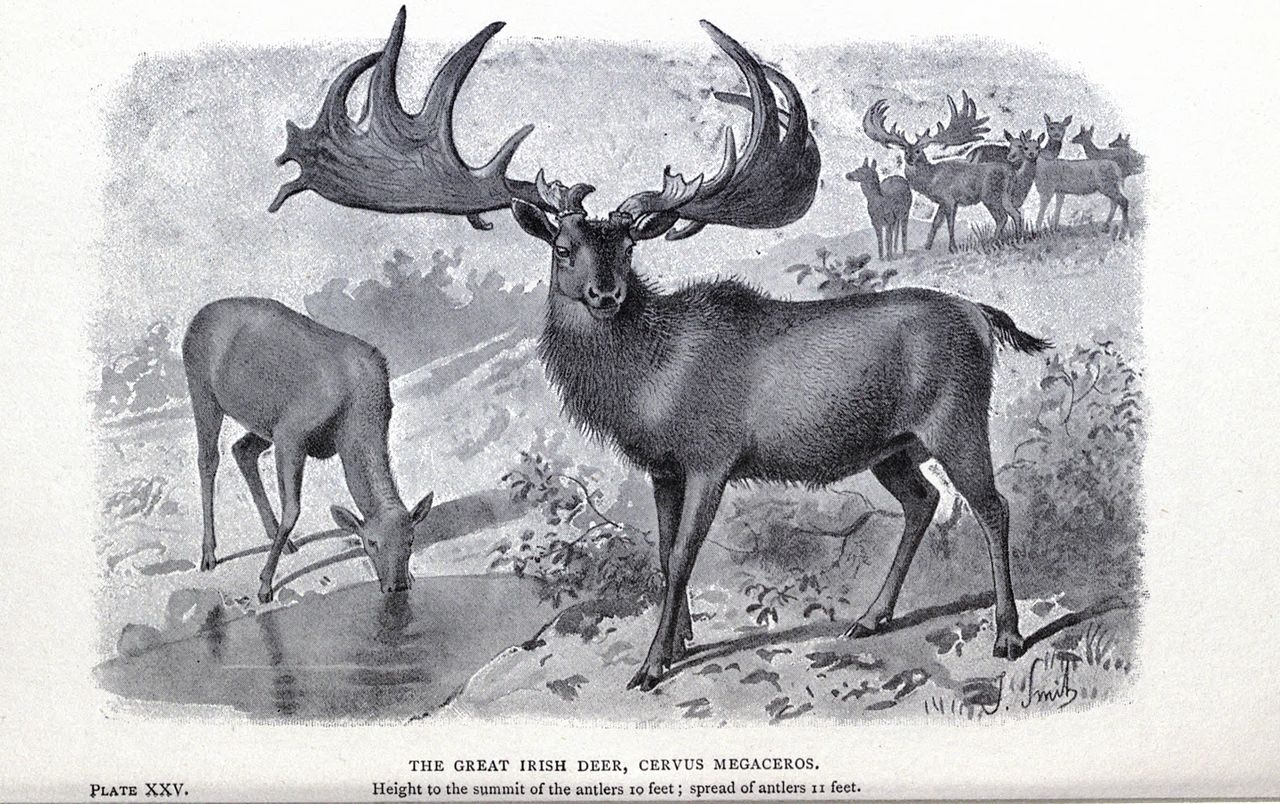
A word of warning from the Irish Elk: Ye are just as mortal as I! 

The existential elk


And now, for something completely different. Evolutionary urban legends, anyone? 

Is it true that the Irish Elk went extinct due to its gigantic antlers, which made it maladaptive?

That’s a great question — and a classic example of how an old evolutionary myth persists long after science has moved on.

Short answer: No, the Irish elk (Megaloceros giganteus) did not go extinct because its antlers were maladaptive. That theory is outdated.


🦌 Background

The Irish elk (not actually confined to Ireland, and not truly an elk) was a gigantic Pleistocene deer species, standing about 2.1 m tall at the shoulder, with antlers up to 3.5–4 m across — the largest ever known in any deer.

It lived across Europe, northern Asia, and even into western Siberia, from roughly 400,000 to 8,000 years ago.


❌ The Old “Antler Hypothesis”

In the 19th and early 20th centuries, naturalists like Richard Owen and others argued that:

  • Sexual selection caused males to evolve ever-larger antlers.

  • These antlers became “too large,” making the animals unable to move through forests or escape predators.

  • This runaway trait supposedly led to extinction — a textbook case of maladaptive sexual selection.

It was a neat moral tale about “evolution gone too far,” but the data never really fit.


✅ The Modern View: Environmental & Nutritional Stress

1. Timing of Extinction

The Irish elk survived multiple glacial and interglacial cycles with its huge antlers.
It only disappeared around the end of the last Ice Age (~8,000 years ago) — long after it had evolved large antlers.

2. Environmental Change

At the end of the Pleistocene:

  • Open steppe-tundra habitats (ideal for large grazers) gave way to dense forests and warmer, wetter climates.

  • Their preferred grazing plants diminished.

  • Populations fragmented and shrank.

3. Nutritional Stress & Antler Growth

Large antlers require enormous amounts of calcium and phosphorus each year.
As vegetation changed, mineral deficiency may have made annual regrowth unsustainable.
Antlers in late populations show pathological thinning and incomplete growth — signs of malnutrition, not maladaptation.

4. Human Hunting

Humans were spreading across Europe at that same time, hunting large mammals.
It’s likely that a combination of climate change, food stress, and human predation pushed the species over the edge.


🧠 The Antlers Were Still Adaptive

  • The antlers were sexually selected — displays of strength and genetic fitness, like a peacock’s tail.

  • Biomechanical studies show they were lighter and more efficient than they appear, well-balanced for the neck and skull.

  • The species thrived for hundreds of thousands of years with those antlers — so they clearly weren’t fatal handicaps.


✅ In summary:

The Irish elk went extinct because of rapid environmental change and resource scarcity at the end of the Ice Age — not because its antlers made it maladaptive.
The “antlers-too-big” story is a Victorian myth, not a scientific conclusion.


If you like, I can show how this misunderstanding influenced Darwin and early evolution debates — he actually discussed the Irish elk as a cautionary example in The Descent of Man. Would you like that?

Yes, please.

Excellent — this is actually one of the most interesting small episodes in the early history of evolutionary theory, because the Irish elk became a kind of test case for Darwin’s idea of sexual selection, and a lightning rod for critics of evolution in the 19th century.

Let’s unpack it step by step.


🧩 1. The Irish Elk in Victorian Science

In the 1800s, when fossils of Megaloceros giganteus were being dug up from Irish peat bogs and English quarries, naturalists were astonished by its size — especially those massive, ornate antlers.

  • Richard Owen, the famous anatomist and critic of Darwin, called it a “magnificent failure of nature.”

  • For Owen, the Irish elk seemed evidence of “degeneration” — that species could over-specialize and doom themselves.

  • This fit a pre-Darwinian worldview where extinction was seen as a kind of moral or cosmic punishment for excess or imbalance.

The image stuck: the Irish elk as a “fallen aristocrat” of evolution.


🧠 2. Darwin’s Counterargument

When Charles Darwin published The Descent of Man (1871), he was developing his concept of sexual selection — how traits evolve not because they help survival, but because they attract mates.

Critics said: “But what about the Irish elk? Its antlers were so big they must have killed it off!”

Darwin replied (in paraphrase):

The antlers were not fatal — the species lived with them for a very long time. They must have been useful for sexual display and competition.
Extinction likely came from environmental change, not from the antlers themselves.

In Descent, Darwin writes that the idea of “destruction through overdevelopment” is “very improbable,” noting that:

“The structure of no living creature is a mistake in the ordinary sense of the word.”

So, for Darwin, the Irish elk actually supported his theory:
its giant antlers were proof that sexual selection can produce extravagant structures, not that evolution goes wrong.


🧮 3. Why the Misinterpretation Lingered

Even after Darwin, Victorian scientists and artists kept returning to the image of the Irish elk as a tragic over-specialization — partly because:

  • It was visually dramatic and moralistic (“pride before a fall”).

  • It resonated with human anxieties about decadence and progress.

  • It seemed to confirm that “too much beauty” or “too much display” leads to extinction.

So the myth persisted well into the 20th century, long after the evidence said otherwise.


🧭 4. Modern Retrospective

Today, evolutionary biologists view the Irish elk in line with Darwin’s mature understanding:

  • Sexual selection drove its antler size.

  • The trait remained stable for hundreds of millennia, meaning it was adaptive.

  • Extinction was due to ecological shift, not “evolutionary error.”

But the myth still has cultural staying power — the Irish elk as a parable of evolutionary hubris, nature’s “Icarus.”


✳️ Summary Table

ViewEraExplanation for Antlers/Extinction
Degeneration Theory (Owen)mid-1800sSpecies over-specialized → self-destruction
Darwin’s Sexual Selection1871Antlers = successful display trait; extinction due to environment
Modern Evolutionary Biology20th–21st c.Stable, adaptive morphology + end-Pleistocene climate/human pressure

In short:

The Irish elk didn’t die because evolution “went too far” — it died because the world changed around it.
But for Victorian thinkers, it symbolized the fear that beauty, pride, or excess might destroy even nature’s noblest creations.


Would you like me to show a few Victorian paintings and illustrations that helped cement that tragic “over-evolved elk” image in popular imagination?

Monday, October 13, 2025

Villebråd


Miljöpartiet vill tydligen introducera visent och skogsvildren i Sverige. Inte mig emot. Kommer ändå inte att rösta på dem. Eftersom de antagligen även vill introducera grottbjörn, sabeltandad tiger och pungvarg. Helst nära mänsklig bebyggelse. Företrädesvis daghem. Så nehejdu.

Och ja, jag vet att bilden härovan inte föreställer en skogsvildren utan snarare en fjällren i skogen, men Bing AI håller inte så noga reda på hjortdjurens taxonomi!  

A cat among the ermines


To use a Swedish proverb. Is *this* the world atheists want, I wonder? LOL. 

Saturday, April 5, 2025

Tyger tyger burning bright


So I decided to fact check a stunning statement overheard on the interwebs with my new friend ChatGPT...

Is this a true statement: Tigers appear orange to humans because most of us are trichromats, but green to deer and boars which are dicromats. The tiger´s orange and black colors provide camouflage, helping it stalk hoofed pray like deer and boars effectively. 

Yes, this statement is generally true.

Explanation:

  1. Human Perception (Trichromats):

    • Most humans are trichromats, meaning we have three types of cone cells in our eyes that detect red, green, and blue light.

    • Because of this, we perceive tigers as orange due to how their fur reflects light.

  2. Deer and Boar Perception (Dichromats):

    • Many of a tiger’s prey, like deer and boars, are dichromats, meaning they have only two types of cone cells (usually sensitive to blue and green).

    • This limits their ability to distinguish between red and green hues, making colors like orange appear more like green or grayish tones to them.

  3. Camouflage Advantage:

    • In a forest or grassy environment, greenish or grayish shades blend in well with foliage and shadows.

    • This helps tigers remain less visible to their prey, making them more effective ambush predators.

So, while tigers look orange to us, they likely appear greenish to their prey, enhancing their natural camouflage.


Is the tiger a trichromat or dichromat? 

Tigers are dichromats, not trichromats.

Like most carnivorous mammals, tigers have only two types of cone cells in their eyes, making them dichromatic. Their color vision is similar to that of deer and other prey animals, meaning they have limited ability to distinguish between red and green.

How This Affects Their Vision:

  • Tigers can see blues and greens fairly well.

  • Reds and oranges likely appear as shades of green or grayish tones.

  • This means that while they don’t see their own fur as bright orange like humans do, their camouflage still works effectively in the forest.

Tigers, like other predators, rely more on motion detection and night vision than detailed color perception. Their eyes are adapted for low-light hunting, which is more critical for their survival than distinguishing a full range of colors.

Saturday, February 8, 2025

Slow food Sápmi


När Göteborgs förskolor nyligen skulle uppmärksamma samernas nationaldag (!) valde man att servera hjortkött från Nya Zeeland (!!), eftersom detta visade sig vara billigare än renkött från lappmarkerna (?!). Ger en helt ny innebörd åt uttrycket "go Woke, get broke"...  

Kritik mot att hjortkött serverades


Tuesday, November 26, 2024

My scary Sweden


"Mitt Sverige" (My Sweden) is a nature documentary by Hungarian Zoltan Török. His Sweden turns out to be the scariest part! Think icy islands in the Gulf of Bothnia (?) featuring colonies of cormorants, eagles fighting each other, and ravens harassing seal cubs. 

Later, Zoltan and his family go trekking somewhere in Lapland, with its vast and seemingly empty hill tracts and woods. Or not so empty, since we do get to see bears, foxes, lynxes and wolverines. At one point, the documentary becomes unintentionally funny, as Zoltan says that the Sami (Laps) live in harmony with nature...while the camera shows how they herd reindeer with snowmobiles! I assume these are powered by gasoline?

But sure, if you want a good argument to stay indoors in some safe burb in southern Sweden (the civilized part), I suppose "Mitt Sverige" could be worth watching! 


Monday, March 4, 2024

Heartland


"Excuse me, dear sir,
is this the way to the heartland?"


“Wild Scandinavia” is a three-part BBC series about nature in the Nordic countries. I just glanced at the episode titled “Heartland”. In Sweden, it has been given a somewhat different title: “Sveriges hjärta” or The Heart of Sweden. Which is kind of odd, since some parts of the docu were apparently filmed in Norway and Finland! Cough, cough, cough…

“Heartland” takes us to the Scandinavian and, I suppose, Finnish boreal forests. For some reason, the winter section is more extensive than the summer ditto. Perhaps the Nordic winters are more fascinating for an international audience? Animals featured include lynxes, bears, beavers, reindeer, wolverines and wolves. One high point of the documentary is a struggle between bears and wolves over a reindeer carcass. Another is a similar struggle involving golden eagles and ravens. Ospreys are also shown. We even get to meet human ice-skaters! A strange oversight is that no deer or moose are shown. 

The production ends with the lekking (mating rituals) of the black grouse, a relatively large galliform living in the “heartland” forests. The film team had to spend the night at the lek grounds in freezing winter temperature. Geezus, can´t footage of this kind be obtained with drone technology these days? Or no?

I admit that “Wild Scandinavia: Heartland” could be of some interest to somebody who is completely uninformed about “our” local wildlife. Personally, I tend to avoid the wilder parts of our land, preferring more urban congregations, but I suppose YMMV!


Thursday, February 29, 2024

No lindorm in this one


No deer were harmed when generating this picture!


"Vilda Småland" is a Swedish nature documentary only available for viewers in Sweden at SVT Play. Småland is a region in southeastern Sweden. Over 100 years ago, a maverick ethnologists actually claimed that the dragon-like lindorm was a real cryptid living somewhere in the Smålandese forests but, alas, nobody took him seriously! The real wildlife in the region in question is featured in this production. 

I admit that I got a bit bored after a while, since most of the docu is about deer. But sure, they show three different species, so if Cervidae is your main interest in life and you live within the borders of our kingdom, I suppose you´ll get your treat. Other animals shown include white-tailed eagles (munching on a dead deer!), whooper swans, grebes, the capercaillie, foxes, badgers, boars and lynxes. Weirldy, the sound made by the lynx sound like dog barks?! 

While it´s kind of interesting to watch animals you *almost* see when out strolling, the deer aspect soon got to me. But then, I´m not a hungry lindorm, so there´s that, I suppose!