Showing posts with label Armstrongites. Show all posts

Wednesday, April 2, 2025

And on the seventh day he rested


And then, maybe not. In case you assumed that Adventism was a straightforward thing...Ready to Harvest is here to set you straight, brother! Note that the Adventist movement was split on several different Churches from the get go. If this was the case with Adventism, why should we think early Christianity was any different? 

Friday, September 14, 2018

The plain truth about Ross Perot


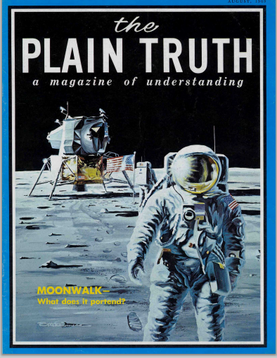
When I searched for “Ross Perot”, all kinds of peculiar stuff showed up. This was the most peculiar. It's an old issue of The Plain Truth, the magazine of the Worldwide Church of God (WCOG), led by Herbert W Armstrong! It turns out that the magazine interviewed H Ross Perot back in 1974.

The interview is short, and so it the accompanying article written by the editors. Perot, originally from the small town of Texarkana at the Texas-Arkansas border, claims to be a Christian in good standing and defends traditional family values. His company, EBS, turns out to have strict standards for its employees. Unfaithful husbands or drunkards are unceremoniously fired. Perot says that he made so much money as a salesman working for IBM that the company stopped him from continuing – he was just too successful. That's when he decided to quit and start a computer business of his own. The Plain Truth argues that making money isn't un-Biblical, as long as you don't love them and endeavor to give back to your community and your country, something Perot has done by starting schools and scouting clubs for disadvantaged children.

Other articles in this issue of The Plain Truth deal with Satanism and Anton LaVey, the Holy Roman Emperor Frederick II, and the importance of family and marriage. Armstrong himself has written an article in his usual grandiose style, “I visited Egypt, met with Kissinger and Sadat”, blah blah. Sure you did, Herb. The strange doctrines of the WCOG are hardly even mentioned, the magazine giving a Christian-in-general impression. In reality, Armstrong preached a message blending Adventism, Mormonism, British Israelism and the power of positive thinking.

As for Ross Perot (who has no known connection to the WCOG), he eventually ran for president as an independent, but that's another story…

Try out a new thing


I've been skimming back issues of “The Plain Truth”, the magazine once published by Herbert W Armstrong's Worldwide Church of God (WCOG). The contents of the issues I've seen so far is surprisingly plain and non-sectarian. This surprises me, since WCOG's theology was anything but. Armstrong's doctrines included the need to observe all Jewish holy days including the Sabbath, the idea that Anglo-Americans are descended from the Lost Tribes of Israel, prophecies about impending doom, and even a kind of “polytheism” (derived from the Mormons). Yet, little of this is visible in the early 1970's back issues of “The Plain Truth”. Clearly, Armstrong used the magazine as a kind of front operation.

This issue contains an article on the war in Biafra. WCOG took a neutral position, but with a slight pro-Nigerian slant. Tribalism and primitive customs are said to be at the root of Africa's problems. There are articles on how to exercise, stay healthy or keep burglars away from your house. The immorality of modern television shows is criticized. A somewhat deceptively written piece on radiocarbon dating turns out to be, surprise, creationist. An article on Franco's Spain claims that Opus Dei (or “Octopus” Dei) is rapidly gaining influence. Anti-Catholic conspiracy theory? There is also a curious piece asking whether the Amazon (!) will become the next bread-basket of the world…

“The Plain Truth” is concluded by a call for hippie teenagers to try out a “new thing”, which turns out to be Biblical (or rather Armstrongite) Christianity. A long list of radio stations transmitting The World Tomorrow (the WCOG's radio talk show) is included. If you had the honor of living in Garden City (Kansas), you could tune in at 6.30 p.m. (presumably local time) and listen to the message. Even on the Sabbath, it seems!

Not sure how to rate this “new thing”, but in the end, I award it three stars.

Neo-liberalism or apocalypse now?


“The Plain Truth” was the magazine of Herbert W Armstrong's Worldwide Church of God. Headquartered in the Californian town of Pasadena, Armstrong's group preached an eclectic message weaving together several different strands of alt-Christianity (my term). Ideas derived from Adventism, Mormonism and even British Israelism can be found in the Armstrongite gospel.

This issue of “The Plain Truth” was published in 1984. It gives a curious impression. On the one hand, the magazine contains optimistic political articles. The main one deals with the transformation of China under Deng Xiaoping, something the editors clearly supported. There is also an interview with Swedish right-wing politician Per Unckel, in which he accuses the Social Democrats of making Sweden too socialist, while expressing the hope that the welfare state will be abolished within 15 years in favor of something better. Once again, the editors sympathize with this (normal neo-liberal) perspective. On the other hand, other articles have an apocalyptic tone, arguing (a bit like the Jehovah's Witnesses) that peace and world government can only come through the return of Jesus Christ and the establishment of the millennial kingdom…

I'm not entirely sure how Armstrong managed to weave *these* strands together!

The Worldwide Church of God also had a radio and TV broad cast, called “The World Tomorrow”. The magazine contains a long list of networks hosting it, including RJR at Jamaica's Montego Bay, CFDL at Deer Lake in Newfoundland, and a radio station in Harrisburg, USA (yes, *that* Harrisburg). Armstrong's strange new gospel was even heard at Radio Luxemburg!

Not sure how to rate this publication, simultaneously both boring and intriguing, but in the end, I will give it three stars.

The mystery of plain truth


Another issue 

“The Plain Truth” was the magazine of the Worldwide Church of God (WCOG), a peculiar Christian group founded by Herbert W Armstrong. WCOG have often been accused of being a sect or even a cult. The back issues of their magazine I skimmed last week looked surprisingly “main line”.

This issue, published after Armstrong's death in 1986, looks more overtly sectarian. It contains a lengthy excerpt on the Kingdom of God from Armstrong's book “The Mystery of the Ages” and an article attacking Spiritualism (the spirits of the deceased are really demons). There is also an article criticizing US protectionism towards Japan and Western Europe. The writer predicts that Western Europe will cut its ties to America in response. This sounds like political commentary, but apparently WCOG believed in an apocalyptic scenario pitting the Anglo-Saxon nations (Israel's descendants) against Germany (Assyria's descendants). Thus, the article is really warning discerning readers that the countdown to eternity has begun…

As usual, “The Plain Truth” contains a lengthy TV and Radio Log, with information on “The World Tomorrow”, the WCOG's TV and radio broadcast. Apart from a large number of North American networks and stations, WCOG's gospel could he seen or heard even in God-forsaken (?) places like Belize, Tonga, Monaco and Norway!

Not sure how to rate this obscure product, which reminds me of Watchtower and Awake, but in the end I give it three stars.

Thursday, August 30, 2018

Got Dan Quayle? Got potatoe?


A review of some kind of cultist material, don´t even remember exactly what anymore! 

I'm not sure exactly what this is supposed to be, but note that God's name is misspelled. It's YAHWEH, for Heaven's sake! The Tetragrammaton. Four consonants ("Y" was a consonant in Hebrew). Or is this some kind of weird Armstrongite cult, still searching for the Ten Lost Tribes somewhere in New England? Besides, some of your neighbours might not wish you Happy Hanukkah if you take the Lord's name in vain, and even spell it incorrectly...

Thursday, August 9, 2018

The mysteries of Herbert W Armstrong


The United States are notorious for spawning strange and idiosyncratic versions of Christianity. The Mormons, the Jehovah's Witnesses and Christian Science come to mind. Some curious Christian groups of foreign origin have also established themselves firmly on US soil, thereby becoming associated with the American religious theatre. The Moonies and the entire spectrum of Rapture-believing premillenial dispensationalists are examples of those.

And then there's the Worldwide Church of God (WCG). Or rather was. During its heyday, the WCG were as well-known as the Moonies, the Witnesses and the Mormons, at least in the United States. Here in Sweden, nobody has heard of them. I therefore read Herbert W. Armstrong's "Mystery of the Ages" with considerable interest! Armstrong was the founder of this church, but after his death, it changed most of its doctrines and turned evangelical. A veritable maze of splinter groups still uphold all or part of Armstrong's original teachings.

Armstrong's message is original and innovative, and yet strangely familiar to students of new religious groups. The explanation is simple: Armstrong combined ideas from several different sources, and then marketed the new blend as his own invention. The avid reader will recognize influences from Mormonism, Adventism, British Israelism and Charles Russell. Perhaps he was also influenced by the later Jehovah's Witnesses? The gap theory is thrown in for good measure, and Armstrong also wrote another book about "the seven laws of success". I haven't read it, but here's a wild guess: Christian Science!

Armstrong believed that God, although an invisible spirit-being, nevertheless has the shape of a human. After all, how could he have created man "in his image" otherwise? And how could those who have seen the Son also have seen the Father? The Son came in the form of a man. Therefore the Father must look like a man. This crudely anthropomorphic concept of God can also be found among Mormons and Russellites. Indeed, it's probably taken from the Mormons, since Armstrong also says that Father and Son are a "God family" and that saved believers will eventually become part of this family. In other words, those who believe the WCG's message will become gods themselves, and will then populate all planets in the universe. This is vintage Mormonism.

Armstrong further taught the doctrine of soul-sleep, the idea that the soul dies with the physical body, and that both are resurrected simultaneously. Thus, he denied the automatic immortality of the soul, and hence any intermediate state in which the disembodied soul consciously awaits the final judgement. This is also the Adventist and Russellite teaching. The Church, according to Armstrong, does not attempt to save all of the world. Christianity was never supposed to become a majority religion. Its function is to organize a spiritual elite, a small group of people who will rule the future Millenium together with Christ. Eventually, this small group will become part of the "God family", as already mentioned. The rest of humanity will be resurrected after the Millenium, at the Great White Throne Judgment. They will be given a second chance (or in many cases, a first chance) to embrace the teachings of Jesus Christ and his saints. This division of humanity into a small elite group and a large majority, which will nevertheless be given another chance, is probably taken from Charles Russell, although the details differ.

Armstrong's description of the Millenium is almost ridiculously detailed. Unless I'm mistaken, the chain of command will look like this: Abraham, Isaac and Jacob will rule over both Israel and the Gentiles, with Moses and Elijah as their assistants. Several times, Armstrong hints that *he* is Elijah, so presumably he will be in charge of "all organized church, religious and educational activity" during Christ's millennial reign. Next in command is David, ruling the twelve tribes of Israel. The nations descended from Ephraim and Manasseh will have a special leading role. The Gentile nations come further down in the hierarchy, being presided over by Daniel and Paul. (The Jehovah's Witnesses became notorious for similar speculations. I'm not sure whether Russell had any ideas about it.) The size of the oceans will be made smaller, and all deserts will become habitable, in order to solve the problem of overpopulation. Everyone will speak the same language, although Armstrong doesn't reveal which one, and there will be a new era of good art and literature. Also, all taxes and interest rates will be abolished, except tithes to the Church. There will also be a fixed gold standard! Armstrong waxes really eloquent when he does away with democracy, political parties and "wasteful" election campaigns. A more peculiar feature of this Christian Millenium is that Jewish feasts and festivals will be celebrated. (Like the Adventists, Armstrong was a Sabbatarian.)

Armstrong's British Israelism is one of the more controversial tenets of his teachings. However, I can't say that Armstrong sounds particularly racist. British Israelism is simply another curious twist to his message. In Armstrong's interpretation, the United States is the tribe of Mannaseh, Britain is the tribe of Ephraim and the other lost tribes of Israel are represented by the nations in northwestern Europe, including Sweden.

The WCG were, of course, accused of being a cult. An entire website devoted to exposing Armstrong and his followers exists. As already mentioned, the new leaders who took over after Armstrong's death actually steered the group into main-line evangelicalism, but many hard-line Armstrongites still remain.

"Mystery of the Ages" is an interesting read for those fascinated by new religious movements and strange forms of Christianity.
Recommended, in a way.

Sticking the pieces together


As I explained in another review, The Worldwide Church of God (WCG) was virtually unknown in Sweden. I even checked the standard work on Swedish "alternative" religions, and it wasn't included. There seems to have been a small group of followers in neighbouring Norway, however. As a teenager, I actually heard of "The World Tomorrow", but assumed it was an obscure fundamentalist TV show, and thought no further of it.

To an outsider like myself, the WCG looks like the Jehovah's Witnesses, but with an even more curious message. The founder and leader of the WCG, Herbert W. Armstrong, seems to have blended Adventism, Mormonism and British Israelism. He was also a "Judaizer" of sorts, who insisted on the keeping of Jewish feast days. After Armstrong's death, something sensational happened: his choosen successor Joseph Tkach slowly but steadfastly began to change the distinctive doctrines of the church, eventually turning it into a main-stream evangelical denomination. There are two books that tell the story from the "Tkachist" perspective: "The Liberation of the Worldwide Church of God" by J. Michael Feazell, and "Transformed by Truth" by Joseph Tkach jr. (the present leader of the WCG).

This book, by contrast, tells the story from the perspective of a splinter group which decided to continue preaching the original message of Armstrong. The group calls itself Philadelphia Church of God (PCG). The author is the son of the current leader of the PCG. Whether Armstrong's movement was an outright cult, sociologically speaking, I cannot say. However, the Armstrongite WCG was obviously a very authoritarian, hyperactivist, top down operation, with the usual string of false prophecies, failed healings, and so on. I therefore expected "Raising the ruins" to be the usual round of cultish mumbo jumbo. In other words, typical weekend entertainment!

Was I surprised...

Actually, the book is a perfectly serious look at the transformation of the WCG from the viewpoint of the dissidents. Many interesting documents are quoted, and intriguing facts are unearthed. We get to learn about the financial situation of the WCG both before and after Armstrong's death, membership figures, the secretive nature of Tkach's changes of fundamental Church doctrine, and, yes, some gossip. One ironic fact that emerges is that the reformers were just as authoritarian as the old guard, since the only way to change the WCG's religious message was by command from above. (Feazell actually admits this in his pro-reform book.) Armstrong had indoctrinated (or educated, if you like) the members and ministers so well, that most simply left the church when Tkach, Feazell and the other reformers started changing the doctrines! Today, the reformed WCG is a very small denomination.

About half of the book deals with a remarkable court case, in which the reformed WCG attempted to stop the PCG from re-printing Armstrong's book "Mystery of the Ages", despite the fact that the WCG no longer believed the contents of the book, and had no plans to re-print it themselves! The WCG even boldly proclaimed that it was their "Christian duty" to stop Armstrong's heretical books from being circulated. After six years, the suit ended in a somewhat unexpected way: the WCG agreed to sell the copyright to most of Armstrong's writings to the PCG for 3 million dollars. The PCG agreed. Instead of stopping the heresy, the WCG now decided to make a fast buck out of it.

Of course, the book is fiercely partisan, and some questions are never really answered. For instance, Tkach is consistently portrayed in a very negative light. Apparently, he was bad both as a leader, speaker and missionary. He was supposedly a bit stupid, too. So how come Armstrong personally designated Tkach as his successor? Judging by the book, Tkach played a prominent role in defending the WCG against an earlier group of reformers, led by Armstrong's own son, who attempted to grab WCG's substantial estates in Pasadena with the aid of the courts and the police. Perhaps Tkach wasn't so incompetent after all? Another question left hanging in the air is the motivation behind the changes. Flurry believes that it was financial. The reformers sold off most of WCG's assets, some of whom were worth tens of millions of dollars! However, his own figures show no particular correlation between the reforms and the financial situation of the church. If anything, I got the impression that the evangelical WCG is *less* successful financially than the Armstrongite original. If the reformers were simply after cash, why not stay on course? Armstrongism, after all, seems more lucrative.

The book does give the impression that Armstrong didn't really control the church during most of the 1970's. This created elbow room for a more reform-minded group to take over the daily operations. Somehow, Armstrong managed to take back control later in the decade. When his own son attempted a hostile take over, some of the reformers must have gotten cold feet and decided to back the old man instead. But as the reformer Feazell points out in his book on the WCG, Armstrong seems to have been a very paranoid and lonely man the last years of his life, constantly attempting to "divide and rule" the administration at Pasadena. Or perhaps not so paranoid - the old fox suspected something! According to Flurry, Armstrong appointed Tkach his successor on the explicit condition that Tkach must fire his personal staff, and he also made room for a board of directors. Clearly, Armstrong attempted to divide and rule almost literally from his deathbed. In the end, he wasn't successful. Tkach seems to have fired *Armstrong's* staff the very same day the old leader died! This doesn't sound like a completely cultist group. In such groups, power struggles of this kind are virtually impossible. My best guess is that control became lax during the 1970's. That's the master key to the whole story.

Finally, some personal observations. When I read "Mystery of the Ages", I was struck by Armstrong's constant references to world leaders he is supposed to have met. Naturally, I assumed he was lying through his teeth. Cult leaders often claim to have contacts on the highest possible levels. Sometimes they are right (Moon and LaRouche comes to mind). Usually, they have delusions of grandeur. In high school, I interviewed the leader of a small political sect the name of which I won't disclose, who claimed to head an "international movement" with sections in far-away places such as Nigeria and Turkey. Naturally, he also claimed to be a backstage advisor to the Swedish government! Did I believe him? Of course not. His group probably never had more than ten members! However, they were *very* good at making PR, and were constantly mentioned in large Swedish newspapers. I was convinced that this Armstrong fellow was something similar. "When I met Chinese officals..." "When I met the king of Thailand". Yeah, sure, whatever.

Was I surprised when I saw the photos in Flurry's book...

:D

I can't say I like Herbert W. Armstrong and his frankly weird message. In fact, I like him even less when I see his smiling face alongside that of Nancy Reagan. Apparently, he had good relations with Ferdinand Marcos, too. But Flurry's book at least shows that Armstrong's opponents may have some explaining to do as well.

Reading "Raising the ruins" and sticking the pieces together, has been a fascinating experience.

Lost in speculation


The author of this book, Stephen M. Collins, is a former member of Barry Fell's hyperdiffusionist organization, the National Epigraphic Society. His religious views are less clear, but he seems to be a dissident Adventist or Armstrongite. The book itself is published by the Christian Patriot Association, apparently a militia outfit in Oregon, best known for its attempt to create an underground bank independent of the IRS. Judging by the author's website, his political positions are less extreme than those of the CPA, however. (The book was published almost 25 years ago.)

The whereabouts of the ten lost tribes of Israel has fascinated both Jews and Christians for millennia. Virtually all regions of the globe has been proposed as the true home of the lost tribes: India, China, Ethiopia, Afghanistan, even northern Europe. The Mormons still believe that the American Indians are descendent from the tribe of Manasseh. That would make *me* a true Israelite. Thank you. Meanwhile, many Oriental Jewish communities claim to be one of the lost tribes, and if you accept that, most of the tribes have already been re-united with Judah in modern Israel. This is also the position of some Orthodox Jews. Of all the speculations about the lost tribes, the only ones that are at least seemingly serious place them in Kashmir and Afghanistan. But even that seems to be a very long shot.

Collins believes in something known as British Israelism. Under this scenario, northwestern Europeans in general and the Anglo-Saxons in particular are descended from the ten lost tribes mentioned in the Bible. More specifically, Britain is Ephraim while the United States is Manasseh. This position was also held by Armstrong's Worldwide Church of God (WCG). One of Armstrong's points was that Biblical prophecies about a future attack on Israel are actually about a Russian attack on the United States and Britain!

Collins' book "The Lost Ten Tribes of Israel Found" is an attempt to back up these claims by historical research. It's not convincing. Rather, the author ends up making even wilder claims as he goes along. He claims that the Phoenician trading empire was really Israelite. Next, he identifies the Scythians and Parthians with the lost tribes. But these peoples were Indo-European rather than Semitic! Parthia is idealized and depicted almost as a Western-style democracy. As for Jesus, he was supposedly a royal claimant to the Parthian throne. Why else would the Magi search for him? During his lost years, not recorded in the Bible, Jesus travelled widely, to both Britain, Parthia and pre-Columbian America. Apparently, Jesus and Quetzalcoatl is the same person! Collins also believes in the correspondence between Jesus and king Abgar of Edessa (actually a 4th century forgery), since the rulers of Edessa had good relations with the Parthians. After the fall of Parthia, the lost tribes migrated to Europe, where they became known as Goths and Saxons. Proof? One of the Schythian tribes was named Massagetae, which sounds like Manasseh. It also sounds like Getae (an ancient people in Thrace), which sounds like...Goths!

Really?

Somehow, I feel Collins has gotten lost in all his speculations!

Of course, the whole point of this book is to claim that the prophecies of the Bible that apply to Israel, really apply to the Germanic nations, making them somehow special. Ironically, this makes it necessary to reclassify the Germanic peoples as Semitic, rather than Indo-European, which may or may not rub some other factions of the alternative milieu the wrong way. It also makes it necessary to claim that the Semites were White. Collins tacitly assumes that the Egyptians were White as well, otherwise the prophecies concerning Ephraim and Manasseh might as well be applied to Black nations. Ephraim and Manasseh, of course, were half-Egyptian.

"The Lost Ten Tribes of Israel Found" is of interest to people doing research on the legend of the ten lost tribes. However, it cannot be considered real history. The ten tribes, it seems, are still lost, somewhere beyond the Sabbath river...

Hard to Believe Award


"The United States and Britain in prophecy" is a book by Herbert W. Armstrong, the founder and leader of the Worldwide Church of God (WCG). Today, this church has repudiated Armstrong's message, but his books are still distributed by other groups, most notably the Philadelphia Church of God (PCG).

Armstrong's book on the United States and Britain argues a peculiar form of replacement theology. According to the author, whenever the Bible speaks of Israel, it's not referring to the Jews. So who is Israel, then? After a long, tedious and sometimes mind-boggling exercise in Biblical exegesis and pseudohistory, Armstrong reaches the conclusion that the ten lost tribes of Israel migrated to northwestern Europe. Anglo-Saxons, Celts, Scandinavians, the Dutch, the Belgians and the people in northern France are the real Israel of the Bible. More specifically, the tribe of Manasseh is the United States, while the tribe of Ephraim is the British Commonwealth. The Germans are excluded from this European Israel. Armstrong wrote the first edition of his book during World War II, taking a strong anti-German stance. In his scenario, the Germans are descended from the Assyrians! Why the people of *southern* France aren't included in Israel, is never explained. Because they weren't conquered by the Normans?

Armstrong concedes that the Jews are part of Israel, but only a smaller part. He very consistently downplays their importance. The Jews did have the "sceptre", but this was fulfilled by Jesus (who, of course, was rejected by most Jews anyway). The right to the land belongs to all of Israel, so presumably Anglo-Saxons and other peoples of north European stock have the right to most of Palestine. God did promise that the throne of David would last forever. According to Armstrong, however, the prophet Jeremiah transplanted the throne from Judah to the ten lost tribes during a visit to Ireland! So the throne of David doesn't belong to the Jews either, but is also in European hands. The author even claims to know where the throne is today. It's the British royal throne! The Stone of Scone, connected to the patriarch Jacob by some old legend, is cited as proof.

But what is the point of this exercise? It cannot be complete anti-Semitism, since Armstrong politically supported the modern state of Israel. The best interpretation is that Anglo-Israelism is a form of British and American nationalism and exceptionalism. The Jewish idea about being God's chosen ethnic people seems to have an irresistible pull on Christians as well. Not content with being the spiritual-universal people of God, such Christians appropriate the role played by ethnic Israel in the "Old Testament" and apply it to themselves. That such an idea would evolve in the British Empire during its Victorian heyday is scarcely surprising. What's more surprising is that Anglo-Israelism has been transplanted to the United States, and taken up by a rather obscure sectarian movement with no special connection to British interests.

But perhaps there is a logical explanation to that as well. Armstrong originally regarded World War II as the end of days. If Western Europe and the US is Israel, then the Nazi attack on those nations can suddenly be given a Biblical interpretation. After all, the Bible does prophesize an attack on "Israel" during the last days. Later, this was taken to mean a Russian attack on NATO. However, Armstrongite groups still believe that Germany will eventually rise again, turn Nazi and presumably go to war against Britain and America.

A more esoteric reason for why anyone would want to construct theories about Ephraim and Manasseh is that the Bible contains a prophecy by Jacob according to which the descendants of these boys will indeed become powerful nations. This prophecy, of course, never came to pass. The tribes of Manasseh and Ephraim were taken captive by the Assyrians and disappeared from history. A certain kind of fundamentalist, who believes that "every word" of scripture is "inspired", simply cannot accept this. Armstrong's solution is that the two tribes *did* become powerful nations: Great Britain and the United States. Hence the Bible is saved.

"The United States and Britain in prophecy" is an essential read for those interested in the legends surrounding the ten lost tribes, and can also serve as an introduction to the ideas of Anglo-Israelism. But is it true? Of course not. Armstrong deserves this week's Hard to Believe Award!

Friday, July 27, 2018

Thank God for the Easter Bunny


For decades, the Worldwide Church of God (WCG) of Herbert W. Armstrong taught a curious message blending Adventism, Mormonism and British Israelism, while claiming to be the only true Christian church. After the death of Armstrong in 1986, his anointed successor Joseph Tkach, Sr began to gradually change the long-established theology of the WCG in the direction of standard evangelicalism or even mainline Protestantism.

"The Liberation of the Worldwide Church of God" is written by J. Michael Feazell, the right hand man of both Tkach Sr and the current leader, Tkach Jr. Somewhat surprisingly, the book says very little about what actually happened when the WCG was "liberated" from Armstrongism. Most of it reads like a sermon, other parts sound like an internal manual for Church administrators with titles like "Strategies for sound body life" and "The path of renewal".

Feazell does make two interesting admissions. First, he reveals that there were a lot of intrigues and conspiracies going on at WCG headquarters in Pasadena during Armstrong's last years. Second, he confirms that the changes after the old man's death were rammed through by an authoritarian, central leadership - most members (interestingly enough) refused to accept the new course. Says Feazell: "To involve pastors and members of a cult in the planning and implementation of doctrinal changes that completely transforms the core assumptions and values of the cult is to destroy the process before it begins". He also writes: "If you take the pressure off, people will revert to their old ways. (...) If we were to stop teaching the changes right now and invite members to go back to the old doctrines, I am convinced that a certain percentage would do so". The book contains statistics showing a steep fall in membership and church attendance due to the doctrinal changes, especially the rejection of Sabbatarianism.

In general, however, Feazell simply sidesteps all the controversies. He says nothing about the (bizarre) court case between the reformed WCG and a splinter group, the Philadelphia Church of God. Instead, the author tells a few, admittedly disturbing, personal anecdotes. Thus, Feazell almost lost one of his children to pneumonia before deciding, at the last moment, that the WCG's prohibition of modern medicine is unbiblical. This is indeed a scary aspect of cultism. The Jehovah's Witnesses' ban on blood transfusions comes to mind.

On a funnier note, the author quotes C.S. Lewis' stories about Narnia to drive home a theological point about inclusive salvation, and exclaims: "Praise God for Fred Rogers and Santa Claus! Praise God for the Easter Bunny and chocolate eggs! Today in the town of David a Savior has been born to you. He is Christ, the Lord." Well, at least it sounds funny to an outsider - maybe Feazell is saying it with a straight face. (Armstrong opposed Christmas and Easter as "pagan". Fred Rogers is apparently a children's channel show host who once dressed as Santa Claus, which bewildered Feazell's kids.)

Believe it or not, but the pro-Armstrong and anti-Tkach book "Raising the ruins" by Stephen Flurry, a member of the Philadelphia Church of God, is actually much more interesting! See my extensive review of it elsewhere.

Feazell's surprisingly boring book only deserves two stars. But sure, thank God - or was it the God Family - for the Easter Bunny, LOL.