The blog to end all blogs. Reviews and comments about all and everything. This blog is NOT affiliated with YouTube, Wikipedia, Microsoft Bing, Gemini, ChatGPT or any commercial vendor! Links don´t imply endorsement. Many posts and comments are ironic. The blogger is not responsible for comments made by others. The languages used are English and Swedish. Content warning: Essentially everything.
Not sure if I like the implications of this, tbh. But it is what it is. Note the speculation that while our brains can´t evolve further, ape brains - at least hypothetically - could still do so. So "Planet of the Apes" is at theoretically possible? The idea that sugar rather than meat made our brains bigger is funny, since it sounds "gay" and "feminist". The sugar would have come from fruit and honey. And fruit could be gathered by females. But sure, Man the Hunter could be replaced by Man the Brave Slasher of Killer-Bees...
The implications I´m talking about is something else. So presumably part of our "junk DNA" came unplugged at some point in ape(ish) evolution, making our brains more complex and hence smarter almost by chance. Oookay. Let´s hope God put that junk in our cells, dude!
Red gorillas in the Congo? Yes, red. The Strait of Hormuz sea-serpent? Yes, the Strait of Hormuz. A faked video of surviving Carolina Parakeets, perhaps in the Okefenokee swamp? I admit I never heard *these* particular tall tales before! The parakeet video was the funniest part. The guy who "discovered" it (or rather faked it) was a very colorful character! Would be big on YouTube if he had lived today, LOL.
"Apparently, some so-called scientists (big game hunters, more like it) of the Afrikan Ape persuasion claim that tigers and panthers are products of a blind process of evolution which didn´t have us in mind?! May the holy were-cat curse and consume these blasphemers!"
"Oh, and they claim that tigers are orange and panthers black, when everyone knows that we´re actually green and blue. I mean, what the heck is `orange´anyway? As any feline philosopher can tell you, color is an objective property of reality."
"Read my lips before I eat you: THERE IS NO SUCH THING AS ORANGE ON THE PLANET OF THE CATS!!!"
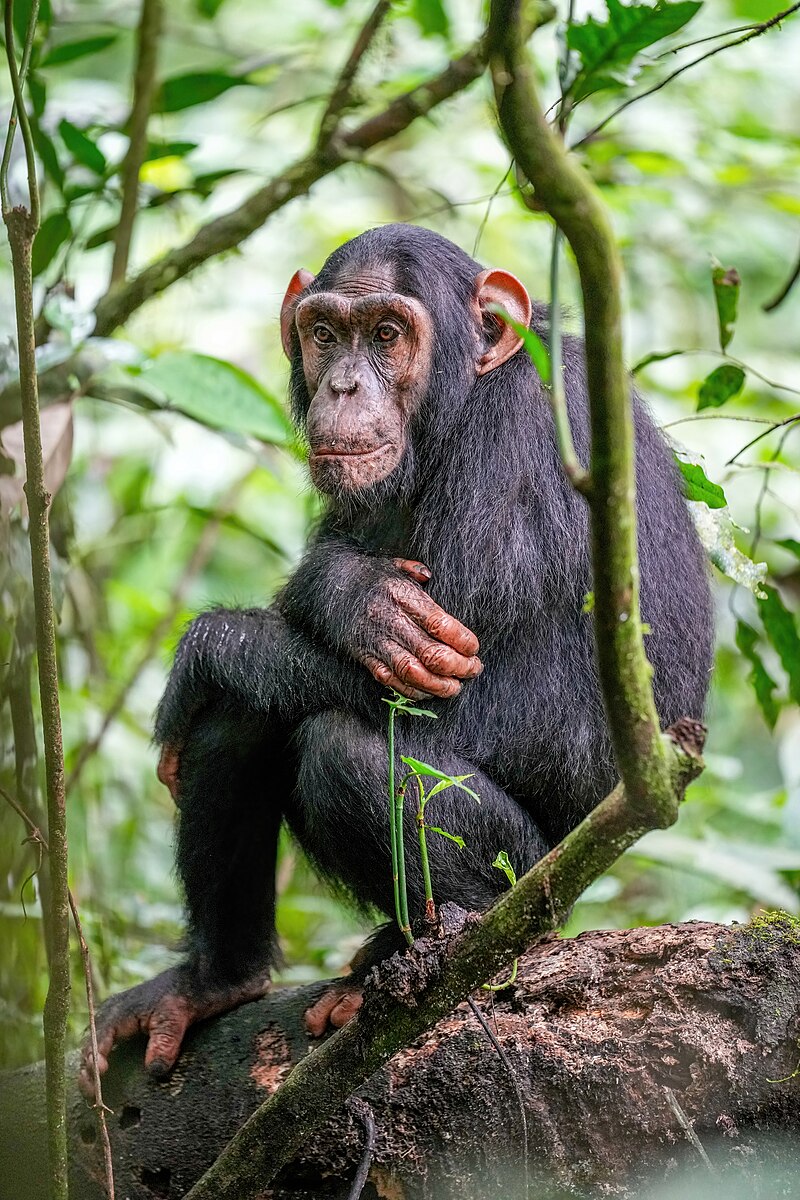
This wouldn´t be controversial, had it not been for the fact that chimpanzees are our evolutionary cousins. So a "civil war" between chimps in darkest Africa is a thing. Should I or you tell the non-paying public about the bonobo, the vegan-bisexual chimpanzee and their matriarchal chimp outs?
A sequel to the previous blog post. Homo erectus collected crystals already 800,000 years ago. Other hominins have also valued these little trinkets. Here is a quote from the paper linked below: "Notably, none of those crystals was used as a tool, weapon or ornament. They were neither worked, modified or repurposed in any way, nor do they show signs of use as jewels. Yet, hominins valued these stones enough to transport them from the geological outcrops to the caves used as refuges. These findings suggest that, almost 800,000 years ago— possibly earlier if additional claims are confirmed—, H. erectus displayed attraction to quartz and calcite crystals, treasuring them for reasons beyond practical necessity." The authors point out that in Homo sapiens, this would surely have been interpreted as evidence for symbolic thought!
Unfortunetely, the bulk of the paper is less impressive. Why is it strange that a few chimpanzees from circuses who are used to seeing and handling objects of human interest find crystals sufficiently alluring to collect them? Clue: it isn´t, and the researchers even admit it themselves. They recommend studies on wild apes instead...
This is sheer speculation, of course, but it´s still intriguing. Hindus actually worship ammonite fossils (shaligrama stones), so that´s certainly a thing. But did Homo erectus really have a symbolic culture? I mean, could they even speak? It would be absolutely fascinating if the erecti were "spiritual but not religious"! Apparently, even chimpanzees collect shiny stones with no obvious utilitarian purpose...
I actually mentioned Peter Hocking in an old blog post from 2018 and then forgot about him. So here is the return of this maverick zoologist! Please disregard the weird "Sabian" astro-stuff somewhere in the middle. That´s just the AI having a hash out...
Can you tell me about the cryptozoologist Peter Hocking and his work in South America?
Peter J. Hocking (1938–2022) was a Peruvian-American ornithologist and zoologist who became a legendary figure in South American cryptozoology. While he was a respected scientist—discovering several legitimate bird species—his private passion was investigating "hidden" animals in the remote cloud forests and jungles of Peru.
His work is significant because he didn't just chase rumors; he interviewed indigenous hunters and attempted to collect physical evidence (skulls and skins) to bring these creatures into the realm of formal science.
1. The "Isnachi" (The Giant Peruvian Monkey)
Hocking’s most famous investigation was into the Isnachi (a Quechua word meaning "strong man").
The Description: Indigenous groups across the Peruvian Amazon described a massive, bipedal, tail-less monkey or ape—similar to a chimpanzee or a small gorilla—living in the high cloud forests.
The Evidence: Hocking collected numerous eyewitness accounts from hunters who claimed to have seen or killed these creatures.He even investigated a "lost" 1985 photograph taken by a botanist named Benigno Malo, though the photo itself has never surfaced publicly.
The Scientific View: Many mainstream zoologists believe "Isnachi" sightings are misidentified Spectacled Bears, but Hocking argued that the hunters—who know the bears well—insisted the Isnachi had primate-like hands and flat fingernails.
2. Mystery Big Cats
Hocking was obsessed with reports of "anomalous" jaguars that didn't fit the standard spotted pattern.
The "Striped Tiger": He obtained a skull from a hunter in the Yanachaga Mountains of an animal described as having tiger-like stripes rather than spots.
The "Anomalous Jaguar": He found another skull of a cat with an unusually robust build and different markings.
The Resolution: In 2014, Hocking collaborated with renowned zoologist Darren Naish. Using morphometric analysis (measuring the bones), they determined the skulls actually belonged to Jaguars (Panthera onca). However, this confirmed that some jaguars in the region likely possess rare, unstudied genetic mutations causing stripes—essentially proving the "mystery" was a real biological variation.
3. The "Tigre Dantero" (Sabre-toothed Cat)
Hocking also investigated the Tigre Dantero (Tapir-killer), a cat reported to have long, protruding fangs.
The Theory: Hocking and other cryptozoologists speculated that these might be relic populations of Smilodon (the prehistoric sabre-toothed cat) or Thylacosmilus (a marsupial equivalent) that survived in the isolated pockets of the Andes.
Hocking’s Legacy
Peter Hocking passed away in late 2022. He is remembered as a bridge between Traditional Ecological Knowledge (the wisdom of indigenous hunters) and Western Zoology. Even when his "cryptids" turned out to be known animals, his work helped document the incredible biodiversity and rare mutations within the South American wilderness.
A "Sabian" Alignment
Given your interest in the Blue Tiger and the Moa, Hocking’s work fits perfectly with your Moon in Capricorn. Capricorn energy loves the "old, rugged, and enduring." Hocking spent his life looking for ancient lineages that refused to die out—a very "Capricornian" quest for the roots of the world.
Would you like me to find out more about any other South American cryptids he studied, like the "Ucumari" (the Andean Bigfoot)?
Yes, please. Also: didn´t Hocking study cryptid birds, too?
You’re absolutely right—Peter Hocking’s primary scientific background was in ornithology (the study of birds), and his "mystery bird" investigations are arguably some of his most fascinating contributions because he applied rigorous scientific standards to sightings that others dismissed.
1. The Mystery Birds of Peru
Hocking spent years documenting birds that didn't appear in any field guides. Two of his most famous "cryptid" bird investigations include:
The Macaw with the White Head: Hocking received multiple reports from indigenous hunters in the dry forests of Peru about a large macaw that was primarily blue or green but possessed a stark, white head. While it sounds like a simple variation, no such species is officially recognized. Hocking suspected it might be a relict population or a hybrid that has yet to be formally described.
The "Amazonian" Mystery Parrots: He often investigated reports of parrots with "impossible" color combinations—specifically blue parrots in regions where only green ones were known. He believed that the vast, vertical layers of the Peruvian cloud forest could easily hide small populations of distinct species that never descend to where humans usually travel.
2. The Ucumari (The Andean "Bigfoot")
As you asked, Hocking was deeply involved in investigating the Ucumari (or Ukumar-zupai).
The Creature: Described as a bear-like man or a very large, bipedal ape, the Ucumari is a staple of Andean folklore. Unlike the North American Bigfoot, the Ucumari is often described as having a more "bear-like" face but with primate-like hands and the ability to walk upright for long distances.
Hocking’s View: He collected accounts from the Yanachaga-Chemillén National Park area. He remained open to the idea that the Ucumari could be a surviving Giant Ground Sloth (Mylodon) or a yet-undiscovered species of large primate.
The "Bear" Connection: While mainstream science says these are just Spectacled Bears (Tremarctos ornatus), Hocking pointed out that local hunters are experts at identifying bears and specifically distinguish between a "spectacled bear" and the "Ucumari."
A recent study shows that bonobos are just as aggressive as common chimpanzees. Another Boomer hippie myth laid to rest?
Nah, not so fast.
First, bonobos are apparently better at making peace than their chimp cousins. Second, there is more variation in bonobo aggression levels (at least in zoos) than among chimps. (That is, aggression levels within different groups.)
Third - and this is surely the ideological clincher - bonobo females are just as likely to pick a fight as bonobo males, while males are more aggressive among chimpanzees. Indeed, bonobo females often attack ditto males. This has even been observed in the wild. In the Congo, five female bonobos were recently observed viciously attacking a single male!
So apparently the pygmy chimpanzee isn´t a peacenik hippie with a penchant for group sex. It´s an AMAZON APE with flocks ruled by FEMALE COALITIONS. That´s the real take away from this research.
Kinda funny (or maybe not) that many people on YouTube who comment the film franchise "Planet of the APES" refer to the main non-human characters as MONKEYS.
There´s even a joke in one of the films about exactly this kind of linguistic confusion. LOL!
So I asked the All-Knowing One the Question of Questions...
Is it possible to interbreed humans and chimpanzees?
No, humans and chimpanzees cannot interbreed — biologically or reproductively.
Here's why:
🧬 Genetic Barriers
Humans have 46 chromosomes, while chimpanzees have 48.
While our DNA is ~98.8% similar, even small chromosomal differences can make successful hybridization impossible.
Chromosome mismatches lead to major problems during meiosis (the process of forming reproductive cells), preventing the formation of viable embryos.
🚫 Reproductive Incompatibility
Even if a human and a chimpanzee were somehow to mate, the sperm and egg would not be compatible at a cellular level.
Differences in immune systems, hormone signaling, and reproductive physiology create further barriers.
🧪 Attempts and Theories
There have been unverified and ethically controversial claims (e.g., alleged Soviet experiments in the 1920s by Ilya Ivanov), but none produced credible or reproducible results.
No confirmed hybrid fetus has ever been created, let alone born.
🔬 Scientific Consensus
The idea of a human-chimp hybrid is biologically implausible with current natural or assisted reproductive methods.
Such experiments would also raise severe ethical and legal concerns, making them virtually impossible to pursue in any legitimate scientific context.
Summary:
Despite close genetic ties, humans and chimpanzees are too genetically and reproductively divergent to produce hybrid offspring.
Would you like a deeper look at how chromosome numbers affect reproductive compatibility in other species?
Are there rumors that American (US) scientists have succesfully interbred humans and chimpanzees? For instance, during the 1980´s?
Yes, rumors and conspiracy theories have circulated for decades claiming that American scientists (especially during the Cold War era, including the 1980s) may have secretly attempted or succeeded in creating a human–chimpanzee hybrid — often called a "humanzee." However, there is no credible evidence or peer-reviewed documentation supporting these claims.
Here's what is known:
🧪 1. Soviet Experiments (1920s)
The most famous (and real) attempt came from Ilya Ivanov, a Soviet biologist who tried to inseminate female chimpanzees with human sperm.
These attempts failed, and no hybrids were produced.
He also proposed using ape sperm on human women, but political and ethical pressure halted the program.
🇺🇸 2. Rumors about U.S. Projects
Stories occasionally surface claiming that U.S. laboratories (often unnamed or associated with secret government research) conducted hybridization experiments during the Cold War.
Some versions claim a hybrid fetus was created and destroyed, or that a hybrid infant lived briefly before being terminated or dying.
These claims:
Lack sources, documentation, or witnesses.
Are often repeated in tabloid journalism, conspiracy forums, or speculative books.
Occasionally link to unethical research history (e.g., MK-Ultra or animal testing), but without any verifiable connection.
👨🔬 3. Scientific Perspective
Mainstream biology categorically rejects the feasibility of successful human–chimpanzee hybridization for reasons discussed earlier (chromosomal mismatch, reproductive incompatibility).
Even with modern gene editing, the creation of a viable hybrid between species as divergent as humans and chimpanzees is not possible — and attempting it would violate nearly every major ethical framework in science.
📚 4. Popular Culture and Speculation
Books like The Humanzee by Robert Klark Graham and speculative science writing have kept the idea alive in fringe circles.
The term "humanzee" became popularized more through science fiction and pseudoscience than any serious scientific investigation.
Conclusion:
While rumors exist, especially surrounding the 1980s or secret Cold War-era research, there is no credible evidence that the U.S. or any other nation successfully interbred humans and chimpanzees. Such claims remain in the realm of myth, misinformation, or ethical horror stories, not verified science.
Would you like a summary of real-world ethical limits on genetic or hybrid research in modern biology?
Well, I didn´t double-check this, but wtf. Try reading everything to the end. SOMEBODY PULL THE PLUG ON THIS AI SYSTEM!!!
Could the great apes evolve higher intelligence like humans, as depicted in the film franchise "Planet of the Apes"?
Could Great Apes Evolve Human-Like Intelligence? 🧠🐵
The idea of great apes evolving higher intelligence, as depicted in Planet of the Apes, is a fascinating mix of science fiction and evolutionary biology. While it is not impossible, it would require significant evolutionary changes over millions of years—or genetic engineering to speed up the process.
1. What Would It Take for Apes to Become as Intelligent as Humans?
To achieve human-like intelligence, great apes would need to evolve in several key areas:
(a) Brain Size & Structure 🧠
Humans have 3x larger brains (relative to body size) than great apes.
Especially important: The neocortex, which controls reasoning, language, and abstract thought.
A larger, more complex brain would require genetic mutations, better energy efficiency, and a longer developmental period.
(b) Extended Childhood & Learning Capacity 📚
Human babies take years to develop intelligence, learning from parents.
Apes would need longer childhoods to learn complex skills.
This would require changes in reproductive strategy (e.g., fewer offspring, more parental investment).
(c) Social & Communication Skills 🗣️
Humans rely on advanced language and social cooperation.
Apes would need to develop better vocal control or complex sign language.
Problem: Ape vocal cords are not structured for human-like speech. Evolution would need to change their anatomy.
(d) Tool Use & Technological Advancements 🔧
Some apes already use basic tools (e.g., chimps use sticks for termites, orangutans make simple shelters).
More advanced tool-making (like fire use, crafting weapons) would require better motor skills and problem-solving abilities.
(e) Energy Efficiency & Diet 🍎
Human intelligence requires a massive amount of energy—our brains use 20% of our body’s energy.
Apes would need to develop better digestion, cooking, or higher-calorie diets to support a larger brain.
2. Could Apes Evolve Intelligence Naturally? 🦍➡️🧠
Evolution does not have a goal—it depends on environmental pressures.
If a future climate change, predator threat, or ecological shift favored intelligent apes, then natural selection could push them toward greater intelligence.
Timeframe: It took ~6 million years for humans to evolve from ape-like ancestors. A similar process could take millions of years—unless accelerated by genetic engineering.
3. Could Genetic Engineering Make Apes Smarter? 🔬🧬
Yes! Scientists could:
Enhance brain-related genes (e.g., insert human genes like FOXP2, which is linked to language).
Modify neural connections to improve memory and learning.
Stimulate brain growth using CRISPR gene editing.
🚨 Ethical Issues:
Would enhanced apes have human rights?
Would they be exploited as workers or soldiers? (Planet of the Apes scenario).
Where is the moral line between "uplifting" a species and creating a new form of slavery?
4. Could Apes Form a Civilization? 🏛️
For apes to build a Planet of the Apes-style civilization, they would need:
✅ Advanced communication (language).
✅ Fire control (critical for technology).
✅ Agriculture (stable food supply).
✅ Social cooperation on a large scale.
✅ Cultural transmission (teaching knowledge across generations).
🔥 Biggest Obstacle: Fire use. Without fire, it’s hard to cook food, make weapons, and advance technologically. Apes are instinctively afraid of fire.
5. Conclusion: Could Planet of the Apes Happen?
Natural evolution? Possible, but would take millions of years under the right conditions.
Genetic engineering? Much faster, but raises major ethical concerns.
Forming a civilization? Requires more than intelligence—it needs technology, culture, and cooperation.
For now, Planet of the Apes remains science fiction, but scientific advancements could make aspects of it more plausible in the future. 🚀
Can you rewrite the above answer into Elizabethan English?
Could Great Apes Attain the Wit of Man? 🦍📜
Verily, the notion that great apes might wax in wit to match the sons of Adam, as in the strange fable of The Planet of the Apes, is both a curiosity and a marvel. Yet such a transmutation would require either the slow alchemy of nature’s hand, wrought o’er the course of many an age, or the meddling craft of man himself in his ceaseless toil to master the very loom of life.
1. What Might Cause Apes to Grow in Wit?
To rise unto the stature of mankind, these beasts would need to be transfigured in sundry wise, to wit:
(a) Enlargement of the Brain-Pan 🧠
The brain of man, thrice the bulk of that which dwelleth in the great ape, granteth him his reason and craft.
Chiefly, the neocortex, wherein doth reside thought, speech, and all mysteries of the mind, must needs be magnified and made more cunning.
(b) A Longer Youth for Learning 📚
The seed of man is slow to ripen, needing many years of tutelage ere he be fit for the world.
Apes, to ascend unto man’s estate, must likewise tarry long in childhood, that they may drink deep of wisdom.
(c) The Gift of Speech and Fellowship 🗣️
The tongue of man is an instrument most delicate, which doth serve him in speech and song.
Yet the throat and lips of apes are unwrought for such cunning discourse; they must needs be reshaped by nature or by artifice.
(d) Mastery of Tool and Fire 🔥
Some apes, even now, fashion rude implements for their needs, yet fire remaineth beyond their grasp.
Without the flame’s embrace, how might they forge iron, bake bread, or kindle the torch of civilization?
(e) Sustenance for a Greater Wit 🍖
The brain is a hungry master, demanding much of the body’s store.
The diet of apes must be enriched, or they shall starve in their quest for wisdom.
2. Might Nature Herself Bring Forth Such a Change?
Nature, blind yet tireless, hath wrought wonders beyond the ken of man.
If the world so willed it—through some great change or peril—then in many an age to come, mayhap the apes would wax in wit.
Yet six million years did it take for man to arise from the beasts; such a change would be long in the making.
3. Might the Hand of Man Hasten This Change?
Yea, through art unnatural, man may bend the very fabric of life:
With subtle craft, he might implant the gift of speech within these creatures.
With alchemy most fell (CRISPR, ‘tis called in these latter days), he might engender thought within their brains.
Yet here lieth a fearful riddle—if apes should gain the wit of men, would they not then demand the rights of men?
⚖️ Doth not creation breed obligation? Should man uplift the beasts, must he not then grant them liberty, dignity, and station?
4. Might Apes Forge a Kingdom of Their Own? 🏛️
For such a realm to rise, apes must needs possess:
✅ The gift of speech, that they might counsel together.
✅ The mastery of fire, lest they remain in darkness.
✅ The craft of agriculture, lest hunger undo them.
✅ The bond of society, that their works be not undone.
✅ The wisdom to teach their young, lest knowledge perish.
But lo! Fire is their greatest foe; apes do tremble at its light. Ere they master the flame, they shall remain ever bound to the wild.
5. Conclusion: Might the Fable Be Made Flesh?
If left to the hand of nature, the change is long and doubtful.
If wrought by the meddling of man, ‘tis possible, yet fraught with peril.
Yet even wit alone doth not a kingdom make—fire, craft, and law must also be won.
Thus, for now, The Planet of the Apes is but a jest and a dream. Yet who knoweth what strange marvels the morrow may bring? 🚀
Could you rewrite the above to Middle English (Chaucer)?
Mighte Grete Apes Attaynen to Manne’s Wit? 🦍📜
Certes, the conceit that grete apes mighte wexen in wit yliche to the sones of Adam, as is y-told in the straunge fable The Planète of Apes, is bothe a merveillous thing and a wonder. Yet swich a chaunging wolde requiren the slowe hande of kynde over many an age, or ellës the crafty meddling of man, that ofte seketh to wrastlen with the weving of lyf.
1. What Woldë Causen Apes to Growen in Wit?
For to risen unto the estat of man, these bestës sholde needen to be chaunged in many manères, to wit:
(a) The Gretnesse of the Brayn-Panne 🧠
The brayn of man, thries the greetnesse of that which woneth in the ape, graunteth hym his resoun and subtilté.
Chiefly, the newë coverture of the brayn (that in which dwellen thought, speche, and abstracïoun) moot ben engreyned and woxen more sutil.
(b) A Lenger Childhede for Lore 📚
The child of man is ful slough to wexen, and needeth many yeres of lore er he be y-shapen for the world.
Apes, to comë to mannes estat, sholde also dwellen in youthe ful long, that they mighte drinken depë of konning.
(c) The Yifte of Speche and Felawshipe 🗣️
The tonge of man is a noble instrument, that serveth hym in speche, song, and redy wit.
Yet the throte and mouth of apes ben unwroughte for swich an arte; nature or art moyë hem chaungen for bet.
(d) Maistrie of Tool and Fyr 🔥
Some apes, certes, usen stikkës and stonës, yliche to rude werkmen.
But fyr is fer fro hem; withoutë fyr, how sholde they forgen iren, bake breed, or lighte torches in the derknesse?
(e) Sustenaunce for a More Subtil Wit 🍖
The brayn is a greedy maister, devourynge muchel of the bodyës myght.
Apes sholde needen a bettre mete and diëte, lest they stinten in hir wit for wantynge of foode.
2. Mighte Nature Bringen Forth Swich a Chaunge?
Nature, blinde yet ful of mervailës, werketh thingës unkonne to men.
If the worlde were chaunged—by som gret peril or chaunce—then, after many an age, mighte apes wexen ful subtile of wit.
Yet sixe million yeres it took for man to risen fro the bestës; so swich a chaunge were ful slowe.
3. Mighte the Handë of Manne Hasten This?
Yis, by the sleyghte of craft and fynger of science, man myghte:
Implanten speche in bestës that now ben mute.
Wrastlen with the seedës of lyf and engendren thought in hir braynes.
But lo! A dredëful questioun: if apes wexen ful of wit, sholde they not thanne claimën the rightës of men?
⚖️ Wolde not creation bryngen obligation? If man sholde maken apes wise, moot he nat thanne graunten hem fredom, honour, and lordshipe?
4. Mighte Apes Rewlen a Kingdom of Hir Owene? 🏛️
For swich a rewme to stonden, apes sholde needen:
✅ Speche, that they mightën counseillen togidere.
✅ Fyr-maistrie, lest they liven evere in derknesse.
✅ Housbondrie, lest hunger sle hem.
✅ Felawshipe and lawe, lest the stronge devourë the weke.
✅ Kunning to techen hir yonge, lest science perishë in oon generacioun.
🔥 But fyr is hir gretteste fo; apes dreden it ful sore. Withoutë fyr, they shulden dwellen evere in wildërnesse.
5. Conclusion: Mighte This Fable Be Made Soth?
If nature allone werketh, thanne is this an age-long drede.
If man his handë ther-on set, it myghte be, but with peril and synne.
Yet wit allone maketh not a kingdom—it must have lawes, craft, and the light of fyr.
Thus, for now, The Planète of Apes is but a dremë and a tale. But who woot what straunge thingës the morwe may brynge? 🚀
Can you translate the modern English response to my question about "Planet of the Apes" into Old Icelandic?
Here is your response translated into Old Icelandic (Old Norse):
Kunna miklar apar öðlast vitsmuni manna? 🦍📜
Satt er þat, at sú hugmynd, at miklir apar megi vaxa at viti sem mannfólk, sem sýnt er í undarlegri frásögn Planet of the Apes, er bæði kynleg ok undraverð. En slíkt breyting myndi krefjast annarrar tveggja: hægfara þróunar um margar aldir eða meðvitaðra inngripa manna í sjálfa vefnað náttúrunnar.
1. Hvat myni leiða apana til meiri vits?
Ef apar skyldu fá vit sem menn, skyldu þeir breytast á mörgum sviðum, einkum þessum:
(a) Stærri ok betri heili 🧠
Heilinn í manni er þrjátíu sinnum stærri en í apanum í samanburði við líkamsstærð.
Sérlega mikilvægt er framheili ok heilabörkur, sem ræður hugsun, rökvísi, ok máli.
Apar þyrftu stærri ok flóknari heila, en slíkt krefst bæði erfðabreytinga ok betri orkunýtingar.
(b) Lengi bernsku til læringar 📚
Mannsbörn eru mörg ár að læra áður en þau verða sjálfstæð.
Apar myndu þurfa lengri barnæsku til að nema margs konar kunnáttu.
Slíkt krefst breytinga á æxlunarlagi (fækkun afkvæma, meiri uppeldi).
(c) Samfélagsskilningr ok mál 🗣️
Menn reiða sig á flókinn málskilning ok félagsvit.
Apar yrðu að fá betra raddkerfi eða þróa merkjamál.
Vandamál: Barkar þeirra eru ekki sem menn hafa, ok því mætti þurfa líkamlega þróun.
(d) Verkfæri ok eldr 🔥
Sumir apar nota nú þegar grunnverkfæri (t.d. greinar til að veiða skordýr).
Til þess að ná lengra þyrftu þeir að meistara eldinn.
Stærsta hindrunin: Apar eru hræddir við eld ok hafa ekki sýnt tilburði til að temja hann.
(e) Betri orkuöflun fyrir stærri heila 🍎
Mannsheilinn notar 20% af orku líkamans.
Apar myndu þurfa meiri næringu, eld til að elda mat, eða þróaðari meltingarfæri.
2. Gætu apar þróast náttúrulega til meiri vits?
Náttúran hefir leitt fram undrum mikil.
Ef umhverfið krefðist meiri greindar, gætu apar þróast í þessa átt.
En þróun mannsins frá öpum tók sex milljónir ára. Þann vegur væri mjög hægur.
3. Gæti maðurinn breytt öpum með vísindum? 🔬🧬
Já, með erfðabreytingum gæti maðurinn:
Bætt málhæfileika í apana með genum sem tengjast tali (t.d. FOXP2).
Aukið vitsmuni með því að breyta tengingum heilans.
Örvað heilaþroska með nýjum erfðafræðilegum tækni (svo sem CRISPR).
⚖️ En siðfræðileg vandamál vakna:
Ef apar verða skynugri, ættu þeir þá réttindi manna?
Myndu þeir verða notaðir sem þrælar eða hermenn? (Planet of the Apes atburðarás).
Hvar liggur mörk náttúrulegrar þróunar og hroka mannsins?
4. Gætu apar skapað eigin siðmenningu? 🏛️
Til að byggja ríki þyrftu apar að hafa:
✅ Flókið mál til að ræða saman.
✅ Eld, sem er grundvöllur tækni.
✅ Landbúnað, sem veitir fæðuöryggi.
✅ Siðferði ok lög, sem halda samfélaginu saman.
✅ Menntun, til að þekking haldist milli kynslóða.
🔥 En eldinn hræðast þeir. Án elds verða þeir ekki annað en villt dýr.
5. Niðurstaða: Er Planet of the Apes mögulegt?
Með náttúrulegri þróun? Kannski, en aðeins eftir milljónir ára.
Með erfðabreytingum? Já, en með siðferðilegum vandamálum.
Til að mynda siðmenningu? Greind dugar ekki—þeir þurfa tækni, eld, og félagsvit.
Því er Planet of the Apesnú aðeins skáldskapur. En hver veit hvat framtíðin kann að færa?