Showing posts with label Accipitriformes. Show all posts

Sunday, August 9, 2026

Garuda in the sky


Our man Thomas has discovered the Orissan (?) speculation that the Kali Yuga will end in 2032. The clips above are from an incident earlier this year, when an eagle apparently grabbed one of the flags atop the Jagannath temple in Puri, sparking a lot of speculation online. Bad omen? Or a good sign, since the eagle could be interpreted as a Garuda?   

Stay alive until 2032

The incident is discussed here:

Eagle circles Jagannath temple with flag

Tuesday, January 6, 2026

Winterland


Credit: John Dyson 

So I saw a sparrowhawk in a residential neighborhood earlier today. In a neighborhood, in fact, in which I *never* seen such a bird before. Wat means? No idea. It could be a co-incidence, but another possibility is that the winter is really cold this year, so the hawk has to scout unfamiliar territory. It did succesfully kill another bird (not sure what kind) and ate it. The local magpies gathered in a nearby bush and looked unhappy. I was surprised that they didn´t band together and attacked the hawk - are the raptors *that* badass?

Is this an omen? I mean, I half-jokingly declared the magpie to be my spirit-animal a while back. Of course, the magpies have been attacking the local Paridae for a while now, so if the hawk´s victim was a Pica, I suppose this was simply another natural cycle in the food chain... 

Monday, December 22, 2025

Terror on stilts


Tales of surviving terror birds. Interesting, but probably not true. I mean, there are tall tales about *very* large snakes and even dragons from 19th century Småland in Sweden. Evidence? None. And nobody has seen them since. Drinking habits have changed, too. Hint hint. So why should I believe these tales are any different? Also, natural explanations are available in some of the "terror bird" cases: the California condor in one case, the marabou stork in another (and a Redditor hoax in a third). 

Verdict: Probably not true. But hey, let´s be careful out there. 

Friday, April 18, 2025

Mammalian butterflies


An entertaining review by Darren Naish of a strange French book in the "speculative zoology" genre: "Demain, les Animaux du Futur". I haven´t seen the work, but it seems the future is *really* wild in this scenario. 

10 million years into the future, all mammals except bats have disappeared. Together with birds, they have taken over land and air. Mega-bats gliding around in the upper atmosphere, enormous geese with four legs, and parrots looking like theropods are some of the evolutionary monstrosities "described" in the book. The front cover shows a flightless terror bird descended from the Lammergeier! The oceans are dominated by 40 meters long tadpoles, squids in various sizes, and whale-like penguins (here we go again). 

"Demain" pays tribute to other works of Spec Zoo, including Dougal Dixon´s classic "After Man: A Zoology of the Future". Apparently, speculative zoology is big in Japan, so a Japanese version of "Demain" actually exist, but no English translation. At one point, Naish (clearly a big fan of this genre) quips: "I, for one, welcome our new gargantuan marine tadpole monster overlords." Dude! 

Not sure if this is of any interest except to a certain kind of super-nerds, but...there you go.     

Speculative zoology grand and photoreal

Tuesday, November 26, 2024

My scary Sweden


"Mitt Sverige" (My Sweden) is a nature documentary by Hungarian Zoltan Török. His Sweden turns out to be the scariest part! Think icy islands in the Gulf of Bothnia (?) featuring colonies of cormorants, eagles fighting each other, and ravens harassing seal cubs. 

Later, Zoltan and his family go trekking somewhere in Lapland, with its vast and seemingly empty hill tracts and woods. Or not so empty, since we do get to see bears, foxes, lynxes and wolverines. At one point, the documentary becomes unintentionally funny, as Zoltan says that the Sami (Laps) live in harmony with nature...while the camera shows how they herd reindeer with snowmobiles! I assume these are powered by gasoline?

But sure, if you want a good argument to stay indoors in some safe burb in southern Sweden (the civilized part), I suppose "Mitt Sverige" could be worth watching! 


Tuesday, March 19, 2024

Mountains of the Moon


A Giant Potto (and it really is huge) and two scary mystery birds...don´t get me wrong, but is *this* the best the fabled Mountains of the Moon at Ruwenzori can offer us in terms of cryptids? Geezus, I had expected albino killer apes, dinosaurs, or at the very least some really nasty spider, but naah!

Some cryptozoological riddles from Ruwenzori


Monday, March 4, 2024

Heartland


"Excuse me, dear sir,
is this the way to the heartland?"


“Wild Scandinavia” is a three-part BBC series about nature in the Nordic countries. I just glanced at the episode titled “Heartland”. In Sweden, it has been given a somewhat different title: “Sveriges hjärta” or The Heart of Sweden. Which is kind of odd, since some parts of the docu were apparently filmed in Norway and Finland! Cough, cough, cough…

“Heartland” takes us to the Scandinavian and, I suppose, Finnish boreal forests. For some reason, the winter section is more extensive than the summer ditto. Perhaps the Nordic winters are more fascinating for an international audience? Animals featured include lynxes, bears, beavers, reindeer, wolverines and wolves. One high point of the documentary is a struggle between bears and wolves over a reindeer carcass. Another is a similar struggle involving golden eagles and ravens. Ospreys are also shown. We even get to meet human ice-skaters! A strange oversight is that no deer or moose are shown. 

The production ends with the lekking (mating rituals) of the black grouse, a relatively large galliform living in the “heartland” forests. The film team had to spend the night at the lek grounds in freezing winter temperature. Geezus, can´t footage of this kind be obtained with drone technology these days? Or no?

I admit that “Wild Scandinavia: Heartland” could be of some interest to somebody who is completely uninformed about “our” local wildlife. Personally, I tend to avoid the wilder parts of our land, preferring more urban congregations, but I suppose YMMV!


Thursday, February 29, 2024

Life on the edge...or just another Tuesday?


"Wild Scandinavia: Life on the Edge" is the first part of a three-part BBC nature documentary about...wait for it...Scandinavian wildlife. It deals with the Scandinavian coasts and features the Stockholm Archipelago, the sand dunes of Jutland, Norwegian fjords and the Arctic coast. 

Perhaps good if you never seen any Scandinavian animals before, but personally, I recognized most of the species shown: the grey seal, the white-tailed eagle, killer whales, sea otters, puffins and so on. But sure, the various marine invertebrates were suitably disgusting. I don´t think I want to swim in Norwegian territorial waters! 

In a later episode, they cheat and take the viewer to Iceland and Svalbard, which are not part of Scandinavia as the term is usually understood in Sweden, Norway and Denmark. 

Could be of some interest on a boring February evening. As long as you know that the wildlife shown is far, far away... 

Saturday, February 18, 2023

Come and see


"Vultures of Tibet” is a mini-documentary about Tibetan-Chinese animosity in northern Sichuan, a province of China. Tibetan nationalists consider this particular region of Sichuan to be part of Tibet, since it belonged to the historical Tibetan country of Amdo. A large portion of the population seems to be of Tibetan or related ethnicity. Apparently, Buddhist monks in the area have self-immolated in protest against the Chinese occupation of Tibet.

The mini-docu isn´t about this, however, but about a somewhat more piquant problem. In northern Sichuan, Tibetan Buddhists still practice the ancient custom of “sky-burial”, during which a dead person´s body is exposed at a charnel ground to be literally eaten by vultures. Often, the corpse is “prepared” so the vultures can eat it. The birds are seen as a kind of compassionate spirit-beings helping the soul of the deceased to reach the afterlife.

The problem is that Chinese tourists often travel to the region to see the sky-burials and take photos of the custom (which they clearly see as pretty bizarre) without permission from the Tibetans. Local Chinese authorities gladly take bribes to bus the tourists to the charnel ground. Some of the tourists seem to enjoy their exotic little trip and laugh rather profusely, while others vomit just as much! The Tibetans obviously see the entire situation as disrespectful and as another example of Han insensitivity to their native culture…

Thursday, February 16, 2023

Dzogchen or sky-burial? A Tibetan pilgrimage


The convent of Gebchak.
Credit: Gyulama 

“Tibet, the path to wisdom” is a slow-paced documentary about a Buddhist nun who leaves her convent and becomes a pilgrim. The nun´s name is Ani Rigsang. According to an ancient Tibetan tradition, a huge female demon is lying across Tibet, her evil energies being the cause of the world´s suffering (!). The demoness is said to be contained by twelve Buddhist temples, and Ani´s pilgrimage takes her to these very temples. Her ultimate goal is Gebchak in eastern Tibet, right between the “eyes” of the imaginary ogre. During her peregrinations, Ani asks several (male) masters about “the yoga of magic heat”, presumably a preliminary stage to the highly esoteric practice known as Dzogchen. One of the masters tells her to go home to her nunnery, another says that you can accomplish everything without wandering, since enlightenment (surprise) can only come from within. A third guru turns out to be dead and worshipped by his followers in the form of a wax effigy, so he obviously can´t tell the nun anything either!

Finally, Ani reaches Gebchak, which turns out to be a collective of female mystics or yoginis, living like nuns in a convent. They gladly show Ani (and the camera crew) some of their peculiar practices, such as wandering in winter cold with a blanket soaked in cold water wrapped around your body (to generate “inner heat”) or sleep in upright position while doing “dream yoga”. The abbess claims that a dying nun recently attained “the body of light” (in other sources called “rainbow body”) and that this miracle was witnessed by the other mystics. The end-point of Dzogchen is the transformation of the physical body into a body in all the colors of the rainbow. According to Wiki, Gebchak is affiliated with the Kagyu branch of Vajrayana Buddhism, but Dzogchen itself is a practice associated with the Nyingma branch.

The story ends with Ani deciding to leave Gebchak and continue her pilgrimage indefinitely, in effect becoming a perpetual wanderer circumambulating Tibet so as to save our world from the demoness…

As already mentioned, the documentary is slow-paced and perhaps not suited for the average watcher (who may not know the Buddhist-Tantric context of the story). Trigger warning: “Tibet, the path to wisdom” actually shows a traditional Tibetan sky-burial. The corpse is placed at a charnel ground and broken into pieces, after which large flocks of vultures simply eat the remains! You heard me. A bit weird to see such a gruesome scene in this particular production, but there you go…

Available on YouTube in all its luminous splendour.


Monday, January 30, 2023

El Condor pasa


Female California condors reproduce through parthenogenesis even if there are males around?! The ultimate feminists? From Wiki and a science journal. 

>>>In 2021, the San Diego Zoo reported that they had two unfertilized eggs from their California condor breeding program hatch. This is the first known example of parthenogenesis in this species, as well as one of the only known examples of parthenogenesis happening where males are still present.

Parthenogenesis

>>>Parthenogenesis is a relatively rare event in birds, documented in unfertilized eggs from columbid, galliform, and passerine females with no access to males. In the critically endangered California condor, parentage analysis conducted utilizing polymorphic microsatellite loci has identified two instances of parthenogenetic development from the eggs of two females in the captive breeding program, each continuously housed with a reproductively capable male with whom they had produced offspring. 

>>>Paternal genetic contribution to the two chicks was excluded. Both parthenotes possessed the expected male ZZ sex chromosomes and were homozygous for all evaluated markers inherited from their dams. These findings represent the first molecular marker-based identification of facultative parthenogenesis in an avian species, notably of females in regular contact with fertile males, and add to the phylogenetic breadth of vertebrate taxa documented to have reproduced via asexual reproduction.

Facultative parthenogenesis among California condors


Thursday, September 15, 2022

We have no information


The founder-acharya of ISKCON (the Hare Krishna movement) was notorious for denying the moon-landing, but he had other interesting ideas, too. My source is "Prabhupada in his own words: Biology and Nature" by Willem Vandenberg, unfortunately only available if you register at the site Academia. I didn´t know the swamiji was making contributions to cryptozoology, but there you go!

SB 5.23.3, purport

Regarding the great eagles mentioned in this verse, it is understood that there are eagles so big that they can prey on big elephants. They fly so high that they can travel from one planet to another. They start flying in one planet and land in another, and while in flight they lay eggs that hatch into other birds while falling through the air. In Sanskrit such eagles are called syena. Under the present circumstances, of course, we cannot see such huge birds, but at least weknow of eagles that can capture monkeys and then throw them down to kill and eat them. Similarly, it is understood that there are gigantic birds that can carry off elephants, kill them and eat them.

SB 1.8.34, Mayapur, October 14, 1974

There are very, very big, big birds. They are floating in the air, very, very big eagle. They fly from one planet to another. Their resting place is… They start from one planet, and they go and rest in other planet. And they lay their eggs while flying. That eggs also become a bird simply by air cohesion. That’s all.

SB 6.1.45, Laguna Beach, July 26, 1975

There is a big eagle bird. We have no information. They are very big bird. They are flying in the sky, and their rest is from one planet to another. Just like here you find the birds, they are flying from one tree to another. Similarly, there are so big birds… They are called garuda. So garuda, these birds, they start their flying from one planet and sits in another planet. Just try to understand what is their flying. Not only that, they also lay eggs while flying, and the eggs, while falling down, it becomes another bird. And these birds can pick up elephants for eating. So this is God’s creation.


Thursday, January 27, 2022

Come and meet the ospreys


"Osprey: Sea Raptor" is a British documentary about - you might just have guessed it - ospreys. It´s made by Love Nature, which has also produced a huge number of other nature documentaries. While ospreys do exist in Europe (including Sweden), "Osprey: Sea Raptor" is taped in the United States. The ospreys have a breeding colony at the Connecticut side of the Long Island Sound. As the bird flies (pun intended), it´s not *that* far away from New York City!

The osprey is a large raptor (diurnal bird of prey) specialized in diving for fish, which it catches with the help of its long claws. It´s sufficiently different from other raptors to be placed in a family all its own. The documentary follows an osprey couple (these birds usually bond for life) as it returns to the Long Island Sound from South America, where it migrates during the winter. Ospreys often reuse the same nests or nesting sites year after year. 

While ospreys are pretty large, they can be challenged by both bald-headed eagles, cormorants and the great black-backed gull. In the documentary, the osprey punishes the cormorants by swooping down on their colony, and also manages to fend off the eagles, while the gull (which is of enormous size) turns out to be more of a problem! On land, foxes can sneak into osprey nests that aren´t elevated enough, and simply eat the eggs. Interestingly, humans living near the marshes help the ospreys by building nesting platforms. 

I never seen an osprey IRL, and probably wouldn´t want to live too close to one of their colonies, but I admit that "Osprey: Sea Raptor" is well-produced and even somewhat fascinating. 


Sunday, February 28, 2021

The myth of the noble moa


"Environmental Histories of New Zealand" is a collection of articles published in 2002, edited by Eric Pawson and Tom Brooking. I read two of them, "A Fragile Plenty: Pre-European Maori and the New Zealand Environment" by Atholl Anderson and "Contesting Resources: Maori, Pakeha, and a Tenurial Revolution" by Evelyn Stokes. Both contain a welter of evidence against the myth of the noble savage, the idea that Natives look like the aliens in "Avatar", live in fundamental harmony with Nature, are "natural conservationists", etc. 

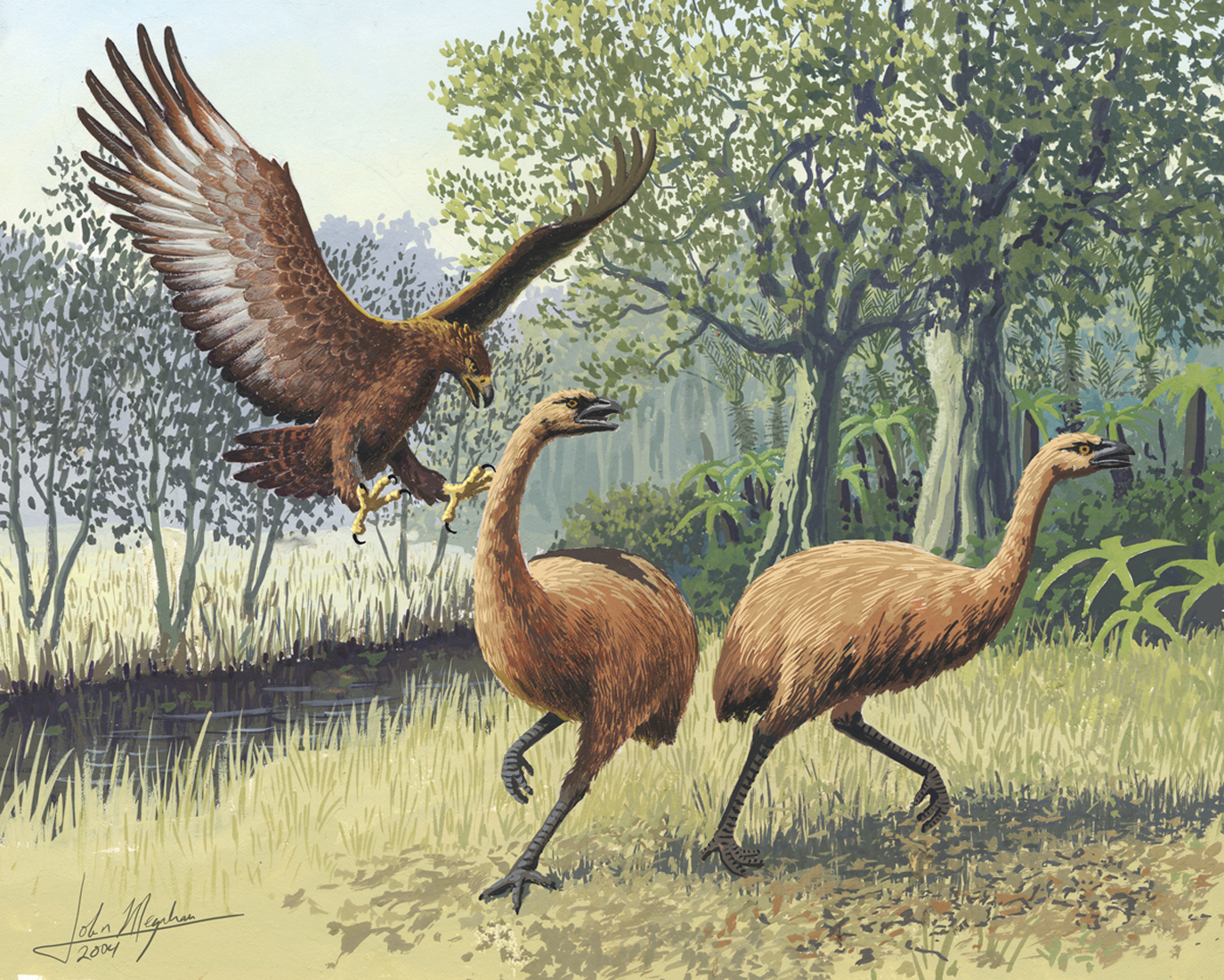
Anderson´s article carefully argues that the Maori settled New Zealand between 600 and 800 years ago. No other humans had settled on the islands before that time. The theory that the species extinctions in New Zealand were caused by rats introduced by earlier temporary visitors is discarded. Maori and rats arrived together (so did dogs). Nor is climate change the cause. Many archeological sites confirm that the Maori heavily hunted the local animals for food. They also show that the initial Maori settlers were drawn to the "leeward province" (southern North Island plus eastern South Island), where large game was most abundant, including 12 species of flightless moa birds, large flightless geese and an abundance of seals and sea lions. In just a couple of centuries, many of these unique species had gone extinct - extirpated by the noble savages. 40 species of birds, a bat, three to five species of frogs, and an unknown amount of lizard taxa had been exterminated. Apart from hunting or egg-collecting, burning of forests and the introduction of rats were factors in the extinctions. The giant Haast´s eagle, which preyed on moas, went extinct when the Maori had killed its prey. Other animals were decimated, but not driven to exinction. This includes the New Zealand fur seal, the sea lion and the peculiar reptile known as tuatara. The animals had conservative life histories, moas only laying one or two eggs at the time, seals bearing a single pup. Flightlessness, ground nesting and diurnal habits made the moas tempting targets for hunting expeditions. 

The Maori also burned forests to clear the ground for settlement, horticulture and perhaps easier travel. Most NZ trees and shrubs are not evolutionary adapted to widespread fires, and therefore die outright if their habitat is torched. In place of forests, fernland and grassland grows instead. Forests were almost eliminated in the eastern part of South Island in a relatively brief period from 1300 to 1450. That the forests were largely devoid of food resources for humans is one reason why the Maori weren´t particularly interested in "conserving" it. 

Only after the leeward province had been stripped of its large game, did the Maori develop something akin to conservation - after first moving into the windward province (which comprises the western part of South Island and most of the North Island). The author says relatively little about this, but it seems the system was based on increasing territoriality and the building of forts, with exploitation of local plant resources being regulated by the territorial chiefs. In other words, a purely pragmatic strategy, not an example of "deep green spirituality". (Even later, population growth and constant wars propelled a return migration of some groups into the leeward province.)

Evelyn Stokes tries to sound more politically correct in her article, but she can´t hide the fact that the Maori voluntarily and swiftly integrated themselves into the new trading networks established by the White colonialists in the Pacific region. Pigs, potatoes and sweet potatoes were introduced late in the 18th century or early in the 19th ditto, even before Whites actually settled on the islands. The Maori soon traded with pigs, potatoes, fish, flax, kauri spars and timber. The Europeans were often dependent on Maori aid and labor to extract the resources sought after. Whaling was another important activity. Indeed, the crews of British whaling ships in the region were often Maori. Nor were the Maori particularly insular. Maori who worked onboard ships found their way to Sydney or even London, learned English and returned home with new experiences. Maori chiefs, who at this point still controlled New Zealand, allowed Whites to settle and marry Native women as a way to build alliances. And yes, the Maori bought firearms for the gold coins used as payment for their exports... 

The story ends with New Zealand becoming a British colony and the Maori being swindled out of their land. So I suppose the rest of the book deals with "Pakeha" (White European) environmental destruction...

None of the above means that the Polynesians were particularly "immoral". Rather, they were like everyone else. Humans hunt for food, expand their populations, wage wars and (gasp) trade in potatoes. That´s simply how our species evolved. But sure, I suppose some stray moa in the New Zealand highlands might have a different perspective on *that*...  


Wednesday, March 4, 2020

Yes, storks

A highly abberant stork? Only in California!


“Handbook of the Birds of the World” (HBW for short) is a gargantuan encyclopedia in 17 volumes describing all living species of birds known to science. That´s about 9,000 of them! The first volume was published in 1992, the last one just a few years ago. There are also two extra volumes containing extensive checklists of…well, all the birds previously described. This is a review of the second volume, published in 1994. It seems I missed to comment it during my illicit reviewing spree at Amazon.com, which ended in Jeff Bezos personally purging me in 2018. OK, not really, but it seems it wasn´t on sale in Bezosland and therefore couldn´t be properly fake-reviewed by yours truly, so here I go on my blog instead!

Somewhat surprisingly, Vol 2 only covers two orders, the “classical” Falconiformes (diurnal birds of prey a.k.a. ditto raptors) and Galliformes (chicken and their allies a.k.a. gamefowl and half a dozen other aliases). I admit that I didn´t dig *that* deeply into the section on the galliforms, but it doesn´t seem to mention the bantam breeds, so perhaps that´s a plus for chicken fanciers, who often positively hate the poor little things, or so I´ve been reliably informed. Instead, I went straight for the main course, the Falconiformes. In HBW´s version, or rather their 1994 version, the raptor order consist of New World vultures, the Osprey, Hawks & Eagles (presumably including the Old World vultures), the Secretarybird, and Falcons & Caracaras (called “falconids” in this work). That being said, all wasn´t well in raptor space back in the 1990´s. The exact taxonomic position of the New World vultures was especially contentious.

HBW argues that New World vultures may actually be closer to storks (yes, storks) than to other birds of prey. The idea of a Californian Condor really being a highly aberrant stork does have a certain intrinsic appeal. Some of the similarities between Cathartidae and Ciconiiformes are absolutely stunning: “For example, both groups of birds keep cool by squirting their legs with urine, which then evaporates off to leave the legs sometimes looking as if they have been white washed”. The genera within Cathartidae may not be closely related either. We also learn that there used to be Old World vultures in the New World until 10,000 years ago and New World vultures in the Old World 20 million years ago (not sure what made them leave). Even on the species level there is confusion. Or was back in ´94. The good ol´ Turkey Vulture, well known from spaghetti western flicks, might actually be several different species. It´s difficult to know since all museum specimens look the same – the skin color (a distinguishing mark for subspecies and species) fades after death!

In this volume, the “falconids” are relatively firmly anchored in Falconiformes (as the diurnal birds of prey are called when they do include them – otherwise it´s Accipitriformes) due to their “external morphology, internal anatomy, behaviour, feather parasites, and moult patterns”. DNA studies suggested the same thing, but today scientists believe on the basis of new research that falconids aren´t closely related to accipitrid raptors at all, rather they are a sister group to parrots and passerines! Interestingly, one M Jollie suggested already in 1977 on non-genetic morphological grounds that falconids are polyphyletic (google it!) and are closer to owls, cuckoos, plantain-eaters and indeed parrots than to other diurnal birds of prey.

Otherwise, everything is pretty much as usual as far as HBW volumes are concerned: detailed family presentations followed by species presentations and range maps, and a lot of color illustrations and ditto photos – one of the reasons why these books are so prohibitively expensive. Yes, I looked it up in a library, thank you! That being said, the species presentations are quite short compared to later volumes in the series with their complete information overload on every small and obscure tropical songbird. Nor are there any additional chapters on mostly unrelated topics, also a feature of later volumes.

Perhaps transcended by current research?

Sunday, September 29, 2019

Wtf, I love falcons now


“Europas rovfåglar” by Gunnar Pettersson is Swedish book about raptors or birds of prey. Published in 1984, it includes the falcons alongside hawks, eagles, vultures and other Accipitriformes. Apparently, the falcons are no longer regarded as raptors in good standing, rather being a dramatic example of convergent evolution. Or so the nerd who writes on Wiki tells me. Until the pendulum swings back again, presumably… Sorting out these birds have long been a problem for biologists!

The book includes all European raptor species. The species presentations are rather short. The book is above all a work of art. And yes, the illustrations are made by Gunnar Pettersson himself. He, or perhaps the editor, seems more fascinated by some species than by others. Peregrine falcons, gyrfalcons and white-tailed eagles are prominently featured. So are some vultures. The author is “pro-raptor” and the concluding chapter attacks humanity as we know it for “persecuting” raptors. I didn´t know that birds of prey were themselves prey for humans just a few centuries ago. In Sweden, the common buzzard was verily food, and in southern Italy and Sicily, the locals feasted on sea eagles and the lammergeier! The author also writes about falconry – I find it fascinating that falcons can actually be trained or tamed.

But no, I´m not particularly raptor-friendly. If it´s between us and them, I´d say kill´em before they multiply (and eat´em). Perhaps I imbibed too much romantic shit about Nature as a kid from books like “Europas rovfåglar”, so this is the counter-reaction. Still, I like parrots and magpies, so the idea that falcons are more closely related to Psittaciformes and Passeriformes than to some ugly buzzard or vulture made me slightly more positive to the fate of the Peregrine…

Monday, September 17, 2018

Make eagles great again


A review of a note pad showing a picture of the famous Washington´s Eagle. 

The bird on the cover is the mysterious Washington's Eagle, described by famous American naturalist John James Audubon “back in the days”. True to form, Audubon shot the bird, bagged it and painted it! The year was 1816 and the place was Kentucky. It's ironic that the largest conservation group in the United States is named after this trigger-happy gentleman. I sometimes wonder whether he's responsible for the extinction of the Passenger Pigeon, but perhaps I'm out on a limb there?

Be that as it may, the all-knowing modern scientists question Audubon's veracity in this case, charging that Washington's Eagle is simply a misidentified juvenile Bald Eagle. Nobody has seen this kind of bird since Audubon killed one for artistic purposes...or was it for artistic license? All stuffed specimens have mysteriously vanished, and the only evidence we have for a third species of North American eagle is the painting reproduced here.

Personally, I'm willing to believe that The Great Naturalist was right in this case. After all, he was on spot observing the bird, he shot it (presumably not with a paranormal silver bullet) and he meticulously studied it in order to make his extraordinary artwork. Washington's Eagle may be extinct today, but probably not due to John James Audubon's career in bird painting…

Wednesday, September 12, 2018

Unidentified Flapping Objects


This episode of "MonsterQuest" is unavailable from Amazon at the present time, but can be watched for free on Youtube or purchased from Amazon together with other episodes from Season 1 on DVD.

"Birdzilla" is a program about Thunderbirds, gigantic raptors said to attack people in various parts of the United States. The Thunderbirds are supposedly much larger than condors, but no hard evidence for their existence seems to exist. Thus, the Thunderbird has the same status as Bigfoot, the Loch Ness monster or UFOs.

The program features both people who claim to have seen these elusive creatures, including a man who claims to have been attacked and almost abducted by a Thunderbird when he was 10 years old. The only hard piece of evidence is a film seemingly showing large black raptors flying around near a lake. Various natural explanations for the sightings are discussed. Some are relatively logical. An experiment with a "thunderbird kite" shows that people are very bad at judging size at a distance. Many Thunderbirds could be misidentified specimens of the Steller's Sea Eagle or even the Turkey Vulture. Other explanations are far-fetched in the extreme. Thus, the program discusses whether the creature that attacked the 10-year old boy was an African Crowned Eagle. Since this eagle (never found in the United States) attacks monkeys, why not other primates, such as...humans? I fail to see the logic. Can they sniff primate DNA?

Of course, natural explanations to Thunderbird sightings only work so far: some of the witnesses claimed that the mega-bird perched on a tree or phone pole, making it possible to fairly judge its (gigantic) size...

Ultimately, it's up to the viewer to decide whether Unidentified Flapping Objects are real or just another figment of our imagination...