Showing posts with label Thrushes. Show all posts

Friday, April 17, 2026

Friday


A rather non-classical Friday goddess, surrounded by mutant(?) bluebirds or something to that effect... 

Thursday, November 20, 2025

Ornithology Ganapati?!


- Trump? Who is Trump?
- Oh boy, oh boy, this alien guy have a lot to learn!

Lord Ganesha discovers the New World, speaks to some of its inhabitants! Rare pic, share for luck.

Saturday, August 25, 2018

The runner up


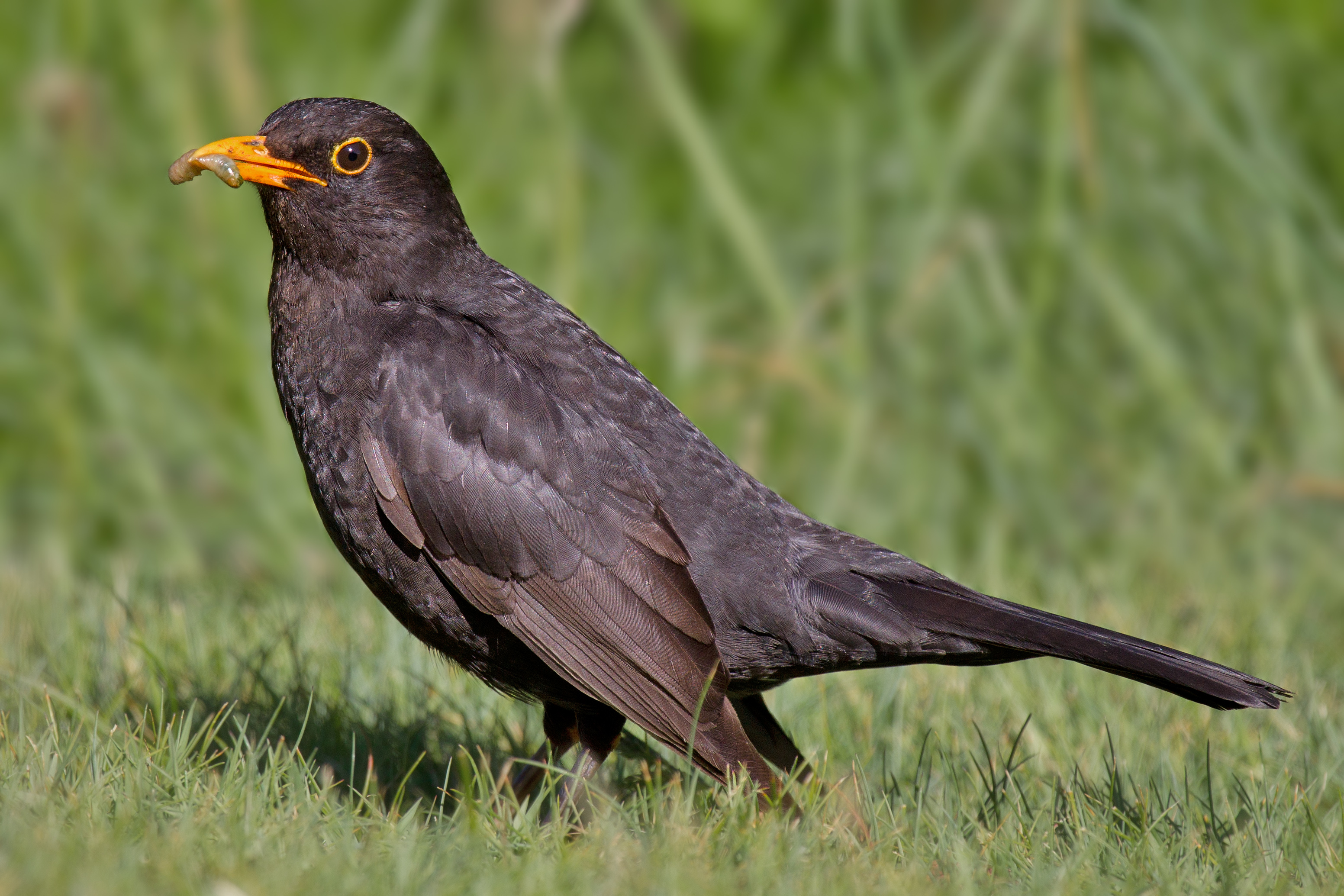
The Common Blackbird is the national bird of Sweden, not officially but certainly in practice. It gained this coveted status in 1962, when the readers of Dagens Nyheter (a large Swedish daily paper) decided in its favour in a readers' poll. I don't know who the runner-up might have been! The Swedish blue-and-yellow duck?

The "national bird" status isn't surprising, I mean these birds are practically...well, everywhere??!! It's almost ridiculous.

My own relation to the Blackbird is pretty complicated. For a very long time, I wondered why I wasn't seeing any Starlings - supposedly another extremely common bird. However, I was seeing those Blackbirds all the damn time (often in unusually large flocks). Just a couple of years ago, when I took up "bad bird-watching", I realized that most "Blackbirds" I've seen for the past thirty years or so were actually...well, Starlings.

Ooops.

In my defence, let me say that most field guide to birds do state that confusing Blackbirds with Starlings at a distance is extremely common. Well, thank you. At least I don't have to die of everlasting shame for confusing the National Bird of the Kingdom of Sweden with the crop-destroying, noisy, dirty, crow-like Starling. (Apparently, it can mimic human speech, too. Including foul language!) Who knows, maybe this pest of the avian world was the runner-up back in 1962?

I've double checked, and the bird above is definitely a Blackbird (Turdus merula).
Not a Starling. Just so you know.

Saturday, August 18, 2018

The reign of quantity and the signs of the times


A channeled message from a Blackbird concerning the recent vote to select a new national bird of Schweden. In the event, Lord Blackbird didn´t need to worry. since he won the vote easily. 

I'm the national bird of Sweden by birth right, and no amount of treacherous “democratic” haggling by the local bird-watchers' association can change that. Are they annoyed that I don't show up every time they call me? Why should I? Being the national bird of an ancient and illustrious kingdom such as Sweden should surely entail some privileges! The new poll, obviously rigged with the nefarious intention to unseat me, is just as treasonous as the “constitution of 1809” or similar acts of lèse-majesté!!! If the ungrateful bird-watchers select the bullfinch, the wagtail or – heaven forfend – the magpie (magpie?!) as Our replacement, We shall leave this nation at once and take up residence in Norway, where Our cadet branch (a.k.a. Ring Ouzel) already dwells since the time of St Olaf of blessed memory.

Yeah, really.

Thursday, August 16, 2018

The triumph of the Blackbird


In 1962, the readers of the Swedish daily Dagens Nyheter decided that the Blackbird should become “the national bird of Sweden”. Only 5,000 people participated in the vote. This year, the Swedish bird-watchers' association decided to organize a new round of voting on the matter. Or several rounds! In total, 75,000 people participated. Yesterday, local time, the result of the grand finale was announced.

And the winner is…the Blackbird, again!

With 12,914 votes, Turdus merula triumphantly held on to its position. Unserious campaign voting organized by two pods gave the Magpie (!) second position with 9,241 votes. Without the buddy votes, the Magpie wouldn't even be in the finale. The real runner-up is the Blue Tit with 7,286 votes. The tit is blue and yellow, the colors of the Swedish flag. The ostensible super-challenger to the Blackbird, the Bullfinch, only got 3,711 votes and the sixth position.

I voted for, ahem, the Blue Tit in the early rounds and the Bullfinch in the finale.

Blasted.

OK, I suppose I should have known. The Swedish people are just as infatuated with their dusky thrushes as they are with polkagris, surströmming and Försäkringskassan!

Monday, August 13, 2018

A blackbird from darkest Morrocco

I know, it´s the wrong subspecies 


"Birds of Africa" is a seven-volume reference work covering all species of birds found in Africa, both North Africa and sub-Saharan Africa. This is the fifth volume, edited by Emil K. Urban, Hilary Fry and Stuart Keith with illustrations by Martin Woodcock and Ian Willis. And let's not forget Claude Chappuis, who is responsible for the acoustic references.

This volume covers thrushes, Old World warblers, Old World flycatchers, monarch flycatchers, wattle-eyes and puffback flycatchers. The book is a typical reference work, probably unsuitable for occasional bird-watchers or the general reader, but a "must have" for every research library and more advanced ornithologist. At least if his way of advancement goes through Africa!

The species presentations include sections on range and status, description, field characters, voice, general habitat, food and breeding habits. The color plates are good but somewhat confusedly edited. The maps in the introductory section show the best (?) haunts in darkest Africa, including the Bamingui-Bangoran National Park, the Mbaéré-Bodingué-Nyota Forest and the Warsangeli Escarpment. I must remember those, although something tells me they can't be reached by metro...

The book also contains its fair share of surprises. Thus, it turns out that the European Blackbird can be found in Morocco! It's supposed to be a special subspecies, "Turdus merula mauritanicus", but I honestly can't tell the difference with the blackbirds hopping around in my very European backyard. The Fieldfare, Redwing and Ring Ouzel also make guest appearances in this work, since they can all be found in Northern Africa during their annual migrations.

Personally, I prefer HBW to any other reference work on birds, but then, I mostly look at the pictures! As already indicated, I'm sure the fifth volume of "Birds of Africa" also fills a niche. 

Friday, August 10, 2018

THE MOTHER OF ALL BIRDBOOKS!!!


A review of "The Handbook of the Birds of the World", vol 10. 

Are you also sick and tired of all the second-rate birdbooks out there? I guess the Spanish (!) publishing company Lynx was, so they decided to do the impossible: publish the mother of all birdbooks, the birdbook to end all birdbooks. Since 1992, 12 volumes have been published, with 4 more waiting in the wings. The purpose of HBW is to illustrate and describe ALL bird species known to man. You heard me. All of them. All 10,000 of them. Gee, what a mindjob!!!

Of course, this makes the HBW extremely expensive. Each volume costs 265 dollars, the entire series (so far) goes for incredible 3,445 dollars. You probably have to be a state congressman to afford the lot! I'm lucky to live in a city where at least one library has all 12 volumes in a public reference section, but if you live in Littletown or Smallville, you might have something of a problem. Personally, I think I'll save some money to buy at least ONE volume of the series, just to prove I wasn't born on the wrong side of the tracks, LOL. But yes, I would LOVE to have the entire series, all 12 volumes sort of casually spread out in my living room, one here and one there. How's that for the lifestyle of the Noveau Riche?

When I eventually buy that one volume, I don't think it will be this one. With all due respect, thrushes are quite boring birds. Volume 4 (includes cuckoos, turacos and parrots) and volume 6 (includes trogons, rollers and hornbills) seem more exciting.

Still, when I went to the library to get a feel for this book, I nevertheless looked through this volume, which includes thrushes, wrens, waxwings and dippers, amongst others. Each volume of the HBW is organized in pretty much the same manner. First comes a general chapter on the bird family under review, including sections on Systematics, Morphological Aspects, Habitat, General Habits, Voice, Food and Feeding, Breeding, Movements, Relationship with Man, and finally a section on Status and Conservation. The general chapters are illustrated with large photos of various birds. There are often two photos per page, and amazingly enough, they are all in color! After the general chapter comes the species presentations. Color plates illustrates each species, and most of the subspecies, with a couple of varieties thrown in for good measure. Each species is then described in some detail. There is also an extensive bibliography after each presentation.

What really struck me when going through this volume, was the sheer immensity of information. Even the photo captions are filled with information. Frankly, a piece of information about thrushes, wrens or dippers not found in this volume, probably isn't worth knowing anyway! Thus we learn that William Blake wrote a poem about Robins, that 36% of the diet of a Mistle Thrush in Britain consist of insects and only 3.5% of slugs, that Fieldfares attack their enemies by defecating (I will avoid Fieldfares in the future), that the Island Thrush prefers to live at elevation 1000-1650 meters in the Philippines, but breed at 2100-3200 meters in Borneo, that Grand Cuckoo-Shrikes occasionally eat House Sparrows, and that there are 85 species of wrens (the gods must be crazy). We also learn that there is a bird named Ring Ouzel, and another called Black Solitaire. And then there's the Hypocolius (you heard me).

:-D

Aren't there any negatives about these books? To advanced biology students, probably not. To laymen, maybe a couple. I already mentioned the sheer volume of information. Another problem is that the book is teeming with never-explained scientific terminology. If you want to buy it, you better learn the meaning of words such as monotypic, congener, superspecies, conspecific, corvoid (sic) and dimorphism. (That's an easy one.) Thus, the HBW isn't for laymen, amateurs or people with a purely casual interest in birds. In order to really appreciate it, you need to be an experienced bird-watcher, a serious biology student, or perhaps a fanatical lover of profesionally produced books (me!). In other words, don't buy it for your kids just because they have a parakeet!

Finally, a personal observation. Although I'm singularly uninterested in thrushes, I almost wanted to spend the 265 dollars anyway, just after a few minutes of leafing. Once again, the photos are superb, and the color illustrations as well. This simply is THE MOTHER OF ALL BIRDBOOKS. Period!