Showing posts with label Morocco. Show all posts

Sunday, August 9, 2026

Krypa till korset


Credit: Hansi_2010

Aftonbladet tvingas erkänna vad alla andra redan visste...

Jag antar att de till slut bestämde sig för att vinkla det hela som "auktoritär högermonarki försöker underminera folkvald vänsterregering". Och då gick det tydligen.

Spanska källor: Agenter klädde ut sig till migranter

Monday, August 3, 2026

Made in Marocko


Det verkar som att varken högern eller vänstern kan hantera det faktum att stormningen av den spanska enklaven Ceuta var en marockansk politisk provokation. Och alltså inte en "vanlig" migrantkris, vilket båda sidor tydligen vill hävda.

Så lockade Spanien invandrarna till Ceuta

Saturday, August 1, 2026

True conspiracy?


Credit: MtBotany

There is an interesting conspiracy theory that *Israel* is behind the recent storming of Ceuta, presumably in collusion with Morocco. The reason? Spain is currently anti-Israeli. Morocco, on the other hand, has signed the Abraham Accords, which are also a key part of Trump´s foreign policy. And some pro-Israeli / pro-Trump outfit in the US actually called on the POTUS to recognize Morocco´s territorial claims on Ceuta and Melilla.

Personally, I think this was really triggered by Morocco´s perennial conflict with Algeria (Spain is "pro-Algerian"). Still, it will be interesting to see if the anti-Zionist portions of the mainstream media will acknowledge this conspiracy theory. After all, it collides with their present narrative, which is that the Moroccan incursion into the Spanish exclave is a genuine refugee crisis...

Den gröna marschen


Credit: carlos corzo - panoramio

Töntarna på Aftonbladet låtsas fortfarande som att krisen i Ceuta inte är en medveten provokation iscensatt av Marocko. Detta trots att 48,000 av de 50,000 "migranterna" återvänt till marockanskt territorium. Måste vara svårt att vara kulturvänster...

Friday, July 31, 2026

The explanation

Credit: Verdulia 
 

There is *something* strange about the alleged "migrant crisis" at the Spanish exclave of Ceuta in North Africa. For starters, all of the migrants are young, able-bodied men. Second, most of them are Moroccans, not migrants from West Africa. Morocco is, of course, next door to Ceuta. Third, in an interview with a foreign news outlet, one of the Moroccan "migrants" stated: "So we heard that the border is open. We quit our jobs and went over here". 

You...quit your day job on a whim to enter the territory of a potentially hostile nation? I see. 

Fourth, about half of the "migrants" have returned home to Morocco (maybe they had to show up for work on Friday morning?), apperently when they realized that all shops and cafés in Ceuta were closed!

So what´s actually going on here? The most likely explanation is that we´re dealing with a more rowdy version of the Green March, the large-scale civilian Moroccan incursion into West Sahara in 1975. Indeed, the situation at Ceuta might be directly connected to West Sahara, a former Spanish colony disputed between Morocco and a resistance movement known as the Polisario Front.

Apparently, the Spanish PM Pedro Sánchez recently visited Algeria, which still backs Polisario. To show their displeasure, Morocco orchestrated the "migrant crisis" at Ceuta, knowing fully well how Spain´s European Union allies would react. As in: react very badly...to Spain! The government of Sánchez is widely seen as the weak link in the EU´s (purported) new and tougher stance against mass immigration. Morocco is sending a signal that they have leverage over Spain and perhaps the entire Schengen agreement. The fact that Ceuta is a Spanish-controlled territory on Moroccan soil might, of course, be an additional cause for the displeasure.

Russia and Belarus has previously weaponized the migrant crisis to create problems for the EU, and now it seems Morocco is doing the same thing, although in their case it´s not even migrants sensu stricto.

We´ll see how this pans out in the upcoming days, but I wouldn´t be surprised if Sánchez is voted out of office because of this. If the Moroccans are going to like his replacement is perhaps another matter entirely...       

Wednesday, January 28, 2026

Antecessors


- Why weren´t we mentioned in
your peer reviewed paper, huh?

Some recent revisions of our bushy family tree. However, the main lines of evolution are still clear. So our direct ancestor wasn´t Lucy, but some *other* ape-woman? Go figure. But sure, the skeletal remains at Dmanisi need to be sorted out, I think!

Last common ancestor of modern humans and Neanderthals possibly found
Homo erectus not the first human to leave Africa

"Lucy" was not our direct ancestor

Sunday, March 24, 2024

Sheer evil


Is sheer evil on the loose in the Mogador archipelago off the coast of Morocco?! 

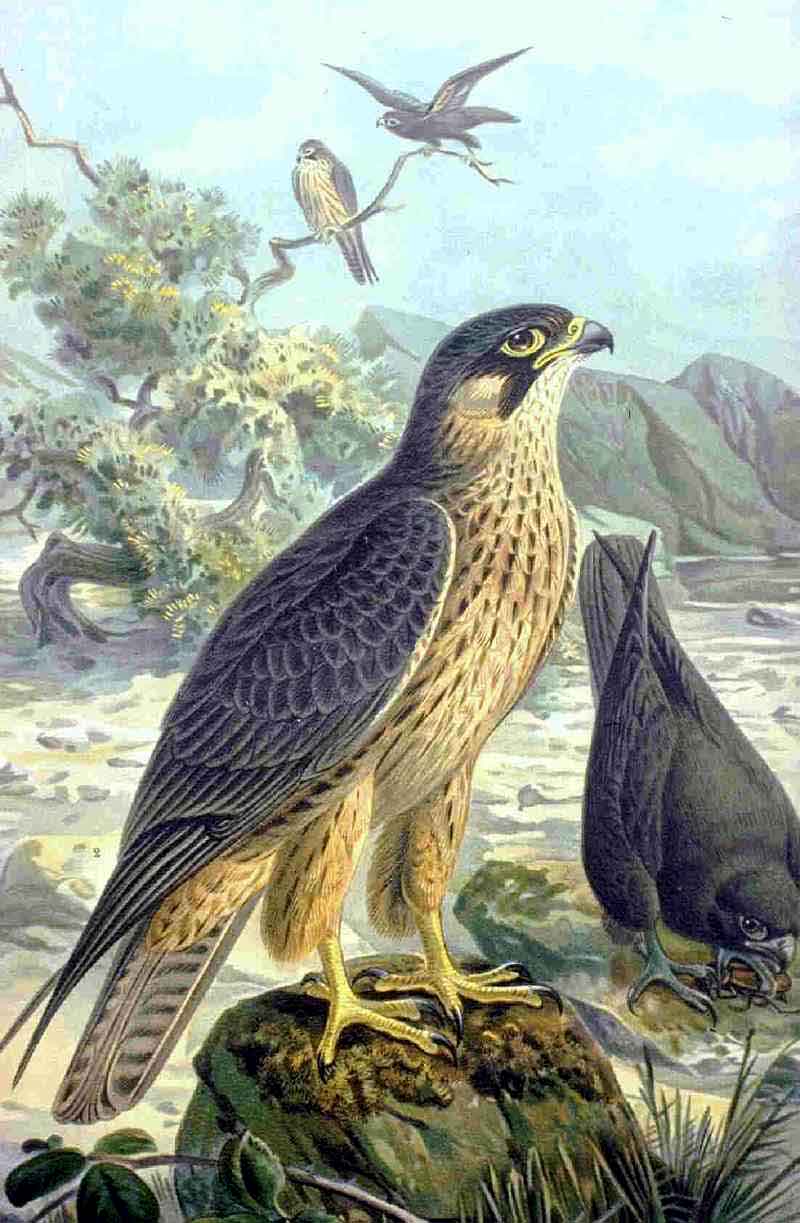
The local population of Eleonora´s falcon is said to hunt smaller birds, strip them of their flight feathers, and then imprisoning them in rock fissures or deep holes. Presumably with the intention of coming back later, the flesh of the live bird still being tender, and kill it then...

This bizarre behavior, known to the local fishermen for a long time, was only recently documented by scientists. Which is what counts. Except that some scientists are skeptical, no doubt because falcons aren´t supposed to be *that* clever.

Well, thank you. Now I can go back to sleep in the knowledge that Eufalconimorphae isn´t completely TAINTED!  

Eleonora´s falcon: The raptor that imprisons birds live

Wednesday, February 21, 2024

Cut down in their prime


For some time, scientists have apparently believed that the dinosaurs started to decline already before that notorious asteroid hit the Earth and finished them off once and for all (or rather their non-avian forms). 

However, recent research suggests that this might not be the case. The fossil record is biased towards North America (and perhaps Mongolia), but fossil finds in Morocco indicate that African dinosaurs still diversified during the period in question. Also, the populations must have been large. 

In other words: the impact of the Chixculub asteroid really did cut down the non-avian dinosaurs in their prime.

Is anyone really surprised?  

"Cut down in their prime": dinosaurs were thriving in Africa before the asteroid hit

Thursday, December 28, 2023

Curiosity killed the moth


Credit: James Lindsey/Ecology of Commanster

Curiosity is supposedly a virtue, and all that, but I can´t help thinking that scientists get some kind of power trip out of this kind of research. During a number of recent field trips to Morocco, lepidopterists discovered 12 new species of Coleophora, a genus of micro-moths. 

While I suppose that´s fascinating somehow, I wonder if this gives scientists (and the rest of us) the illusion of control over the natural world, the universe and/or Existence itself? We can find any small critter, catalogue it and fit it into a vast Systeme. We can also colonize the Moon and terraform Mars. And become like gods? 

Perhaps the really interesting observation here is that 12 species of living creatures could evade discovery by Science (or is it Man) for tens of thousands of years...

Who knows what else is out there, LOL.  

New and little known Coleophora from Morocco 


Thursday, November 18, 2021

Monday, January 18, 2021

Continuity and change


I promised myself to stop commenting politics, but here is a link to a serious article in Financial Times about the differences (or lack of them?) between Trump's and Biden's foreign policies.

Should be read with Biden's tough (?) stance on China in mind.

Financial Times on Trump's and Biden's foreign policies

Thursday, September 20, 2018

The Dwarf Question


This book is actually subtitled “Collected Papers on the Curious Anthropology of Robert Grant Haliburton”. Curious is indeed the right word here. Haliburton was a Canadian lawyer who dabbled in anthropological research and comparative mythology. (He was also a Canada First supporter and hence an opponent of Louis Riel and the Métis.) Apparently, Haliburton believed that a world-wide cult of the Pleiades was one of the primordial religions of Man. He also argued that many Greek legends and traditions had originated in the Atlas Mountains in Morocco. And perhaps the Greeks as a people, too? However, it seems Haliburton's main claim to fame were his papers on the Dwarf Question.

In these peculiar articles, reprinted in this volume, Haliburton claims that an unknown race of dwarves or Pygmies lived in the Akka region of Morocco, south of the Atlas range. These Pygmies supposedly have a reddish complexion, wooly hair, ride small but fast ponies, and are specialized at ostrich-hunting. They are probably pagans, worshipping Dido and Osiris, and can occasionally be seen in a remote temple dedicated to these deities. The Arabs and Berbers fear the purported supernatural powers of these dwarves, pay them tribute and in general refuse to talk about them. There are also dwarves who work as acrobats or tinkers, and these sometimes travel to the towns of northern Morocco.

Haliburton was mocked by several critics for his speculations (the critical comments are also reprinted in this book), and it was strongly implied that he may have concocted the entire thing. A more “charitable” interpretation was that he had been taken in by recreational liars while visiting Morocco. Haliburton himself insisted that other Western travelers in the region had corroborated his findings. He also claimed that a dwarf race lived in the Pyrenees in Spain! I admit that the exchanges between the amateur anthropologist and his detractors have certain humorous quality, and so have the “corroborative” reports. I think it's obvious that Haliburton was either extremely credulous or something of a Schwärmer. Many of the “Pygmies” observed by him and others were simply ordinary Moors of smaller stature, or people with genetic disorders.

Haliburton's search for dwarves was connected to a grander theory, according to which Pygmid races had once roamed all the world, and gone extinct only recently. Thus, Haliburton speculated that a dimunitive Turanian race had once lived all over Europe. Legends about “fairies” and “little people” are really distorted memories of the Pygmy races. Presumably, the same is true of the legends about trolls and gnomes. I don't know what happened to Haliburton's Moroccan dwarves (or their ponies), but like the editor of this material, I suspect they may never have existed at all. That being said, I think it's well-established that Central African Pygmies and Southeast Asian Negritos are very ancient and must have been more widespread during the Stone Age than they are today. And what about Homo floresiensis?

Maybe, just maybe, the curious anthropology of the old credulous Canadian Tory might one day be vindicated…

Saturday, September 15, 2018

Operation kept to


“The Sacred Magician: A Ritual Diary” is a fascinating but also slightly bizarre book, written by British spiritual teacher William Bloom. He was previously connected to Findhorn. The book exists in two different editions (or perhaps versions), one of which is written under the pseudonym Georges Chevalier. I haven't seen the other one, but apparently it contains material not found in this one (and vice versa).

As indicated by the subtitle, “The Sacred Magician” is written in the form of a diary, detailing Bloom's experiment with the ritual magic found in the medieval grimoire “The Book of the Sacred Magic of Abramelin the Mage”. The edition used by Bloom was the 19th century English translation by Samuel MacGregor Mathers, a leading member of the Hermetic Order of the Golden Dawn. The goal of Abramelin's magic is to encounter the Holy Guardian Angel and receive power over the demons, who will then serve the magician. In order to accomplish this feat, the magician must isolate himself for six months, something Bloom attempted to do in the Atlas Mountains of Morocco. The isolation doesn't need to be total, since the magician may still socialize with his wife and servants. Bloom even entertained visitors at his house. The rituals described in Abramelin's work sound “Christian”, and in large parts consist of prayers to God for the forgiveness of sins. Conjurations of angels and challenges to the demons form the concluding part. Some of the rituals described are almost stereotypical, with the magician wearing a mysterious gown, using a magical wand, etc.

I haven't read the original grimoire, but I do get the impression that Bloom mixes the medieval magic with influences from many other sources. His view of the cosmos is based on Alice Bailey's teachings, and he even claims that Bailey's spirit-guide, the Tibetan or DK, appeared to him during the rituals. Bloom also uses the divinatory techniques of the I Ching to understand what's happening to him. At several points, the author reveals that the real purpose of the magic is to raise the kundalini from the base chakra to the crown.

Be that as it may, Bloom certainly did experience dramatic ecstasies, visions and transformations during the six months of the “Operation”. Astral travel, experiences of blissful unity with the Divine, a great white light, and a personality “split” between a spiritual component “up here” and the physical personality “down there”, were some of the effects. On the negative side were demonic attacks (including a meeting with an astral version of Hitler!), acute paranoia and intense guilt-feelings. The latter are particularly pronounced, as Bloom constantly feels like a “worm” and seeks to overcome his sinfulness and inadequacy. A few bizarre miracles also took place: Bloom's dogs placed two horns of a ram outside his cabin – presumably a message from the Devil himself. Many of the phemomena experienced by the author seem kundalini-related, including massive surges of energy through the physical body, shaking, intense headaches, sexual arousal etc. Some sections of the diary sound frivolous and easy-going, while others are more serious. I get the impression that "Georges Chevalier" was on an emotional rollercoaster ride. The only constant is his almost mantric expression "Operation kept to", which concludes every entry.

The diary ends inconclusively. While Bloom claims to have been given the power to control the eighth demonic sub-princes, he also says that he couldn't continue the ritual. What happened next, I don't know, but since the author is alive and well (and even has a blog!), I suppose he somehow survived the ordeal… Today, scholars know that Mathers' translation of “The Sacred Magic of Abramelin the Mage” was based on an unreliable French version of the originally German text, and that the *real* ritual of Abramelin takes 18 months to accomplish, not just six. If this means anything, and if so what, presumably depends on your personal philosophy (if any) of things magical.

“The Sacred Magician” is a very narrow book, but if ritual magic, kundalini, mysticism or Golden Dawn-related material is your thing, it could be of some interest.

Saturday, September 8, 2018

A rambling lecture


"The Forgotten Queens of Islam" is something of a disappointment. The author, Muslim feminist Fatima Mernissi, delivers what sounds like an extended, rambling college lecture. Most of the material isn't even about the forgotten queens. Of course, the author needs to establish a context, but IMHO she strays too far away from the proper subject of the book. Mernissi also sounds preachy and moralistic. Is it a scholarly book? Or a political statement? Or a sermon, even?

As for the subject matter, Mernissi have only been able to find 15 female Muslim rulers before the election of Benazir Bhutto to head Pakistan in 1988. Perhaps unsurprisingly, all of them were "deviant" in one way or another. Some were connected to the Mongols, who had a more positive view of female rulers even after their conversion to Islam. Others ruled areas far outside the Sunni Arab fold: Shia Arab Yemen (where local traditions still eulogized the Queen of Sheba and in general rejected religious orthodoxy imposed from without), the Maldives and Aceh. Two other female rulers, Radiyya in India and Shajarat al-Durr in Egypt, were connected to the Mamluks, the former slave soldiers (and elite corps) who rebelled against their masters. There have also been de facto female rulers during shorter periods, but that's less sensational - such things are known from all patriarchal societies.

Thus, Mernissi paints a rather bleak picture of the Muslim world. The book is not some kind of feminist rehabilitation of the Muslim world. Quite the contrary. In a concluding chapter, Mernissi (who still sees herself as a Muslim) strongly implies that Islam might not be compatible with the Universal Declaration of Human Rights, democracy, free speech or indeed women's rights. At least not Islam as it has traditionally been understood for a very, very long time...

Despite its interesting subject matter, I will only give this book two stars because of its major stylistic deficiencies.

Thursday, August 9, 2018

Islam and modernity


"Liberal Islam" is a collection of writings by real or perceived Muslim reformers who argue that Islam is compatible with democracy, secularism, universal human rights and women's emancipation. With the exception of Benazir Bhutto, none of the authors in the collection are widely known in the Western world.

The book contains writings from almost all parts of the Muslim world: North Africa, West Africa, the Middle East, South and Southeast Asia. There is also a contribution from Bosnia, and a text written by an African-American Muslim.

The most interesting texts are the ones dealing with women's rights, especially Muslim feminist Fatima Mernissi's attempt to deconstruct a popular anti-woman hadith (saying of the Prophet). Benazir Bhutto's arguments for a progressive interpretation of Islam are also interesting. Bhutto, of course, was the prime minister of Pakistan for two terms, becoming the first woman elected to lead a Muslim state. (Unless you count Aisha!) Another interesting contribution is Ali Bulac's analysis of the Medina Constitution.

A problem with "Liberal Islam" is that the editor's introductions to each text are very short. This makes the volume difficult to use for people unacquainted with the various authors. For instance, one wishes to learn more about the writer from Bosnia, who quotes both Plato and René Guenon, and sometimes sounds like Leo Strauss! One also wonders have much influence the respective writers really have. For instance, how important is "the reform group" in the Philippines?

For rather obvious reasons, I prefer modernist or secularist Islam to traditionalist or fundamentalist versions. Hopefully, ideas such as the ones in this book will one day become the dominant interpretation of this particular world religion!

Friday, July 27, 2018

The message of the Koran...made in Europe?


"Koranens budskap" is a modern Swedish translation or interpretation of the Koran, first published in 1998. The translator, Mohammed Knut Bernström, was a Swedish convert to Islam. According to Swedish Wikipedia, Bernström had been the Swedish ambassador to Morocco, and became a Muslim after his retirement.

"Koranens budskap" was warmly welcomed by Muslims living in Sweden. Until its publication, they had to put up with K.V. Zettersténs translation from 1917, which includes a critical (read anti-Muslim) introduction and equally critical notes. From a purely stylistic point of view, however, Zettersténs translation is the better one. It captures the sacral, archaic and elliptical style of the Koran better than Bernström's interpretation. But then, Bernström's goal was probably to make a useful translation, one which the believers could actually understand.

"Koranens budskap" is officially approved by the Al-Azhar University in Cairo, the closest thing one can get to imprimatur in the Sunni Muslim world. Unsurprisingly, its extended notes are apologetic in character. Thus, we are told that Muhammad didn't confuse Mary and Miriam, that Dhul Qarnayn isn't Alexander the Great but some kind of Arab ruler, that the mention of a "Samaritan" in an sura about pre-Samaritan events isn't anachronistic, etc. Haman's curious presence at Pharaoh's court is explained away by denying that the Koranic Haman is identical to the Biblical character of the same name (who worked for the Persian court about 2000 years later). Apparently, Pharaoh's henchman was a certain Ha-Ammun.

More controversial from a Muslim perspective is the crypto- or pseudo-modernist tendency in the commentary notes. Thus, Muhammad didn't convert any djinns, the tradition about Jesus' doppelganger being crucified is denied (!), the severe hudud punishments are said to be applicable only in a strictly just society (which presumably doesn't exist anywhere at the present time), etc. The commentaries also attempt to deny or downplay any miraculous elements in the Muslim religion.

Somehow, this doesn't sound like really existing Islam, but some kind of more rational or rationalized version for educated Western converts. Indeed, most of the notes are taken from Muhammad Asad's "The Message of the Qur'an", published by Dar al-Andalus in Gibraltar in 1980. Asad was born Leopold Weiss in Austrian Poland and was thus a Western convert. Sometimes, Bernström actually "corrects" Asad, when the latter becomes too modernist and allegorizing!