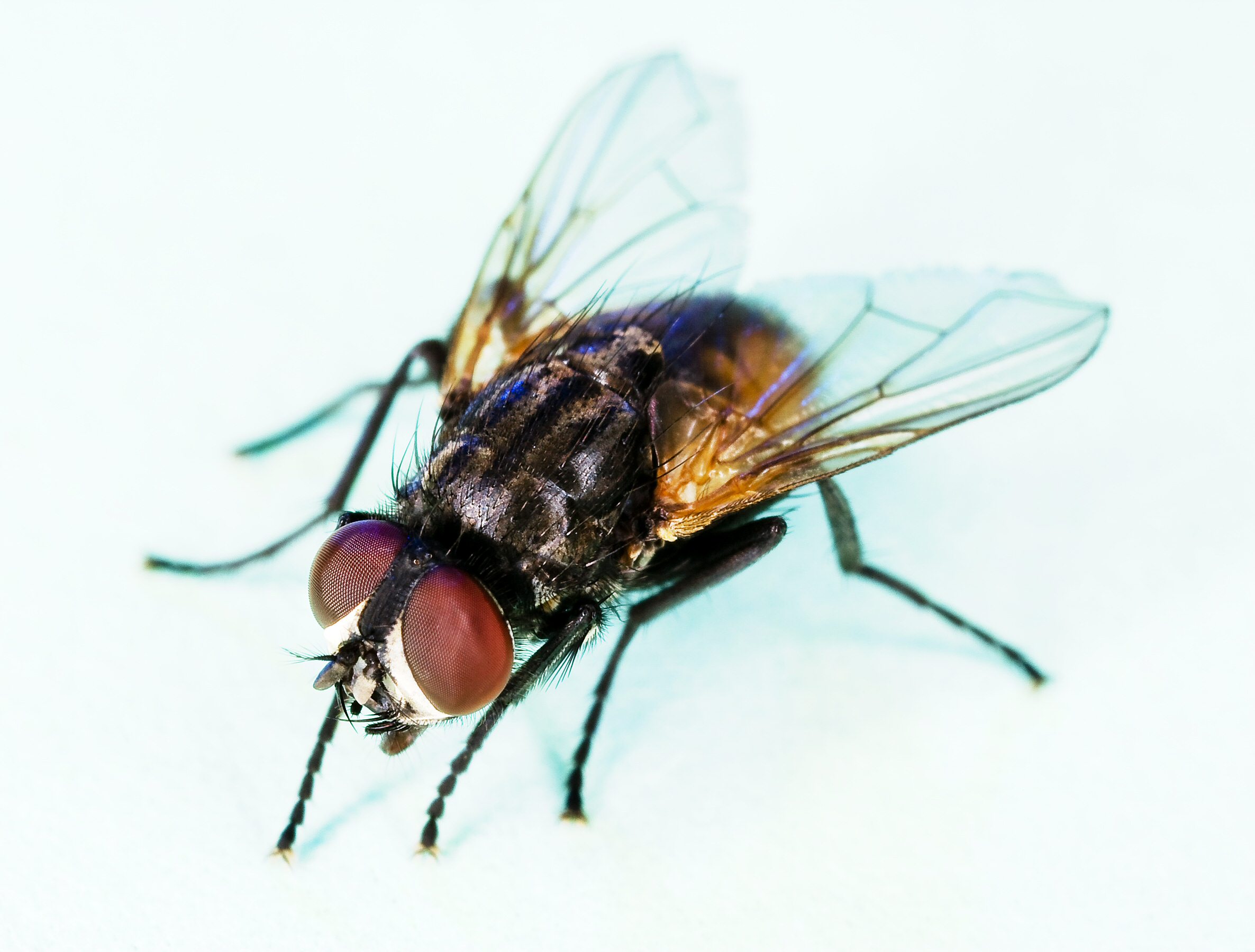
In my
book, the "D" in Diptera stands for DISGUSTING. Is there anything
more obnoxious than blowflies, gadflies, robber flies, horse flies, mosquitos,
crane flies, and, yes, house flies? Well, spiders perhaps. Or Roman emperors.
The only exception to the rule seems to be the hoverflies, known as flower
flies in the US (and in Sweden). These are the NICE flies: their maggots often
feed on aphids, they pollinate flowers, they are beautifully colored, and don't
carry any diseases known to harm humans.
So how come there aren't more books about these friendly flies, I wonder? When
I searched Amazon, most works on the Syrphidae - the scientific name of this
group - turned out to be either extremely specialized, currently unavailable,
or both. I only came across two vaguely popularized books,
"Hoverflies" by Francis S. Gilbert, and "British
Hoverflies" by Alan Stubbs and Stephen J. Falk. Both are more reasonably
priced at the British version of Amazon, and none of them are as interestingly
written as "Bees of the World", "The Magpies" and some
other natural science books I reviewed. Still, if you are interested in
hoverflies, and don't have access to a specialized enthomology library (I bet
you don't), I guess this is where you have to start off your quest for the Holy
Hoverfly Grail.
Since hoverflies are so ecologically important as pollinators and eaters of
aphids, it's strange that no *really* popularized work exist about them!
Gilbert's "Hoverflies" is a very short book (only 66 pages), and only
35 pages contain information of interest to the general reader. The book sounds
like a recruitment pitch for your local Young Enthomologists Association, and
seems primarily directed at people who actually plan to make it a around-the-clock
hobby to observe, catch or breed hoverflies. Also, the book was published in
1986 and is hence very dated.
Still, Gilbert does manage to make the reader interested in his subject. He
mentions that some species of hoverflies migrate in large numbers from Britain
to southern Europe through Switzerland, rather like birds or Monarch
butterflies. I didn't know small insects like dipterans could migrate over long
distances. Even more interesting, Gilbert suggests that hoverflies don't mimic
bees and wasps. Most species are rather poor mimics, and at least one bird
species, the Spotted Flycatcher, can easily distinguish hoverflies from wasps.
Hoverflies that lay their eggs in nests of wasps or bumblebees are easily
spotted by their host species, and killed unless they sneak into the nests at
night, under the cover of darkness! Gilbert believes that the bright colors of
the hoverflies serve some hitherto unknown function. But please note that the
book was written over 20 years ago. What's the current theory on this subject,
I wonder?
"Hoverflies" also cleared up some mysteries from my childhood, for
instance why hoverflies endlessly hover in the air, suddenly attack other
flying insects, and then return to the same spot. It's male hoverflies trying
to catch females! The male hoverfly, rather stupidly, assumes that *any*
passing insect is a hoverfly female, and hence tries to intercept it, realizing
it's mistake only at the last possible moment. That weird, high-pitched sound
in the forests also get its explanation: it's the hoverfly Syrphus ribesii
"singing" while perching in trees or bushes. It's their way of
keeping their body temperature high enough for sudden attacks against other
insects, once again with the purpose to catch a female of the same species. (The
book doesn't explain how insects sturdier than hoverflies might react to being
bullied in mid-air.)
Gilbert also gives some short information on Drone Flies, hoverfly eggs and
larvae, and the role of adult hoverflies as pollinators. It turns out that not
all hoverflies feed on aphids when in their larval stage. Some actually prefer
manure, cowdung or decaying wood. Some species spend their larval stage in
polluted water! One species, Merodon equestris, live on onions and daffodils,
and is hence considered a pest species. As already noted, a few species lay
their eggs in wasp or bumblebee nests, feeding on the dead grubs and faeces of
these insects! Somehow, this strikes me as typical fly behaviour...
This is a book that wants you to have more, but unfortunately the literature
sections mostly include old articles in various specialized enthomology
journals. Somebody must write that definitive natural history of hoverflies!
Any takers?
PS. This book claims to be an identification guide to the hoverflies of
Britain, but it's obviously incomplete, and all the color plates are pilfered
from "British Hoverflies" by Alan Stubbs and Steven J. Falk. That
book also covers more species.




_(3).jpg)