Showing posts with label Suriname. Show all posts

Sunday, September 23, 2018

Marooned, but still fighting


“Maroon Societies” was originally published in 1979. This is the new edition from 1996. The editor, Richard Price, is an anthropologist and historian with field work experience from Suriname. “Maroon Societies” is a collection of many different texts, both scholarly and non-scholarly, dealing with rebel slave communities in the Americas.

The Maroons were runaway Black slaves who had created their own communities out of reach of the colonial authorities and the slave-owners. Marronage existed throughout the American continent from the 16th century to the 19th, when slavery was finally abolished. This, of course, is scarcely surprising. Resistance to slavery is as old as slavery itself. The first Black slave rebellion in the New World took place in 1522 in Santo Domingo against Governor Diego Columbus (the son of Christopher Columbus). The first recorded act of marronage might have been the escape of some Black slaves to join the Indians in 1526 at a Spanish outpost in the territory later known as South Carolina.

The more slavery spread, the more Maroon societies were formed. Some were located deep in the wilderness and were more or less self-sufficient, while others established themselves at the outskirts of slave plantations, often surviving through brigandage. If Maroon communities managed to survive colonial repression, they often established trade relations even with White settlers who were willing to look the other way for a profit. Repression, execution and re-enslavement were the typical reactions of the “proper” authorities to Black marronage, but in areas where the Maroons were too many, the slave power sometimes signed peace agreements with them. A common stipulation of such treaties was that the Maroons had to aid the slave-owners to track down new fugitive slaves!

The Maroon societies were frequently authoritarian. New arrivals were treated as servants or menial laborers during a trial period, until they had proven their loyalty. Defection was punished by death. What is known about Maroon culture point to a mixture of various African traditions, pragmatic knowledge about survival in the wilderness and (sometimes) bits and pieces of Christianity.

The White overlords tried to “divide and conquer”, for instance by pitting Blacks and Mulattoes against each other, by using Indians to track down Maroons, or by promising Black slaves freedom if they participated in punitive expeditions against Maroon settlements. The best soldiers in these anti-Black military expeditions were often Blacks themselves! Conversely, the Maroons attempted to establish cordial relations with the Indians, with varying degrees of success. In some Latin American nations, so-called Zambos are descendants of Black Maroon men and Indian women.

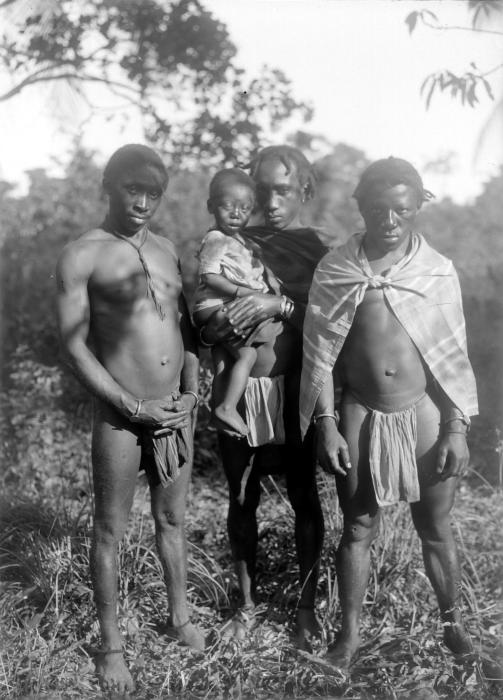
The most long lived Maroon settlement was Palmares in Brazil, which lasted almost the entire 17th century, until it was destroyed by Portuguese troops. After the abolition of slavery, most Maroons slowly integrated into wider society. The foremost exception is Suriname, where the Maroons (known as Bush Negroes) have kept their separate communities and identities until today, forming an ethnic group distinct from other Surinamese Blacks.

“Maroon Societies” doesn't deal with “real” slave rebellions, and therefore mentions Haiti and Demerara mostly in passing. It says relatively little about North America. Neither the Black Seminoles nor the escaped slaves in the Great Dismal Swamp are extensively covered. Most of the material is about Latin America, the Caribbean and Suriname. The collection can be somewhat bewildering to the general reader, and is mostly intended for students, but most of the texts aren't written in a heavy scholarly jargon. For that reason, I think “Maroon Societies” may be of interest to non-academic readers.
Four stars.

Friday, September 14, 2018

Forgotten hotspot


This is a volume in the “Marxist Regimes” series. It deals with the military regime of Desi Bouterse in Suriname (or Surinam), a former Dutch colony in South America. The book was published in 1986. It's somewhat eclectic, combining chapters on politics and history with sections which sound more anthropological in character. The first chapter even includes geological information! It's good to know that the New Coastal Plain was formed during the Weichsel Ice Age, but what on earth does this have got to do with Marxist regime-change?

Suriname became independent as late as 1975. The official language is still Dutch. The nation is a virtual mosaic of ethnic and religious groups, the most prominent being the Creoles (most of whom are Catholic or Moravian Brethren) and the East Indians (who are usually Hindus). There are also “Bush Negroes”, who are descendants of Maroons (runaway slaves). Bouterse and the military took power in a bloodless coup in 1980 and initially enjoyed widespread support due to their promises to end corruption and dependence on the former colonial power. After some initial hesitation, or perhaps dissimulation, Bouterse turned to the “left” and established close relations with Cuba and Grenada. The Cuban presence was particularly conspicuous. This turned the erstwhile god-forsaken country into a Cold War hotspot. Bouterse's courting of Libya didn't exactly help. Suriname borders French Guiana, which may explain Colonel Gaddafi's interest in the region, Libya being embroiled in several conflicts with France in Africa.

Bouterse was challenged by the trade unions and churches, and feared (perhaps rightly) some kind of foreign intervention. In December 1982, thirteen prominent leaders of the opposition were arrested and summarily executed, an event which still haunts Surinamese politics. After pressure from both Brazil and the United States, Bouterse broke with Cuba and moved to the “right” again, initiating talks with the unions and the old political parties. However, repression continued as Bouterse's regime was challenged by Ronnie Brunswijk (a former bodyguard of the dictator) who had formed a guerilla group popularly known as the Jungle Commando. It was based on the Bush Negroes. The war led to a refugee crisis, as thousands of Bush Negroes fled to French Guiana. That a prominent associate of Bouterse was arrested in Florida suspected of cocaine smuggling lowered the prestige of the regime even more.

The authors of this book believe that Bouterse had lost most of his popular support by 1982, and that the people no longer trusted the union and party leaders who had sat down to negotiate with the military leader. The mineworkers (a powerful group in Surinamese society) had gone out on strike against the regime without union blessing. There the story pretty much ends. I'm old enough to remember Swedish newspapers mentioning the Jungle Commando, but that's all I knew about Suriname before I read this book. I admit that it was relatively informative (albeit extremely boring!).

Little is heard of Suriname today. Apparently, Desi Bouterse is back as president after a democratic election (!), but the December killings and suspicions concerning Bouterse's own involvement in drug trafficking (mentioned by WikiLeaks) tarnishes his reputation. He has been convicted of the latter crime in absentia in the Netherlands.

That would be all for now…

PS. This is my 3333th customer review!

Sunday, August 12, 2018

There´s a bug from Surinam in my soup


A review of "Insects and Flowers: The Art of Maria Sibylla Merian" 

This little art book shows details from a much more extensive 1719 book published in Oosterwyk, Holland. The Dutch title is too strange to spell out, but in English the book is known as "Metamorphosis on the Insects of Suriname". The artists name is Maria Sibylla Merian.

At the time, Surinam was a Dutch colony. Today, it's an independent nation with a somewhat colourful history. But that's another show. Back to main frame.

I don't doubt that Ms. Sibylla Merian was a remarkable woman for her day. Still, I didn't like the pictures in this book. They are scary, disgusting and dilettantish. And yes, they really do show bugs.

Only two stars for this "flying Dutchwoman".