| Credit: Angelica Brockne |
Hade jag väl skrivit om jag varit stenhård trotskist, anarkist eller något sådant. Eftersom (s)-märkta Aftonbladet här "stödjer" Fröken Snusks yttrandefrihet. Det rör sig alltså om den nya Fröken Snusk (inte Felicia).
The blog to end all blogs. Reviews and comments about all and everything. This blog is NOT affiliated with YouTube, Wikipedia, Microsoft Bing, Gemini, ChatGPT or any commercial vendor! Links don´t imply endorsement. Many posts and comments are ironic. The blogger is not responsible for comments made by others. The languages used are English and Swedish. Content warning: Essentially everything.
En intressant artikel från GP om "nykterhetsrörelsens fader" Peter (Pehr) Wieselgren. Som verkar ha varit en riktig tokstolle! Var han ens helnykterist? Läsen ock begrunden!
Stollerier från virdiskt håll har vi ju behandlat tidigare på denna blogg...
Wtf, ChatGPT debunks some of my favorite speculations about ancient Scandinavia, damn you, Sam Altman, damn you!
Is there any evidence that Uppland was ruled by queens from Scythia during the so-called Vendel period?
There’s no credible archaeological or historical evidence that Uppland — or any other part of Sweden — was ruled by “queens from Scythia” during the Vendel Period (c. 550–790 CE). That idea belongs more to the realm of myth, speculative ethnography, and 19th–early 20th century romantic nationalism than to modern historical research.
Here’s why:
1. Where the “Scythian queens” idea comes from
Classical sources like Herodotus describe the Scythians (nomadic Iranian-speaking peoples in the Pontic steppe) and occasionally mention prominent women among related groups (e.g., Sarmatians, Amazons).
In the early modern period, antiquarians tried to link Scandinavian legends to ancient world peoples. Olaus Rudbeck (17th century) famously identified Swedes as descendants of Atlanteans and Scythians.
Some 19th-century historians interpreted saga references to powerful women — especially in Hervarar saga and Ynglingatal — as dim memories of steppe-born “Amazon” rulers.
The Hervarar saga itself places part of its action in a semi-mythical “Reiðgotaland” and has connections between eastern warriors and the Svear, but this is saga-literary geography, not a reliable historical record.
2. What archaeology says about the Vendel period
Uppland in the Vendel Period is known for rich boat graves, weapon burials, and elite male warrior culture. The style of helmets, shields, and harness mounts shows contact with both the Byzantine world and the steppe (through trade routes along the Volga and Dnieper).
Some burial finds — horse gear, decorated mounts, and certain weapon types — have stylistic parallels with steppe nomad art. This shows trade and cultural contact, not political rule by foreign queens.
Women’s graves from the period are sometimes richly furnished, indicating high status, but there’s no evidence these women were foreign-born Scythians or held sole political power.
3. Why the “queens” part is unlikely
The political structures in Vendel-era Svealand appear to have been dominated by male war-leaders and kin-groups, with ceremonial kingship linked to cult sites like Old Uppsala.
Elite women could have strong influence (as landholders, marriage alliance brokers, priestesses), but no contemporary or near-contemporary evidence points to a dynastic line of foreign female rulers.
Even the most prominent saga queens — like Yrsa or Auðr the Deep-Minded — are embedded in a legendary chronology that mixes myth and historical kernels from many centuries apart.
4. The kernel of truth
Uppland elites did have contacts with eastern Europe and the steppe world during the Vendel period via trade routes (the “Eastern Way”).
Exotic goods — silks, glassware, silver, horse equipment — sometimes came via steppe intermediaries.
A few decorative motifs on weaponry and gear have clear Sassanian or steppe-nomad origins, probably copied locally after goods reached Scandinavia.
It’s conceivable that some high-status women in Svealand had eastern ancestry through marriage alliances with merchant-warrior groups from the Baltic’s eastern shore, but that’s not the same as rule by “Scythian queens.”
If you like, I can outline how certain burial finds in Vendel and Valsgärde have been misread as “Amazon” graves and why modern archaeologists interpret them differently. That’s where most of this legend picked up its pseudo-historical momentum.
Alright — here’s where the “Amazon graves” idea in Vendel-period Uppland came from, and why modern archaeology doesn’t buy it.
In the late 19th and early 20th centuries, Swedish archaeologists excavating Valsgärde, Vendel, and other sites in Uppland found:
Boat graves with richly furnished male warrior burials.
A smaller number of richly equipped female burials — sometimes with jewelry, imported glassware, high-quality horse gear, and occasionally a weapon.
Some women were buried with horses or elaborate horse equipment, which is unusual for most of Scandinavia but does have parallels in Eurasian steppe cultures (where mounted female warriors appear in both archaeology and myth).
Early scholars (working under the influence of Herodotus and the Amazon legends) leapt to the idea:
“These must be Scythian or Sarmatian ‘Amazon queens’ who came to rule the Svear!”
Steppe parallels: In the 19th century, a few female burials from the Pontic steppe were found with weapons, leading to the “real Amazons” hypothesis. When similar patterns (women + horses) were seen in Sweden, the connection was tempting.
Saga echoes: Old Norse literature (e.g., Hervarar saga) speaks of warrior women (skjaldmær), sometimes tied to eastern lands. Linking them to archaeology felt natural to romantic nationalist historians.
Diffusionism: The prevailing model assumed major cultural innovations came from outside — so rich or unusual graves were interpreted as proof of foreign elites.
Contemporary archaeology looks at these finds differently:
a) Local elite women, not steppe rulers
The rich female graves match local Scandinavian elite burial customs — the goods, although sometimes imported, are arranged in Scandinavian styles and are part of known local assemblages.
Horse burials for women may signal status within an elite household tied to horse-breeding or ceremonial functions, not necessarily martial roles.
b) Trade, not conquest
The steppe-style horse gear and decorative metalwork probably arrived via Baltic trade routes linking Uppland with Gotland, the eastern Baltic, and through the Rus’ river systems to the steppe.
Imported objects do not automatically mean imported rulers — the elite were avid consumers of exotic prestige goods.
c) The “weapons = warrior” assumption is shaky
In many cases where weapons are found in women’s graves, they may be symbolic or related to status rather than evidence of active combat.
Burial practice is a cultural performance, not a literal record of a person’s life role.
It’s a romantic, cinematic image: exotic warrior women riding into Uppland from the steppe.
It neatly connects Scandinavian prehistory to the wider Eurasian drama.
It blends saga heroines, Greek legends, and striking archaeology — irresistible for TV and novels.
Bottom line:
Those “Amazon” burials from Vendel-period Uppland are almost certainly local high-status women buried according to Scandinavian traditions, with some imported goods from the east. The “queens from Scythia” hypothesis is a romantic 19th-century overlay, not supported by current archaeological interpretation.
That theory has actually been floated — especially in the 19th and early 20th centuries — but it’s on very shaky ground. Let’s break it down.
Medieval sources: Snorri Sturluson (Prose Edda, Ynglinga saga) and the Old English poem Widsith present Odin not purely as a god, but also as a legendary ancestor-king who led the Æsir from somewhere in the east into Scandinavia. Snorri even suggests he came from “Asaland” or “Asia,” specifically around the Don River or Black Sea region.
Medieval chroniclers (like Saxo Grammaticus) sometimes rationalized pagan gods as deified human leaders — this is the euhemerist approach.
Since Attila the Hun († 453 CE) came from the Eurasian steppe, and Odin was imagined as an eastern conqueror, some antiquarians guessed they were the same person.
Chronology guesswork: If Odin had been a real steppe chieftain, his supposed migration to Scandinavia could (in imagination) align with the 5th century — right after Attila’s death.
Steppe imagery in Norse myth: Odin’s horse (Sleipnir), his role as a war god, and some of his shamanic traits have vague parallels with Central Asian warrior and shaman traditions.
Name parallels in migration myths: Medieval historians sometimes mapped known “barbarian kings” onto older mythic figures to make sense of them.
Time depth: Odin worship is attested in Scandinavia well before Attila — Roman sources from the 1st–2nd century (like Tacitus) already mention a god similar to Odin (Mercury in the interpretatio romana).
Mythic complexity: Odin’s role as death-god, magic-worker, and culture-bringer is far too mythologically layered to originate from a single historical chieftain.
Geographic mismatch: The “Asaland” of Snorri is mythic geography, not a literal memory of Hunnic Hungary.
Linguistics: The name Óðinn (from Proto-Germanic Wōðanaz) has Indo-European etymology meaning “fury” or “inspiration,” unrelated to Attila’s name or title.
Lack of cultural continuity: Huns left little trace in Scandinavia compared to the massive influence of earlier and later trade/migration waves.
Snorri and others were using euhemerism to integrate pagan gods into Christian historiography. They chose “Asia” origins for Odin to make him fit biblical migration stories (everyone ultimately coming from the east after the Flood).
The “Odin as eastern king” motif might preserve dim memories of some migration of elite warrior bands from the south or east — possibly Goths, Lombards, or other Germanic groups returning north — but not of Attila specifically.
In short:
The “Odin = Attila the Hun” theory is more of a romantic antiquarian speculation than a serious historical proposition. Odin’s cult is far older, and his mythic profile doesn’t match Attila’s biography. The resemblance is a product of medieval euhemerism plus 19th-century fascination with linking all dramatic history to famous named figures.
If you want, I can also walk you through the other “historical Odin” theories, including the one that ties him to a real migration leader in southern Denmark around the 4th century. Those have a bit more plausibility than the Attila idea.
There’s no hard archaeological proof that Värend (the southeastern inland part of modern Småland) was the home of the Heruli, but there is a longstanding historical speculation tying the two together — and it’s based almost entirely on medieval chroniclers and some suggestive (but not conclusive) patterns in place names and burial finds.
The Heruli (Heruli in Latin, Eruli in Greek) were a Germanic-speaking warrior people who appear in late Roman sources from the 3rd to 6th centuries CE.
They roamed widely — fighting in the Balkans, raiding the Aegean, serving in Roman armies — and were sometimes based near the lower Danube.
In the mid-6th century, Procopius (Wars, VI.15) famously reports that a remnant of the Heruli, after losing to the Lombards, “returned to the island of Thule” — meaning Scandinavia — to live among “their kinsmen.”
Olaus Rudbeck (17th century) and later Swedish antiquarians suggested that Procopius’s “Thule” meant southern Sweden, and that Värend (and perhaps Blekinge) was their ancestral homeland.
Part of this comes from the phonetic similarity between Heruli and certain old place names in Småland (e.g., Härlöv, Härlunda, Häradsbäck). “Här” could be linked to Herul-, though it’s just as likely from Old Norse herr (“army”).
The region has a concentration of large Iron Age burial mounds and weapon-rich graves, consistent with a militarized elite — but this is true of several parts of southern Sweden.
There’s no direct inscription, runestone, or artifact in Värend that explicitly names the Heruli.
Procopius is vague — “Thule” could mean anywhere in Scandinavia. Many have argued for Gotland, Öland, or southern Norway instead.
Archaeology can’t distinguish “Heruli” graves from those of other Scandinavian elites of the period.
The idea that the Heruli originated in Värend is mainly a 17th–19th century romantic-nationalist hypothesis; most modern historians treat it cautiously.
Mainstream view: The Heruli were a mobile warrior group whose exact homeland in Scandinavia is unknown.
Värend is a possible return point after 550 CE, but not proven.
The only solid link is the possibility of onomastic echoes and the general martial character of the archaeological finds in the region.
Many experts lean toward the idea that the “return” was small in scale — perhaps a noble band rejoining related clans — rather than a large tribal migration.
If you’d like, I can walk you through the step-by-step reasoning Procopius gives and compare each detail to archaeological finds in Värend, Gotland, and Öland to see which location best fits his account. That’s the method historians use to test the Värend-Heruli theory.
There’s no direct, indisputable evidence that Phoenicians ever reached Scandinavia during the Bronze Age — but there is a mix of suggestive clues, speculative theories, and a few genuine archaeological puzzles that have kept the idea alive in fringe and semi-academic circles.
Here’s how the case is usually presented and why mainstream archaeology remains skeptical:
The Phoenicians (centered in what’s now Lebanon) became a major seafaring and trading power around 1200 BCE and thrived until the 6th century BCE.
The Nordic Bronze Age was roughly 1700–500 BCE, overlapping with the Phoenician period in its later centuries.
So in theory, long-distance contact was possible in the later Bronze Age.
Bronze Age Scandinavia had no native copper or tin — both had to be imported.
Phoenicians were expert long-range traders, sourcing tin from as far away as Cornwall.
Some have speculated they could have extended their tin-seeking voyages farther north, perhaps reaching the amber-rich Baltic.
Amber from the Baltic is found in Mediterranean Bronze Age contexts — but this doesn’t prove direct Phoenician voyages; amber could have moved through many intermediary traders.
Bronze artifacts in Scandinavia sometimes show stylistic parallels to Mediterranean designs (spirals, sun motifs), but these could also be due to shared Indo-European cultural themes or indirect trade.
A few rock carvings in Sweden and Norway depict ships with profiles that some claim resemble Mediterranean galleys — but most Scandinavian archaeologists see them as native designs.
Metal composition studies sometimes show copper in Nordic Bronze Age artifacts with isotopic signatures matching Iberian or even Cypriot sources — again, this shows trade links but not necessarily Phoenician sailors in Nordic waters.
Later Phoenicians (especially Carthaginians) certainly reached the Atlantic coasts of Spain, Portugal, and possibly the British Isles.
Ancient authors like Himilco (reported by later Roman sources) describe voyages far north, perhaps to Britain’s tin mines — but there’s no firm textual evidence of voyages beyond Britain.
A few fringe writers link the Carthaginian voyages to mythical lands like Thule, which some place in Scandinavia, but this is highly speculative.
Yes: Baltic amber and southern copper moved between Scandinavia and the Mediterranean during the Bronze Age.
Yes: Phoenicians were capable of such voyages and had trade interests that could, in theory, lead them north.
No: There’s no solid archaeological or textual proof they personally sailed into Scandinavian waters. The more plausible scenario is a trade relay system through continental and Atlantic intermediaries.
If you want, I can give you a map reconstruction of possible Bronze Age trade networks showing how amber could have moved from Jutland and southern Sweden all the way to Tyre and Sidon without a Phoenician ship ever touching the Skagerrak. That’s where most scholarly models land today.
No, it never was a true scholarly consensus. Even 30–40 years ago, mainstream archaeologists treated the idea that Phoenicians directly visited Scandinavia as speculative or fringe.
Here’s a brief context:
Some scholars in the early 1900s were fascinated by possible Mediterranean influences on northern Europe.
Researchers sometimes suggested “Phoenician voyages to Scandinavia” to explain certain Bronze Age artifacts or amber trade, but these were mostly hypotheses, not widely accepted conclusions.
By the 1970s–1990s, Scandinavian archaeology had strong empirical bases from local material culture, rock art, burial practices, and isotope studies.
The focus shifted to regional developments and long-distance trade networks, showing that Mediterranean goods reached the north via intermediaries (Germanic and Central European traders) rather than direct Phoenician contact.
Textual sources on Phoenician voyages were treated cautiously because they were often much later and sometimes mythologized.
The “Phoenicians in Scandinavia” idea is now considered highly unlikely, bordering on pseudohistory, though some popular books and fringe writers still promote it.
Most archaeologists accept Phoenician amber trade via relay networks, not personal navigation into the Baltic.
So, 30 years ago, the hypothesis existed in publications, but it was never mainstream or consensus. It was more a curiosity at the edge of Bronze Age studies.
If you want, I can list some of the main scholars who argued for and against it in the 1970s–1990s to see exactly how it was debated. Do you want me to do that?
While the idea that Phoenicians directly visited Scandinavia during the Bronze Age was never a scholarly consensus, it did gain some traction in certain circles during the 20th century. This hypothesis was largely based on interpretations of archaeological finds, such as Mediterranean-style artifacts and the presence of Baltic amber in Mediterranean graves. However, these theories were often speculative and lacked direct evidence.
By the late 20th century, with advancements in archaeological methods and a more nuanced understanding of trade networks, the mainstream scholarly community moved away from the notion of direct Phoenician contact with Scandinavia. Instead, researchers emphasized the role of intermediary trade routes and local developments in the Nordic Bronze Age.
Today, the idea of direct Phoenician voyages to Scandinavia is largely considered a fringe theory, with most scholars focusing on more substantiated models of trade and cultural exchange.
| No deer were harmed when generating this picture! |
"Vilda Småland" is a Swedish nature documentary only available for viewers in Sweden at SVT Play. Småland is a region in southeastern Sweden. Over 100 years ago, a maverick ethnologists actually claimed that the dragon-like lindorm was a real cryptid living somewhere in the Smålandese forests but, alas, nobody took him seriously! The real wildlife in the region in question is featured in this production.
I admit that I got a bit bored after a while, since most of the docu is about deer. But sure, they show three different species, so if Cervidae is your main interest in life and you live within the borders of our kingdom, I suppose you´ll get your treat. Other animals shown include white-tailed eagles (munching on a dead deer!), whooper swans, grebes, the capercaillie, foxes, badgers, boars and lynxes. Weirldy, the sound made by the lynx sound like dog barks?!
While it´s kind of interesting to watch animals you *almost* see when out strolling, the deer aspect soon got to me. But then, I´m not a hungry lindorm, so there´s that, I suppose!
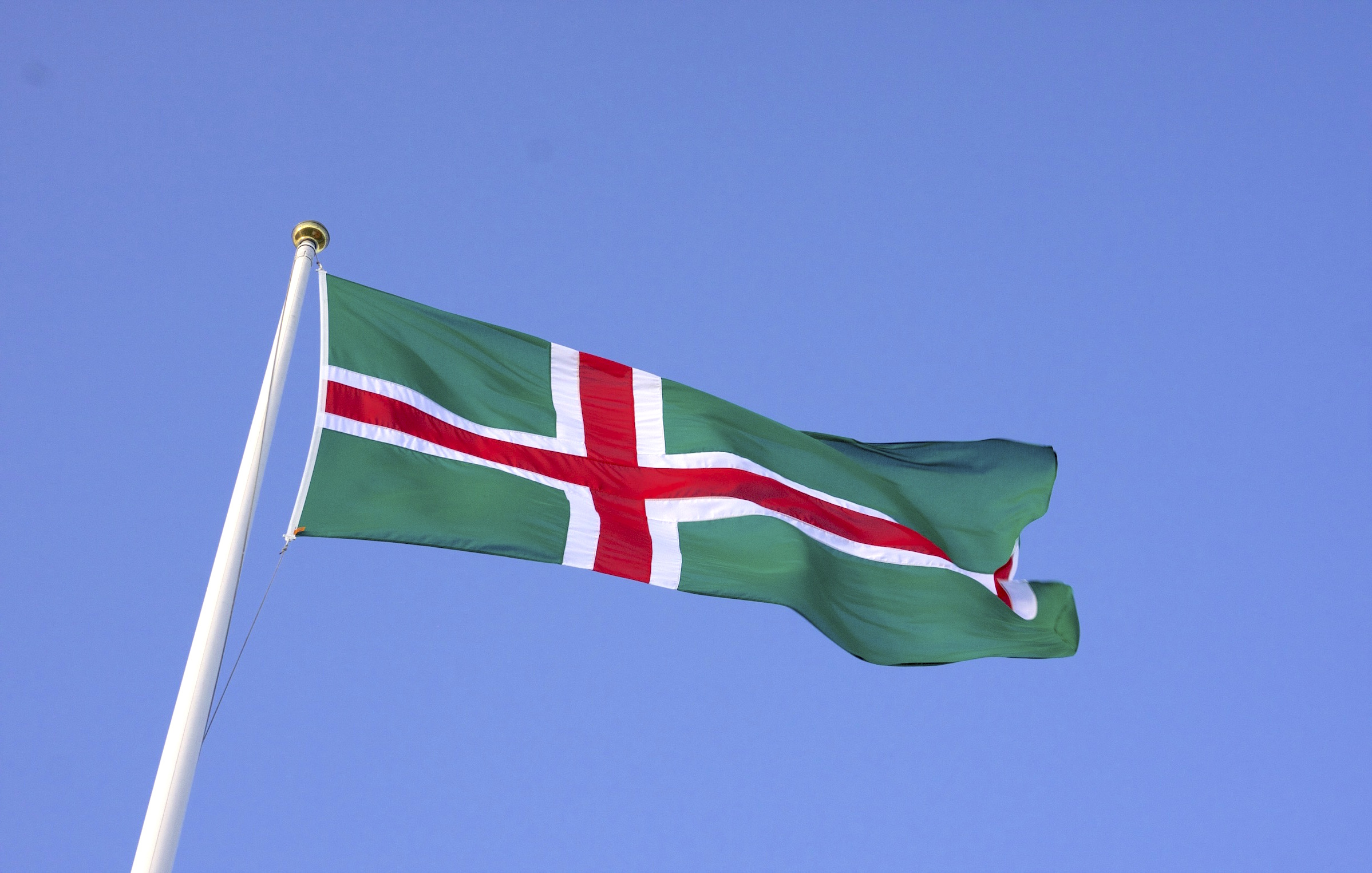
| The real flag of Småland... but quite similar to the one seen in the TV series! Credit: FlaggorOnline.se |
“Det finns inga smålänningar” is a four-part
Swedish TV series first aired in 1981 (and probably never aired since). It´s
easily the most controversial production ever shown on SVT (Swedish public
service television). A total of 164 complaints were registered with Radionämnden,
the government agency tasked with overseeing public service TV and radio in Sweden.
In the end, Radionämnden decided not to take any action. Critics in the media accused
the series of being absurd, partisan, anti-Israeli and anti-Semitic, but many
also called it “pretentious twaddle” and considered it an embarrassment for SVT.
Absurd and confusing were other judgments. And yes, it´s about the Israel-Palestine
conflict!
The series retells the conflict between Jews/Israelis
and Arabs/Palestinians in allegoric form, placing it on an alternate timeline
in which a broadly similar conflict takes place in Sweden. The point of the
exercise is presumably to make it easier for the average Swedish TV viewer to
identify with the Palestinians, since they are recast as Swedish-speaking
peasants living in refugee camps, but if that was the intention, it probably
failed. Instead, “Det finns inga smålänningar” gives a chaotic and surrealistic
impression, and frequently comes across as a real turkey. Pro-Palestinian activists
could probably decode the various esoteric references in the series, but I doubt
anybody else came even close. I actually watched the first episode as a kid, didn´t
get half of it, and never watched the rest – until now (it´s available on SVT
Play, but can only be seen in Sweden). Interestingly, I remember it being even
more surreal than it actually was!
The title “Det finns inga smålänningar” means ”There are no Smålanders”, Småland being a historical province of Sweden. It´s a reference to Golda Meir´s notorious statement “There are no Palestinians”. In the series, Småland symbolizes Palestine, the town of Jönköping being Jerusalem. That´s actually quite apt, since Jönköping is often jokingly called “Småland´s Jerusalem” due to its large evangelical Christian community. The area of Värend in Småland symbolizes Israel, and its inhabitants (known as “virdar”) are a stand-in for the Jews. Zionism is called “viridism” in the series, a wholly fictitious concept! The forces of Värend expel the other Smålanders (= the Palestinians) in a bloody war of conquest. Östergötland is Lebanon, Västergötland is Syria and Skåne (Scania) is Egypt. Öresund is the Suez Canal. Somewhat confusingly, the rest of Sweden symbolizes the real Sweden, while no equivalent of Jordan has been included.
The PLO is called the Småland Liberation Organization (SBO) and its leader does look like a convincing cross between Arafat and Castro. The Smålandian militant Lisa Jonsson is clearly based on the PFLP terrorist Leila Khaled. Like her real counterpart, Lisa hijacks an airplane and blows it up. The Smålanders are depicted as simple rural folk who suffer in refugee camps without ever really “getting it”, expect for the younger generation who goes on to form the militant SBO. It struck me that this could be an allegory for young people during the 1970´s becoming leftist radicals, while their parents and grandparents are apolitical and aloof.
Indeed, the entire series could be taken as a fantasy of a revolution in 1970´s Sweden, with the Smålander-Palestinians being "the working class" or "the common people", the treacherous Arab leaders really being the Social Democrats, and so on. At one point, the displaced Smålanders clearly symbolize 1970´s immigrants in Sweden looking for gainful employment, not Palestinians in the Middle East. Maybe it´s a double allegory? Even the use of folk music – which looks rural and traditional – is really
a 1970´s Swedish leftist thing in context, since “progressive” music was
sometimes “folksy”.
It was (of course) the series´ sympathetic portrayal of the Palestinians, including the PLO, that made it intensely controversial. Today, a pro-Israeli series would probably be seen as far worse, which may tell us how (purported) public opinion has shifted since 1981. But, as already indicated, “Det finns inga smålänningar” is so absurdistic that it´s difficult to believe that *it* moved the needle!
On one point, I actually found the series quite
funny: the reporter Valter Ersson is depicted as vain, careerist, uncomprehending
towards the plight of the refugees, and even something of a fake. While this
may be an unfair caricature of an actual foreign news correspondent, it does
capture a certain breed of “intellectuals” almost to a tee. The series is also
hilariously precocious: in one episode, one of Ersson´s colleagues says that
anything pro-Småland (i.e. pro-Palestinian) will surely be reported to
Radionämnden! Go figure.
I think it´s pretty obvious why I decided
to watch “There are no Smålanders” now. Let´s face it, the fact that SVT could
show an anti-Zionist/pro-hijacker propaganda production in 1981 and get away with
it, probably does tell us something of our Woke predicament. But, to repeat myself again,
“Det finns inga smålänningar” in itself is so peculiar that I suspect it had
very little effect on public opinion either way. Even today, it comes across
more like a monument to the stranger strands of the 1970´s left-intellectual
mindset...
Just när man trodde att man sett allt, eller åtminstone det mesta...
Styrs Piteå och Älmhult i själva verket av frimurare och, host host, "druider"?
Druider? I Norrbotten år 2020. *Efter* Kristus?
Åååååkej. ☮️