Showing posts with label Russian philosophy. Show all posts

Sunday, January 29, 2023

Friday, January 27, 2023

Welcome to Russia!


I admit that this is quite funny, despite the anti-Ukrainian angle. Now, the dastardly kholokhols must respond in kind! By wrestling down a wisent, perhaps? 

Sunday, December 4, 2022

The riddle of the world


Previously posted on this blog on July 26, 2018 under a different title. This is what I want to believe in, when I´m not entirely awake or something!

"Lectures on Divine Humanity" by Vladimir Solovyov is a somewhat difficult book, in which the Russian philosopher-mystic expounds his particular version of Christian panentheism. I nevertheless felt right at home. But then, I've been immersing myself (somewhat haphazardly) in panentheist literature for some time. Solovyov draws from a wide variety of sources when spinning his own philosophy: I recognized obvious affinities with Plotinus, Leibniz, Hegel, Schelling, Fichte and Schopenhauer. However, his main font of inspiration must have been more mystical sources. The kabbalists are the usual suspects. Indeed, some of the other names on the panentheist laundry list were probably also inspired by such sources. Finally, I recognized affinities between Solovyov and later writers, including Steiner, Barfield, Grant-Watson and even the process philosophers.

It seems Solovyov is the best blend! He is also believed to be the prototype of Alyosha Karamazov. Both Dostoevsky and Tolstoy were present when Solovyov delivered his lectures on divine humanity. Dostoevsky obviously paid attention - at least to Solovyov's personality (he seems to have been quite a character), while Tolstoy rejected him as absurd and childish.

Solovyov's philosophy is difficult to summarize, so what follows are just a few short sketches.

The most fundamental metaphysical objects, simply called "entities", have three aspects: the atom, the living force or monad, and the idea. The most basic mode of knowledge is a form of subconscious, intellectual intuition which predates both rational thinking and empirical observations. This reminds me of the panpsychism of Whitehead, with its "creative occasions" and "prehension" or "radical empiricism". However, Solovyov's version seems to be a form of idealism, since neither the "atom", the monad nor the idea seem to be really material. At one point, he even says that the existence of the outside world can't really be known for sure, except through faith, a position presumably taken from Fichte. I'm not sure if Solovyov really believed this, since his metaphysics sound very "objective" and centered on God rather than individual consciousness. But then, perhaps Solovyov didn't see any necessary contradiction between an objective and a subjective perspective? In his system, God and the world are con-substantial, and the Trinity is somehow reflected everywhere in creation. The Trinity is the solution to the problem of unity-multiplicity.

There doesn't seem to be any point at which creation "began". Rather I got the impression that Solovyov believed in a constant creation in the Neo-Platonist fashion. Thus, there is permanent unity-multiplicity, rather than creatio ex nihilo. Solovyov explicitly argues for a compatibilist view of divine freedom. Creation and love are necessary for God.

The cosmic fall is the fall of the world-soul or Sophia away from its true source in God. The world-soul is also a unity-multiplicity: both a single organism and a collection of many different entities. (This is presumably similar to the Primal Man, Purusha or Adam Kadmon.) By falling away from God, the world-soul looses its unity and fractures into complete chaos. However, the love of God works to lure the world-soul back to its original state. Our universe is the result of divine love working on the fractured, chaotic multiplicity of fallen Sophia. It's slowly evolving back to God. (Note both the similarity and difference with process philosophy, really a truncated version of this more supra-cosmic vision.) Many of the beings regarded as "spirits" or "gods" are former aspects of our own selves, which have been separated from us as a result of the fall. They are said to be in charge of the evolutionary process. Presumably, they used to be our higher selves. A similar position can be found in Anthroposophy and Theosophy.

In contrast to Schelling, Solovyov doesn't seem to locate the origin of evil in God himself. Rather, evil is the result of the world-soul's free will to fall away from God. Evil results from the fragmentation and finitude of each living creature, which strives to expand itself and survive in hostile competition with other creatures. In the fallen world, evil is inevitable. Everyone is born with radical evil in his heart, and the problem is therefore metaphysical.

At several points in his lectures, Solovyov discusses the evolution of religion. He sees several different stages in this process, which have a dialectical relation to each other in a scheme of thesis-antithesis-synthesis. Original paganism is negated by Buddhism. Greek philosophy and the Judaism of the Law are both negated by the Judaism of the Prophets, with Christianity as a grand synthesis of everything that went before. There are also different stages in original pagan religion: star worship, sun worship, etc. Solovyov's attempts to squeeze the history of religions into a Hegelian (?) scheme aren't very convincing, but his main point seems to be that Christianity is a natural, evolutionary zenith of previous religious traditions, rather than a completely unique revelation de novo. He even attempts to trace the Trinity to pre-Christian notions, Philo in particular. Clearly, Solovyov wouldn't feel threatened by parallels between Christ and the deities of mystery religions. One is reminded of C.S. Lewis in this respect.

Indeed, it's not entirely clear whether the actual person Jesus Christ is a product of internal cosmic evolution or a divine personage coming "from the outside" to the fallen world. Perhaps he's both, or perhaps it really doesn't matter. The universe is, after all, "in" God even in its fallen state. The entities simply doesn't realize it, having posited themselves as completely autonomous. Also, Christ is not simply a person (human or divine), but a kind of collective organism or Primal Man presumably similar in character to the original world-soul before its fall. Solovyov says that the incarnation was natural, in the sense that the world was ready for the incarnation of Christ due to its upward evolution. The end-goal of the process is less clear, but the author does suggest that the Church, or rather the Universal Church (perhaps a mystical category) is a divine organism which wants to freely convert and hence unite with all men on Earth.

Solovyov's view of history is also, I take it, Hegelian. He doesn't reject modernity and secularism out of hand. Rather, he sees the modern West as a necessary antithesis to the institutionalized Christianity of the Middle Ages and Russia, which is no longer based on love. The synthesis will be a voluntary Christian union and society, and Solovyov hopes that his own motherland will lift itself up and bring in this happy state of affairs. (He later lost faith in intra-historical salvation, as seen in his famous "Short Story of the Anti-Christ".) While I consider Solovyov's political ideas the weakest spot in his entire philosophical edifice, he did have two sympathetic traits: he seems to have rejected the most virulent forms of Russian and pan-Slavist nationalism, and he doesn't sound anti-Semitic. Indeed, at one point he writes that the Jewish prophets' combination of positive patriotism and universalism should be a model for Russia!

For more on Vladimir Solovyov, see Frederick Copleston's "History of Philosophy. Volume 10: Russian Philosophy" and N.O. Lossky's "History of Russian Philosophy", which also mentions Solovyov's mystical side and somewhat peculiar personal habits.

Meanwhile, I will give this panentheist best blend five stars.

Wednesday, August 24, 2022

The fourth fascism


I actually read "The Fourth Political Theory" by Alexander Dugin. My review is linked below. A propos recent events in Moscow, and so on. 

Friday, May 28, 2021

Knocking on the door of Progress


"Knocking on Heaven´s Door" is a 2011 BBC documentary narrated by George Carey. It deals with a very obscure topic (at least outside Russia), and yet I posted about it before. Yes, it´s time for another close encounter with Nikolai Fyodorovich Fyodorov and the Russian Cosmists! 

On YouTube, the documentary has been given the click-bait subtitle "The Bizarre Story of the Soviet Space Program". Some of it deals with the "official" space program and Yuri Gagarin, still considered a hero and a martyr in Russia. No surprise: Gagarin (not Buzz Aldrin or John Glenn) was the first man in space. Digging deeper, Carey discovers a strange underworld where science is de facto treated as a religion, religion becomes a science, and nobody really seems to get the difference (or even give a damn). This holism is, of course, typical of much Russian philosophy. 

The "prophet" of the space age turns out to be the 19th century excentric Fyodorov (often misspelled Fedorov in English), who lived like a "fool in Christ", yet preached a secular religion in which high technology would make humans immortal, including a resurrection of those already dead. Space exploration and conquest was part of this futuristic utopia. In the West, a man like Fyodorov would presumably be seen as a kook, but in Russia, people like Tolstoy and Dostoevsky saught him out, and some later scientists were inspired by the prophetic quality of his ideas. One of them was Konstantin Tsiolkovsky, Vladimir Vernadsky perhaps another. Still today, there are Cosmists in Russia. Carey meets both the more quasi-religious types (one of them even showing him a kind of pagan idol!) and the more scientific ones, including a group that investigates "remote viewing" and out-of-body experiences. The latter group seems well connected. 

What I find fascinating is precisely the seamless, careless manner in which these people jump across the (supposed) science-religion divide. Tsiolkovsky was a rocket scientist, but judging by George M Young´s book "The Russian Cosmists", he was also a kind of crypto-Theosophist, hiding his religious views behind a scientific-sounding language. But then, he may not have seen any contradiction. In the documentary, the parapsychology researchers comes across as a more fortrightly spiritual group, more interested in inner exploration than space conquest, but once again, they might not see any binary opposition between them. The spiritual dimension is, after all, simultaneously also a kind of space "out there". All matter is alive and communicates with itself, and humans are simply small particles trying to get integrated into a vast spiritual-cosmic matrix. I admit that this more "Hindu" perspective is more sympathetic than Fyodorov´s bizarre ideas about a high tech resurrection (the Cosmists also had an authoritarian and eugenicist streak, making me wonder if *all* humans really were chosen to enter Heaven´s door). 

Another reflection: we may look upon Fyodorov as a kook and the personality cult of Gagarin as weird and cultish, but are we that different ourselves? The Soviet cult of the cosmonaut is simply the Communist version of the more general Western idea of Progress, which during its heyday also claimed that "our destiny is in the stars". Perhaps that´s why I found Fyodorov so unsettling. His speculations expose that our pop-scientific worldview is really our religion (Christianity) with the serial numbers filed off. And probably even more crazy, to boot. 


Sunday, December 16, 2018

Russian chimera


“The Gumilev Mystique: Biopolitics, Eurasianism, and the Construction of Community in Modern Russia” by Mark Bassin is a scholarly summary of the life, ideas and contemporary influence of Lev Gumilyov (1912-1992). Or perhaps attempted summary since Gumilyov´s ideas were incredibly complex, eclectic and contradictory. So is his influence on the political discourse in the ex-Soviet Union. First, an admission: I never even heard of Gumilyov (whose name is spelled Gumilev in the book) until a few months ago, yet he has been a towering intellectual presence in Russia since the 1970´s. Bassin´s book popped up in a search engine when I was looking for material by Nikolai Trubetzkoy in English…

Lev Gumilyov was the son of two prominent Russian poets, Nikolai Gumilyov and Anna Akhmatova. Nikolai was executed by the Communist Cheka in 1921, while Lev spent a total of 15 years in Stalin´s labor camps. He enjoyed a kind of quasi-approval during the post-Stalin decades, but it wasn´t until the advent of the perestroika and the collapse of the Communist regime that Gumilyov´s ideas became more widely known. Gumilyov is regarded as a historian and ethnologist, but I think it´s more useful to see him as a philosopher in the broad Russian sense. Indeed, I get the impression that Gumilyov was a mercurial intellectual and “mad genius” with the usual persecution complex and delusions of grandeur. Somehow, I consider this particular type of person to be very Russian!

Gumilyov´s ideas are difficult to describe in a short review. They are a bewildering blend of vitalism, biologism, geographic determinism, anti-Semitism, anti-Communism, anti-modernism and Russian nationalism, but also Turkophilia and Mongolophilia. I agree with Bassin that the various strands don´t always combine very well. There are certain similarities to the ideas developed by Spengler and Toynbee, but the differences are more striking. Gumilyov had an essentialist view of ethnic groups, viewing them as more or less self-contained units of a biological and psychological character. In some writings, he described the origins of an ethnos in geographical and ecological terms. Each ethnos was molded by its natural living environment and could even be seen as part of nature itself (note the strong biologism). In other writings he claimed that the “ethnies” (plural of ethnos) were products of cosmic radiation (!). Somehow, this solar radiation gives rise to new ethnies by mutations affecting the psychological make-up of certain persons. These founding fathers are also given an energy impetus (which thus comes at least indirectly from the sun), giving rise to what Gumilyov called “passionarnost” – a central term in his writings. My interpretation is that passionarnost is really the élan vital and that its bearers roughly correspond to the “creative minority” in Toynbee´s writings. A new ethnos is *not* dependent on its living environment, to the contrary, it rebels against it, perhaps by moving out to new territories. Each ethnos follows a life cycle of roughly 1,500 years during which it rises, reaches maturity and then loses the energetic impetus due to entropy. Eventually the ethnos disappears or becomes a relict population. (Curiously, the Russians – uniquely – have experienced two ethnic cycles, rather than just one.) Gumilyov believed that his ideas were scientific in the strict sense of that term, but critics see them as sheer fantasy. Another central concept for Gumilyov is “chimera”. Apparently, there is one way in which an ethnos could artificially prolong its existence almost indefinitely: by turning into a parasite on other ethnies, sucking their solar energy. This kind of parasitical ethnos is what Gumilyov called a chimera. Unsurprisingly for a Russian nationalist, his prime example of such was the Jewish people…

More surprising are Gumilyov´s pro-Turkic and pro-Mongol positions. Bassin never really explains where they come from, except that some Russians romanticized the life and culture of the steppe nomads, both that of ancient peoples such as the Scythians and that of later Tatars and Mongols. Gumilyov´s parents were influenced by this romanticism in their poetry, and his mother´s last name Akhmatova is really a pseudonym – she claimed to be a literal descendant of Khan Ahmed (Akhmat) of the Golden Horde! Gumilyov claimed that the Tatar yoke never existed, calling it a “black legend”. Russians and Mongols/Tatars cooperated peacefully. The battle of Kulikovo in 1380, when Prince Dmitri of Moscow defeated the Horde, wasn´t a Russian liberation struggle against the evil Tatars, but rather a joint Russian-Tatar effort to repulse a dissident Tatar faction backed by Lithuania (a hostile “Western” nation). Today, Gumilyov´s legacy is cherished in Kazakhstan, Tatarstan and Sakha (Yakutia). A university in Kazakhstan´s capital Astana is named after Gumilyov and a monument in Tatarstan´s capital Kazan – the monument was dedicated in the presence of Vladimir Putin himself – shows a statue of the man.

One thing that immediately struck me when reading “The Gumilev Mystique” is the strongly anachronistic character of Gumilyov´s writings. Thus, he claims that Khazaria and the Vikings cooperated in a genocidal war against Kievan Rus. Translation: Jews and Nazis are equally dangerous to modern Russia. Another possible translation: Bolsheviks and Nazis! Gumilyov believed that some ethnies were closer than others. They could be grouped into “super-ethnies” based on “complementarity” (another essentialist psychological term). This is strikingly similar to the Soviet concept of “the brotherhood of nations”. Gumilyov also made a distinction between ethnos, which is natural, and society, which is a social construct by man. This notion also has an affinity with the Soviet idea that the Communist state, of course, transcends all ethnic identities. It may seem strange that a man who spent most of his youth in Soviet labor camps would nevertheless have certain similarities to the regime which put him away, but the relation between Russian nationalism and Communism is a complex issue in itself. Gumilyov was no liberal democrat, usually avoided the pro-Western dissidents, supported the Soviet Cold War confrontation with the West, and opposed Gorbachev´s perestroika. He enjoyed a certain amount of support in the party hierarchy from the Brezhnev years onwards.

Due to their highly eclectic nature, Gumilyov´s ideas have inspired a wide range of people, from more strictly scholarly types interested in sociobiology or geography to decidedly less scholarly people such as Eurasianist philosopher Alexander Dugin, often cast in the role of Putin´s Rasputin (at least by the Western media). Russian ethno-nationalists, Russian imperial or state “nationalists”, Kazakh pro-Russian Eurasianists and Kazakh anti-Russian ethno-nationalists have all claimed Gumilyov´s legacy. Ziuganov, Zhirinovsky and Putin himself have name-dropped him on many occasions. The Green movement in the Soviet Union was inspired by Gumilyov, but also by Russian nationalism. At least two of his “scientific” terms have become virtual household words in Russia: passionarnost and chimera. The national question is just as vexing in Putin´s Russia as it was in Communist or Czarist ditto. Should loyalty primarily be to the state or to the Russian ethnos? And should the state be seen as multi-ethnic, non-ethnic or specifically Russian? Similar problems exist in Kazakhstan, where Russians form a substantial minority and the total number of nationalities is about 150. Should Kazakhstan be “Kazakh” or “Kazakhstani”? One possible interpretation of Gumilyov´s ideas is that Russians shouldn´t be “primus inter pares” in Russia or the Russosphere, rather this role should belong to a coalition of Russians and various Central Asian peoples! Bassin also mentions that some admirers of Gumilyov, including outright neo-Nazis, have drawn the conclusion that Jews could form a natural ethnos by moving to Israel, since the Israeli nation isn´t a chimera. Is this where the bizarre blend of neo-Nazism and Zionism of the National Bolshevik Party comes from?

My overall impression after reading “The Gumilev Mystique” is that Gumilyov, in his own kind of way, actually was right. A discourse of his type is surely impossible in Western nations, or even in “Eastern” Europe. What other European nation has spawned an intelligentsia seriously debating whether or not their historical legacy is somehow identical to or intertwined with that of Genghis Khan? Maybe the Russian ethnos really is fundamentally different. If that´s a good thing, is perhaps an entirely different question.

Thursday, September 13, 2018

Unjustly famous?

"War, Progress and the End of History" is a small book in dialogue format, written by Russian mystic, philosopher and sage Vladimir Solovyov. It's most known for a section called "A Short Story of the Anti-Christ". The book was originally published in 1900.

This edition has a foreword by the well-known writer and dissident Czeslaw Milosz and an afterword by Stephan Hoeller, a Gnostic "bishop" well-known in his own circles. Neither really explains the meaning or context of Solovyov's book. The reader is therefore left pretty much on his own, for good or for worse.

"War, Progress and the End of History" is written in the form of three conversations, held at the French Riviera. The main protagonists are the Prince, the Politician, the General and Mr. Z. There is also a Lady, but she says nothing of importance. The Prince is obviously modelled on Leo Tolstoy, whose Christian pacifism Solovyov opposed. Mr. Z is Solovyov's alter ego. The exact roles of the Politician and the General are more unclear. The Politician is "liberal" by late 19th century standards (actually, he is a kind of "liberal" imperialist and purveyor of balance-of-power Realpolitik), while the General is an ultra-conservative Christian who fancies himself a crusader. During the third conversation, Mr. Z reads "A Short Story of the Anti-Christ", supposedly a document written by a learned Orthodox monk named Pansophius. Since Solovyov is mostly known for his veneration of Sophia, Pansophius is clearly another mouthpiece for the author. Perhaps it's also a subtle form of self-irony - unless I'm mistaken, "Pansophius" means "The All-Wise".

The standard interpretation of "War, Progress and the End of History" is that Solovyov had given up on reforming society, instead awaiting the arrival of the Anti-Christ and his eventual defeat by God. However, this interpretation doesn't seem to capture all the nuances of the three conversations, since Solovyov points out in an introduction that he agrees with both the General and the Politician, as far as it goes. This doesn't make us much wiser, since these characters frequently contradict each other. There is also a contradiction between the Politician's faith in "progress", Mr. Z's statement that progress is a symptom showing that the end of the world is near, and Pansophius' short story, which rather indicates that the 20th century will be marked by wars and revolutions, not peaceful progress. Indeed, the "progress" in the short story is inaugurated by the Anti-Christ!

One thing that *is* clear is Solovyov's belief that metaphysical evil exists and is a real force to be reckoned with and opposed. His alter ego's main opponent during the conversations is the Prince, who calls for non-resistance to evil, while interpreting the Bible in a purely symbolic manner (no resurrection, no second advent, etc). Solovyov considered non-resistance to evil to be absurd, pointing out that Jesus never managed to regenerate the heart of Judas and the Sanhedrin. Judging by context, Christian pacifists pointed to the Good Thief crucified with Jesus as proof that everyone could be regenerated. In response, Solovyov points out that (of course) there were *two* thieves crucified alongside Jesus. The other one - the truly wicked one - was unrepentant to the end. *How* evil should be resisted is a tactical matter, and this makes it possible for Solovyov to agree both with the warrior-prone General, the wily Politician or the meek Jesus (and, presumably, the less meek Jesus in the last chapters of Revelation). Unfortunately, this is a commonplace and thus ads little depth to the conversations. Of course evil can be resisted in different ways, but so what? Surely Jesus said more than this!

Solovyov makes the argument that moral and societal good isn't enough. Death is the ultimate evil, and as long as death isn't conquered, life is ultimately meaningless despite moral and societal good. Mr. Z accuses the Prince of being inconsistent in his rejection of the resurrection - if good really is the primary force in the universe (which the Prince claims), then the resurrection must be true as well, since this is the only way in which evil can be finally overcome and goodness reign supreme. Unfortunately, Solovyov argues for his position ex cathedra, apparently considering it obvious. It is far from obvious, however: if the soul is immortal, why bother with a resurrection? Why should death be seen as "evil" in the metaphysical sense, if we all live morally upright lives in a perfect society? These questions are never touched upon in the dialogues, but Pansophius' musings on the Anti-Christ shows that Solovyov probably didn't believe in progress in the first place.

While "A Short Story of the Anti-Christ" has become famous, its description of the Anti-Christ is the usual one: a counterfeit Christ who proclaims himself emperor, seduces the churches, launches a syncretistic world religion, brings peace and prosperity only to reveal himself as a demon-worshipper, etc. I think the real importance of the story is Solovyov's irenic ecumenism. Although Russian Orthodox, Solovyov was all in favour of talks with the Catholic Church, and Catholics occasionally claim that he converted to Catholicism, something his Orthodox admirers hotly deny. In the short story, three small groups of Christians withstand the seductions of the Anti-Christ. They are led by Pope Peter, Elder John and Ernest Pauli, obvious symbols for Catholicism (which claims apostolic succession from St. Peter), Orthodoxy (which places special emphasis on the Gospel of John) and Protestantism (which claims the mantle of Paul). Eventually, the three groups form a united Church in the wilderness, led by...Pope Peter. The Russian nationalists, Slavophiles and Black-Hundreds can't have been amused...

Despite its fame, "War, Progress and the End of History" really isn't a good introduction to the thoughts of Vladimir Solovyov. Try "Lectures on Divine Humanity" instead.


Monday, September 10, 2018

The theosis of Vladimir Lossky


Vladimir Lossky was the son of Russian philosopher N.O. Lossky. Both father and son were extradited from the Soviet Union in 1922, together with Nikolai Berdyaev, Sergius Bulgakov and other non-Communist intellectuals. During World War II, Lossky joined the French Gaullist resistance. Despite his status as an expellee, Lossky had contacts with the Soviet-approved patriarch of Moscow, and was allowed to visit the USSR in 1956.

Otherwise, Lossky junior is most known as an Orthodox theologian. He studied the writings of Meister Eckhart, Thomas Aquinas and Etienne Gilson, and is said to have influenced quite a few people within the Church of England. His work "The Mystical Theology of the Eastern Church", however, shows no Thomist or Eckhartian influences whatsoever.

"The Mystical Theology" is an extremely difficult work, as several other reviewers have already pointed out. It's not an introductory text, but rather a very advanced theological treatise. Lossky attempts to unite two strands of thought many would consider to be irreconcilable: apophatic mysticism and traditional Christian dogma. Indeed, his dependence on the latter might be one of the reasons why the work is so complex. You need a proper grounding in theology to appreciate Lossky's book, especially when it tackles issues outsiders would consider hopelessly abstruse, such as the filioque.

In the tradition of Pseudo-Dionysius and other apophatic mystics, Lossky considers God to be fundamentally incomprehensible. In a certain sense, we can't really say anything about God at all. Indeed, Lossky believes that the Christian god is unfathomable in a more radical sense than The One of Neo-Platonist mysticism. To Lossky, the idea that the divine is "One" rather than "Many" can at least be conceptualized by our rational thinking, whereas the God of Christianity cannot. He is wholly other. (I recently discussed this issue with a non-Christian explorer of mysticism. He disagreed with Lossky - how can you *really* conceptualize the movement from One to Many, and back?)

Further, Vladimir Lossky regards the central doctrines of Christianity as unfathomable, standing above and beyond our rational categories. The Incarnation, the Atonement, the Trinity, the relation between nature and grace...none of these ideas can really be understood, and are therefore examples of apophaticism. Of course, there is something paradoxical about rejecting all positive descriptions of God, while insisting that the Incarnation or the Trinity are true. That's clearly a statement *of* something, and this becomes even clearer when we have in mind all the theological conflicts between different Christian groups. If the Divine is a dazzling darkness beyond both knowing and unknowing, how did the Church Fathers knew that Gnosticism, Arianism, Nestorianism, Monophysitism and Monotheletism were heretical?

Lossky's response seems to be that although God is in one sense utterly mysterious, in another sense he is very near. The goal of all creation is "theosis" or deification, whereby we get to partake of the Uncreated Light of the Godhead. Theosis is described as a very concrete process, whereby the individual believer (usually a saintly mystic) becomes bodily transformed to an exalted state of being through the divine light. This temporary transformation is a foreshadowing of the new heavens and new earth said to be established by Christ at his second coming. I don't think Lossky suggests that all mystical raptures are of this sort, but this dramatic scenario seems to be the highest version of such ecstasy.

To Lossky, the reality of theosis is captured by the orthodox Christian creeds. It is denied or rendered ineffectual by the ideas of the heretics. Thus, the Gnostics denied theosis altogether, regarding the material world as irredeemably evil. Contrary to the Arians, the Church regarded the Father and the Son to be of the same substance - if the Son wouldn't have the same nature as the Father, he wouldn't be able to divinize man. The Church condemned Nestorianism for similar reasons, since the Nestorians claimed that there was a chasm between the divine and the human in the person of Jesus himself. Contrary to the Monophysites, the Church believed that the Son had taken upon him human nature in its fullness, thereby making it possible for all of our earthly nature to be united with God. And so on! Lossky also mentions the iconoclast controversy, arguing that the issue was whether or not matter can symbolize spiritual, salvific realities. Naturally, the author responds in the affirmative.

It should be said in this context that Lossky doesn't view the Christian dogmas as strictly "empirical". They weren't discovered by clever mystics who then went on to formulate a creed based on them. Rather, the creeds are the result of divine revelation through the medium of the Holy Spirit, working in the Church, which is the mystical body of Christ. Not even a mystic can discover these truths all by himself. They have become known only because God has chosen to reveal them. Nobody knew the full truth before the death and resurrection of Jesus, and the subsequent sending of the Holy Ghost. However, I suppose the Orthodox doctrines can nevertheless be "tested" in the sense that a faithful believer will be properly transformed if he follows the orthodox mystical path. This would be a kind of "evidence" for those who crave such. In that sense, they are "empirical" or experientially based. Of course, the idea of bodily transformation exists in other religious traditions, as well. Their representatives would presumably take issue with the statement that theosis is only possible within the strict confines of the Eastern Orthodox Church.

These, then, were some of my reflections when reading Vladimir Lossky's "The Mystical Theology of the Eastern Church". I'm not sure how to rate this difficult work, but eventually I decided on four stars.

Sunday, September 9, 2018

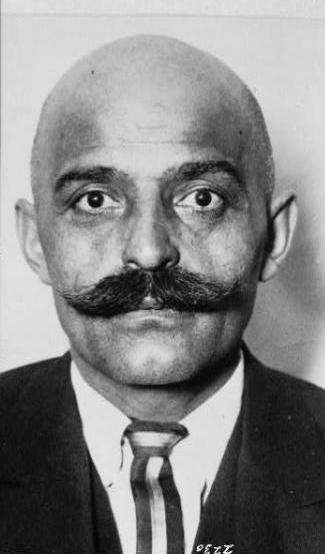
In search of Gurdjieff


"In search of the miraculous" is an Australian-Yugoslav film about P.D. Ouspensky's search for esoteric truths and a master that can teach them. The film is quite short (45 minutes) and not very interesting. It's filmed in black-and-white, and includes old footage from pre-revolutionary Russia.

However, the old footage seems to come in the wrong order. For instance, Lenin is shown speaking to the Russian crowds already before the Czar abdicates. In reality, Lenin didn't return to Russia until a few months later. A small detail, perhaps, but yes, I'm a perfectionist. ;-)

Most of the film deals with Ouspensky's search for a higher, spiritual truth than can change humanity for the better, and his encounter with the mysterious G.I. Gurdjieff. I admit that the two actors are convincing as high-brow intellectual and shady Oriental, respectively.

Ouspensky wonders why a transformative truth must be hidden from the people. How can that accomplish anything? Gurdjieff explains that most people simply couldn't be bothered. Man is at bottom a machine. Only a small minority can break free from its deterministic, robot-like existence. When Ouspensky demands proof in the form of miracles, Gurdjieff promises he will get it, but the film doesn't specify what he may have shown his chief disciple.

Surprisingly, "In search of the miraculous" mentions Ouspensky's later problems with and ambivalence towards Gurdjieff, whose behaviour was frequently erratic and incomprehensible. Yet, the film ends with Ouspensky nevertheless drawing the conclusion that Gurdjieff's "work" is worth it: "There is no place where I would rather be".

This short film is named after Ouspensky's voluminous work "In search of the miraculous", which I unfortunately haven't read (I have it, of course - don't you?). I'm not sure how to rate the film, but since it doesn't strike me as particularly important or interesting, I only give it two stars.

The Moon eats people


P.D. Ouspensky was a Russian spiritual seeker who searched for esoteric truth during a series of journeys to India, Ceylon and Egypt. Much to his surprise, Ouspensky met an esoteric teacher after his return to Russia. The teacher was, of course, the Greek-Armenian G. I. Gurdjieff. "In search of the miraculous" is Ouspensky's record of his meetings with Gurdjieff and an exposition of Gurdjieff's system. The book briefly mentions Ouspensky's subsequent break or quasi-break with his teacher. There are also sections dealing with Gurdjieff's and Ouspensky's contretemps during the Russian revolution and its aftermath. Gurdjieff eventually settled in France, while Ouspensky apparently ended up in London. The book was published posthumously, two years after Ouspensky's death. It's a much easier read than Gurdjieff's own tome "Beelzebub's tales to his grandson".

Gurdjieff's ideas strike me as similar to Buddhism. They sound like a Buddhism stripped to its bare bones, combined with some kind of pop psychology. A few bizarre ideas have been introduced as well, such as the claim that the Moon eats people (you heard me). Nobody really knows where Gurdjieff picked up his ideas. His autobiography "Meetings with remarkable men" claims that he travelled widely in the Middle East, India and Central Asia. This might very well be true, but it's also possible that Gurdjieff was a product of his native land. After all, there are Orthodox Christians, Sufi Muslims and "Tibetan" Buddhists in the Caucasus and adjacent parts of southern Russia. Ouspensky depicts Gurdjieff as a clever survival artist, almost something of a con man, who earned a living by selling Persian mats, knew quite a lot about machines despite not being an engineer, and had contacts at posh resorts in southern Russia. But above all, Gurdjieff had an all-encompassing, esoteric teaching which he gradually portioned out to his few devoted followers. The con man impression is strengthened by Gurdjieff's description of his system as "the way of the sly man", and his statement that the "sly man" might have access to a teaching which he found by accident or stole somewhere! This suggests that Gurdjieff wasn't part of a legitimate succession of teachers - no big deal in itself, but probably embarrassing for those of his followers who consider such things important.

Gurdjieff's worldview strikes me as very bleak. Most humans are machines. They are bundles of meaningless passions and sensations, have false personalities and are easy prey to deterministic cosmic forces, many of which are astrological in character. The cosmos is "spiritual" in a kind of panpsychist sense, but there doesn't seem to be any overriding meaning or purpose, at least not from a human viewpoint. Quite the contrary. The "purpose" of organic life on Earth is to feed the Moon. The Moon lives on cosmic energies emitted by humans. Essentially, humans are a kind of cosmic cattle! Nor do humans have immortal souls. There is a kind of reincarnation, but it seems to happen only once or twice. After that, humans simply dissolve together with whatever spiritual components they might have. Only a paltry few are able to liberate themselves from the wheel of existence and the tyranny of the Moon, by literally creating immortal souls in themselves. "Waking up" in this manner takes a lot of "work" and voluntary suffering. The "work" seems to consist of various meditation techniques, constant self-observation, breaking with past habits, learning Dervish-inspired dances and experimenting with various parapsychological phenomena. Is this "liberation"? In what sense are these people really "free", I wonder, and "free" to do what?

Many passages in Ouspensky's book suggest that the group around Gurdjieff was really a cult. Unquestioning obedience to the teacher (i.e. to Gurdjieff) is absolutely necessary for the "work" to succeed. People can be expelled for the misdeed of *other* members, presumably to create a harder internal discipline. Gurdjieff also told Ouspensky that he sometimes forced members to resign by placing them in impossible situations! These forced resignations were a kind of tests to see how the expellee would react - if he remained loyal to the guru despite the expulsion, he could be readmitted at a later date. Gurdjieff frequently told the entire group things that a member had told him in strict confidence, etc. These are all classical cult techniques. Ouspensky, who comes across as rather naïve, frequently reports the adverse reactions of outsiders to Gurdjieff's group, reactions he doesn't seem to have understood. It seems the outsiders easily spotted the group members' devotion to Gurdjieff, their mechanical habits, reserved demeanour, strange and uniform language, lack of love, etc. The elitist character of the Gurdjieff circle was compounded by Gurdjieff's habits of having his meetings at impossible hours, places that were difficult to reach, etc. He also demanded large sums of money from some of his supporters. People who couldn't "work" would presumably be eaten by the Moon, but that's just tough... Naturally, only those who have reached a higher elevation can understand the message, making it impossible for an outsider, newcomer or defector to judge Gurdjieff's methods. Gurdjieff is, simply put, always right.

Ouspensky seems to have been a victim of the brain washing himself. He broke with Gurdjieff already before their respective departures from Russia, apparently because he couldn't accept Gurdjieff's erratic antics. And yet, he never *completely* broke with Gurdjieff either, even sending some of his own students to "work" with the rogue guru in France. It seems Ouspensky had a strange, love-hate relationship with his former teacher all the way until his death in 1947 (Gurdjieff himself passed away in 1949). "In search of the miraculous" is yet another example of Ouspensky's strange relation to "G", as he constantly calls the erratic Armenian.

"In search of the miraculous" is a quite uneven book. Some chapters are relatively easy to understand. Others are extremely convoluted, and contain Gurdjieff's mysterious cosmology: "the law of octaves", "the law of three and the law of seven", the "enneagram" and other symbols, and long-winding lectures on some kind of esoteric atoms or "hydrogens". The autobiographical information is found throughout the book at various places, rather than being placed in one single chapter. I suspect that the book is deliberately written in a somewhat unsystematic way. This was probably how Gurdjieff himself revealed his teachings: little by little, rather than all at once, perhaps in order to entice or snare people?

The book ends with Gurdjieff and his supporters being forced to leave Moscow and Petrograd, fearing the Bolsheviks. Ironically, the Communists took power in the region to which Gurdjieff's group had fled, as well. The survival artist Gurdjieff managed to survive anyway, even claiming that his cultic commune was really some kind of socialist initiative (the Bolsheviks had other things on their minds than checking G's claims). Later, Gurdjieff relocated to Menshevik Georgia, once again under cover, and even later moved to Constantinople (the centre of Russian White émigrés), where Ouspensky had already set up shop. As already mentioned, the odyssey of the two men eventually ended in France and Britain, respectively. Gurdjieff seems to have recruited a group of wealthy supporters with an almost astounding speed, perhaps aided by the hapless Ouspensky, who was on a first-name basis with members of the British intelligentsia.

I admit that "In search of the miraculous" is a fascinating read, with the possible exception of the "hydrogens". Ouspensky does manage to communicate how it feels to belong to the chosen few with access to the absolute truth, and the worthlessness of existence outside the exclusive circle. I had to pinch myself a few times when reading this in order not to fall for it...

But, of course, I didn't. I suppose that means I'm going to be eaten by the Man in the Moon. But then, I prefer that perspective to the moonshine of Gurdjieff's cult...

Beelzebub's grandson


Gary Lachman's book "In search of P.D. Ouspensky" is a biography of the Russian occultist Ouspensky, whose life took an unexpected turn when he met the Greek-Armenian G. I. Gurdjieff, a mysterious spiritual teacher with a shadowy background and colourful disposition.

A turn for the worse, if we are to believe Lachman...

The fateful meeting between Ouspensky and "G" took place in the Russian capital of St. Petersburg (or Petrograd) in 1915. Ouspensky was a successful author and lecturer on various arcane subjects, and had at one point been associated with the Theosophists. He was also a journalist. Ouspensky had travelled extensively in the East, searching for "schools" of esoteric wisdom. By contrast, Gurdjieff was virtually unknown, but had somehow managed to assemble a small group of followers in Moscow. Ouspensky was impressed by Gurdjieff's teachings, later known as The Fourth Way or The Work. He devoted the remainder of his life teaching and practicing it. The best introduction to Gurdjieff's system is still Ouspensky's book "In search of the miraculous".

To make a very long story much shorter, Gurdjieff's message sounds like a strange form of Buddhism combined with techniques similar to encounter therapy. Humans are said to be "machines" and "asleep", and the goal is to wake them up. An awakened human being will develop a kind of immortal soul and miraculous powers, while most humans will simply perish. Gurdjieff even suggested that spiritually unenlightened humans will become food for the Moon! The Fourth Way strikes me as a bleak and pessimistic philosophy, and I frankly never understood why anybody would want to sign up.

Both Gurdjieff and Ouspensky were forced to leave Russia after the Bolshevik revolution, eventually finding their ways to the West. Ouspensky settled in Britain and later in the United States. He returned to Britain shortly before his death in 1947. Gurdjieff stayed in France, somehow managed to survive the Nazi occupation, and died in 1949. Still today, various Fourth Way groups (both official and unofficial) exist in various countries.

However, it's patently obvious from Lachman's account that not everything was well within The Work. Gurdjieff was an authoritarian, manipulative, erratic kook. The movement he created around himself had all the usual characters of a cult. Gurdjieff didn't even like Ouspensky! He seems to have recruited Ouspensky largely for strategic reasons. The unknown Armenian wanted influential, rich or prestigious supporters as a front. The erratic antics of Gurdjieff soon taxed Ouspensky's patience. The apostle broke with the master already before their respective departures from Russia. And yet, Ouspensky never *really* broke with Gurdjieff, maintaining a bizarre love-hate relationship with him for decades. This seems to have been the most disturbing aspect of their relationship: even though Ouspensky had left Gurdjieff behind, he nevertheless developed similar character traits and turned his own group into a kind of cult, with no little help from his wife Sophie Grigorievna, who had been a Gurdjieff devotee far longer than Ouspensky.

Lachman paints a tragic portrait of P.D. Ouspensky, as a man who started out as a positive, life-affirming, loving and independent-minded seeker, but ended up as a carbon-copy of Gurdjieff, the rogue guru he had repudiated. Ouspensky was a man who longed all his life for a transformative spiritual experience, but to no avail. He also longed for a teacher, and after the break with Gurdjieff, expected the *real* esoteric masters to contact him. Of course, they never did. The "Inner Circle" seems to have been a product of Ouspensky's own imagination.

But the most bizarre events took place shortly before Ouspensky's death. Much to the shock of his followers, Ouspensky declared that "the System" (his and Gurdjieff's spiritual path) was finished, that he had been wrong about it all along, and that everyone must strike out and experiment on their own. Only in such a manner can the truth eventually be found. Lachman believes that Ouspensky quite seriously wanted to break with his past, but his followers regarded Ouspensky's sudden turn of heart as a "test", and refused to go along with it! Ouspensky, already a sick and dying man, was trapped, surrounded by sheep-like devotees whose veneration seems to have increased the more their master condemned both them and his old message.

The worst loyalist was a young man named Rodney Collin, who for a time even adopted the speech patterns and personal mannerisms of Ouspensky, scaring the living daylights out of Ouspensky's wife Sophie (who by all accounts wasn't easily scared - she was, after all, one of the cult leaders!). Collin believed that Ouspensky was preparing himself to "die consciously" and would be transformed, Christ-like, to a luminous being with a mystical body existing for all eternity. In Britain, Collin took the dying Ouspensky on an extensive car ride across the country, during which the old man supposedly prepared himself to break free from the reincarnation cycle. Many people believed that the journey was Collin's idea, and that Ouspensky went along with it somewhat unwillingly. After the death and burial of Ouspensky, Collin entered his study, locked himself up and meditated for six days without eating, drinking or shaving. When the other devotees broke the door open, they found an emaciated Collin declaring that he had been in telepathic contact with Ouspensky, who had appointed Collin the new leader, that a New Age would soon dawn on man, etc.

In the event, nobody followed Collin. Most of Ouspensky's followers instead travelled to Paris and joined Gurdjieff's movement! They also published "In search of the miraculous", Ouspensky's book on The Fourth Way, a book Ouspensky expressly had forbidden them to ever publish. Thus, rather than breaking with The Work and leaving cultism behind, as Ouspensky had wanted them to do in his waning months, his brain-washed admirers decided to follow the very guru Ouspensky had tried decades to get away from. A partial exception was Ouspensky's close friend Maurice Nicoll. He never broke with the Fourth Way, but he *did* refuse to work with Gurdjieff. Yet, Nicolls' magnum opus is titled "Psychological commentaries on the teaching of Gurdjieff and Ouspensky". Another exception was J. B. Bennett, who simply joined a new string of cults. Poor Collin moved to South America, still convinced that Ouspensky was evolving into a divine Sun-Being. He eventually died by falling from the tower of a cathedral...

There is enough material in this book for an entire congress of psychiatrists!

"In Search of P.D. Ouspensky" is a captivating read about the dysfunctional relationship between two spiritual masters. Unfortunately, the book is somewhat sloppy, not based on original research (Lachman can't read Russian) and has an obviously "journalistic" bent. I nevertheless award it four stars. If only half of what's in this book is true, I can only say: Karnak, come in, we have a problem!

Sunday, August 26, 2018

The nihilistic fascism of Alexander Dugin


"The Fourth Political Theory" is a book by Alexander Dugin, a Russian philosopher and political activist. He is sometimes referred to as a Traditionalist, at other times as an Eurasianist. Dugin is the leader of a small political party in Russia, the Eurasia Movement. More ominously, he is rumoured to be an advisor to Russian president Vladimir Putin. As far as I can tell, "The Fourth Political Theory" is the only book by Dugin translated to English. It's not an easy read, since the author writes in a difficult prose filled with references to Heidegger, Carl Schmitt, Deleuze and other thinkers not considered main stream. It took me about two weeks to sift through this material.

While Dugin claims to represent a striving to create a Fourth Political Theory beyond liberalism, socialism and fascism, I think it's obvious that he is a fascist. A nihilistic fascist, to be exact. While he pretends to oppose postmodernism, he is in fact heavily indebted to it for his own perspective. In Dugin's universe, there are no absolute truths. Each culture, nature or community is a (more or less) self-contained whole. Its worldview is purely subjective (even "time" and "past" are subjective concepts). Hence, no outsider can judge whether or not a certain culture is "right" or "wrong". Humans are constituted by "politics", by which Dugin seems to mean pre-existing hierarchies in each culture which inevitably moulds us into what we are. For this reason, Dugin rejects liberal individualism. Of course, this contradicts his claim that no absolute truths exists. There is at least one absolute truth in Dugin's system: the collective is everything, the individual nothing. How this squares with his claim that the most basic ontological category is the Radical Subject is unclear. The Radical Subject is, I suppose, individual. Dugin is well aware of his affinity with postmodernism. He wants to use postmodernism to further his own (fascist) agenda. The tolerance of postmodernism can be used to justify a multi-polar world in which "traditional" cultures can co-exist with each other, and (temporarily) with Anglo-American liberalism. The existence of classes and the left-right dichotomy is also denied in favour of a postmodernist-sounding perspective, according to which there is only "centre" and "periphery".

In a universe with no absolute truths, the will to power is central, and Dugin (unsurprisingly) believes that "geopolitics is epistemology" and that "the political" is fundamental. In plain English, Russian imperial expansionism is a good thing, and nothing meaningful can exist outside the imperial-hierarchic state. Of course, this is so only from a Russian perspective, but that's apparently irrelevant. War is a perennial condition of human existence. The author clearly wants the particular subjective perspective of his own tribe to win the day.

Since Hitler and the Nazis killed millions of Russians during World War II, Dugin has no choice but to repudiate Hitler's politics, especially his racism against Slav Untermenschen. At the same time, however, he is interested in the German current known as Conservative Revolution. His book contains a lot of references to "National Bolsheviks", who attempted to combine Communism and nationalism. Dugin makes the (admittedly interesting) observation that many Communist regimes were nationalist, and that National Bolshevism in all but name existed in the Soviet Union, China, North Korea, and so on. He claims that Communism as it looked like in practice wasn't really "modern", but a resurrection of archaic forms. Many critics of Stalin's Soviet Union or Mao's China have noticed similarities with the so-called Asiatic mode of production in ancient societies. Dugin agrees, but regards this as something positive! While rejecting liberalism, he wants to salvage the "positive" traits of both Communism (actually Stalin's regime) and fascism. This is a common project in Russia, where "Red-Brown Blocs" between Stalinists and right-wing nationalists (including fascists) were influential during the 1990's. Dugin himself was a founding member of the notorious National Bolshevik Party, but seems to have left the organization when it became too burlesque. (Today, the NBP is opposed to Putin, and Dugin actually accuses it of being in cahoots with Western intelligence services.) Although Dugin is included in Mark Sedgwick's seminal study of Traditionalism, "Against the Modern World", the Traditionalist traits of the Fourth Political Theory are incidental. Dugin is anti-modernist, and does mention Guénon and Evola. Yet, his covert postmodernism, relativism and nihilism are difficult to square with the Traditionalist insistence on an absolutely valid and universal esoteric truth.

Dugin is curiously oblivious to peak oil and peak uranium (perhaps because Russia has plenty of those natural resources?), and believes that postmodernism can actually succeed in creating a bizarre world dominated by "post-humans" and other "simulacra", apparently some kind of cyborgs. Both transhumanism and transgenderism are perceived as threats. When condemning LGBTQI, Dugin sounds more essentialist than relativist. However, resistance isn't futile, it seems. Here, Dugin has a voluntarist perspective. Humans can freely decide to resist the system, and thereby challenge and change their "fate". This is the will to power again. The step from this to gratuitous violence and terrorism is short.

Personally, I doubt that Vladimir Putin is listening to the gaga of Alexander Dugin. However, "The Fourth Political Theory" is interesting. It shows us the real face of fascism behind the ideological façade: nihilistic violence from the Supermen, just because they can. For more insight into this subject, see Shadia Drury's "Alexandre Kojève: The Roots of Postmodern Politics".

Saturday, August 25, 2018

Roses and thorns


I recently skimmed Daniel Andreev's curious work “The Rose of the World”. The author was a Russian mystic arrested by the Soviet authorities in 1947. Written during the 1950's (to a large extent in prison), the work wasn't officially published until 1991 by the author's wife Alla Andreeva. Daniel passed away already in 1959. The English translation by Lindisfarne Press is an abridgement, leaving out all sections exclusively dealing with Russia and Russian history. “The Rose of the World” is often referenced by the Anthroposophical offshoot around Robert Powell, but seems to be otherwise unknown in the West.

I can't say I was overly impressed by Andreev's work. It comes across as a somewhat exotic version of Theosophy or Anthroposophy, complete with annoying neologisms. An entire glossary is needed to explain the author's newly coined terms, including Witzraor, Skrivnus, Shrastr, Rarugg, Agga and Bramfatura. Our Earth is called Enrof and belongs to a wider cosmic system known as Shadanakar. The Planetary Logos (who incarnated as Jesus Christ) and his bride Zventa-Sventana are opposed by Gagtungr, a planetary demon resembling the Devil in more traditional systems. Humanity is on an evolutionary path towards higher spiritual perfection, a path that will eventually lead to the creation of a world government and the Rose of the World, a syncretistic pan-religion incorporating Christianity and other traditions of Light. A wide assortment of demonic beings oppose this development, preferring instead to create an satanic anti-humanity.

Jesus Christ (who seems to have lived on Atlantis and other unknown continents in earlier incarnations) partially failed in his mission, which wasn't supposed to end with his crucifixion. Rather, Jesus was supposed to have turned the world into a kind of paradise through a gradual, centuries-long evolutionary uplift of humanity. Andreev claims that such a thing actually happened in the world of the “daemons” (not to be confused with the demons), where Jesus had incarnated at an earlier point in time. The daemons (a kind of spiritualized humans) readily accepted Jesus and has therefore evolved further than terrestrial mankind.

Since God is all-good, evil is the result of creatures misusing their free will. The demons are responsible for all evil and suffering in the world, including death, karmic retribution and hell. Thus, the hellish realms where sinful human souls are tortured are really the creation of powerful demons, not of God! Some of the hells are of relatively recent vintage. The most important heavenly realm seems to be Heavenly Russia. Interestingly, there is also a kind of satanic Russia, complete with dark versions of St Petersburg and the Kremlin! Sometimes, the author gets unintentionally comic, as when he claims with an entirely straight face that the similarities between the demonic Raruggs and flying dinosaurs aren't co-incidental, since (of course) the Raruggs *are* flying dinosaurs… Another curious notion is the claim that certain fiction characters in novels are really a kind of undeveloped spirit-beings who get to live a fuller life by being incorporated into works of fiction here on Earth!

I'm not entirely sure why anyone would want to uncritically accept Daniel Andreev's works over those of, say, Rudolf Steiner or Valentin Tomberg. Andreev comes across as a well-meaning but confused visionary, trying to make sense of his spiritual experiences with varied degrees of success. Knowledge of his sources might have been helpful, but isn't provided since the publisher claims that we are dealing with a genuine revelation.

In my opinion, “The Rose of the World” only deserves two stars, although I admit rating a religious work is somewhat difficult…

Cosmists, kooks and Anti-Christs


"The Russian Cosmists" is a scholarly overview of a rather broad current of thought known as Cosmism. In many ways, the Cosmists were early Russian equivalents of today's transhumanists and other peculiar, super-cornucopian groups on the far side of American cyberspace (Ray Kurzweil and his "singularity" comes to mind).

Cosmism originated with Nikolai Fedorov (pronounced Fyodorov), a 19th century Russian intellectual and - some would argue - crank, who attempted to influence both Dostoevsky, Tolstoy and Solovyov with his "Philosophy of the Common Task". Typical of Cosmist thought is a strong belief in "active evolution" and eternal progress through super-technology, the conquest of outer space and physical immortality. This is often coupled with quasi-spiritual ideas derived from Madame Blavatsky's Theosophy and garbled Orthodox Christianity. Thus, Fedorov believed in a general resurrection of the dead going back to Adam, but accomplished through an advanced technology, rather than by supernatural means. An interest in subjects considered heretical by establishment science, such as reincarnation or the search for Shamballa, is another defining trait. The prominent Soviet rocket scientist Konstantin Tsiolkovsky semi-secretly harboured ideas similar to those of Theosophy, but expressed in pseudo-scientific language ("atom-spirit" for monad, "ethereal being" for Mahatma, etc).

With some notable exceptions, Cosmists broadly defined had an authoritarian political streak. Fedorov supported Czarist autocracy and longed for a time when all Earth would be under the suzerainty of a single autocrat and a single "Orthodox" Church. His geopolitics were "Eurasianist", pitting a continental-collectivist civilization against both the Atlantic West and the nomadic barbarians of the East. Tsiolkovsky believed that future human evolution necesserily means weeding out the weak and unfit. Modern Russian Cosmists are nostalgic about the Soviet era, especially the halcyon days of Stalin. This is richly ironic, since many of the original Cosmists were sent to the gulag or executed by Stalin's regime! Yet another defining trait of Cosmists seem to be their sheer personal weirdness. Let's be honest: Fedorov and many other luminaries mentioned in this volume were kooks, pure and simple. A psychologist would love to poke into the heads of these people, and might even discover a new syndrome or two!

"The Russian Cosmists" is an interesting book, but I sometimes get the feeling that the author attempts to find connections between thinkers that were really very different. In what sense is Vladimir Solovyov a "Cosmist", for instance? As the author points out himself, Solovyov argued against Fedorov's materialist-technological conception of the resurrection. On this point, Solovyov's ideas strike me as similar to Steiner's Anthroposophy or Sri Aurobindo's Integral Yoga, with humanity slowly evolving towards godmanhood through purely spiritual techniques. Apparently, the figure of the Anti-Christ in Solovyov's famous short story is to some extent based on (perhaps parodically) Fedorov! And while the author does place Cosmism in an early 20th century Russian intellectual context, he says very little about the obvious parallels to Communism and fascism. Fedorov's ideas could also be seen as a particularly bizarre and self-conscious "immanentization of the eschaton", complete with faux references to Christianity and Orthodoxy. (Reverend Straik from C. S. Lewis' "That Hideous Strength" comes to mind here.) Indeed, Cosmism is probably best understood as a materialist or materialistic form of messianism, promising this-wordly salvation through science fiction technology.

But yes, the author is probably on to something important when he investigates the Cosmist-occult interface. It's difficult *not* to sound supernatural when proposing "naturalist" solutions to physical death, universal decay, etc. Arthur C Clarke famously quipped that a sufficiently advanced technology would look like magic to the uninitiated. Clarke's statement could be altered to state that a really advanced "technology" *would be* magic. Compare this to Steven Greer's UFO books, or the rather odd combinations of New Age and dreams of super-technology that were once popular on the alternative spirituality scene. Once again, I'm also reminded of C.S. Lewis' novel, where a group of scientists believe they have cracked the riddle of immortality, when actually their laboratory is under the control of supernatural demonic forces! It's almost as if religion forces itself on the Cosmists, but - unfortunately for them, and perhaps for us, too - it's the wrong kind of religion, a cult of the divinized Overman who extirpates the weak, or who graciously resurrects everyone in the name of a eternal Czarist autocracy...

Perhaps Solovyov was right. Nikolai Fedorovich Fedorov really was the Anti-Christ.

Friday, August 24, 2018

The real Bolsheviks?


"The Other Bolsheviks. Lenin and His Critics" by Robert Williams is a study of the political, philosophical and pecuniary conflicts *within* Bolshevism during the period 1904-1914. The author is a Harvard-educated professor of history. The main characters in his story, apart from Lenin, are A A Bogdanov, A V Lunacharsky and Maxim Gorky. Stalin and Leonid Krasin stars supporting roles.

I procured this book in the belief that it contained a detailed analysis of Bogdanov's and Lunacharsky's respective philosophies, known as Tectonics and God-building. It didn't, although it touches on the issue. Still, "The Other Bolsheviks" is interesting reading. An "alternative" history of early Bolshevism, it contains a number of startling claims, most of them previously unknown to the present reviewer.

It turns out that Lenin's Bolshevik faction was financed by wealthy middle class donors, including Russian industrialists (i.e. capitalists). The Moscow HQ of the Bolsheviks during the abortive 1905 revolution, from which they attempted to stage an armed uprising, turns out to have been an industrial plant the owner of which secretely supported the revolutionary movement. Even more curiously, some of the pro-Bolshevik industrialists were Old Believers, i.e. supporters of a conservative, dissident group of Orthodox Christians! Lenin's go-between with "the religious sects" was a certain Bonch-Bruevich, a kind of ethnographer who wrote scholarly articles on Russian dissenters, while simultaneously attempting to woo them to the Bolshevik side.

Two other important financial contributors to the Bolshevik cause were the author Maxim Gorky and his companion, the actress Maria Andreeva. Some Bolshevik conferences were held at Gorky's residence at the Italian resort of Capri. More well known are the Bolshevik bank robberies and train robberies (some of them organized by Stalin), which contributed substantial sums of money to the faction's treasury, but also led to severe problems with the police in several European nations. The Mensheviks weren't amused either, and threatened to officially expel the Bolsheviki from the Russian Social Democratic Party due to these illegal activities. More sensational were the attempts by Bolshevik operative Krasin to divert a Japanese-funded arms shipment, intended for anti-Czarist activist Father Gapon, into Bolshevik hands. (Japan and Russia were hostile nations.) The shipment was organized by a Finnish socialist, but he and Gapon were persuaded by Krasin to let the Bolsheviks get the weapons instead. "The Other Bolsheviks" also mentions that Lenin threatened to sue the German Social Democrats over money they held in trust for the Russian Social Democrats (pending the unification of their party).

Bolshevism was never a monolithic movement before the late 1920's (when former bank robber Stalin made it such). During the period under discussion, Lenin was often in sharp conflict with Bogdanov and Lunacharsky, who represented a kind of "left" Bolshevism, more sectarian than Lenin's version, but also more syndicalist-sounding. Gorky tended towards the "lefts", probably attracted by their curious philosophy, but eventually threw his weight (and money) behind Lenin, apparently after a purely personal fall-out with Bogdanov (Andreeva didn't like him either). The author dubs Bogdanov and Lunacharsky "collectivists", in the sense that they emphasized the importance of the working class collective over and above the hierarchic vanguard party envisioned by Lenin. Lunacharsky attempted to create a new religion of Man, based on the idea of collective immortality. The (heroic?) individual lives on in the memory of the collective. Bogdanov developed "Tectonics", a precursor of modern systems theory, and communicated his political ideas through a work of science fiction, "Red Star" (yes, it's about a socialist revolution on Mars, the red planet). Both Bogdanov and Gorky speculated about the literal abolition of death through advanced technology, a notion similar in some ways to those of Nikolai Fyodorov and the Cosmists (see my review of "The Russian Cosmists" by George Young).

It's interesting to note that Bogdanov, Lunacharsky and many other Marxists at the time were fascinated by the relativist and positivist philosophy of Ernst Mach, a renowned Austrian physicist. On the basis of Mach and Richard Avenarius (a Swiss philosopher with similar ideas), Bogdanov argued that all truth was relative. Statements of "truth" were simply useful tools. Bold action for socialism is "true" from the viewpoint of the revolutionary working class. Technological mastery of Nature by humanity is also "true" in this sense. Dualist metaphysics should be rejected, since mind and matter are really the same thing. From this, Bogdanov reached the conclusion that ideas and consciousness can change the world, even without a hardened vanguard party. What matters is to spread revolutionary consciousness in the working class as a whole. The syndicalist tendency is obvious here, but note the technocratic tendency (which points in a different direction) in Bogdanov's emphasis on science, technology, the intelligentsia, etc. Note also the potentially voluntarist-adventurist consequences of a strong belief that revolutionary "ideas" can change reality. The author points out the similarities between the Bogdanovites and George Sorel in France. It's not entirely clear what Mach himself thought of the controversy, but as a moderate reform socialist and respectable scientist, he can't have been amused! The position of the "left" Bolsheviks seems to have been that collective will-power and bold action can topple the system and usher in a Communist utopia. The similarity with anarchism, but also with fascism, is striking. Bogdanov, Lunacharsky and other collectivists had a strong aversion to individualism, viewed as a typical "bourgeois" idea. The "I" must be extinguished and individuals should make self-sacrifices for the common good of the collective: the working class, the Russian people, etc. Here, too, Mach was seen as an inspirator, due to his "Buddhist" ideas about the destruction of individuality. Or so he was interpreted.

Lenin wasn't amused. Needing followers and funds, he originally agreed to make a philosophical truce with Bogdanov, since they seemed to agree on politics. Later, the conflict became inevitable, as the "lefts" demanded a Bolshevik boycott of the Russian state duma, a move hotly opposed by Lenin. (The duma - an elected parliament - was a token concession by the Czar made after 1905, but one that the revolutionary parties could nevertheless exploit as an arena for propaganda). Lenin dashed off "Materialism and Empiro-Criticism", a turgid criticism of Mach and Avenarius, but also a (mostly veiled) broad-side against Bogdanov and Lunacharsky. That being said, Vladimir Illich was probably right that Machism was a new form of idealism, having little or nothing to do with Marxism as usually concieved.

I don't always agree with the author's take on things. Thus, he often claims that squabbling over party funds was an independent variable explaining many factional conflicts within Russian Social Democracy. This is hardly likely on Lenin's part. After all, the author admits that Lenin took every disagreement (including philosophical ones) very seriously indeed. Still, Robert Williams' book is intriguing, despite its super-boring, scholarly style. It's even amusing, in a wry kind of way, for those familiar with the antics of the sectarian far left. It seems Lenin did everything wrong by modern Trotskyist-Stalinist standards! Let's see: he threatened to sue another socialist group in a "bourgeois" court, he declared a philosophical truce with an enemy of dialectical materialism (Shachtman and Burnham later used this against Trotsky), he took money from capitalists and Orthodox Christians (popular front, anyone?), his followers robbed banks (petty bourgeois adventurism, anyone?) and he was even willing to lay his hands on an arms shipment financed by an enemy nation (imperialist Japan, remember?).

Somehow, I found this book more revealing than Richard Pipes' ridiculous tome "The Unknown Lenin"!

It's also fascinating to speculate about what would have happened if Bogdanov, Lunacharsky and Gorky had gotten the upper hand within Bolshevism. Probably nothing: Sorel, Labriola, Bellamy or Mach didn't make any revolution, so why should we expect the Russian empiriomonists to do so? Still, I can't help wonder if their techno-utopianism, anti-individualism, emphasis on ideas and will-power, and quasi-religious attitude has more in common with the true Communist ethos than Lenin's turgid writings...

In a strange kind of way, perhaps Bogdanov and Lunacharsky really were the true Bolsheviks.

From a Russian mystic with love


This is a translation of Vladimir Solovyov's "The Meaning of Love", with an introduction by Owen Barfield. Solovyov was a prominent 19th century Russian philosopher, perhaps most known for his "Short Story of the Anti-Christ". Working within the Christian tradition, he was nevertheless inspired by "occult" sources, which may explain why Barfield (a lifelong student of Rudolf Steiner) found him interesting.

Despite being short, "The Meaning of Love" is difficult to summarize in a review, containing many interesting ideas and speculations. The main idea is that love between man and woman (including sexual love) is a reflection of the Divine, and in some sense points forward to union with God and the restoration of true humanity, which Solovyov pictures as androgynic. For this reason, Solovyov rejects homosexual unions, since they aren't complementary and hence can't restore the androgyne. Solovyov further argues that only rapturous, ecstatic love can overcome egoism, both in the lover and the beloved, since only such love makes it possible for us to feel that our individuality (and that of another) has absolute and infinite worth. Since our empirical, earthly selves obviously cannot have such worth, all by themselves, love points towards a perfect human archetype, which can only exist in God.

Solovyov rejects a purely biological, evolutionary explanation of love (in the above sense of the term). Most living organisms procreate without love, some don't even have sexual reproduction. Humans usually also procreate without love. Even stable families are possible without love. Yet, love in the highest degree undoubtedly exists among humans. Where does it come from? Its sources must be spiritual. Thus, the Russian sage rejects the biologistic notion (common even among religious believers) that the only function of sex is the begetting of children.

But why is sex needed at all? Why not have a purely spiritual, "Platonic" love? Solovyov believes that sexual love is higher since it's directed towards both the body and soul of the beloved. Humans aren't pure spirits, and the goal is the resurrection of the whole human, including the physical aspect. Thus, Solovyov connects his positive view of the sexual aspect of love with a distinctly Christian anthropology. He further argues that even spiritual love, when it's directed to a personal conception of the divine, seems distinctly "sexual". His examples are the Song of Songs and Revelation, but he could also have mentioned Bernhard of Clairvaux or Bernini's famous sculpture of Theresa of Avila. An interesting take on a tradition usually regarded as semi-celibate or fully celibate!

Sometimes, "The Meaning of Love" is difficult to comprehend. Thus, Solovyov connects love between two partners with love towards the entire community, nation or humanity. However, such love surely lacks the erotic aspect of love between spouses. There is also a tension between emphasizing the individuality of humans, and the perfect unity of the Divine, the ultimate goal even of humans. Solovyov somehow wants to synthesize individual freedom and a more "organic" collectivity (a bit like Steiner), but it's not clear from this particular text how this can be achieved concretely. At times, the author sounds patriarchal, depicting women as "passive", while at other times, the Divine Feminine (Sophia) is the *active* mover behind or within God. It's almost as if Solovyov wants to reconcile potentially radical notions (androgyny, a female aspect of the Divine, sex without procreation) with the everyday realities of conservative, 19th century Russia.

Neither Solovyov himself nor Barfield says anything about Solovyov's sources, but as already indicated, some kind of "Tantric", "heretical" source is a prime suspect. (See Arthur Versluis' study "The Secret History of Western Sexual Mysticism" for some real or purported examples of such "heresies" in a Western context.) Solovyov's view of the cosmos as slowly evolving towards perfection is reminiscent of Theosophy (which existed during Solovyov's lifetime - his brother Vsevolod was briefly a member of Blavatsky's society) or Anthroposophy (which was created by Steiner only after Solovyov's death). Here, too, there might be earlier sources in the background, perhaps Goethe and the Romantics? (For a more comprehensive introduction to Solovyov's ideas, see his "Lectures on Divine Humanity".) Solovyov may also have been inspired, although perhaps in a more roundabout or negative way, by his contemporary Nikolai Fyodorov and his curious ideas about overcoming death through technology and hence also through "evolution" (see George Young's study "The Russian Cosmists").

"The Meaning of Love", though written in a deceptively easy style, is really a hard read, unless you have been exposed to this kind of ideas before. Ultimately, of course, it's difficult to "prove" (or disprove) Vladimir Solovyov's speculations by empirical research or formal logic. They can only be lived. Barfield hopes that at least *somebody* reading the work will experience a "Beatrician moment" and act accordingly.

Somehow, I find that hard to believe. But then, cosmic evolution is a slow process... ;-)

Tuesday, August 21, 2018

Don't mess with Andrei Zhdanov


This pamphlet contains a number of speeches and reports by Andrei Zhdanov, who for a few years was Soviet leader Joseph Stalin's “culture czar” (pun intended). During this period, roughly 1946-48, Zhdanov carried out a struggle against real or perceived anti-Marxist deviations in art, music and literature. The campaign is known as the Zhdanovshchina. Among his victims were the “formalists” in music (including world famous composers such as Prokofiev and Khachaturian), satirist Mikhail Zoshchenko, crypto-dissident poet Anna Akhmatova and an opera by Vano Muradeli, “The Great Friendship”. The pamphlet also contains an attack on “bourgeois” science, including the Big Bang theory and the notion that electrons are really waves!

Although heavily loaded with the usual Soviet rhetoric, Zhdanov's speeches on culture are nevertheless intriguing. On the one hand, they sound “socialist realist” and emphasize that all art and literature must be “partisan”, optimistic and extol the virtues of the Soviet socialist order, the better to “educate the youth”. Stalin had called writers “engineers of the soul”, and Zhdanov concurs. The authors he mentions the most are Nikolai Chernyshevsky, whose novel “What is to be done” had been popular among the first generation of Bolsheviks, and Maxim Gorky, the purported founder of socialist realism. There is also a populist tendency in Zhdanov's speeches. He attacks modern art for being elitist and incomprehensible. Art should serve the people, not be “art for art's sake”. Zhdanov is particularly incensed at Symbolism and similar currents of the immediate pre-revolutionary period, especially their mystical streaks. He calls them bourgeois-aristocratic.

However, there is also a “conservative” and nationalist tendency in Zhdanov's view of culture. He constantly attacks the decadence of Western art styles. A certain kind of “realism” in which gangsters are turned into heroes, homosexuality is treated in detail, and everything ugly is obsessively extolled, sparks his ire. He also opposes “music” which mostly consists of noise, or innovations for the sake of it. Despite his seemingly populist streak, he emphasizes the need for professionalism in music and, in passing, attacks various pedagogical experiments which give students power over their teachers. Zhdanov's alternative to “formalism in music” turns out to be the 19th century Russian Romantic movement in music, including Tchaikovsky, Rimsky-Korsakov and the critic Vladimir Stasov. They represent a “realist” form of classical music, to a large extent based on folk music, which isn't “composed” by anyone, but rather grows organically from the depths of the people. The Russian nationalist aspect is also important, and Zhdanov criticizes those who claim that the classical Russian composers were influenced by foreign models. I cannot help wondering whether Andrei Zhdanov was a closeted Romantic! When discussing painting, Zhdanov mentions the so-called Itinerants as a positive example, being a group of 19th century painters who combined professionalism, realism and social criticism. However, he also mentions a number of more "Romantic" painters inspired by fairy-tale or myth.

Interestingly, the Bolshevik leader Lenin had a surprisingly “conservative” view of culture, too. While Lenin never stopped the experimentation with new artistic styles that took place after the October Revolution, his own view of culture was that “the proletariat” shouldn't attempt to create “its own culture”, but instead assimilate and creatively develop the culture of the old society. Exactly what this meant was anybody's guess, since Lenin, as far as I know, never appointed a culture czar all his own. Zhdanov's attempts to combine “socialist realism” with 19th century Russian romanticism (or pre-socialist Realism) is a perfectly serious attempt to follow in Lenin's footsteps. It's also an interesting position on cultural affairs in its own right. The problem with the Zhdanovshchina was, of course, that it was carried out in the only way cultural policy could be carried out in a highly repressive one-party state: by authoritarian decree from above. Thankfully, nobody was executed and after Stalin's death, Zhdanov's targets were rehabilitated (Zhdanov himself died already in 1948).

I have to admit, though, that part of me longs for another A A Zhdanov in today's cultural climate, which is arguably even more decadent than it was in Leningrad circa 1948!