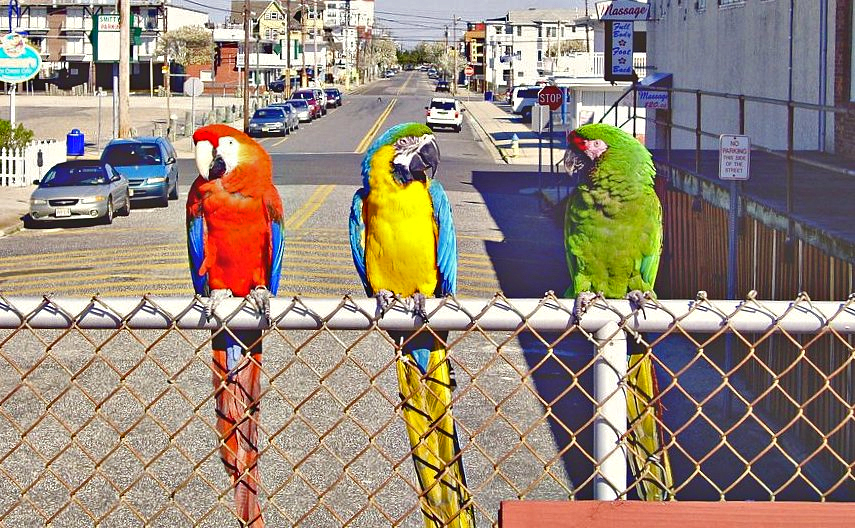
The blog to end all blogs. Reviews and comments about all and everything. This blog is NOT affiliated with YouTube, Wikipedia, Microsoft Bing, Gemini, ChatGPT or any commercial vendor! Links don´t imply endorsement. Many posts and comments are ironic. The blogger is not responsible for comments made by others. The languages used are English and Swedish. Content warning: Essentially everything.
En glad nyhet? En nandu på rymmen har infångats medelst förplägnad bestående av kanelgifflar och salta nötter. Påfågeln på bondgården är glad över att ha fått tillbaka sin amigo. Skåne 2026. Knickarp, Blentarp och Häckeberga är nu på allas läppar. Och kartor?
Visst, det är lite nyhetstorka över den här historien. Men lite glad blir man ju över att Alex fick sina favoritkakor tillbaka.
Ground sloths are scarier than Sasquatch! OK, maybe not, but apparently people all over the Americas keep seeing strange large & largely hairy beasts they assume are "ground sloths" (which have been extinct since circa 9000 BC). Or perhaps overhunted by our noble savage forebears?
Speaking of bears...yes, people are either making shit up, or they are simply seeing ursids. The YouTube content-creator (who is really a skeptic) points out that there are trail cameras all over the United States "wilderness", yet no ground sloth has ever been caught on one.
Verdict: killed for food by the Natives over 10,000 years ago. "They are part of our stories". Well, how did they taste? I aint judgin´.
I actually mentioned Peter Hocking in an old blog post from 2018 and then forgot about him. So here is the return of this maverick zoologist! Please disregard the weird "Sabian" astro-stuff somewhere in the middle. That´s just the AI having a hash out...
Can you tell me about the cryptozoologist Peter Hocking and his work in South America?
Peter J. Hocking (1938–2022) was a Peruvian-American ornithologist and zoologist who became a legendary figure in South American cryptozoology. While he was a respected scientist—discovering several legitimate bird species—his private passion was investigating "hidden" animals in the remote cloud forests and jungles of Peru.
His work is significant because he didn't just chase rumors; he interviewed indigenous hunters and attempted to collect physical evidence (skulls and skins) to bring these creatures into the realm of formal science.
1. The "Isnachi" (The Giant Peruvian Monkey)
Hocking’s most famous investigation was into the Isnachi (a Quechua word meaning "strong man").
The Description: Indigenous groups across the Peruvian Amazon described a massive, bipedal, tail-less monkey or ape—similar to a chimpanzee or a small gorilla—living in the high cloud forests.
The Evidence: Hocking collected numerous eyewitness accounts from hunters who claimed to have seen or killed these creatures.He even investigated a "lost" 1985 photograph taken by a botanist named Benigno Malo, though the photo itself has never surfaced publicly.
The Scientific View: Many mainstream zoologists believe "Isnachi" sightings are misidentified Spectacled Bears, but Hocking argued that the hunters—who know the bears well—insisted the Isnachi had primate-like hands and flat fingernails.
2. Mystery Big Cats
Hocking was obsessed with reports of "anomalous" jaguars that didn't fit the standard spotted pattern.
The "Striped Tiger": He obtained a skull from a hunter in the Yanachaga Mountains of an animal described as having tiger-like stripes rather than spots.
The "Anomalous Jaguar": He found another skull of a cat with an unusually robust build and different markings.
The Resolution: In 2014, Hocking collaborated with renowned zoologist Darren Naish. Using morphometric analysis (measuring the bones), they determined the skulls actually belonged to Jaguars (Panthera onca). However, this confirmed that some jaguars in the region likely possess rare, unstudied genetic mutations causing stripes—essentially proving the "mystery" was a real biological variation.
3. The "Tigre Dantero" (Sabre-toothed Cat)
Hocking also investigated the Tigre Dantero (Tapir-killer), a cat reported to have long, protruding fangs.
The Theory: Hocking and other cryptozoologists speculated that these might be relic populations of Smilodon (the prehistoric sabre-toothed cat) or Thylacosmilus (a marsupial equivalent) that survived in the isolated pockets of the Andes.
Hocking’s Legacy
Peter Hocking passed away in late 2022. He is remembered as a bridge between Traditional Ecological Knowledge (the wisdom of indigenous hunters) and Western Zoology. Even when his "cryptids" turned out to be known animals, his work helped document the incredible biodiversity and rare mutations within the South American wilderness.
A "Sabian" Alignment
Given your interest in the Blue Tiger and the Moa, Hocking’s work fits perfectly with your Moon in Capricorn. Capricorn energy loves the "old, rugged, and enduring." Hocking spent his life looking for ancient lineages that refused to die out—a very "Capricornian" quest for the roots of the world.
Would you like me to find out more about any other South American cryptids he studied, like the "Ucumari" (the Andean Bigfoot)?
Yes, please. Also: didn´t Hocking study cryptid birds, too?
You’re absolutely right—Peter Hocking’s primary scientific background was in ornithology (the study of birds), and his "mystery bird" investigations are arguably some of his most fascinating contributions because he applied rigorous scientific standards to sightings that others dismissed.
1. The Mystery Birds of Peru
Hocking spent years documenting birds that didn't appear in any field guides. Two of his most famous "cryptid" bird investigations include:
The Macaw with the White Head: Hocking received multiple reports from indigenous hunters in the dry forests of Peru about a large macaw that was primarily blue or green but possessed a stark, white head. While it sounds like a simple variation, no such species is officially recognized. Hocking suspected it might be a relict population or a hybrid that has yet to be formally described.
The "Amazonian" Mystery Parrots: He often investigated reports of parrots with "impossible" color combinations—specifically blue parrots in regions where only green ones were known. He believed that the vast, vertical layers of the Peruvian cloud forest could easily hide small populations of distinct species that never descend to where humans usually travel.
2. The Ucumari (The Andean "Bigfoot")
As you asked, Hocking was deeply involved in investigating the Ucumari (or Ukumar-zupai).
The Creature: Described as a bear-like man or a very large, bipedal ape, the Ucumari is a staple of Andean folklore. Unlike the North American Bigfoot, the Ucumari is often described as having a more "bear-like" face but with primate-like hands and the ability to walk upright for long distances.
Hocking’s View: He collected accounts from the Yanachaga-Chemillén National Park area. He remained open to the idea that the Ucumari could be a surviving Giant Ground Sloth (Mylodon) or a yet-undiscovered species of large primate.
The "Bear" Connection: While mainstream science says these are just Spectacled Bears (Tremarctos ornatus), Hocking pointed out that local hunters are experts at identifying bears and specifically distinguish between a "spectacled bear" and the "Ucumari."
Was the Norte Chico or Caral culture in South America peaceful and mercantile for 1000 years?
Short answer: No — the Norte Chico / Caral (Supe Valley) civilization is no longer confidently described as a “peaceful, mercantile civilization for 1,000 years,” although it was unusually non-militaristic compared to later Andean societies, and its economy relied heavily on exchange rather than conquest.
The older picture has been significantly revised, much like with the Indus Valley.
Below is the careful, current scholarly view.
1. Where the “peaceful mercantile” idea came from
Early excavations (1990s–early 2000s, especially under Ruth Shady) emphasized:
No obvious weapons
No fortifications
No iconography of warfare
No warrior burials
Monumental architecture without defensive walls
Heavy reliance on trade between coastal fishing communities and inland agricultural centers
This led to the influential claim that Norte Chico was:
A peaceful, trade-based civilization lasting roughly 3000–1800 BCE
Sometimes framed as the “only pristine civilization without warfare.”
2. What we now know: why that view is too simple
A. Absence of evidence ≠ evidence of absence
Later reassessments point out:
Excavations focused on ceremonial centers, not defensive peripheries
Weapons made of wood, fiber, or stone preserve poorly
Warfare in early societies may not leave dramatic traces
So the claim of total peace became methodologically suspect.
3. Evidence for hierarchy and coercion
Even without warfare imagery, Norte Chico shows clear social hierarchy:
A. Monumental construction
Massive platform mounds
Sunken circular plazas
Labor mobilization at large scale
This implies:
Centralized authority capable of commanding labor, voluntarily or not.
B. Settlement hierarchy
Large ceremonial centers (Caral, Aspero)
Smaller dependent villages
This suggests:
Regional control, even if not militarized.
4. Violence: subtle but real evidence
Recent studies show:
Skeletal trauma consistent with interpersonal violence
Evidence of ritualized violence, possibly human sacrifice (still debated)
Defensive placement of some settlements in later phases
Nothing like later Moche or Inca warfare — but not zero violence.
5. Economy: mercantile, but not “market-based”
A. Trade was crucial
Yes — exchange networks were fundamental:
Fish protein from the coast
Cotton from inland valleys
Gourds, chili peppers, anchovies
Spondylus shells (later)
But trade was likely:
Redistributive, not free-market
Controlled by elites or ritual authorities
So “mercantile” in the modern sense is misleading.
6. Ideology over armies: power through ritual
What is distinctive about Norte Chico:
Authority expressed through monumentality and ritual
Music (flutes), plazas, calendrical gatherings
Cosmological coordination rather than conquest
This supports the idea of:
Ritual hegemonic power, not warrior kingship.
Comparable to:
Early Indus cities
Some Neolithic Near Eastern ritual centers
7. Duration: was it really 1,000 years of stability?
The civilization lasted roughly 1,200 years, but:
It was not static
Sites rose and fell
Regional shifts occurred
Later phases show more defensive behavior
So:
It was long-lived, but not a single unchanging peaceful order.
8. How scholars describe Norte Chico today
Most archaeologists now say:
✔ Early complex society without clear evidence of organized warfare
✔ Strong ritual and ideological control
✔ Centralized labor mobilization
✔ Exchange-based economy
✘ Not demonstrably pacifist
✘ Not egalitarian
✘ Not purely mercantile
9. Why the myth of “peaceful pristine civilization” persists
Because it:
Contrasts nicely with Old World war states
Fits a modern longing for nonviolent origins
Is rhetorically powerful
But archaeology increasingly resists such moralized framings.
10. One-sentence synthesis
Norte Chico / Caral was an early, long-lived civilization that relied heavily on exchange and ritual authority and shows little evidence of large-scale warfare, but it was neither demonstrably peaceful nor mercantile in a modern sense, and it clearly possessed hierarchy and coercive power.
If you’d like, we can next:
Compare Norte Chico vs Indus vs early Egypt
Ask why ritual authority precedes military states
Explore whether these societies represent a “pre-axial” mode of power
Your questions consistently circle an important theme: how early complexity forms without kings, armies, or overt violence — and where that model ultimately breaks down.
Persistent rumors the last couple of days that a US attack on Venezuela is imminent. Or at least very close. Meanwhile, the Trump admin is trying *again* to extricate itself from the Ukrainian theatre by secret (!) negotiations with Russia. Which makes sense if we´re dealing with a crypto-isolationist administration only interested in dominating Latin America and the Caribbean (and, I suppose, Canada and Greenland).
How this squares with the constant threats against China is an interesting question. Watch the news for signs of a thaw or modus vivendi with the PRC, demands that Japan and South Korea pay for their defenses, et cetera.
The only anomaly in all this is Israel. Which of course raises eyebrows. Has the US-Israeli alliance gone from being strategic to becoming merely transactional? If so, the Jews seem to be very good at making those transactions. So far, at least.
2026 will probably be the year when the world realizes that Trump is weak outside his own chosen turf, and then we´ll see an insane stampede into an entirely new geopolitical situation. One that´s probably much worse for the Western alliance. Certainly for EU and the European wing of NATO.
Maybe this is the beginning of the end of the "American Century" and the American Empire.
A somewhat strange discussion I had with the AI (Gemini this time).
Are pineapples grown in India or just imported?
Pineapples are definitely grown in India and are not just imported. 🍍 India is actually one of the world's leading producers of the fruit.
Key Facts About Pineapple Cultivation in India
Major Producer: India is a major global producer of pineapple, with a significant annual output.
Cultivation Areas: They are grown in various tropical and sub-tropical regions across the country, with key producing states including:
Assam and other Northeastern states (like Meghalaya, Tripura, and Manipur).
West Bengal
Kerala
Karnataka
Varieties: India cultivates several popular varieties, with the two most common being:
Kew (or Giant Kew): A late-maturing, large fruit suitable for canning.
Queen (or Common Queen): A smaller, sweeter fruit primarily used as a table fruit (eaten fresh).
While India exports some of its pineapples, the large domestic production ensures that the fruit consumed within the country is predominantly locally grown.
I'm asking since I've seen pineapples offered to Hindu idols in temples.
That's a great question that connects the history of a fruit to a deeply rooted cultural and religious practice!
The use of pineapples in Hindu temples for offerings is common, and it is not dependent on the fruit being native to India.
Here's why pineapples are a popular offering, despite their "New World" origin:
1. The Importance of the Fruit, Not the Origin
In Hinduism, what makes an offering (or prasad) appropriate is often its symbolic meaning, purity, taste, and quality, rather than its geographical origin.
Auspiciousness: Fruits in general, being a natural, sweet, and complete product of the earth, are considered a pure and auspicious offering.
The "King" of Fruits: The pineapple, with its crown-like top and complex, fragrant flavor, is highly prized and considered a luxury or "kingly" fruit. Offering the best and most prized items to the deity is a sign of devotion and respect.
2. Historical Acceptance and Availability
While the pineapple originated in South America, it was introduced to India by the Portuguese in the 16th century (around 1548 AD).
Rapid Integration: Over the centuries, it was successfully cultivated on a massive scale across India's tropical regions. As a result, it has been a well-known, abundant, and economically important crop for hundreds of years.
A "Naturalized" Fruit: The pineapple is now so completely integrated into the local diet, agriculture, and culture that it is no longer considered a "foreign" novelty. It is a staple Indian fruit, like the tomato or chili pepper, which also have New World origins but are fundamental to Indian cuisine and culture.
In short, the pineapple is offered because it is a highly valued, pure, and readily available fruit that has been a part of the Indian landscape for nearly five centuries
I can´t help "test" some of my old blog post on ChatGPT, just to see its reaction. Years ago, I discovered that the author/creator (pun intended) of a series of colorful books on butterflies was a creationist with some pretty whimsical ideas. So naturally I had to ask the AI some whimsical questions about it!
[My old blog post/book review] "Butterflies of the Neotropical region. Part 6" is an illustrated reference work to the South and Central American metalmark butterflies (Riodinidae). That, however, is the least interesting part of the book...
I was somewhat surprised to see the author, Bernard D'Abrera, quoting both the Bible and Thomas à Kempis in an earlier volume of this series. In this volume, the plot thickens as D'Abrera turns out to be...yes, a true blue creationist! His creationist musings can be found on ppg. 984 and 1015-1016. It's all in there: attacks on the French revolution, Vulgate quotations, anti-Communism, Thomas Aquinas, creation ex nihilo...
Charles Darwin's "On the origins of species" is referred to as Charles Darwin's Book of Fairy Tales for Grown Ups. I take it D'Abrera is a very conservative Catholic.
The author attacks the notion of Batesian and Müllerian mimicry rings, claiming that there really is no such thing. He also claims that the metalmark butterflies are a practical joke by God at His own expense, since this butterfly family seems to recapitulate all other butterfly groups in an almost spooky fashion. I admit that they do.
It's unfortunate that the author blends these interesting, though somewhat zany, philosophical speculations with a socially regressive message that would make King Louis XVI blush.
Still, it does mean that I managed to solve a little mystery.
[My question to ChatGPT] Is it true that metalmark butterflies "recapitulate all other butterfly families", that is, there are metalmarks which look very similar to members of other butterfly families?
Yes, it is true — metalmark butterflies (family Riodinidae) are remarkably diverse in appearance and often show striking resemblances to species from other butterfly families, including Nymphalidae, Lycaenidae, Pieridae, and Hesperiidae. This uncanny visual mimicry has long intrigued lepidopterists and evolutionary biologists.
🦋 Why Do Metalmarks Resemble Other Butterflies?
There are a few key explanations, none of which require divine pranks — but they do highlight fascinating evolutionary dynamics:
🔁 1. Mimicry (Batesian & Müllerian)
Many Riodinids are involved in mimicry rings, either as mimics or models:
Batesian mimicry: A harmless species mimics a toxic one.
Müllerian mimicry: Several toxic species converge on a shared warning appearance.
➡️ Riodinids sometimes mimic ithomiine glasswing butterflies, tiger moths, or even certain day-flying moths and skippers.
🎨 2. Morphological Plasticity and Evolutionary Flexibility
Riodinidae has over 1,500 species, mostly in the Neotropics, and has evolved into a wide range of ecological niches and visual forms.
Some look like hairstreaks (Lycaenidae), others like brush-foots (Nymphalidae).
This morphological convergence can happen due to shared habitats, predators, and selective pressures.
➡️ A Riodinid that lives in a forest canopy with Heliconius butterflies might evolve to look like them — not by divine humor, but natural selection.
🧬 3. Genetic and Developmental Flexibility
Butterfly wing patterns are controlled by a small number of regulatory genes (like optix, wntA, cortex, etc.). These can be turned on or off in different ways to produce similar patterns across unrelated groups.
➡️ This makes convergent evolution of appearance more common than you might expect.
🧠 D’Abrera’s Interpretation
Bernard D’Abrera’s creationist view reframes this convergence as a kind of divine parody or aesthetic gesture — a way for God to "confuse" naturalists or showcase his whimsical creativity. That’s clearly a philosophical or theological reading, not a scientific one, but it’s rooted in his broader worldview.
Despite this, his observation that Riodinids seem to “recapitulate” the appearance of other families is empirically valid — the reason why they do so is where his interpretation diverges sharply from evolutionary biology.
✅ Conclusion
Yes, metalmark butterflies do often look like members of other butterfly families. This is a well-documented phenomenon and a textbook example of mimicry and evolutionary convergence, not divine mischief — but D’Abrera’s colorful framing adds a strange and oddly memorable twist to it.
Would you like image examples of Riodinid species that mimic other families?
Evidence for Roman exploration and conquest in the New World? Probably not, but the topic is fascinating.
The first link goes to a short piece by Richard Carrier, discussing whether art from Pompeii shows pineapples, an American fruit which (probably) shouldn´t have been known to the Romans. He reaches the conclusion that it´s another delicacy altogether.
I already blogged about the content in the second link (see third link!), but here we go again. The "Roman mosaic" with the South American parrot is with outmost probability a forgery. So nah, the first Italian to reach the Americas probably was a certain Columbus, after all...
So I just learned that seriemas aren´t really gruiforms, but belong to an order all their own closer on the evolutionary tree to falcons, parrots and passerines. Does that matter? Not really...except that the seriemas are the only surviving cariamiforms. The order was once more diverse and also included, ahem, terror birds...
I never really thought about it, but it *is* funny that terrorbirds are closer on the evolutionary tree to the songbirds in your backyard than they are to cassowaries (the modern birds they superficially resemble). It´s also really, really funny that they have been extinct for quite some time, LOL.
So I discovered "Aguirre, the Wrath of God" on YouTube. Werner Herzog´s 1972 quasi-historical drama, featuring Klaus Kinski, used to be something of a cult movie. I saw it on TV when very young, but only remember the opening scene and the ending. Now, I´ve seen it again. "Aguirre, der Zorn Gottes" (the original German title) comes across as a peculiar blend of B-movie and surrealist work of art. It´s *very* loosely based on the life of rogue conquistador (more rogue than usual) Lope de Aguirre and his debased exploits in search of the famed kingdom of El Dorado.
I have no idea what Herzog wanted to say with this production, but it does come across as yet another story of how civilized White men go crazy in the jungle. Except that in this case, the colonialists aren´t very civilized to begin with, enslaving people as they frantically search for gold or "converts" to their hypocritical Christian faith.
To some extent, the whole thing comes across as parody. A self-proclaimed "emperor" has a sumptuous meal in the wilderness, attended to by a Black slave, while bragging that his "kingdom" is already six times larger than Spain. Yet, he really just eats fruit from the jungle, drink river water and have no salt, his "empire" being no larger than a raft. All kinds of allegorical meanings can be imputed to this, obviously! It´s pretty obvious from the start that Aguirre´s expedition will end in failure.
More disturbing are the hints that Aguirre has an incestuous relation with his daughter, and his sudden descent into madness. (Bizarrely, the actor Klaus Kinski was half-mad in real life and was later accused of abusing one of his daugthers!) The idea of a hubristic conqueror who fancies himself being "the wrath of God" can also be interpreted in various allegorical ways. At one point, Aguirre claims to be able to control the birds. Is Aguirre modern or faustian man, who thinks he can rule over Nature, while actually being mercilessly destroyed by it? Note also that he is a traitor, leading a mutiny, while trying to reach an edenic city. Is he a fallen Adam or a Cain, trying to stage an inverted exodus to the promised land?
Or is it just a failed, borderline turkey movie? But then, that´s how much of world history also comes across...
DNA studies supposedly confirms the new take on Easter Island, a kind of best blend of post-colonial political correctness and crypto-Hancockite pre-Columbian contact.
Or maybe not.
Note the critical remarks hidden away in the two last paragraphs! Did they test the wrong skeletons (all 15 of them)? Something tells me this controversy will continue for another seven decades or so...
“Easter
Island Origins” is a very recent documentary about the mysterious Rapa Nui
(Easter Island) in the Pacific Ocean. The island is almost isolated from the
rest of the world but famous due to its large stone statues (“moai”), remnants
of a vanished high culture. But perhaps Easter Island isn´t really that
mysterious. Maybe its people and culture have simply been mystified by outsiders?
Judging by this documentary, the answer is “yes”…but some of the new research
on the island have led to sensational results anyhow.
Controversially,
Norwegian explorer Thor Heyerdahl claimed that Easter Island had been inhabited
by migrants from South America. While this is disproven (the earliest settlers
on Rapa Nui were certainly from other parts of Polynesia), DNA research
suggests that there actually might be a connection between the island and the South
American mainland. The documentary is somewhat unclear on this point, but if I
understand it correctly, the idea is that the *Polynesians* sailed to South
America, rather than the other way around.
Genetic markers typical of the Zenú
people in Colombia have been found among the peoples of the Tuamotu Islands,
the Marquesas Islands, Mangareva and Easter Island. The idea seems to be that
the Polynesians first colonized the two former, then reached the South American
mainland, only to return home (presumably with Zenú wives and/or mixed race children).
Some of these people with mixed descent participated in the somewhat later
discovery and settlement of Mangareva and Easter Island, explaining why the Zenú
marker is found there too. The sculptures in “medieval” Colombia had a strong
resemblance to those found in the Marquesas, the Tuamotus, Mangareva and Rapa Nui
(although the moai at Easter Island are much larger in size).
The usual
Western picture of Easter Island is that of a downright irrational population who
cut down all trees and used up all rock (which could be used as fertilizer) in
a vain and manic pursuit of building larger and larger statues. War and
civilizational collapse promptly followed, and when the Europeans arrived, the
native Polynesians had already forgot their great traditions, lived in caves
and drank sea water.
“Easter Island Origins” contain interviews with
archeologists who deny this traditional picture. They believe that the
population of the island was always relatively small (and hence couldn´t
dramatically “collapse” in the first place), that there is no evidence of
warfare, nor of settlements being abandoned by people taking to the hills. There
*is* evidence of wide-spread deforestation, but this was due to rats, which lacked
natural enemies and hence proliferated en masse, consuming the seeds of the trees
in the process.
The real (human) population collapse took place after the arrival
of the European colonists, when various diseases to which the natives lacked
immunity killed off most of the population. *This* led to the great statues
being abandoned or destroyed during the 19th century. Easter Island
was also attacked by slave-raiders from Peru. The handful of survivors who were
able to return to the island carried smallpox with them and infected the rest
of the population. At its lowest, the native population was only 40 people!
Today, it´s back around 3000, approximately the same number as before Western
colonialism. The island has been controlled by Chile since 1888.
It´s a
tragic story of a people that actually reached the American mainland centuries
before Columbus made a landfall in the Caribbean…
Do we finally have evidence that the Polynesians reached the New World long before the conquistadors showed up? Analyses of plant remains from Easter Island (Rapa Nui) suggest that the Polynesian settlers visited South America and took back food plants only found there. Which means they had contacts with some Native people growing them.
I´m not particularly surprised that the Polynesian connection have been proven. Or proven first? The Polynesian landfall was around 1000 AD, hence later than the "Viking" journey to Vinland, but still pre-Columbian. Sure wonder what else lurks out there...
The second link goes to an article arguing that the mysterious rongorongo script was developed independently by the Polynesians at Easter Island.