Showing posts with label Soka Gakkai. Show all posts

Tuesday, July 14, 2026

Abraham´s mutants


If you know, you know!


So I´ve been doing some reading on Japanese Buddhism. Again. It´s actually quite disconcerting (and not a little annoying) to see how even Mahayana Buddhists can generate the same kind of absurd dynamics as the "Abrahamic" religions: sectarianism, exclusivism, missionary zeal, martyrdom complex and completely absurd theological conflicts (which almost made me prefer the Protestant ditto). 

Well, I´m not a "joiner" anyway, so maybe I shouldn´t give a damn? I´m not likely to ever sign up for some specific "faith community", except maybe for purely social/cultural reasons (or as dissimulation). I suppose I would have to annoy the Abrahamics and their mutant children by calling myself "Spiritual But Not Religious" (which I know some of them hated back when SBNR was the new kid on the block about 15 years ago). 

I have spoken.  

Monday, March 25, 2024

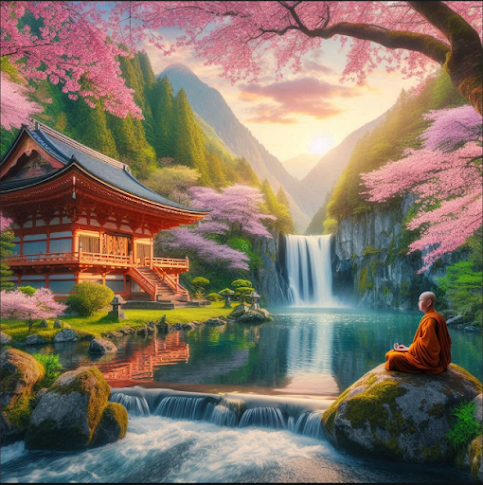
Manga Buddhism


So I fooled around with Copilot Designer again. This came up when I asked AI to generate pictures of Tendai, Soka Gakkai, Zen and Shingon. Make of this what ye wish...


Thursday, January 11, 2024

Value creation


Buddha preaching the Lotus Sutra


"Soka Gakkai in Japan" is an article by Levi McLaughlin about the controversial New Religious Movement. The publication date isn´t clear from my copy. Perhaps around 2010? The piece is a good introduction to the history and activities of the Value Creation Society, as its name could perhaps be translated to English. While Soka Gakkai is usually described as a Nichiren Buddhist lay organization, the truth turns out to be more complicated. Indeed, after reading McLaughlin´s article, it´s not clear to me how Soka Gakkai is "Buddhist" at all, except in an extremely broad sense. 

Already from the start (the group was formally founded in 1930), Soka Gakkai fused Nichiren Buddhism with other commitments, which sounded more "modern" or even "Western", including an emphasis on education and upward social mobility. The group appealed to the urban poor and promised them advancement, if not in mainstream society, then at least through the alternative institutions created by Soka Gakkai itself. Under its autocratic third president, Daisaku Ikeda, the group began to increasingly espouse his private cultural tastes, including an admiration for Napoleon, Beethoven, Martin Luther King and Mahatma Gandhi (a somewhat unusual combination). There is apparently very little distinctly Buddhist or even Japanese in the meeting halls of Soka Gakkai. In 1991, the group split from the Nichiren Buddhist temple priesthood of the Nichiren Shoshu sect, to which it had previously been affiliated as a lay movement. That being said, Soka Gakkai still claims to be Nichiren Buddhist, chant its distinctive mantra and worships the "gohonzon" (a symbol associated with this particular Buddhist tradition). 

In terms of membership, Soka Gakkai may be one of the largest organizations in Japan (sic), only rivaled by the labor unions. It´s exact membership is unknown and often exaggerated by the leadership, but certainly count in millions. It has a formalized organization with a bureaucratic structure, local branches, special "divisions" for different kinds of members (young men, young women etc), a school system, a newspaper and even its own flag (a European-looking tricolor). There is also an international arm, Soka Gakkai International or SGI, active all over the world. In Japan, Soka Gakkai has also formed its own political party, Komeito, and an important activity of the group is to campaign for its candidates (at the moment, Komeito are actually the junior partners in a LDP-dominated coalition government). 

The history of Soka Gakkai has been turbulent, with periods of aggressive proselytizing and cultishness, accompanied by goals to convert all of Japan to Nichiren Buddhism and turn it into a new state religion - plans that were later (thankfully) abandoned. While the fanaticism and mass mobilizations of Soka Gakkai has a distinct "fascist" feel, especially under Ikeda the movement promoted itself as apostles for peace, nuclear disarmament and international cooperation. Soka Gakkai registered as an NGO with the United Nations, Ikeda promoted the thaw in relations between Japan and China, and the organization had a "cultural" image internationally. 

Ikeda died only recently, and the future direction of both the Society and its political wing are presumably unclear at the present moment. I wouldn´t be surprised at all if Japan starts to rearm itself in the near future, presumably still under LDP hegemony, which might create strains between the LDP and Komeito. In another article, McLaughlin also reveals that Soka Gakkai has gradually de-emphasized the "Beethoven" aspects of its activities. Who knows what kind of "values" this NRM will produce by 2030, 100 years after its foundation? 


Saturday, January 6, 2024

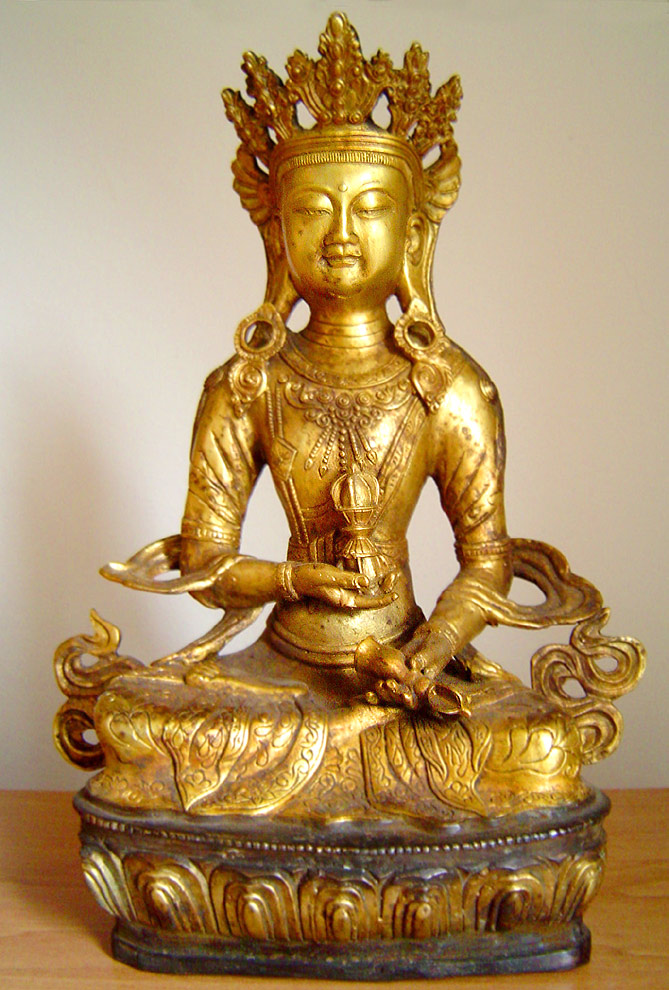
An ode to Buddha


Probably the wrong Buddha
Credit: Robert Aichinger 

"Beethoven and Buddhism in a Japanese Religion: Culture and Cultivation in Soka Gakkai" is an intriguing article by Levi McLaughlin, published in a 2021 issue of the journal Numen. The author was a participant observer studying an orchestra associated with the New Religious Movement Soka Gakkai in Japan. Yes, really: McLaughlin can play the violin, and could therefore quite literally participate in the work of the Tokyo orchestra he was also observing as an anthropologist. 

I heard of Soka Gakkai´s promotion of classical music and Western-style culture before, but I didn´t realize that it runs so deep (or at least used to until recently). Soka Gakkai´s founder Daisaku Ikeda (who passed away last year) seems to have been almost obsessed with Ludwig von Beethoven, both Beethoven the man and Beethoven the composer. Apart from Beethoven, Soka Gakkai also promoted Schiller, Shakespeare and European Romantic culture more generally. McLaughlin´s article starts out by describing a Soka Gakkai museum in Tokyo which prides itself on having obtained a piano actually owned by one of Beethoven´s students, with the museum guides enthusing that Beethoven´s fingerprints might still be on it! 

Nor did I realize that this weird fixation on a 19th century European composer is far from unique to Soka Gakkai. "Everyone" in Japan were into European Romanticism, including Beethoven, during the early 20th century. This was Ikeda´s formative period. Soka Gakkai recruited most of its membership among working class people, Ikeda himself being almost dirt poor in his youth. The promotion of refined Western culture was seen as a way to secure status and upward social mobility. When the author studied this particular NRM (one of the strongest in Japan), they had scores of orchestras playing Beethoven´s music all across the country. Their training wasn´t purely musical in nature. It also included listening to a kind of ideological lectures about Beethoven´s life. The performances were seen as expressions of gratitude to Ikeda, and hence were integral parts of the religious life of the organization. 

Soka Gakkai were for decades the lay arm of Nichiren Shoshu, a temple-based Buddhist group following the teachings of 13th century Buddhist priest Nichiren. In 1991, the two groups underwent an open schism, but conflicts between the Nichiren Shoshu priesthood and Ikeda apparently go back to the 1970´s. One of the reasons why Soka Gakkai has so many pianos at their Tokyo museum is that Ikeda supposedly garnered strength from playing his piano during the earlier conflict with Nichiren Shoshu. This has made pianos a potent symbol within Soka Gakkai. The article says relatively little about the 1991 schism, but its clear that the temple priests regarded Ikeda´s obsession with European culture as heterodox and not in keeping with Nichiren´s teachings (teachings which Ikeda also claims to uphold). For instance, Nichiren Shoshu claimed that Schiller´s "Ode to Joy" (famously set to music by Beethoven) was Christian. McLaughlin finds this ironic, since "Ode to Joy" was generally regarded as Masonic during Schiller´s lifetime and revolutionary when used by Beethoven. Interestingly, Ikeda doubled down on Beethoven after the schism with the head temple, suggesting that the Romantic or "humanist" element in his ostensibly Buddhist message isn´t a minor point.

Or wasn´t. The author strongly implies that the Beethoven-mania gradually became less prominent as Ikeda became older and no longer could exercise complete control of Soka Gakkai. This seems to have happened within the last 15 years or so. What will replace it now when Ikeda has passad away nobody really knows...

Fascinating. 


Friday, January 5, 2024

Jammin´


Probably the wrong chant 

"Nichiren Buddhism in the Contemporary Jazz Improvisation of Herbie Hancock and Wayne Shorter" is one of the more curious articles I ever read. It´s strictly speaking a kind of speech or tribute delivered at a conference in Arizona, the First Jazz and Philosophy Intermodal Conference (JPIC) in 2017 to be exact. None other than legendary jazz musician Herbie Hancock was supposed to participate at the con, but for some reason his participation had to be cancelled at the last moment, but the tribute by Steve Odin was delivered anyway. To be absolutely blunt, the article mostly repeats the same statements over and over again, almost as if it was a Buddhist chant. But then, it *is* (after a fashion) about Buddhist chanting!

Herbie Hancock is a Black American jazz musician who converted to a rather heterodox form of Japanese Buddhism, known as Nichiren Buddhism and represented in the United States by Soka Gakkai International (SGI). Wayne Shorter and Tina Turner have also been associated with the SGI. In passing, the article mentions that many jazz musicians were inspired by religious and spiritual sources, ranging from Christianity and Islam to Scientology, Bahai and the Fourth Way. The article then discusses some aspects of SGI metaphysics. The concept of "Buddha-nature" as expressed through "Three thousand realms in a single moment of life" is interpreted as the microcosmos reflecting the macrocosmos. This is connected in the "mutual containment of the ten worlds" - the idea that each one of us is simultaneously in ten states at the same time, ranging from Hell to Buddhahood. By chanting the mystical mantra Nam-myoho-renge-kyo, the individual can unlock his creative potential in every moment, presumably accessing the "realms" or "worlds" we presently are unaware of. In this way, we can "create values" (Soka Gakkai means Value Creating Society), the most important of which are beauty, goodness and practical benefit. SGI seems to have amended the traditional Nichiren metaphysics with the idea of a vitalistic life-force that can be accessed through the mantra. 

Apparently, SGI founder Ikeda was interested in art, music and aesthetics. This presumably explains why some musicians and singers are drawn to this particular New Religious Movement. I read elsewhere that the SGI also promote Western classical music. Jazz seem to fall on the other end of the musical spectrum! 

As for Hancock, he apparently used the above take on creativity to further his work as a jazz musician, since jazz is based on improvisation and hence "creativity in every moment". I admit that I don´t get it - it sounds frankly pretentious and pseudo-intellectual - but then, I´m not a jazz aficionado, so I´m gonna give the bro the benefit of the doubt here. And in case the talk about unlimited creativity locked in every occasion sounds a bit like Whitehead, why, Odin has written a paper on process philosophy, too... 


Tuesday, January 2, 2024

Rockit, Buddha


The only Herbie Hancock composition I´m familiar with...

A propos a previous blog post on Black American musicians connected to Soka Gakkai.

Monday, January 1, 2024

Beyond Nichiren´s thunderdome


Our man Brad reflects on Tina Turner´s Buddhism. In September 2022, I actually linked to some content dealing with the same topic. Purely by coincidence, I researched it on the same day as a Tina Turner death hoax was spreading like wildfire on the web. Tina Turner did pass away eventually, but in May 2023.

I don´t claim to know the details of the pop icon´s connections to Nichiren Buddhism or the Soka Gakkai, but she did have an interest in it, at least for some time. Nor was she alone on the African-American music scene to adopt Nichiren chanting. Wayne Shorter and Herbie Hancock are two other examples. 

I admit I had no idea! Interesting.

Friday, September 23, 2022

One of the living


Here´s a strange co-incidence. For whatever reason, I decided to check up Tina Turner´s supposed connection to the controversial Soka Gakkai organization. And then I read on Wikipedia that Tina had passed away...earlier today?! 

However, it seems to be a hoax...

Still, it *is* a strange chance event, don´t you think? Or a divine calling from the Great Beyond...

"Tina Turner is not an SGI member"

Singer killed by Internet death hoax