WTF, I love Singapore now.
The title of this video is evidently click bait, since the "anti-Hindu temple" or "Hindu anti-temple" is really a medieval royal cremation ground in Cambodia. It´s popularly known as the Terrace of the Leper King.
The content-creator ("Ancient Aliens" personality Praveen Mohan) treats it as Hindu, but according to all-knowing Wikipedia and ChatGPT, the site is Buddhist but with Hindu admixture. Hardly surprising in a syncretic religious environment. Besides, Buddhism took over much of the South Asian ("Hindu") cosmology.
For a moment, I assumed Mohan had come across some kind of truly demonic super-Tantra stuff, but naaah, apparently not.
An interesting video on ancient Greek influence on various aspects of Asian art and culture (including martial arts).
The Greco-Buddhist kingdoms of Bactria and NW India are of course featured, but it turns out that the Hellenic influence survived far longer. Note that the first depictions of the Hindu gods Krishna and Balarama are Greco-Buddhist, and so are the first anthropomorphic depictions of the Buddha. There are even depictions of the Buddha with two dharma-protectors, who on closer inspection turns out to be Alexander the Great and Herakles!
The content-creator argues that some Asian martial arts might be influenced by ancient Greek Pankration (made famous by the games at Olympia). Thai boxing and Bokator in Cambodia are apparently the main suspects. The video also claims that there are descriptions of fighting techniques in the Hindu epic Mahabharata which resembles Pankration.
Interesting. So here we go again: Ex Occidente lux. Or at least mixed martial arts...
 |
| Credit: DrThneed |
Den här gamle skojaren bor i Kambodja numera. Tydligen. Läste delar av SvD:s ursprungliga artikel innan den låstes. Länken är till TH:s blogg.
I´m usually skeptical to this guy (think Erich von Däniken´s speculations), but this was actually interesting. Could this be an early example of electricity in Cambodia of all places? Note that part of the video is AI-generated.

Israel, Pakistan and now Cambodia have all nominated Donald Trump for the Nobel peace prize. Yes, really. I suppose Rwanda is next. Something tells me these nations might get in big trouble if a RINO or Dem ever retakes the White House...
What a pity Greta supports Hamas, I mean, this would have been an excellent opportunity for Norway to give *her* the peace prize instead, LOL.
Why didn´t Kim just call King Sihanouk and ask him to send over some really tasty apples?

Monday night I watched Francis Ford Coppola´s classic "Apocalypse Now" in the "Final Cut" version. I won´t attempt a full analysis of this "best film ever made", but one thing struck me when watching it. The film is obviously very critical of the Vietnam War. The crook Colonel Kurtz is a renegade who "went too far" and therefore has to be dispatched - something the main character Willard rather explicitly regards as hypocritical. Kurtz is simply the product of the insane war itself. One of the "good" guys - the officer who loves the smell of napalm in the morning - is just as crazy as Kurtz (although with different symptoms).
But...
In the end, "Apocalypse Now" actually becomes "problematic" (to use Woke terminology). The Montagnards or tribals who follow Kurtz worship him as a god, apparently voluntarily. The American soldiers who join these renegade forces "go native". So does Kurtz, living in a Khmer temple and presiding over pagan sacrifices. So in the end, it´s not really the American war that drives the colonel insane. It´s the jungle, the colored peoples and the pagan rituals. No White man can withstand the evil influence of the colonized environment.
Logically, this means that civilized Whites should leave the Third World because it will inevitably corrupt them. The same theme is also visible in the plantation sub-plot, where an incredulous Willard asks the French settlers why they don´t just return home to France. The old planter who believes that an understanding can be reached with the natives is depicted as senile, while the stalwart colonialist who argues with Willard is obviously "out of touch", spewing absurd conspiracy theories as he babbles on.
Note also that Kurtz hides in Cambodia and that his temple compound is littered with skulls and dead bodies. Could this be a hidden reference to the Cambodian genocide? Maybe it´s a co-incidence, since the film was in production for years before finally released in 1979. Still, the parallels are hard to miss, especially since the worst Khmer Rouge soldiers were tribals.
Maybe our White asses should avoid the heart of colored darkness, but don´t tell me that´s a "progressive" critique of colonialism...
It seems a new form of trafficking and slavery has developed in Southeast Asia. Hundreds of thousands of people from all over the world are virtually imprisoned in "scam centers" in Myanmar, Laos and Cambodia. Tricked by promises of good office jobs, they are forced to work with various Internet and phone scams. The centers are often controlled by Chinese crime gangs.
However, it seems that both China and Thailand have decided to move against the gangs after a high profile abduction of a Chinese actor (!) in Thailand (he was trafficked to Myanmar) and Thai fears that Chinese tourists might avoid their country unless something is done stat. The Chinese government is of course entirely hypocritical, due to the slave-like conditions in China´s seafood industry, not to mention Tibet and Xinjiang. I suppose the crime syndicates messed with the wrong officials.
The Myanmar military is apparently also sick and tired of the scam centers at their side of the porous Thailand-Myanmar border, since they have decided to aid the Thai efforts to clean up the place. So I suppose you could say that this story has a "happy ending" of sorts...for now. Something tells me the scamming will continue elsewhere.
Speaking of which...
The YouTube clip above tells a somewhat bizarre story connected to the scam center issue, this time from Cambodia. An attention-seeking influencer from Taiwan staged an incident in Cambodia, claiming to have been kidnapped and tortured by a gang operating a center. The Cambodian authorities weren´t amused and sentenced both him and an accomplice to a long prison sentence. Even the Prime Minister of Cambodia Hun Manet condemned the hoax. One thing the YouTube clip doesn´t tell us is whether or not the Cambodian police also took action against the scam centers...
Slavery never really went away, did it?
This is supposedly a "wild bear trap", but surely it should say "wild BOAR trap"? LOL.
Meanwhile, on the fringe...
An intra-mural Catholic polemic on young earth creationism (YEC), complete with the claim that dinosaurs survived the Flood and were still around...during the Middle Ages?!
Best comment: "I did expect them to read the Bible literally, I didn´t expect them to read Beowulf literally". Not to mention the legend of Saint George and the dragon!
Stegosaurs in Cambodia, theropods in China, sauropods (et. al.) around England´s greenest hills...the evidence isn´t exactly convincing. I´m honestly getting a bit tired of all this crap. Should I stop commenting fringe beliefs completely?
"Röda khmererna: Pol Pots revolution i Kambodja" is a Swedish book from 2022 by Peter Fröberg Idling. It´s published by Historiska Media, a press with a wide assortement of popularized but still surprisingly informative books written by various authors. The topic this time: the Khmer Rouge and their reign of terror in Cambodia 1975-79.
The bulk of the story is well known by now: how the Khmer Rouge forcibly evacuated the capital of Phnom Penh after a bloody civil war, how they subsequently turned the entire country into a enormous labor camp, and how the regime was finally overthrown by a Vietnamese invasion. The Khmer Rouge genocide may have claimed the lives of over one million people. Few people would have missed the name of the crazed dictator behind it all: Pol Pot. Since the Khmer Rouge were Communists, their depradations are placed in the same ball park as those of Stalin or Mao.
While none of the above is "wrong", there is also a wider context: a brutal colonial history, constant conflicts between Vietnam and Cambodia that go back centuries, and Richard Nixon´s "secret" war (including carpet bombings). At their peak, a large proprotion of the Cambodian peasant population must have supported the Khmer Rouge. Pol Pot´s bizarre regime was overthrown by another Communist government and his movement kept afloat as a "contra" force by the United States and Thailand. Add to this the constant scheming of Prince (or King) Sihanouk, and the story suddenly gets more complicated...and arguably even more brutal. All of this is covered by the author.
The book also contains more unexpected information. For instance, that Pol Pot (whose real name was Saloth Sar) was something of a dandy and bon vivant in his younger days. Somewhat ironically given later developments, Saloth Sar came from a kulak background and had a family connection to the royal Cambodian court. He seems to have been a charismatic, smiling and jovial man...well, until he wasn´t, although I suppose he kept his charisma. He flunked both high school and college, first due to his bohemian lifestyle, later because of his revolutionary pastimes. In other words: another intellectual mediocrity who fancies himself the Messiah. It´s not even clear if he had any real grounding in Marxism-Leninism. Fröberg Idling believes that his main source of inspiration was the French revolution, including its most radical and terroristic phase. Pol Pot´s source? A work by Peter Kropotkin!
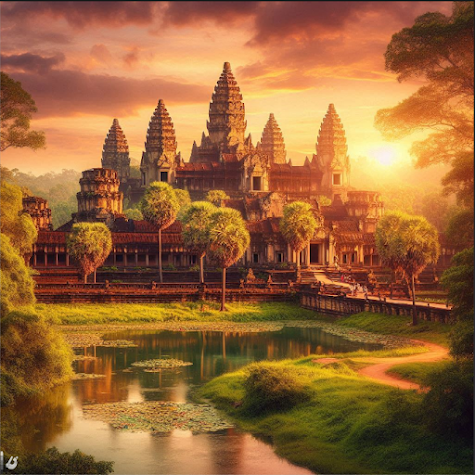
Another new piece of information is that Cambodian nationalism was a by-product of French colonialism. Not just in the trivial sense that colonialism breeds resistance, but also in a more "ideological" sense. It was the French that made the Cambodians interested in Angkor Wat. The old temple complex had been in ruins for centuries and nobody much cared about it (except maybe a few Buddhist monks) before the French became fascinated by it and the ancient Khmer Empire in general. This prompted Cambodians to turn Angkor Wat into a potent symbol of Cambodian nationalism. Indeed, even the ultra-Communist Khmer Rouge had the silhoutte of Angkor Wat on their flag. (If Wikipedia is to be believed, the author makes two factual errors about Cambodian flags. The first flag showing Angkor was adopted in 1863 by the French-dominated puppet kingdom of Cambodia, while the flag used by the nationalist Khmer Issarak was re-used by the pro-Vietnamese Hun Sen regime, not by the Khmer Rouge. Perhaps a vexillology nerd could weigh in on this?) Note also that both the ideals of the French revolution and Marxism are, of course, Western.
A constant theme in the book is Pol Pot´s weird and quasi-Masonic secrecy, unique among Communist parties. The very existence of the Communist Party of Kampuchea was a secret, the party using the cover name "The Organization" (Angkar). Its leadership was just as secret. It took several years after the "revolution" before the Khmer Rouge revealed that the leader of their regime was a certain Pol Pot. But that´s really a pseudonym (the exact meaning of which is unknown) and Brother Number One was given an entirely fictitious biography. At this point, he was paranoid and strongly xenophobic, constantly moving his HQ around Cambodia. It struck me that even this strange obsession with secrecy (including when actually in power!) could be derived from some kind of Jacobin or Blanquist conspiracy during or after the French revolution.
Another thing that shines through (despite the author for unclear reasons not liking Michael Vickery) is the weird blend of authoritarianism and decentralization during the Khmer Rouge´s years in power. The decentralization aspect is emphasized in Vickery´s books. Cambodia or "Democratic Kampuchea" was sub-divided into seven "zones", each under its own effective leadership. The conditions in the various zones varied considerably, with the Eastern zone bordering Vietnam being the most lenient, while other zones were under the control of de facto dacoit warlords who really did "hate the cities". At the center, Pol Pot tried to keep control with semi-regular purges left and right. His commands were often contradictory, the production quotas impossible, and the paranoia rampant (but nevertheless "justified", since Vietnam *did* conspire against the Angkar). Most people who died under the Khmer Rouge probably perished due to famine, malnutrition and overwork. For more on Pol Pot´s utter insanity, see my review of the book "Pol Pot Plans the Future", which contains translations of the few internal Angkar documents that have come to light.
It´s difficult to "explain" any of this in a strictly rational fashion, but the author does point to a few factors. For instance, that violence has long been part and parcel of Cambodian culture. It´s an extreme "honor culture" in which every sleight is punished with over-the-top violence, which in turn leads to new violence. Add to this colonial terror and civil wars. The fact that Cambodia has long been weak and squeezed between its more powerful neighbors Thailand and Vietnam is also part of the picture. Obviously, extreme nationalism can appeal to people in such a situation. As for the Khmer Rouge, the author believes that they are best seen as a kind of cult or sect, which under extraordinary conditions of societal breakdown managed to take power. (The Taliban in Afghanistan could be another example of this.) And yes, the "Communist" mixture of utopian millenarianism and authoritarianism obviously also plays a role here. A trail not explored by the author is that millenarian cults seem to be pretty common in East Asia (and perhaps Southeast Asia?). The Khmer Rouge may be part of a tradition that long pre-dates Communism. Indeed, maybe Communism is seen by many adherents in Asia as a new millenerian cult? The author does speculate that Pol Pot might in some strange sense have been influenced by Buddhism and mysticism.
The book ends with an epilogue, in which it becomes clear that most of the Khmer Rouge were never punished for their crimes. Pol Pot was - somewhat ironically - unseated by his own supporters in 1997 in a remote part of Cambodia after ordering yet another round of purges, this time of fellow guerilla commanders fighting the new Cambodian administration. Pol Pot was placed under house arrest and died of unknown causes in 1998. For some reason, the author strongly dislikes Hun Sen and the pro-Vietnamese ex-Communists, constantly accusing them of being somehow implicated in the genocide, when in fact they were the moderates who tried and succeeded in removing Pol Pot from power.
With those reflections, I end this review.
 |
| - Why are we here, we´re Egyptian vultures and have no connection to esotericism in power! - I know, brother, I know, this blogger clearly lost it! |
“How public was Shaivism?” is a 2019 essay by
British scholar Alexis Sanderson, apparently taken from a volume called “Tantric
Communities in Context”. It´s an interesting summary of what we know about
Shaivism as a state religion during the early medieval period. At first glance,
the Shaiva religious traditions seem unlikely candidates to play such a role,
being either “lay” and non-Brahminical, or esoteric in character. Indeed, some
of the esoteric groups were extremely ascetic or downright bizarre. But as
usual, nothing it what it seems in good ol´ Hindustan!
Sanderson distinguishes four distinct
tradition within Shaivism, which he terms lay Shaivism, Atimarga, Mantramarga
and Kulamarga. Of these, the two latter are usually considered Tantric, but the
author makes the interesting point that the Mantramarga emerged from the Atimarga,
and that even the Shakta element within Tantrism was originally taken over from
an Atimarga group. Traditions sharply different and divergent on paper were
frequently syncretized, making the boundaries less clear cut in practice. The
relations between initiatory (esoteric) groups and lay groups were frequently
complex, for instance when initiatory Shaivas took control of lay Shaiva institutions
with the blessings of the local king. Within lay Shaivism, the Shivadharma literature
is directed at a kind of “lay elite” the members of which wish to become more
devout and pious. When performed by a king, Shivadharma rituals benefit not
only the king personally, but the entire royal family and government, who are
all said to be saved and transposed to Shiva´s heaven after death due to the
monarch´s observance. Indeed, if the king organizes public spectacles while
sacrificing to Shiva in a temple and showing respects to the Shaiva guru and
ditto ascetics, the entire kingdom will prosper: no famine or plague will
befall it, it will expand territorially, and so on. Here, there can be no doubt
that Shaivism was a very public religion indeed. (I assume that the guru and
the ascetics mentioned here were initiatory Shaivas who had attached themselves
to public places of worship.)
Sanderson then makes an interesting excursus
on the Atimarga, often considered one of the most extreme religious traditions,
since its practitioners actively try to become outcasts from society, for instance
by feigning madness or by seemingly doing penance for murdering a Brahmin.
However, it turns out that there were actually two kinds of Atimargins: the
ascetic sadhakas and the more moderate acharyas. The latter are said to acquire
“infinite merit” by initiating the sadhakas, conversing with laymen, and giving
them darshan (a blessing transmitted through gazing). Inscriptions from the
Middle Ages prove that acharyas could own property, got married and transferred
their positions to their sons, and donated resources on a non-sectarian basis
to religious shrines (the sadhakas by contrast were only allowed to worship
Rudra). Somnath Patan, a town holy to the Pashupata branch of the Atimarga, was
ruled by king-like acharyas in charge of building fortifications and engaging in
other building projects. This obviously raises all kinds of awkward questions,
such as: are *all* religious traditions essentially fake?! The acharyas could
also interact with the king, something forbidden to sadhakas. Sanderson
mentions epigraphic evidence showing that a certain Maharaja donated land to a
temple for the Mother-Goddesses established by a Pashupata acharya.
While the barking mad Atimargins thus turn out
to have a moderate faction, the moderate Right Hand Path Tantrikas of the Shaiva
Siddhanta school turn out to have ascetics and monasteries. Indeed, the
Saiddhantikas spread throughout the Indian subcontinent precisely by initiating
kings and using their lavish initiation fees to found new monasteries as sub-branches
of a rapidly expanding organization. Some Saiddhantika gurus had initiated more
than one monarch. This alliance with the royal power necessitated a pragmatic change
in the teachings of Shaiva Siddhanta. Liberation was originally only possible
for those able to regularly carry out the complex rituals associated with this form
of the Mantramarga. Since kings evidently couldn´t practice in this exacting
way, the doctrine was changed so that initiation itself bestowed liberation. The
Tantric rituals were to be observed only by those who had the ability to do so.
As if the promise of liberation after death wasn´t enough, the kings were also
promised prestige and military might as additional benefits of initiation.
Really, we are hard to please! It´s also interesting that while the royal initiation
ritual sensu stricto was private, the celebrations surrounding it were very
public indeed, making an “esoteric” form of Shaivism highly visible.
But what about the even more esoteric
non-Saiddhantika forms of the Mantramarga and the Kulamarga? It turns out that
even these traditions have been used by the royal power to carry out magical rituals
of protection on behalf of the royal family, the state or the community.
Sanderson gives a number of examples, including a medieval cult of Shaiva deities
in the Khmer Empire and secretive cults of the transgressive goddess Kubjika in
Nepal down to the early 21st century. Indeed, the royal massacre in
Nepal in 2001 was attributed by some traditionalists to a failure to carry out
certain Tantric rituals. Even non-Shaivas such as the Atharvavedins (Vedic
“priests” specializing in the Atharva Veda) coopted some Kulamarga practices,
specifically mantras associated with Kali to offer kings protection in battle.
It seems esotericism isn´t always esoteric. No
surprise there, tbh. Still, it could be seen as somewhat weird and perhaps even
chilling that “problematic” Tantric deities are worshipped at the highest echelons
of a warrior-prone royal hierarchy. With that, I close this perhaps somewhat
narrow blog post.

Åsa Linderborg slår till igen, med en mycket baserad tagning. Blev faktiskt själv förvånad för ett tag sedan när jag insåg att Forum för levande historia faktiskt är en *bokstavlig* statlig myndighet!

The classical definition of fascism is something like "a reactionary mass mobilization directed against the labor movement and democracy as such, headed by an authoritarian right-wing party with pseudo-socialist traits", one of these being a mixed economy under strict government supervision.
But is that really the only way fascism can manifest? Why can´t there be a neo-liberal form of fascism, for instance? After all, Social Democrats or centrists can adopt neo-liberal policies, so why can´t fascists?
In the United States, David Duke - if I understand him correctly - calls for a free market economy. However, it would be weird not to call him a fascist. He has, after all, an almost explicit Nazi ideology on all other points! Indeed, most American far right-wingers probably call for a free market (or a combination of free domestic markets and closed borders).
Other examples inlcude the Islamic Salvation Front in Algeria, or the BJP in India (or at least the earlier and more militant incarnations of the Hindutva movement).
Another interesting question is if fascism can also take a Communist form. Most people would think of Stalin, but for obvious reasons, Stalin and mass mobilizations (at least in his home town) didn´t exactly mix. More relevant examples would be the Russian Red-Brown Bloc of the 1990´s, Sendero Luminoso in Peru, and the Khmer Rouge in Cambodia.
Of course, the term "fascism" doesn´t have an essentialist meaning, so strictly speaking, we can define it anyway we see fit. (Stalin notoriously called the Social Democrats "social fascists"!) However, if stormtroopers start stirring up "the masses" against your union hall in the name of the Nation, the Great Leader and the free market, it would seem strange not to see this as somewhat analogous to Hitler or Mussolini...
 |
| The Indonesian orchid "Kimilsungia" |
"Guns, Guerillas and the Great Leader: North Korea and the Third World" is a book written hy Benjamin R Young. It was recently published by Standford University Press as part of their "Cold War International History Project". While the book does contain interesting facts (and a lot of borderline factoids), it nevertheless comes across as a rough draft. The book tries to describe North Korea´s foreign policy from 1956 to 1989, but lacks a more detailed analysis of the entire period in question. There isn´t even a general summary chapter. To be honest, the book comes across as a kind of catalogue of every weird North Korean mishap in the Third World, but without any attemp at a real synthesis. There are also a number of strange errors: the author (or his editor?) confuses Mauritius with Mauritania, claims that Muhammad is a "deity", and insists on calling the Janatha Vimukthi Peramuna "the People´s Liberation Front" - while that is what the name means, everyone else just calls it JVP. After reading the book, I still don´t understand *why* the DPRK did what they did (as in "why really"), although a few answers can be gleaned by reading the narrative carefully.
Which doesn´t mean you shouldn´t read the book. If you love killer clowns on a Halloween rampage in the Third World, you gonna love "Guns, Guerillas and the Great Leader".
A long time ago, I assumed that the DPRK were a super-isolationist Communist regime which really did have an independent line, and in contrast to Enver Hoxha´s Albania didn´t even try to create a "world movement" all their own. Later, I assumed that North Korea was really just a Soviet satellite, although a slightly idiosyncratic one. Judging by Young´s overview, the truth is more complex and also more sinister. North Korea was politically independent from both the Soviet Union and the People´s Republic of China, but also economically dependent on them - the "North Korean miracle" was really Made in Elsewhere. The solution seems to have been to play off the Soviets and the Chinese against each other, reaping dividends from both. When necessary, the DPRK carried out its own influence operations, economic deals and even terrorist attacks. There is a certain irony in this, since the "Democratic People´s Republic of Korea" was established by the Soviet Army and saved from USA/UN occupation by the People´s Liberation Army of China! Yet, since both the Soviets and the Chinese left early, the Kim family clan could remain firmly in control and pursue their own policies without direct supervision by Moscow or Beijing (both of which frequently complained about the North Korean attitude). So why were the North Koreans allowed to continue, year after year, even when they carried out crazy stuff worthy of a Gaddafi? I assume the reason is geopolitical: neither the Soviets nor the Chinese Communists can allow a "capitalist" or "pro-American" unification of Korea, and therefore need the DPRK as their buffer state in the north. This gives the Kims (including the present one) a certain leverage and ability to manoeuvre. They can go very far without risking more than some diplomatic reprimands backstage...
I think the main, or even only, reason for DPRK´s "solidarity" with "the Third World" is the North-South conflict on the Korean peninsula. Judging by Young´s account, this is the case even when North Korea tries to get influence in Africa. It´s really a way to counter attempts by *South* Korea to gain such influence, or to move first. Sometimes, North Korea wants to test its weaponry, or even engage South Korean agents and military personnel abroad. During the Vietnam War, North Korea supported North Vietnam and the NLF, while South Korea did likewise with South Vietnam. The DPRK sent fighter pilots to Vietnam, and tried to assess the strengths and weaknesses of the South Korean troops active there. They also attempted to abduct South Korean military, spread Communist propaganda among them, etc. In Africa, the two Koreas were engaged in a decades-long propaganda war against each other, the purpose of which was to secure African support for the North Korean position within the Non-Aligned Movement (NAM), which North Korean diplomacy tried to use as a forum and a tool for DPRK interests. While the aid to various Third World nations was originally free of charge (the North Koreans even paid handsomely for propaganda in various foreign newspapers), during the 1980´s the relations became more business-like, with the DPRK demanding payment (in foreign currency) for services rendered.
What struck me most was the intensely opportunist character of the North Korean foreign operations. Machiavelli would have liked these guys. In Uganda, North Korea supported both Idi Amin, Milton Obote and Yoveri Museveni! In southern Africa, North Korea originally had cozy relations with Zaire´s very own killer clown Mobutu Sese Seko, only to abandon him (and his Angolan FLNA proxies, and I suppose his avasuits), in favor of the Angolan MPLA. In the Middle East, Kim Il Sung secretly supported Egypt´s peace deal with Israel, while saying the opposite in public! And despite its support for North Vietnam during the Vietnam War, the DPRK pivoted to Pol Pot´s Cambodia after the war, even trying to get Vietnam expelled from the NAM. The bromance between Cambodia´s Sihanouk and Kim Il Sung must have been something to behold, with Sihanouk telling a high-ranking US official that the North Korean leaders don´t want war, since they are used to a life in complete comfort and luxury (something that must have impressed this truly precious prince who, alas, was no stranger to war). Sihanouk preferred having North Korean body guards, notorious for their brutality, being intensely suspicious of Cambodian royal palace guards...
A fun fact is that North Korea weren´t the only opportunists in these transactions. Frequently, *they* were taken advantage of themselves, especially in the super-corrupted African theatre. Once, a pro-Western newspaper in Cameroon published pro-DPRK propaganda just for the money. Many "Korean friendship associations" in Africa paid people to become members, which all kinds of unscrupulous elements took advantage of. In Uganda, the "friendship association" supported Museveni, at a time when the North Korean regime was still aiding and abetting Obote. The Communist Dergue regime in Ethiopia cynically accepted aid from both Koreas! But then, the Dergue may also have been the only regime in the world which accepted aid from both Cuba and Israel...
Judging by Young´s account, the best aid rendered by the Kim regime to its "allies" in the Third World was the military one, which included both weapons, ammunition and frequently brutal instructors. He doesn´t have an opinion on the quality of the huge palaces and monuments built in Africa by North Koreans. Much other aid was substandard, including porcelain factories which made dishes of such bad quality that you could cut through them with a steak knife. I´m not surprised. One popular "export" were the Mass Games, a kind of political gymnastic exercises, which could be used for propaganda purposes in a variety of nations (although the locals preferred to enhance the Mass Games with references to their own cultures). This brings me to perhaps the most entertaining portion of North Korean foreign propaganda: its notoriously inept character. It´s not clear to me whether the Kim Il Sung leadership really didn´t get it, or whether they simply didn´t care, since the real deals between DPRK and its "allies" were negotiated off-stage.
North Korea is notorious for its bizarre and hysterical personality cult of Kim Il Sung, and later also of Kim Jong Il, his son and heir-very-apparent. This personality cult was liberally diffused abroad (or in North Korea to visiting foreign delegations), often to the bemusement and slight consternation of the intended targets. After reading some of the Great Leader´s sage pronouncements myself, I have to say that most of them are basic bitch commonplaces. "We have to strengthen the people, weaken imperialism, and mobilize. This is very important". That kind of level. I assume that the statements *about* the Great Leader and the Dear Leader are more, shall we say, turgid. Even foreign diplomats, including from friendly socialist nations, where frequently forced to listen to long speeches extolling the virtues and excellencies of Kim Il Sung. One Spanish visitor, I think, was taken to the doctor for a check up before being allowed to visit Kim - the medic explained that the Leader is such a great man, that people frequently faint in his presence! An African delegation, when realizing that the next 40 rooms of a Kim Il Sung exhibition in Pyongyang were very similar to the 20 rooms they had already walked through, kindly asked to be taken elsewhere. The translations of books about Kim Il Sung to foreign languages were frequently pretty bizarre. One English translation had the headline "Kim Il Sung: The Divine Man", while an Arabic translation claimed that Kim Il Sung is God! (No less.) Ironically, the idea known as Juche, which the Korean Workers´ Party claims is Kim Il Sung´s foremost contribution to revolutionary theory, was succeful in the Third World mostly because it was interpreted as a commonplace. Thus, in India, Juche was associated with everything from Plato to Mahatma Gandhi, which seems correct - for what is Juche other than the idea of autarkic self-reliance from the Western-dominated world economy, the dream of many Third World nationalists?
Unfortunately, the Communist fun house of North Korea also had a darker side. One thing that struck me was that the North Koreans sometimes attacked "progressive" governments they should logically have tried to lobby diplomatically instead, as when they supported the mad Maoists of the JVP against the left-nationalist SLFP government of Sri Lanka, or when they backed a small revolutionary foco against the Mexican PRI government. In both cases, the rebellions were adventurist and doomed from the start (the Mexicans hardly started theirs before the police arrested them). Notoriously, North Korea supported the Japanese Red Army, a kind of East Asian version of the Baader Meinhof gang. Further, there was the Rangoon bombing of 1983, during which North Korean agents tried to assassinate Chun Doo-hwan, the president of South Korea, during his official visit to Burma (at the time a socialist nation). Finally, there was the bombing of Korean Air Flight 858 in 1987, killing over 100 people, in retaliation for South Korea refusing to co-host the 1988 olympic summer games. After the Cold War, it´s been pretty much downhill from there, with the North Korean regime looking upon the Third World as a gigantic smorgasbord for smuggling, hacking and other ways to obtain hard currency (implicitly or explicitly threatening to nuke the US unless the West pays tribute is another sure method).
North Korea has become a rogue state and international outlaw, and it seems the roots of the predicament go pretty deep. So does the geopolitical realities that seemlingly make the North Korean entity as viable as ever, at least for the Kim clan and its cronies. Today, the great benefactor of "self-reliant" Juche DPRK is, of course, China.
.jpg)
"Esoteric Theravada: The Story of the Forgotten Meditation Tradition of Southeast Asia" is a book by Kate Crosby published last year. I haven´t read literally all of it (it *is* very "esoteric"), but will post a review anyway (it´s my blog, after all). Despite being a scholarly work, it´s published by Shambhala, an independent pro-Buddhist publisher based in Boulder, Colorado.
Judging by several other works I´ve read, the almost exclusive emphasis on Vipassana meditation (which modern Mindfulness is based on) is a new phenomenon within Theravada, not older than the 19th century, when various modernization processes conspired to "resurrect" (or perhaps create wholly de novo) this kind of meditation technique. Before the 19th century, few, if any, Buddhists meditated at all, Theravada practice being about "merit-creating" and pseudo-magical rituals. While this scenario isn´t "wrong", Kate Crosby shows that the actual picture is more complex - and even more interesting.
It turns out that alongside the official Theravada, there *was* a tradition of advanced meditation, which Crosby calls "boran kammatthana". This was an esoteric practice of unknown date which played a prominent part in certain monastic circles prior to the 19th and 20th centuries, usually communicated by word of mouth from master to disciple. It even played a role in a major Buddhist revival in Ceylon during the 18th century. There are similarities between boran kammatthana, Tibetan dream yoga, other Tantric practices, alchemy and Ayurvedic medicine. For some reason, Crosby doesn´t discuss possible similarities with esoteric Taoism. The usual suspicion is that the esoteric tradition within Theravada really is Tantrism, and since such influences were anathema to the 19th century modernizers, this simply became another argument to ignore or suppress it. Crosby, by contrast, believes that boran kammatthana is really inspired by Ayurveda, and that it´s so closely aligned to Theravada philosophy that an "alien" Tantric intrusion is unlikely. In other words, the secret tradition is in some sense legit. (Personally, I don´t see the contradiction.)
The most interesting section of the book tries to describe the actual practices associated with this old school form of meditation. The practitioner does experience various paranormal or supernatural phenomena: encounters with the spirits of the deceased, visions of other realms of reality, seeing spheres of light sometimes accompanied by luminous letters in ancient Khmer script, etc. Physical objects may be visible even when the meditator closes his eyes, or may appear in strange and unfamiliar shapes. Abstract themes for meditation may "appear" as quasi-physical objects, such as a sun´s disk or radiant gems. The practitioner is supposed to absorb the luminous orbs through his nostrils and place them inside his body, at the locations of various chakras or energy centers. This will eventually transform the physical body of the meditator into that of a Buddha! The relationship between this (apparently literal) transformation and the ultimate goal of nibbana (nirvana) is not spelled out in the esoteric scriptures, but presumably a person who dies while in this transmogrified state will immidiately attain liberation. (Does this mean that the Buddha-body is mortal? Or does the person choose to die? Not clear!)
Some additional techniques described in the book take numerology and peculiar written code words as their point of departure. There are affinities between boran kammatthana and alchemy (yes, it works with quicksilver and sulphur in Southeast Asia, too), magical tattoos, traditional medicine, and "forest monks" living at the outskirts of Theravadin civilization. At the same time, the esotericism was also surprisingly intellectually sophisticated. A close reading of Theravada Buddhist philosophy suggested that the "atoms" of samsaric existence are simultaneously both material and spiritual. (Compare Whitehead´s process philosophy!) But if so, spiritual mutations should lead to changes in the physical. Therefore, it´s entirely in keeping with Buddhist understanding that a spiritual technique such as meditation can transform a physical body. Presumably, it´s also logical to assume that a certain kind of body can make it easier to attain a "spiritual" state such as nibbana.
When Theravada modernized itself during the 19th and early 20th centuries, the esoteric practices were gradually squeezed out. One way of doing so was to ban traditional medicine in favor of the modern, Western version. The sangha (monastic order) was taken over by modernists and controlled by the modernizing state. This was the course taken in Siam (Thailand). The esoteric tradition there had already been weakened during the 18th century when the Burmese invaded and devasted Siam, including the then capital of Ayutthaya. In Cambodia, the French colonial power supported the modernist faction within the sangha. The Cold War was another crushing blow. In Cambodia and Laos, Communist regimes (most notoriously the Khmer Rouge in Cambodia) decimated the sangha and Buddhism in general. In pro-Western Thailand, millions of people were relocated from the border regions, where the Thai government feared Communist infiltration. Traditional forms of Buddhism had survived longer in these areas than in others. However, it seems boran kammatthana isn´t completely dead. A few monasteries in Thailand still teach the practice, and the controversial Dhammakaya new religious movement has adopted a modified version of it. Somewhat ironically, it seems that the latest phase of modernization, with its emphasis on individual choices in religion, might favor the ancient esotericism...
There seems to be more to explore here. This is the *inner* school of the elders.
 |
| 70% bad? |

