The blog to end all blogs. Reviews and comments about all and everything. This blog is NOT affiliated with YouTube, Wikipedia, Microsoft Bing, Gemini, ChatGPT or any commercial vendor! Links don´t imply endorsement. Many posts and comments are ironic. The blogger is not responsible for comments made by others. The languages used are English and Swedish. Content warning: Essentially everything.
Is this really existing cyberpunk? We assumed we would be living in cyber-utopia by now. Or at the very least a very interesting cyber-dystopia (think "Blade Runner"). Instead, we got...this.
A humanoid robot named Edward chases invasive boars in Warsaw, Poland. Yes, really. Boars. Wild pigs. Suids.
"I have seen the fire birds of Orion, the space ships at Tannenberg Gate, the suids of Warsaw". HA HA HA!
So I decided to fact check a stunning statement overheard on the interwebs with my new friend ChatGPT...
Is this a true statement: Tigers appear orange to humans because most of us are trichromats, but green to deer and boars which are dicromats. The tiger´s orange and black colors provide camouflage, helping it stalk hoofed pray like deer and boars effectively.
Yes, this statement is generally true.
Explanation:
Human Perception (Trichromats):
Most humans are trichromats, meaning we have three types of cone cells in our eyes that detect red, green, and blue light.
Because of this, we perceive tigers as orange due to how their fur reflects light.
Deer and Boar Perception (Dichromats):
Many of a tiger’s prey, like deer and boars, are dichromats, meaning they have only two types of cone cells (usually sensitive to blue and green).
This limits their ability to distinguish between red and green hues, making colors like orange appear more like green or grayish tones to them.
Camouflage Advantage:
In a forest or grassy environment, greenish or grayish shades blend in well with foliage and shadows.
This helps tigers remain less visible to their prey, making them more effective ambush predators.
So, while tigers look orange to us, they likely appear greenish to their prey, enhancing their natural camouflage.
Is the tiger a trichromat or dichromat?
Tigers are dichromats, not trichromats.
Like most carnivorous mammals, tigers have only two types of cone cells in their eyes, making them dichromatic. Their color vision is similar to that of deer and other prey animals, meaning they have limited ability to distinguish between red and green.
How This Affects Their Vision:
Tigers can see blues and greens fairly well.
Reds and oranges likely appear as shades of green or grayish tones.
This means that while they don’t see their own fur as bright orange like humans do, their camouflage still works effectively in the forest.
Tigers, like other predators, rely more on motion detection and night vision than detailed color perception. Their eyes are adapted for low-light hunting, which is more critical for their survival than distinguishing a full range of colors.
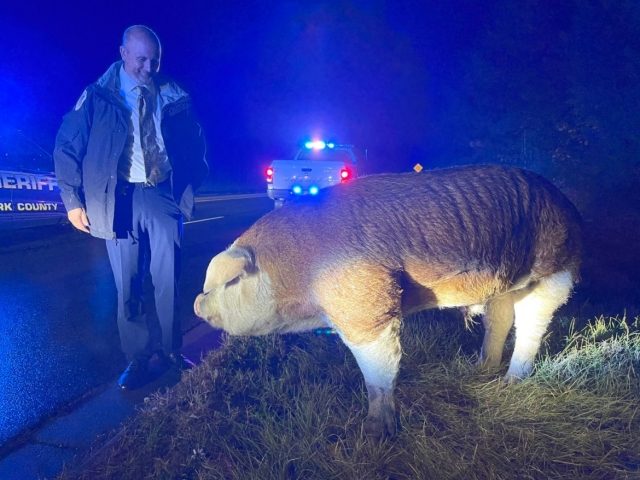
Even better than beaver bombing? What should we call this, boar bombing? The article proposes "guerilla rewilding". Lynxes, too! Note also that some of the suids released were apparently domestic pigs! Eh? Can´t the rewilders tell the difference between a feral pig and a boar?!
Another bizarre cult in the never-ending *human* saga...
A crazy website by a *very* heretical scientist actually named Eugene McCarthy, arguing that humans are the products of hybridization between chimpanzees and...pigs.
Or at the very least chimp-like animals and pig-like animals, with the hybrid then being backcrossed with chimp-like creatures.
To call this fringe is to understate the case considerably, and I don´t really believe it either, but since I link to all and everything on this blog, enjoy!
This is one of the sillier miracles stories I´ve seen. It´s undated, but supposedly took place in a small village somewhere in Sichuan in China.
The story revolves around the pious Buddhist wife Lianxiang and her uncomprehending husband, who is (of course) also the village butcher. The husband prohibits Lianxiang from chanting the Niamfo, the mantra of Amitabha Buddha (called Amituofo in Chinese), the savior figure of "Pure Land Buddhism", the particular Mahayana tradition spinning the miracle story. Even worse, the husband forces his wife to participate in the pig slaughter (apparently, Chinese Pure Land Buddhists are supposed to be strictly vegetarian). However, by repeating the Niamfo in her mind every time a pig is killed, Lianxiang saves the immortal souls (or non-souls?) of the hapless animals, until all of them are reborn as angelic humans in the Pure Land of Ultimate Bliss, the name of Amitabha´s paradise! In this story, apparently, pigs can fly...
Then, the ex-suid angels kindly informs Lianxiang that she will be taken to the Pure Land herself in three days. The husband and his drinking buddies will have none of it, and roundly mocks the wife and some other old ladies from the village as they fervently pray to Amitabha. In the end, Lianxiang *is* translated body and soul to Heaven, while the villagers beg Amitabha for forgiveness, meat-eating and hostility to the Niamfo being their foremost sins.
I´m sure this all happened as stated.
One thing did struck me when watching the excerpts from the amateur movie about the rebirth story. All Amitabha devotees are women, and so is the YouTube narrator, while all skeptics are male. The angels are also female. The only good male in the story seems to be Amitabha, but he is never actually shown (as far as I can tell). This might tell us something about both the social base of this particular Buddhist group, and gender roles in Sichuan villages.
Another thing that struck me was the "sectarian" or "cult" angle, since the wife is obviously converted by some outsider (perhaps one of the older ladies in the village?) to Pure Land Buddhism, which leads to a conflict with her more conventional husband. Note also that it´s considered OK to challenge your husband, but only so far - after all, Lianxiang pretends to be the good waifu and is saved only by supernatural intervention. Sounds familiar, somehow?
Seriously, are these people stuck in the early 1950´s, or something? Which brings me to another aspect of the story I´ve found strange: no mention of Communism. Or did the original story take place even earlier?
I admit that this channel rubbed my onion the wrong way when it claimed that anyone who denies that Amitabha Buddha is real risk ending up in Avici, the lowest hell realm of Buddhism. We all heard *that* one before, haven´t we? So perhaps I´m not being entirely objective here. Still, there you go!
"Realm of the Volga" is a two-part German nature documentary, produced by Altay Films. It takes the viewer on a journey from the taiga of northern European Russia all the way down to the steppes surrounding the Caspian Sea. Most of the time, the documentary follows the Volga, the largest river in Europe. With the exception of Astrakhan close to the delta, the cities in the Volga basin are mostly not shown, the most notorious of these being Volgograd (Stalingrad). Instead, we get to see the Russian wilds (and a few Orthodox churches) in mostly pristine condition.
Many of the animals shown are instantly familiar to a Swedish viewer like myself: moose, beaver, red fox, boar, capercaillie, mallard, tawny owl, black woodpecker, great tit... I even recognized the wisents, since we have them at the Skansen zoo in Stockholm!
Further south, the fauna becomes more exotic. Large flocks of saiga antelopes roam the desolate landscape and drink the brackish water, while trying to stay clear of the steppe wolfe. Meanwhile, steppe eagles build their nests on the ground, and demoiselle cranes carry out their mating rituals. Corsac foxes, rosy starlings and hoopoes are other characteristic species found around Volga´s southern portions. In the Caspian Sea, cormorants and white-tailed eagles live onboard eerie abandoned ships, while enormous colonies of seals gather at the islands of this peculiar inland sea. And yet, even this feels familiar somehow, obviously because all these animals are included in field guides to European mammals or birds, the geographical border of "Europe" being situated even further east than the Volga river.
It´s a fascinating trip, to be sure, almost aesthetical. And yet, by not showing the great cities, the oil industry and the environmental degradation, I still get the impression that perhaps somehow we are being served the wrong picture here! I can´t help thinking that perhaps Mother Volga has fallen on hard times...
When the "Angry Birds" product line introduced a piglet, I posted this on Amazon to school them on the basix of modern biology.
I hate to break the news, but pigs are...ahem...not
birds, although I'm sure they can be angry. Sensu stricto, they are...well,
mammals. Mammalia. Sus scrofa. Different line of evolution. But who knows,
maybe some new DNA sequencing can solve our conundrums on this point? Where is
the Discovery Institute when you need them?




.jpg)