Showing posts with label Shingon. Show all posts

Wednesday, April 9, 2025

Do you wish to know *even* more?


Yes, this is really turning into a bad habit! Here´s an improved version of ChatGPT´s little essay on self-mummification among Shingon monks in Japan. 

What is the philosophy behind self-mummification in Shingon Buddhism?

The Philosophy Behind Self-Mummification in Shingon Buddhism (Sokushinbutsu)

🛕 Overview

The practice of self-mummification in Shingon Buddhism is known as Sokushinbutsu (即身仏), meaning “Buddha in this very body.” It was practiced by certain ascetic monks, particularly in Japan’s Tōhoku region, between the 11th and 19th centuries. These monks sought spiritual immortality by undergoing a gradual process of extreme asceticism, leading to self-induced mummification before death.

Unlike Egyptian mummies, who were embalmed after death, Sokushinbutsu monks mummified themselves while still alive, believing that through this process, they could transcend suffering and attain Buddhahood in their own body.


🧘‍♂️ The Philosophical Foundations

The philosophy behind self-mummification is rooted in Shingon Buddhism, a form of Esoteric Buddhism (Mikkyō 密教) introduced to Japan by Kūkai (774–835 CE). It is influenced by both Tantric Buddhism and Daoist longevity practices. The core beliefs behind Sokushinbutsu include:

1️⃣ Sokushin Jōbutsu (即身成仏) – Becoming a Buddha in This Life

  • In Shingon Buddhism, enlightenment is not something attained after death, but rather something that can be realized in the body, here and now.

  • By overcoming physical desires, hunger, and attachment to the body, the monk transcends suffering and becomes one with the cosmic Buddha (Dainichi Nyorai).

  • The mummified body is not seen as dead, but as a living Buddha, continuing to offer blessings to the world.

2️⃣ Merging with Dainichi Nyorai (大日如来) – The Cosmic Buddha

  • Shingon Buddhism teaches that Dainichi Nyorai (Mahavairocana) is the ultimate, all-encompassing Buddha.

  • By self-purification through asceticism, a monk aligns their body with Dainichi's eternal, enlightened presence, transcending normal human death.

  • The preserved body becomes a sacred object, radiating spiritual energy, ensuring continued existence beyond death.

3️⃣ Mastery of Life and Death (Fudō Myō-ō Influence)

  • Many Sokushinbutsu practitioners followed Fudō Myō-ō (Acala), a wrathful deity who symbolizes absolute discipline and transformation of suffering into wisdom.

  • By undergoing the extreme pain of self-starvation, the monk demonstrates mastery over life and death, proving their spiritual strength.

4️⃣ Saving All Sentient Beings (Bodhisattva Ideal)

  • The monks did not mummify themselves for personal liberation alone.

  • They believed their act of extreme self-discipline would help alleviate suffering for others, acting as a living beacon of compassion even after "death."


🔥 The Self-Mummification Process (Extreme Asceticism)

The process of Sokushinbutsu was grueling and took up to 10 years. It involved three main phases:

🔹 Phase 1: Mokujikigyō (木食行) – The “Tree Eating” Stage (1,000 Days or More)

  • The monk eliminates body fat by eating only nuts, seeds, berries, tree bark, pine needles, and roots.

  • They engage in intense meditation, fasting, and chanting to purify the mind and body.

  • The goal is extreme bodily purification while weakening the body without damaging internal organs.

🔹 Phase 2: Water Fasting and Poisoning the Body (Another 1,000 Days)

  • The monk begins drinking Urushi tea, made from the sap of the Japanese lacquer tree (Toxicodendron vernicifluum).

  • This is poisonous, causing vomiting and diarrhea, which prevents bacteria and insects from decomposing the body after death.

  • The monk gradually reduces water intake, slowly dehydrating the body.

🔹 Phase 3: Burial and Final Meditation

  • Nearing death, the monk enters a small underground stone chamber, sitting in the lotus position.

  • A breathing tube is provided, and they continue chanting mantras and meditating.

  • When the chanting stops, the tube is removed, and the tomb is sealed.

  • After 1,000 days, the tomb is reopened. If the body is found preserved, the monk is declared a Sokushinbutsu (a living Buddha). If decomposition occurs, it is seen as a sign of insufficient purification.


⚖️ The End of the Practice

  • The Japanese government banned self-mummification in the late 19th century (Meiji era) due to its extreme nature.

  • However, several Sokushinbutsu remain enshrined today in temples, particularly in Yamagata Prefecture.

  • Monks today no longer practice full self-mummification, but some still undergo modified ascetic practices inspired by it.


🛕 Notable Sokushinbutsu Monks in Japan

  • Tetsumonkai (1789–1871): A famous self-mummified monk enshrined at Dainichibō Temple.

  • Shinnyokai Shonin (1787–1851): One of the best-preserved Sokushinbutsu, also in Yamagata Prefecture.

  • Kūkai (774–835, Founder of Shingon Buddhism): Some legends say that he, too, entered eternal meditation and remains in his tomb at Mount Kōya.


🛕 Final Thoughts: The Meaning of Sokushinbutsu

✅ Ultimate mastery over suffering and death
✅ Achieving Buddhahood in this life
✅ Serving as an eternal spiritual guide
✅ Demonstrating deep devotion to the Bodhisattva path

While self-mummification is no longer practiced, its philosophy still inspires deep meditation, fasting, and extreme spiritual discipline in some Shingon Buddhist circles.


Would you like to know where you can visit Sokushinbutsu monks in Japan or explore similar ascetic traditions in other religions? 😊

Tuesday, April 8, 2025

Do you wish to know more?


Probably not, LOL. 


Is there any truth in the claim that some Shingon monks in Japan can "self-mummify", gradually turning themselves into mummies?


Yes, the claim is true. Some Shingon Buddhist monks in Japan practiced a form of self-mummification known as Sokushinbutsu (即身仏), a process in which a monk would undergo an extreme ascetic regimen to gradually mummify themselves while still alive.

🛕 What Is Sokushinbutsu?

Sokushinbutsu is the practice of deliberate self-mummification carried out mainly by Shingon Buddhist monks between the 11th and 19th centuries in northern Japan. The monks believed that through intense discipline, they could achieve Buddhahood in their physical body without dying in the conventional sense.

  • The most well-known cases are found in Yamagata Prefecture, particularly around Dainichi-Bō Temple.

  • More than two dozen self-mummified monks have been discovered.


⚰️ How Did the Monks Self-Mummify? (The 3-Phase Process)

The self-mummification process took around 1,000 days (almost 3 years) and followed these steps:

📜 Phase 1: Extreme Fasting & Physical Depletion (1,000 Days)

  • The monk followed the "Mokujikigyō" (木食行) diet—consisting only of nuts, seeds, tree bark, pine needles, and roots.

  • This led to extreme weight loss, eliminating body fat that would normally decompose after death.

  • Intense meditation and fasting prepared the monk spiritually for the transformation.

💀 Phase 2: Starvation & Dehydration (Next 1,000 Days)

  • The monk switched to a liquid diet of tea made from urushi (lacquer tree) sap.

  • Urushi is toxic, making the body inhospitable to bacteria and parasites, preventing decomposition.

  • Near the end, the monk ceased all food and water intake, leading to death by starvation and dehydration.

🛕 Phase 3: Burial & Mummification

  • The monk was placed in a stone chamber or wooden box just large enough for them to sit in full lotus posture.

  • A small breathing tube allowed air into the chamber.

  • The monk rang a bell each day to signal they were alive. When the bell stopped ringing, the chamber was sealed.


🧐 Did It Actually Work?

  • Most monks did not fully mummify—their bodies decomposed after death.

  • However, about 20 monks successfully mummified, and their preserved bodies are still displayed in temples today.

  • These Sokushinbutsu mummies show remarkably well-preserved features, supporting the idea that their extreme diet, dehydration, and urushi ingestion prevented decomposition.


⚠️ Why Did the Practice End?

  • The Japanese government banned Sokushinbutsu in the late 19th century, considering it a form of suicide.

  • However, Shingon Buddhists still venerate the existing mummified monks as living Buddhas.


🌟 Notable Sokushinbutsu Monks

  • Shinnyokai Shonin (新如海上人) – A fully preserved mummy at Dainichi-Bō Temple in Yamagata.

  • Tetsuryūkai Shonin (鉄竜海上人) – Another famous sokushinbutsu whose remains are enshrined at Honmyōji Temple.

Would you like information on where to see these mummies in Japan or details about the philosophy behind self-mummification? 😊

Wednesday, October 9, 2024

What are you guys doing?


Shugendo is an old religious tradition in Japan, today mostly under esoteric Buddhist supervision. The clips above feature two Shugendo practitioners, one American and the other Japanese, trying the best they can to explain the tradition to a Japanese interviewer. The language used is English.

The American mentions that many Japanese Shugenja are a tad bit difficult, and this seems to be born out by the Japanese master in the second clip, who does answer the questions in a somewhat trollish manner. 

But...the really difficult guy seems to be the interviewer! I have to admire the patience of the two Shugendo practitioners when dealing with him. I suppose that proves that their asceticism really is working...    

Wednesday, March 27, 2024

Strictly esoteric


My odyssey through hard-to-understand scholarly essays on the ins and outs of esoteric Buddhist astrology continues. This time with a 2022 article in the journal “Religions”, written by Jeffrey Kotyk. The title of the piece is “Astronomy and Calendrical Science in Early Mikkyo in Japan: Challenges and Adaptations”. Mikkyo is the Japanese term for esoteric or Tantric Buddhism, here also called Mantrayana. The time period in question is the Early Middle Ages (by our quasi-calendrical reckoning).

Buddhism originated in India and astrology was part of its canonical lore. For instance, monastic meetings were to be scheduled on astrologically auspicious days. In China, this system was “translated” according to Chinese astrology, but many other aspects of the Indian system were never implemented. They were treated as canonical lore, but with no practical application. The planets were not believed to impede enlightenment or have any influence on the bodhisattva path. This changed when Mantrayana was introduced in China and Japan. Suddenly, a detailed knowledge of astrology became absolutely necessary. The goal of Mantrayana was to reach bodhisattvahood in the present lifetime, and for this to take place, various complex esoteric rituals had to be carried out according to Indian calendric calculations. Even in China, information on Indian astronomy and astrology was difficult to come by, and in Japan it was almost impossible. Yet, a knowledge of astrology was absolutely central to the Tantric path. Mandalas had to be created at exactly the right dates. The mandala was itself astrological in character, with the planets, zodiacal signs and lunar mansions aiding the process to reach “bodhi”.

As already mentioned, the article is quite hard to follow, but my understanding is that – strictly speaking – the Mikkyo practitioners *didn´t* find a satisfactory solution to their problems. They simply devised a new “abstract” system not based on astronomical observations and calculations to find the “right” dates for their rituals. The main Chinese sources used by the Japanese were moreover very eclectic and hence already some steps removed from the “Vedic” original. Mikkyo Astrology did use a seven-day week (the Shingon founder Kukai is credited with introducing it to Japan), but that was the only “Indian” trait used. It was not really used for advanced time-keeping, but to place religious festivals on auspicious days.

That being said, the Chinese and Japanese sources are nevertheless very interesting. Some illustrations in them seem to show jinn, when Indian sources show Hindu gods instead. (In other works, the author has argued that Chinese astrologers had access to Iranian sources independent of the Indian ones, containing Hellenistic star lore.) Also, there is no understanding of what star constellations the signs of the zodiac refer to. Somewhat ironically, the icons illustrating the zodiacal signs are fairly “correct”. For instance, one of the icons is a satyr-like bowman, obviously a reference to Sagittarius. In Indian astrology, exact astronomical knowledge of the zodiac and its signs was a necessary part of casting horoscopes, but in Mikkyo, this knowledge was lost. It wasn´t until a few centuries later, with the introduction of Sukuyodo (a more “regular” form of astrology), that this was remedied, but that´s another story.

Not sure who is even interested in stuff like this outside my little zodiac on the web, but I suppose it does raise one question for true believers in Tantrism: did any Shingon or Tendai practitioner ever become a bodhisattva during this lifetime, if this requires a detailed knowledge of Indian astrology and even astronomy? And why on earth (pun intended) would that be necessary for a true spiritual super-man in the first place?

With that, I close this little discussion.    


Barbarian light


So I amused myself by trying to decode a very heavy scholarly essay by Jeffrey Kotyk, with the appealing title “Japanese Buddhist Astrology and Astral Magic: Mikkyo and Sukuyodo”, published in the “Japanese Journal of Religious Studies” and copyrighted in 2018. I admit that I hardly got half of it, but it was still a fascinating read, after a fashion. My man Kotyk might be on to something! Perhaps he has a good horoscope?

Apparently, contemporary Japanese astrology is called sukuyo and is attributed to Kukai, the medieval founder of the esoteric Buddhist sect known as Shingon. However, this form of astrology is evidently fully modern and has very little to do with “real” Japanese astrology from the actual Middle Ages (to use European terminology). Kotyk argues that there were two distinct forms of astrology during the period in question. He calls them Mikkyo Astrology and Sukuyodo. The former is part and parcel of esoteric Buddhist practice, while the latter could be regarded as “standard” astrology, including natal horoscopes, predictions of wealth and success for prominent individuals, etc.

Mikkyo Astrology, as should be evident by its name (Mikkyo being the Japanese word for Vajrayana or esoteric Tantric Buddhism), was introduced to Japan from China by Shingon and Tendai monks, including the aforementioned Kukai. The two prominent Tendai monks Ennin and Enchin were two other transmitters. Mikkyo Astrology is based on highly complex Chinese manuals which in turn go back to Indian sources. It was necessary to correctly time various esoteric rituals. Of course, “Vedic” astrology in its turn is heavily influenced by Greek astrology. Mikkyo Astrology also includes astral magic, including worship of planetary deities, to ward off disasters forecasted in the horoscopes. Kotyk therefore regards this form of astrology as non-fatalistic. 

While the system is Indian in origin, the author has also identified Iranian elements in the Chinese sources. These in turn can be traced further back, to Greek or Egyptian sources. The icon of Saturn used in these texts is “Iranian-Mesopotamian” rather than Indian. During the later Tang period in China, the cult of Saturn (seen as a malefic planet to be appeased) became prominent among both Buddhists and Taoists. The main feature of the astral magic, however, is presumably Indian in origin: the cult of a bodhisattva referred to by modern scholars as Tejaprabha (a name unattested in any Sanskrit source). This powerful figure was worshipped when heavenly anomalies disturbed the peaceful skies, such as comets appearing in the “lunar mansion” associated with the incumbent ruler. To complicate the criss-crossing lines of cultural influence even further, Mikkyo Astrology in Japan also interacted with Onmyodo, a school of divination indebted to Taoism. Its practitioners worshipped the Big Dipper as yet another example of astral magic.

Sukuyodo seems to have been originally connected somehow to Onmyodo, but later became an independent lineage or school (or actually several). It had strong support in the medieval Japanese aristocracy. What makes Sukuyodo interesting to the author is that it must be derived from Chinese sources dependent not on any Indian source, but on Iranian sources the contents of which goes back to the Hellenistic astrologer Dorotheus. The lore itself can be traced even further back, to Alexandria or even Babylonia. One intriguing fact is that Sukuyodo used the tropical zodiac (also used in ancient Greek and modern Western astrology) while “Vedic” astrology uses the sidereal zodiac. The positions of the star signs are somewhat different in the two versions. Even Indian traits in Sukuyodo, such as the use of the imaginary planets Rahu and Ketu (actually the lunar nodes) in horoscopes could come from Iranian sources, since these had evidently taken up the practice. What makes all this important is that it could point to a previously unknown path of cultural diffusion from the Near East to China and Japan (without passing India). The author wonders aloud whether music or medicine could have followed this path of transmission, too.

What he doesn´t mention is the profoundly humbling effect all of this should have on Chinese and Japanese nationalists. Much of their “unique” cultures really come from “barbarians”, including the White devils. If they will ever admit it, is another thing entirely. Ex *Occidente* Lux? White Boy Summer is a thing!     


Monday, March 25, 2024

Manga Buddhism


So I fooled around with Copilot Designer again. This came up when I asked AI to generate pictures of Tendai, Soka Gakkai, Zen and Shingon. Make of this what ye wish...


Friday, January 28, 2022

Morning Star


"Shingon: Japanese Esoteric Buddhism" is a book published in 1988. It´s attributed to Taiko Yamasaki, but has apparently been heavily edited and amended by an entire team of American translators. The publisher is Shambhala. 

Shingon is a form of Tantric Buddhism practiced in Japan since the 9th century, when the Japanese Buddhist monk Kukai (later known as Kobo Daishi) introduced it from China. As far as I understand, the Chinese mother branch no longer exists. Ultimately, Tantric Buddhism comes from India. "Shingon: Japansese Esoteric Buddhism" doesn´t deny that Tantrism is originally non-Buddhist, and sees parallels with both Vedic religion and the pre-Vedic ditto of the Indus Valley Civilization. Interestingly, the book tries to distance Shingon from Vajrayana, the name used for the Tantric Buddhist traditions today associated with Tibet. Shingon comes across as a less "wild" version of esoteric Buddhism, a kind of Vajrayana minus the ritual sex and the drugs. If this is true, is anybody´s guess. While the Shingon priesthood has revealed many of its secret rituals, beginning in the 1960´s, we obviously cannot rule out that further secrets might exist...

The book is incredibly complex (a bit like Shingon´s own system) and I admit that I only skimmed certain sections. Much space is devoted to describe elaborate rituals involving mudras (hand signs), mantras, mandalas and visualizations, taking place together with more "standard" ritual activity. Each little detail has a deep symbolic significance. Some rituals can take 100 days to perform! Others can only be carried out at certain select locations, since the practitioner is expected to experience mystical communion with mountains, trees and stars. The "Morning Star" meditation must end on the day of a lunar eclipse. Perhaps unsurprisingly, Shingon is a minority religion, with about 10 million followers, of which 16,000 are initiated into the priesthood. There are about 18 sub-sects of Shingon. (These figures are from 1988 or earlier.) 

The history of Shingon is equally complicated. The tradition is usually associated with the "medieval" Japanese aristocracy, its rituals often being conducted for worldly ends such as protection of Japan or the imperial house. However, periodically Shingon was also associated with wandering miracle-workers and mountain ascetics, some of which were popular among the common people due to their percieved abilities to heal disease or make the rains fall. Some of the monastic leaders put strong emphasis on charity towards the commoners and the poor, including the building of bridges and the digging of wells. During the pre-modern period, Japanese Buddhism had a strong syncretistic tendency, both towards Shinto and between different Buddhist schools. Shingon and Tendai, a competing school, mutually influenced each other, and at one point Koya-san (Shingon´s holy mountain) was virtually invaded by unruly Amida bhaktas who apparently didn´t see the contradiction between their cult and whatever it was Shingon was doing (they were eventually expelled). Shingon seems to have gotten into trouble during the Meiji Restoration on account of both its aristocratic connections, and its popular superstitions. The Meiji Restoration was generally anti-Buddhist, instead promoting a modernized version of Shinto as Japan´s new national religion. But as already mentioned, Shingon managed to survive anyway.

Shingon is obviously different from both Theravada and "exoteric" Mahayana, with rather daring reinterpretations of the Dharma. The tradition could be described as "pantheist", since it argues that the Dharmakaya (the closest equivalent to "the divine" in Mahayana) is identical to the phenomenal universe. Shingon argues that the phenomena we can experience *are* the Dharmakaya, there is nothing "above", "beyond" or "behind" the phenomena. Or perhaps there is (from a somewhat different vantage point): an eternal and eternally dynamic energy (obviously similar to the Shakti of Hinduism), which spontaneously gives rise to new phenomena. The universe is constantly evolving towards enlightenment of all its parts, but this creative evolution is incomprehensible to humans. In this system, Nirvana doesn´t seem to exist, and there is no real distinction between "good" and "evil", although "compassion" is often used to describe the Dharmakaya´s nature. Enlightenment seems to entail some kind of mystical communion with the Dharmakaya. The river is sometimes used as a metaphor: to an outsider, the movements of the water in a river looks incomprehensible, but if you would *be* the river, you would be fully conscious of every little drop and its motion. In the same way, a buddha is presumably conscious of the entire cosmos. Somewhat ironically, this pantheist creed at the same time has a "personal god", Dainichi Nyorai (in Sanskrit Vairocana), really a symbolic manifestation of the Dharma Body. There are also countless of buddhas, bodhisattvas and "gods" symbolizing various aspects of Shingon theory and practice. They are depicted in mandalas. 

Since everything is divine, everything has Buddha-nature and can be used as a vehicle for enlightenment. Indeed, in a certain sense, everything *is* enlightenment. Desire is a good thing, and rather than being suppressed or transcended, desire is transmuted into an instrument for attaining buddhahood. After all, a desire for enlightenment is a positive thing! Nor should the mind be emptied. In a certain sense, it should be made more full. The purpose of meditation is to make the mind disciplined and one-pointed, not empty. From this follows that visualizations (often very complex ones) can be used in meditation. A typical visualization may entail imagining a calligraphic letter change form into a sword, and then into a god. Imagining yourself merging with a god is another common exercise. Since the human body is just as much part of the Dharmakaya as everything else, mudras (hand-signs) can be used as a tool for enlightenment. So can art, colors, or statues. The most important practice is the chanting of mantras, indeed "Shingon" means mantra. Mantras are considered to be identical to the Dharmakaya and therefore the Buddha - they *are* enlightenment.

Probably not my cup of tea, since I like to think that there is something beyond the élan vital´s crazy perturbations, something with real compassion, perhaps? Still, it´s a fascinating book about a somewhat exotic worldview. Should I check out Tendai next? 


Monday, May 25, 2020

Cryptozoology be damned


“Around the world in 80 trees” is a book published in 2018. The British author´s name is Jonathan Drori. The illustrations (which I frankly don´t like) were made by Lucille Clerc. Drori is the quintessential super-nerd, a guy who grew up outside the Kew Botanical Gardens in London and later became one of its trustees! He has also worked for the WWF and various other conservationist groups.

Drori and Clerc take us on a wild journey around the world presenting popular science facts (or factoids?) about 80 species of trees. Come and learn everything about the connection between the Leyland cypress, the British Anti-Social Behaviour Act and Lady Gardner, the Baroness of Parks. Or how about trees that can become 1,000 years old? Did you know that violins made from European spruce growing during the Little Ice Age make better sounds than any other? Or that alder made Venice a great military power during the Middle Ages, while literally keeping the entire city, ahem, above water? 

We also learn that neem oil is an excellent pesticide for use in organic farming, that goats love to climb argan trees, and that a poison extracted from the Chinese lacquer tree is used by Shingon Buddhist monks to self-mummify. Yes, you read that right. Meanwhile, Israeli scientists have managed to make 2,000 year old seeds found at Masada grow. The seeds belong to an extinct subspecies of date palm mentioned by Josephus. Or not so extinct, as it turns out! Finally, I have to mention the Wollemia, believed to be extinct for 65 million years, until it was rediscovered in a small corner of an Australian national park… Crypto-zoology be damned, here comes crypto-botany.

I´m not an expert on trees, but I did manage to find two factual errors in this book anyway. Yes, we are in “Well, actually” territory, boyz´n girlz. The first one is a major gaffe. Surely, the evil captain onboard the “Bounty” was named William Bligh, not Robert? The second one is that the author wrongly attributes “De Mirabilis” to Aristotle. It´s his distant evolutionary cousin Pseudo-Aristotle, of course. I also find Drori´s constant politically correct preaching about this and that annoying. Still, I don´t regret picking up a Swedish-translation copy of this book (full price) at my local bookstore. It did made me marvel more than once at the claim that humans (?!) are the crown of creation. Yeah, whatever…

Sunday, September 29, 2019

Real change we can believe in. Please?


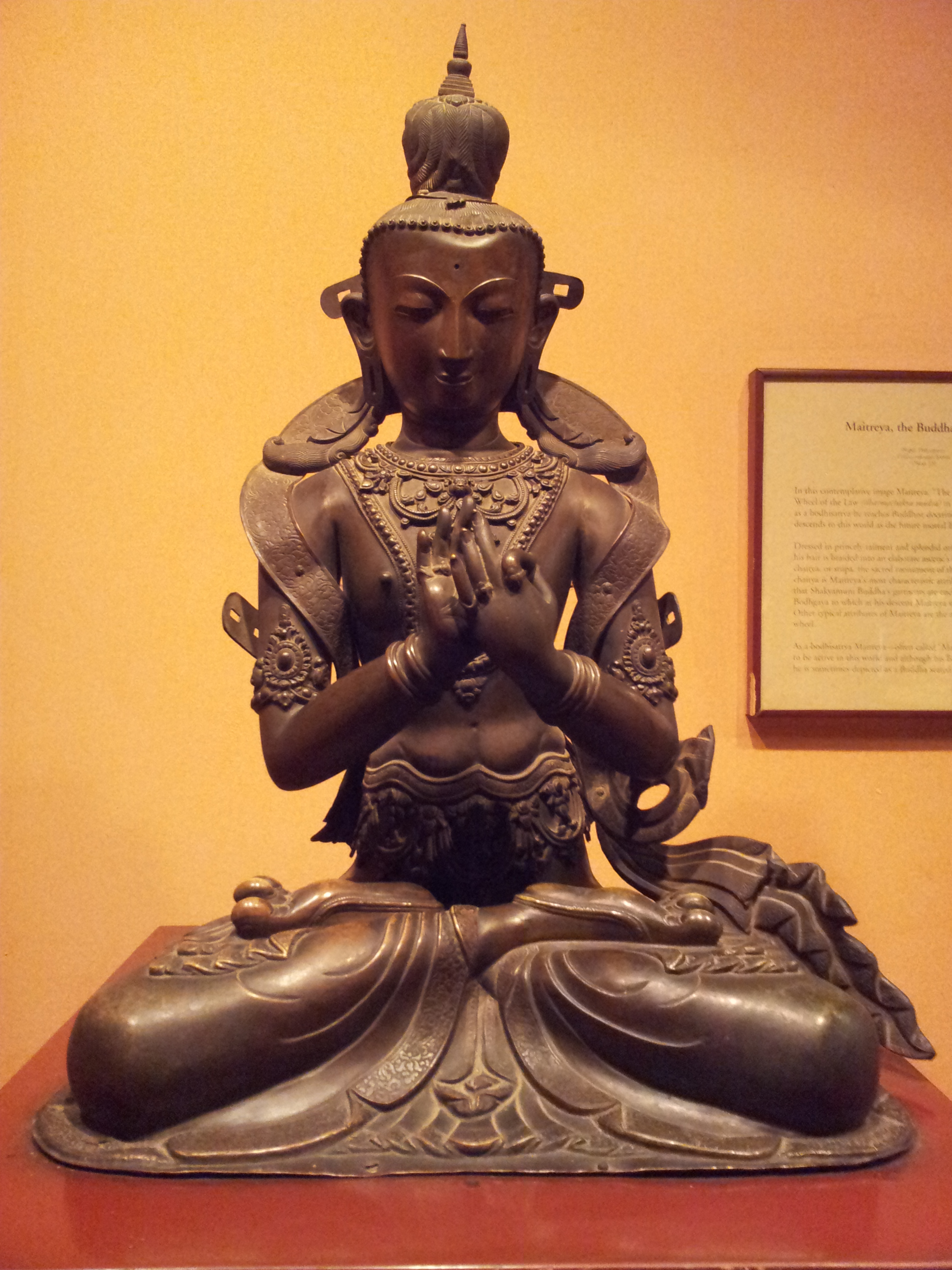
Maitreya came to his people,
and his people comprehendeth him not

According to the Shingon school of Esoteric Buddhism, the Buddha of the future will appear in 
5.6 billion years and save all sentient beings by taking them to the Pure Land Paradise. 

Can we really afford waiting that long for real change we can believe in?

Especially since the Earth will be swallowed by the Sun in just 4 billion years. The prospect of having to be suspended in inter-planetary space in the form of a gas cloud chased by Lovecraftian Wyrms for 1.6 billion years doesn´t really appeal to me.

Can Christ Jesus please come back in 2030 instead? 

Thursday, September 19, 2019

Finally some good news


In 4 billion years, the sun will swallow the Earth and then collapse. Which I suppose is bad news. However, I´ve been reliably informed that the Maitreya Buddha will appear in 5.6 billion years and save all sentient beings by taking them to the Pure Land Paradise in the West. Which, if you chose to believe it, sounds like good news.

I´m a believer.

Of course, it also means that humanity and other Buddha-forsaken monads have been given 5.6 billion years to sort out their acts.

If *that* is good or bad news, I honestly don´t know…

;-)

Saturday, July 27, 2019

Pilgrimage to pantheism


“Pilgrimage to Koyasan” is a slow-paced (some would say boring) documentary about Koyasan in Japan, a temple complex recognized as a UNESCO World Heritage site. Koyasan was originally founded by the Buddhist monk Kukai (Kobo-Daishi) during the 9th century. Kobo-Daishi was the creator of Shingon, the most esoteric of the Japanese Buddhist sects (also known as Orthodox Esoteric Buddhism and originally a Vajrayana lineage introduced to China by Indian monks). 

The documentary shows most of the important sites at Koyasan, with the exception of Kobo-Daishi´s mausoleum, where taking photos is prohibited. Pilgrims, monks and causal visitors fill the area. Inside the temples, there are statues of Vairocana (the “god” of Shingon) and other cosmic buddhas, and also of Hindu-looking wrathful deities. 

It´s obvious from the description that Shingon has strong similarities to Advaita Vedanta, since the goal is to realize that “the Buddha” is really in your mind (i.e. it´s the Atman), and that the mind of the Buddha, you and all sentient beings is the same. This is connected to the belief in the Dharmakaya, the cosmic body of the Buddha, similar to the Brahman in Hinduism. Vairocana is purely symbolic in nature, since in this system, everything is divine, and the divine is ultimately impersonal. 

Thus, we are dealing with another form of Eastern pantheism. Some people find it profound. I just find it depressing, a kind of worship of the fallen world as “God”. Why the instinctive religion of mankind has to be “esoteric” is beyond me. Perhaps the meditation techniques are too dangerous to ordinary monads?

Friday, August 3, 2018

Lost in the world of Buddhism


"The World of Buddhism", edited by Heinz Brechert and Richard Gombrich, is an excellent scholarly anthology. It deals with the teachings, historical development and contemporary practice of Buddhism, the first world religion. The book is primarily intended for students of comparative religion. With some effort, it could also be read by the general reader.

The book says relatively little about the original teachings of the Buddha (only one chapter) and almost nothing about Buddhist philosophy. Instead, the emphasis is on the history and current practice of Buddhism. There are extensive chapters on Nepal, Sri Lanka, Burma, Thailand and Japan. It turns out that Buddhism has changed in often bewildering ways, which makes you wonder how much of the original teaching really remains. Thus, Buddhist monks in many nations are involved in social work or political activism, something prohibited by the monastic rules. In some nations, certain forms of Buddhism have become laicized. Virtually everywhere, Buddhism has been combined with other religions, including Hinduism, Shintoism or local spirit cults. Tibetan Buddhism in particular is very different from the original form. Yet, Tibetan Buddhism is easily the most well known form of Buddhism in the West!

The book ends with a relatively short chapter on Buddhist modernism and the spread of Buddhism in the United States and Western Europe. Apparently, neither Alan Watts nor Herman Hesse were Buddhist enough for the authors, who express strong disagreement with the first and don't even mention the second. (Isn't Alan the man anymore?) Yet, Watts, Hesse and perhaps Winnie the Pooh are probably the closest thing most Westerners have come to Buddhism, save the Tibetan Book of the Dead. A more comprehensive chapter on "really existing" Western Buddhism (warts and all) would have been better. Interestingly, the book doesn't criticize D.T. Suzuki.

Still, I recommend "The World of Buddhism" to everyone seriously interested in this religion and its practices. Without this book, you would probably feel lost in this strange and wonderful world!