Showing posts with label Thailand. Show all posts

Tuesday, July 7, 2026

Specter or spoiler?


What everyone wants to know is this: will Restore stand against Nigel Farage in the upcoming by-election in Whatever-whatever-upon-Supermere-whatever (OK, so it´s Clacton-on-Sea)? They failed to act as an anti-Reform spoiler in (checking my notes) Makerfield, much to my disappointment, but perhaps the far right outfit can do so this time? 

It would be great fun if they managed to stop the reelection of *Nigel Freakin´ Farage*, LOL. But knowing him, he´ll probably be back in the next general election anyway. Drama, drama!  

Tuesday, June 23, 2026

"There is no hell in Buddhism"


That´s where you´re wrong, kiddo. Seriously, though, this is a YouTube video narrated by a scholar of religion, dealing with the Buddhist hell-realms. Also note the discussion on Orientalism.

Wednesday, April 15, 2026

The Golden Child


"The Creator" is a 2023 science fiction movie. It comes across as a peculiar hybrid between "Blade Runner", "Star Wars" and the US war in Vietnam. The first portion of the film is interesting. In the second half, the Vietnam War analogies and Buddhist savior-complex becomes downright cringey. 

The story begins with a technological breakthrough: humanoid robots with Artificial Intelligence. Something goes wrong and the robots detonate a nuclear bomb that wipes out Los Angeles. The United States promptly stops all AI development, but a competing nation known as New Asia refuses. The American military builds a space station called NOMAD to wipe out the Asiatic robots (and all human Asians who stand in the way). This may be an allegory for the fact that China is supposedly a world leader in AI technology. But as already noted, the similarity with the US intervention in Vietnam 1965-73 are also obvious. New Asia is clearly located in Indochina. 

The main characters have religiously inspired names: Joshua (compare Joshua or Jesus in the Bible), Maya (compare Buddha´s mother) and the robot "Alpha and Omega" (compare God or Jesus). A mysterious character is named Nirmata, apparently the Nepalese word for creator - according to ChatGPT, the term has no metaphysical connotations, but in the context of this film, it presumably does. New Asia turns out to be a strange place in which humans and robots live in peaceful harmony with each other, both apparently being Buddhists (or something like it). It´s clear that the robots are a stand-in for the Other, the excluded, the marginalized, and their armed rebel movements. The good guys are almost all colored, while the bad guys seem to be exclusively White (including a White female). Naturally, it turns out that the nuclear blast which destroyed LA might not have been the work of the AI, after all. 

"Alpha and Omega" (nicknamed Alphie) is a child, but also a Messiah-like savior with paranormal powers. She can control all technology and hence might wipe out NOMAD, which explains why the Americans want to kill/de-activate her. Note again that Alphie´s "mother" or creator is named Maya, suggesting that the child might be the Buddha. Note also that Alphie is artifically engineered by Maya, perhaps a reference to a virgin birth. It further struck me that there could be a weird parallel to the Biblical story of Joshua and the harlot Rahab, since the character Joshua in the film is tasked with infiltrating New Asia before NOMAD (= the nomadic Israelites?) wipes them out (like Jericho?). Note that he meets "Rahab"/Maya in an apparent strip club!

OK, so I´m a nerd...

Despite all the above, "The Creator" nevertheless feels like a self-parodic low budget production. Perhaps because the left-liberal message is too obvious. These days, films apparently *must* be like explicit pamphlets, otherwise the Woke autists don´t get it. Or something. Well, at least the religious allegories were *somewhat* hidden. One intriguing feature of "The Creator" is that the White Evil Empire isn´t really evil. The atomic explosion in California seems to have been an accident, rather than the result of a conspiracy. Thus, the US are misguided rather than actively malevolent. The worldview of the film turns out to be a form of milktoast liberalism in which everyone might at least potentially get along, rather than the hardline Marxism you expect from a "pro-Viet Cong" allegory. It´s all so "unproblematic".

OK, so I didn´t like this production. Or did I simply misunderstand its intended demographic? *Is* it a film for very young middle schoolers? Or for 24-year olds who think like 14-year olds?     

Not sure how many stars to give "The Creator". Perhaps two-and-a-half out of five. 

Tuesday, February 24, 2026

White Boy Summer...again


An interesting video on ancient Greek influence on various aspects of Asian art and culture (including martial arts). 

The Greco-Buddhist kingdoms of Bactria and NW India are of course featured, but it turns out that the Hellenic influence survived far longer. Note that the first depictions of the Hindu gods Krishna and Balarama are Greco-Buddhist, and so are the first anthropomorphic depictions of the Buddha. There are even depictions of the Buddha with two dharma-protectors, who on closer inspection turns out to be Alexander the Great and Herakles! 

The content-creator argues that some Asian martial arts might be influenced by ancient Greek Pankration (made famous by the games at Olympia). Thai boxing and Bokator in Cambodia are apparently the main suspects. The video also claims that there are descriptions of fighting techniques in the Hindu epic Mahabharata which resembles Pankration.

Interesting. So here we go again: Ex Occidente lux. Or at least mixed martial arts...   

Wednesday, February 11, 2026

G som i grooming


Credit: DrThneed

Den här gamle skojaren bor i Kambodja numera. Tydligen. Läste delar av SvD:s ursprungliga artikel innan den låstes. Länken är till TH:s blogg. 

Staffan Hildebrands nya liv

Friday, January 2, 2026

Casual anthropology


There is a probably fake (AI-generated) YouTube video featuring a 102-year old Buddhist monk in Thailand who supposedly cried out to Jesus (in perfect English) on his deathbed, recovered and now assures everyone (in even more perfect and almost poetic English) that the video wasn´t a hoax. The monk is supposedly a former farmer who lived in the jungle with elephants most of his life! Sure wonder where he picked up those marvelous English-language skills? 

That being said, the claim that the old monk had "worshipped elephants" (surely not a normative Buddhist habit) led me down an unexpected anthropological rabbit hole. I´ll let Gemini AI explain... 

Are elephant-trainers in Thailand called mahouts?

Yes, elephant trainers in Thailand are widely known as mahouts in English. However, if you were speaking Thai, you would use the local term Kwan-chaang (ควาญช้าง).

While "mahout" is the international standard, the Thai word provides a bit more insight into the role itself.

The Thai Term: Kwan-chaang

  • Kwan (ควาญ): Means "handler" or "driver."

  • Chaang (ช้าง): The Thai word for "elephant."

Together, a Kwan-chaang is literally an "elephant handler." While the English word "mahout" actually originates from the Hindi word mahavat, it has been adopted so thoroughly in global tourism that even Thai guides and sanctuaries will use "mahout" when speaking with international visitors.


Key Cultural Aspects

The role of a mahout in Thailand is much deeper than a simple "trainer" or "job."

  • A Lifelong Bond: Traditionally, a mahout is assigned a young elephant when both are still very young. They grow up together, and the mahout often stays with that same elephant for their entire life.

  • Ethnic Heritage: Many of Thailand's most famous mahouts come from specific ethnic groups with centuries of elephant-handling history, particularly the Kui (or Kuy) people in the Surin province and the Karen people in the northern mountains.

  • The Tool of the Trade: You may see them carrying a tool called an ankus (or "bullhook"). While controversial in some modern contexts, in traditional mahout culture, it is viewed as a guide and a safety tool, used to apply pressure to specific sensitive points behind the elephant’s ear.

Modern Context

Today, the role is changing. In the past, mahouts worked primarily in logging (dragging heavy teak wood) or warfare. Since logging was banned in Thailand in 1989, many mahouts moved into the tourism industry. In high-quality ethical sanctuaries, the mahout’s role has shifted from a "driver" to a "caregiver" who ensures the elephant's health and safety.

Would you like to know more about where to see elephants ethically in Thailand, or perhaps more about Thai animal symbolism?

Are mahouts in Thailand Buddhists or Christians?

The answer is both, but it depends heavily on their ethnic background and which part of Thailand they come from.

While Thailand is a predominantly Buddhist country, the mahout community is actually a mix of Buddhists, Christians, and Animists (spirit-worshippers). To understand why, you have to look at the two main ethnic groups that traditionally work with elephants:

1. The Kui (or Guay) People: Primarily Buddhist & Animist

The Kui are the legendary "elephant people" of Northeast Thailand (specifically the Surin province).1

  • Religion: Most Kui identify as Theravada Buddhists. However, their daily work with elephants is governed by a ancient Animism.

  • The Spirit of the Rope: They believe in Phra Khru Pakam, the spirit of the elephant-catching rope.2 Before any major event or when training a young elephant, they perform rituals and make offerings to the spirits of their ancestors and the forest. For a Kui mahout, Buddhism and spirit-worship coexist seamlessly.3

2. The Karen People: Buddhist & Christian

The Karen (or Karian) live in the mountainous regions of Northern Thailand (near Chiang Mai and Mae Hong Son).4

  • Diversity: Among the Karen, religious identity is split.5 About 65-70% are Buddhist, but a significant 30% are Christian (mostly Baptist or Catholic).6

  • Christian Mahouts: Because many elephant sanctuaries and trekking camps are located in Karen territory, you will meet many mahouts who are devout Christians. They often attend church on Sundays and might have Christian crosses or icons in their homes, even while following traditional elephant-care practices passed down through generations.


The Common Thread: Animism

Regardless of whether a mahout goes to a temple (Buddhist) or a church (Christian), almost all traditional mahouts share a foundation of Animism.

They believe that elephants have a "Kwan" (a soul or life force) and that the forest is inhabited by guardian spirits. Even a Christian or Buddhist mahout will usually:

  • Perform a "blessing" ceremony for a new elephant.

  • Avoid certain behaviors that might "offend" the spirit of the elephant.7

  • Treat the elephant as a sentient being with a spiritual status higher than other livestock.

Summary Table

Ethnic GroupPrimary RegionDominant Religions
Kui (Guay)Northeast (Surin)Buddhism & Animism
KarenNorth (Chiang Mai)Buddhism & Christianity

Would you like to know more about the specific rituals mahouts perform to "bless" an elephant, or perhaps about the history of Christian missionaries in the Thai mountains?

Tuesday, May 6, 2025

Buddha blasphemy


There is a YouTube video called "Rude Buddha" or something to that effect. The commentary section is full of supposed Buddhists who claim that "real" Buddhists shouldn´t be insulted by the skits in the video, that "real" Buddhists actually think they´re funny, and so on.

Oh, really.

So I asked ChatGPT about blasphemy laws in Thailand, Sri Lanka and Bhutan (three Buddhist nations which are also popular tourist destinations). Guess what, guys...

It seems *really existing Buddhists* aren´t particularly keen on their prophet being mocked. But sure, if you are a stoned hippie in California, I suppose you might think insulting the Enlightened One is all good and well!

Are there Buddhist blasphemy laws in nations like Thailand, Sri Lanka or Bhutan? Can you criticize Buddhism, or insult the Buddha without facing criminal conviction?

Yes, several predominantly Buddhist countries—including Thailand, Sri Lanka, and Bhutan—have laws or legal practices that restrict speech perceived as offensive to Buddhism, particularly when it is seen as insulting the Buddha, Buddhist institutions, or religious sentiments. These are not always framed as "blasphemy laws" in the way they are in some Islamic nations, but they often function similarly in practice.

Here’s a breakdown by country:


Thailand

  • Legal Basis: Section 206 of the Thai Criminal Code criminalizes defamation or insult of religion.

  • Details: Anyone who "defames, insults or threatens" Buddhism (or any religion recognized by the state) can be punished with up to seven years in prison.

  • Recent Examples:

    • Foreigners and locals have been prosecuted or deported for social media posts or artwork deemed disrespectful to the Buddha.

    • Wearing clothing with Buddha images or tattoos of the Buddha—especially in inappropriate body areas—has led to arrest or deportation.


Sri Lanka

  • Legal Basis: Several laws, including the Penal Code (Section 291A and 291B), criminalize deliberate acts intended to insult religious beliefs.

  • Details: These laws apply broadly to all religions but are often used in defense of Buddhism.

  • Recent Examples:

    • In 2014, a British woman was arrested and deported for having a Buddha tattoo.

    • In 2020, a Sri Lankan writer and teacher was charged for allegedly defaming Buddhism in an article that criticized religious extremism.


Bhutan

  • Legal Status: Bhutan does not have overt blasphemy laws, but the constitution protects Buddhism as the spiritual heritage of the country.

  • Details: Freedom of speech is guaranteed, but it is limited by considerations of public order and respect for religion.

  • Cultural Practice: Criticism or satire of Buddhism or the monarch (who holds a semi-sacred position) is culturally taboo and can invite social or legal consequences, even if not codified as explicit blasphemy laws.


Summary

While these countries do not always use the term "blasphemy," insulting Buddhism or the Buddha can lead to legal action, including fines, imprisonment, deportation, or social persecution. Laws are often vaguely worded, giving authorities wide discretion in what is considered "insulting."

Would you like a comparison with blasphemy laws in other religious-majority countries? 

Saturday, February 22, 2025

The scam of slavery


It seems a new form of trafficking and slavery has developed in Southeast Asia. Hundreds of thousands of people from all over the world are virtually imprisoned in "scam centers" in Myanmar, Laos and Cambodia. Tricked by promises of good office jobs, they are forced to work with various Internet and phone scams. The centers are often controlled by Chinese crime gangs.

However, it seems that both China and Thailand have decided to move against the gangs after a high profile abduction of a Chinese actor (!) in Thailand (he was trafficked to Myanmar) and Thai fears that Chinese tourists might avoid their country unless something is done stat. The Chinese government is of course entirely hypocritical, due to the slave-like conditions in China´s seafood industry, not to mention Tibet and Xinjiang. I suppose the crime syndicates messed with the wrong officials.

The Myanmar military is apparently also sick and tired of the scam centers at their side of the porous Thailand-Myanmar border, since they have decided to aid the Thai efforts to clean up the place. So I suppose you could say that this story has a "happy ending" of sorts...for now. Something tells me the scamming will continue elsewhere. 

Speaking of which...

The YouTube clip above tells a somewhat bizarre story connected to the scam center issue, this time from Cambodia. An attention-seeking influencer from Taiwan staged an incident in Cambodia, claiming to have been kidnapped and tortured by a gang operating a center. The Cambodian authorities weren´t amused and sentenced both him and an accomplice to a long prison sentence. Even the Prime Minister of Cambodia Hun Manet condemned the hoax. One thing the YouTube clip doesn´t tell us is whether or not the Cambodian police also took action against the scam centers...

Slavery never really went away, did it?  

Tens of thousands could be held in illegal scam compounds

Thousands rescued from illegal scam compounds

Sunday, December 29, 2024

En tragisk olycka


Aftonbladets språkbehandling är...tragisk. Deras rubrik betyder alltså "Vi gjorde så att planet kraschade, men tyvärr överlevde två personer". 

Båda artikelförfattarna är svenskar, och AB har rimligtvis tillgång till AI. Eller?

Kulturbarn från Waldorf-skolan?

Wednesday, December 18, 2024

Coping


Many of the Buddha´s teachings have been lost forever. Note the reactions in the commentary section! "You never explained what was lost". Eh, cuz it´s lost, bro. "What is left is sufficient". Eh, how do you know, since many teachings *and meditation techniques* were lost? My favorite: "Nothing was lost, we have the Pali Canon". While the comments aren´t as acerbic as when Christians and atheists fight it out (maybe meditation has *some* beneficial aspects), the whole thing still sounds like a cope. 

Said with the reservation that I don´t know what this YouTube channel really stands for. Maybe in other videos *they* claim to have access to the lost teachings...

Which, I suppose, would also be a coping mechanism of sorts. 

Tuesday, November 19, 2024

Buddhists and aliens


A fascinating article from 2019 about Buddhist space aliens seeking contact in a small town in Thailand, about a three hour journey from Bangkok. Note that the new religious group worshipping these spiritual entities explicitly refer to them as aliens and their vehicles as UFOs! The space brothers supposedly appear on a hill where there is a Buddha statue and a ditto footprint. 

The whole thing sounds like a combination of traditional Buddhist beliefs, New Age channeling and the American UFO phenomenon. 

The Hindu teacher Sadhguru is also into this kind of syncretism, but I´m not sure if the videos of his visits to Lake Manasarovar in Tibet are still up at YouTube...  

In search of Buddhist aliens in Thailand

Sunday, June 23, 2024

Authentic sayings


“The Authenticity of the Early Buddhist Texts” by Bhikkhu Sujato and Bhikkhu Brahmali is a text available free on the web in PDF format. It´s undated, but seems to have been published in 2013. The two authors are probably supporters of the Buddhist Association of Western Australia, a Theravada group with a mostly White membership. The association in turn is inspired by the “forest tradition” in Thailand, of which I know very little (but I suspect they may be vaguely heterodox). The point of the text is to prove that important portions of the Pali Canon can be traced back to the Buddha himself or his immediate disciples. The question is important, since the earliest preserved manuscripts of Buddhist scriptures have been dated to perhaps 500 years after the Buddha´s death (give or take a few centuries). Even the Buddhists themselves admit that the Buddha´s message must have been transmitted by oral recitation for at least a few centuries. Modern scholars can therefore ask: how do we *know* that the material was transmitted without changes until it was written down hundreds of years later? Indeed, how do we know the scriptures weren´t tampered with, too? Add to this that Buddhists can´t even agree among themselves on when the Buddha lived…

The Pali Canon (a.k.a. the Tripitaka or Tipitaka) is divided into three sections: Vinaya Pitaka, Sutta Pitaka and Abhidhamma Pitaka. Sujato and Brahmali argues that there is a good scholarly case for most of the Sutta Pitaka being spoken by the Buddha or his closest associates. Most of the Vinaya Pitaka and all of the Abhidhamma, by contrast, is later. So are Buddha biographies, historical chronicles and the Mahayana sutras. The jataka tales are somewhat anomalous, for while some of them might even predate the Buddha, their Buddhist forms are late. The authors refer to the texts containing the spoken message of the Buddha as “Early Buddhist Texts” or EBTs. All others are non-EBTs. The theological implications of the EBT/non-EBT distinction are never spelled out in the essay, but I assume there must be one. Note that the distinction privileges one “basket” of the Pali Canon (the Suttas or discourses) from the two other “baskets” (the monastic code and the theological treatises). Note also that the Buddha´s biography and the jataka tales about the Buddha´s previous lives aren´t part of the EBTs in this scenario. Are they less reliable, non-canonical, or what? I suppose a deep dive into the worldview of the Buddhist Association of Western Australia might be in order here.

That being said, I admit that the essay is relatively well written and sounds convincing enough. For instance, the authors point out that the EBTs describe a political situation that must predate the Magadha kingdom of the Nanda dynasty (which unified the middle Ganges plain) and the even later Mauryan empire (which united most of India). There are 16 smaller warring states, and most of the world outside their territories is poorly known or unknown. Magadha is depicted as fairly important and expansionist, but the united kingdom is still in the future. The royal and imperial capital of Pataliputra is described as an obscure village. Chandragupta Maurya and Ashoka are never mentioned in the EBTs, despite being extremely important figures in Indian history, the latter also in Buddhist ditto. This would have been impossible had the material in the EBTs been changed during their respective reigns.

Another clue is the language used. The authors believe that the Pali Canon was first committed to writing in Sri Lanka. Yet, the EBTs contain no legends about the Buddha visiting the island (an important part of Singhalese self-identity), nor is the Pali used in the texts influenced by Singhalese or the Dravidian languages. Other Pali texts composed in Sri Lanka apparently are so influenced, suggesting that the “purist” Pali of the oral tradition must be older. The fact that the EBTs never reference non-EBTs, while the opposite happens frequently, also suggests that the EBT material is older. The authors also use the “criterion of embarrassment”. The EBTs depict the Buddha and his monks as very human, even including some foibles, while later generations rather elevated them to a more superhuman/supernatural status. That the “human” stories weren´t revised to suit later understandings suggest that they must be early (it also implies a very exact and conservative mode of oral transmission). A more piquant difference between EBTs and non-EBTs is that the former never mention the art of writing! They must therefore have their origins in an oral culture.

Archeological evidence is harder to use, since there is relatively little of it from the Buddha´s own time. Most of the early evidence for Buddhism comes from the time of Ashoka, several centuries after the Buddha. Still, it does seem to confirm that the material in both the EBTs and some of the non-EBTs must have existed during that time. To take just one example, the EBTs mention five earlier Buddhas who supposedly appeared before Prince Siddharta Gautama. Non-EBTs expand on their number. An inscription from a stupa from the Mauryan period only mentions the legendary Buddhas from the EBTs. Sometimes the authors are a bit overenthusiastic. I mean, how do they know for sure that the relics discovered at Piprahwa in northern India (one of two sites identified with the ancient Kapilavastu) really are from the historical Buddha? Just because some inscription says so? Dude!

The essay ends with some chastising words to those scholars who are skeptical about all or most of the above, whom the authors dub “denialists”. They somewhat uncharitably compare them to climate change deniers and creationists. The authors also believe that these scholars are experts on later Buddhism (including Mahayana and Vajrayana), rather than on the earlier material. Since later Buddhism is obviously based on well-crafted myths, these scholars presumably tend towards skepticism about the “EBTs”, as well. Not sure if the denialists ever bothered responding to the dear monks…

With that, I end this review.


Tuesday, October 3, 2023

More than three jewels


An interesting clip on the quest for the historical Buddha, his relics and (perhaps) some really precious gemstones...

It seems some people could afford more than the Three Jewels! 

From Doug´s Dharma, a YouTube channel promoting "secular Buddhism". 

Wednesday, August 2, 2023

Lost in the immensity


A little report from the trenches. I haven´t found my ishta-devata yet. So I´ve been reading about Martinism (all three versions) and now I´m preparing to devour a book about the Ismailites. I´m also trying to re-read Valentin Tomberg´s "Lazarus, Come Forth". Wish me luck, guys. And no, I haven´t asked Ganapati yet, I prefer to eat my sweets myself, thank you! 

Saturday, February 4, 2023

Until Naraka freezes over


Supposedly gentle and compassionate Buddhism (insert story of cute kittens saved by some buddha here) is actually the religion with the worst and most elaborate hell-realms?!

That being said, there are still some mitigating circumstances. For instance, Buddhist hell is temporary, you can be saved from it (kind of), and one bodhisattva even goes to hell voluntarily to ease the sufferings of its denizens! 

Still sounds like a better deal than certain "Abrahamic" religions, yes?

Unless you end up in Avici, that is, not mentioned in this clip. According to all-knowing Wiki, the time spent in Avici is 3.4 quintillion years. You can´t say you haven´t been warned, buddha-killer!


Sunday, December 26, 2021

Gorillas against guerillas

Credit: virunga.org

"Primates" is a 2020 BBC mini-series about apes, monkeys and prosimians. Some humans (mostly primatologists) have been thrown in for good measure, too! Most of the documentary is standard fare: spectacular footage of non-human primates from all over the world, and calls to save them for posterity. Good for a boring Christmas holiday, but perhaps not *that* interesting...

However, I did notice a few things. 

In the Congolese hills, the Virunga National Park - with a rare population of mountain gorillas - is protected by "park rangers", actually a heavily armed uniformed militia. The park rangers have been repeatedly attacked by rebel groups operating in the region. But why would humans volunteer to protect gorillas against guerillas, risking their lives in the process? The BBC interviews a ranger who claims to have a spiritual bond with the gorillas. Maybe he has. 

However, there is a much more mundane explanation. The rangers are recruited from the local population and paid by international organizations. Eco-tourism from Western nations is another source of income. Also, the local communities get a share of the profits. Nothing wrong with that, per se, but it *does* mean that the rangers have a very vested *human* (Homo sapiens sapiens) interest in protecting the gorillas. They are simply protecting their own sources of income. Since the rebels are presumably Hutu expats or expellees from Rwanda, some kind of ethnic dimension can´t be ruled out either. The people in the Virunga area are literally defending their homeland against foreign intruders. See how I managed to de-romanticize the whole situation? When the Western money stops coming, the mountain gorillas are bush meat, if you ask me...

Another uncomfortable fact. As I have repeatedly pointed out on this blog, even Native peoples deplete their resource bases if given half the chance. Research carried out at Koram Island off the coast of Thailand shows that monkeys, specifically crab-eating macaques, do exactly the same thing! The monkeys are tool-users: they use heavy stones to crack open oysters. The tool-use leads to over-exploitation of the oysters, which tend to become smaller and less abundant as a result. Imagine what would happen if some primate started to use tools consistently...wait... 

Edenic ecological balance doesn´t even exist among tool-using freakin´ *animals*, it seems. 

"Primates" does contain other interesting information, to be sure. We get to meet a team of animal rescuers trying to "retrain" young orphaned orangutans for a life in the wild (the orphans are used to human "foster parents" and have therefore lost these skills). As part of their project, the human trainers have to take climbing lessons in really tall trees! Another team tries to reintroduce pet gibbons into the wild. Gibbons are popular as exotic pets, but many of them are snatched from the wild and essentially trafficked as part of the illegal animal trade. The gibbons shown in the docu are rescued and taken back to their original habitat. 

So perhaps there is some hope, after all. However, I have to say that what really caught my attention was the somewhat more pessimistic facts, some of which BBC doesn´t really want the viewers to confront...  


Monday, December 6, 2021

Några klassiska hübinetter

Credit: Naturpuur


Hübinette är tillbaka i högform igen, och slår faktiskt mot både högern och vänstern (respektive) i de artiklar jag länkar till nedan.

Ett citat från artikeln om adoptioner: 

>>>Likt de flesta andra som ingick i den svenska adoptionsrörelsen sådan den växte fram i anslutning till den s k 68-revolutionen tillhörde Sterky de s k övre skikten och bodde bl a i en stor s k våning på Östermalm i Stockholm, d v s det var i mycket hög grad vänsterinriktade överklasskvinnor som utgjorde hela det gigantiska svenska adoptionsprojektets s k ”urmödrar”. 

>>>Att vara högutbildad och förmögen och bo stort och bra på s k ”fina” adresser och att få och ha ett bra materiellt liv och i övrigt leva ett s k rikt liv är naturligtvis inte fel i sig men det sticker i ögonen när den typen av personer – d v s de s k socialgrupp ett:arna – samtidigt livnär sig på den utomvästerländska världens allra fattigaste och mest utsatta människor, stjäl deras barn och gör pengar på dem. 

Högerextrema hovpredikanter 

Ansvarig för korrumperad adoptionsverksamhet har gått bort

Tuesday, May 25, 2021

The Inner School of the Elders


"Esoteric Theravada: The Story of the Forgotten Meditation Tradition of Southeast Asia" is a book by Kate Crosby published last year. I haven´t read literally all of it (it *is* very "esoteric"), but will post a review anyway (it´s my blog, after all). Despite being a scholarly work, it´s published by Shambhala, an independent pro-Buddhist publisher based in Boulder, Colorado. 

Judging by several other works I´ve read, the almost exclusive emphasis on Vipassana meditation (which modern Mindfulness is based on) is a new phenomenon within Theravada, not older than the 19th century, when various modernization processes conspired to "resurrect" (or perhaps create wholly de novo) this kind of meditation technique. Before the 19th century, few, if any, Buddhists meditated at all, Theravada practice being about "merit-creating" and pseudo-magical rituals. While this scenario isn´t "wrong", Kate Crosby shows that the actual picture is more complex - and even more interesting. 

It turns out that alongside the official Theravada, there *was* a tradition of advanced meditation, which Crosby calls "boran kammatthana". This was an esoteric practice of unknown date which played a prominent part in certain monastic circles prior to the 19th and 20th centuries, usually communicated by word of mouth from master to disciple. It even played a role in a major Buddhist revival in Ceylon during the 18th century. There are similarities between boran kammatthana, Tibetan dream yoga, other Tantric practices, alchemy and Ayurvedic medicine. For some reason, Crosby doesn´t discuss possible similarities with esoteric Taoism. The usual suspicion is that the esoteric tradition within Theravada really is Tantrism, and since such influences were anathema to the 19th century modernizers, this simply became another argument to ignore or suppress it. Crosby, by contrast, believes that boran kammatthana is really inspired by Ayurveda, and that it´s so closely aligned to Theravada philosophy that an "alien" Tantric intrusion is unlikely. In other words, the secret tradition is in some sense legit. (Personally, I don´t see the contradiction.) 

The most interesting section of the book tries to describe the actual practices associated with this old school form of meditation. The practitioner does experience various paranormal or supernatural phenomena: encounters with the spirits of the deceased, visions of other realms of reality, seeing spheres of light sometimes accompanied by luminous letters in ancient Khmer script, etc. Physical objects may be visible even when the meditator closes his eyes, or may appear in strange and unfamiliar shapes. Abstract themes for meditation may "appear" as quasi-physical objects, such as a sun´s disk or radiant gems. The practitioner is supposed to absorb the luminous orbs through his nostrils and place them inside his body, at the locations of various chakras or energy centers. This will eventually transform the physical body of the meditator into that of a Buddha! The relationship between this (apparently literal) transformation and the ultimate goal of nibbana (nirvana) is not spelled out in the esoteric scriptures, but presumably a person who dies while in this transmogrified state will immidiately attain liberation. (Does this mean that the Buddha-body is mortal? Or does the person choose to die? Not clear!) 

Some additional techniques described in the book take numerology and peculiar written code words as their point of departure. There are affinities between boran kammatthana and alchemy (yes, it works with quicksilver and sulphur in Southeast Asia, too), magical tattoos, traditional medicine, and "forest monks" living at the outskirts of Theravadin civilization. At the same time, the esotericism was also surprisingly intellectually sophisticated. A close reading of Theravada Buddhist philosophy suggested that the "atoms" of samsaric existence are simultaneously both material and spiritual. (Compare Whitehead´s process philosophy!) But if so, spiritual mutations should lead to changes in the physical. Therefore, it´s entirely in keeping with Buddhist understanding that a spiritual technique such as meditation can transform a physical body. Presumably, it´s also logical to assume that a certain kind of body can make it easier to attain a "spiritual" state such as nibbana.  

When Theravada modernized itself during the 19th and early 20th centuries, the esoteric practices were gradually squeezed out. One way of doing so was to ban traditional medicine in favor of the modern, Western version. The sangha (monastic order) was taken over by modernists and controlled by the modernizing state. This was the course taken in Siam (Thailand). The esoteric tradition there had already been weakened during the 18th century when the Burmese invaded and devasted Siam, including the then capital of Ayutthaya. In Cambodia, the French colonial power supported the modernist faction within the sangha. The Cold War was another crushing blow. In Cambodia and Laos, Communist regimes (most notoriously the Khmer Rouge in Cambodia) decimated the sangha and Buddhism in general. In pro-Western Thailand, millions of people were relocated from the border regions, where the Thai government feared Communist infiltration. Traditional forms of Buddhism had survived longer in these areas than in others. However, it seems boran kammatthana isn´t completely dead. A few monasteries in Thailand still teach the practice, and the controversial Dhammakaya new religious movement has adopted a modified version of it. Somewhat ironically, it seems that the latest phase of modernization, with its emphasis on individual choices in religion, might favor the ancient esotericism...

There seems to be more to explore here. This is the *inner* school of the elders. 


Wednesday, September 19, 2018

Saigon has fallen


This is a somewhat peculiar field guide, first published in 1975 and regularly reprinted since. “My” copy is from 1995. Since it’s a reprint of the original edition, Ho Chi Minh City is still called Saigon, while Myanmar is still Burma. The guide covers Myanmar, the Malaya peninsula, Thailand, Cambodia, Vietnam and Laos. Presumably, the book was rushed to the printer shortly after the fall of South Vietnam! Curiously, it also covers Hong Kong (not a part of South-East Asia) and contains checklists of birds found on the islands of Hainan and Taiwan (not part of South-East Asia either). A total of 1198 species are presented.

The book is obviously written by “nerds”, and like true nerds, they have spent considerable time sorting out the English vernacular names for the various birds, and occasionally invented new ones. The four page long explanation as to how this was done is at least good for comic relief: “All compound group names composed only of nouns were hyphenated or joined into a single word…Wherever a group name is used for more than one species, each species in the group is indicated by a different adjective”, et cetera. You grok? The addresses to societies of bird-lovers are also funny. One of them is the Oriental Bird Club…in Bedfordshire! Still, that may be easier to find than Hoi Dieu Hoc Viet-Nam in “Saigon”…

The field guide itself is downright annoying and has all the traits users of field guides love to hate. Texts and illustrations are not on facing pages, the color plates are not found in one single section but interspersed throughout the book in a bewildering fashion, and many plates are in black-and-white! Nor are the birds shown in the same order as in the text, although on this point there is a logical explanation: the authors wanted to group similar-looking species together for easier identification.

I admit that I don't like the layout of this volume, and I will therefore only give it two stars. And I still don't understand why Hainan and Hong Kong are included in a guide to SE Asian Aves…

Tuesday, September 18, 2018

Two, three, many Vietnams


“Maoist Insurgency since Vietnam” is a book about leftist insurgency and government counterinsurgency in Thailand, the Philippines, Sri Lanka and Peru. The author, Thomas A Marks, is a former US intelligence officer. Despite this, his book is written in a deceptively objective style. Sometimes, it sounds as if he's advising the rebels! The book tries to be both empirical and analytical, but I'm not entirely sure if it succeeds in this. Also, the “Maoist” moniker in the title is misleading, since the Tamil insurgents in Sri Lanka (including the “Liberation Tigers” or LTTE) aren't strictly Maoist in ideological orientation. The main problem with the book is that Marks tries to generalize on the basis of four very different examples. The political situations in Thailand and the Philippines have certain similarities, but neither Sri Lanka nor Peru fit the general pattern laid down by the author. Still, I found his study interesting.

One thing that struck me when reading Marks' study was the dogmatic approach of the Maoist groups covered. Very often, they attempted to slavishly copy the Chinese model (“protracted people's war” and “surround the cities from the countryside”) even when other tactics would have been more effective. Ironically, this was *not* Mao's approach – he came up with the “Maoist” model when the Russian model failed in China. The last thing Mao would have wanted (if I may give some advice to the rebels myself) was for foreign revolutionaries to copy the Chinese model in nations where circumstances are very different. This “nationalist” or “exceptionalist” aspect of Maoism seems to have been lost on the Maoists in Thailand, the Philippines and Peru…

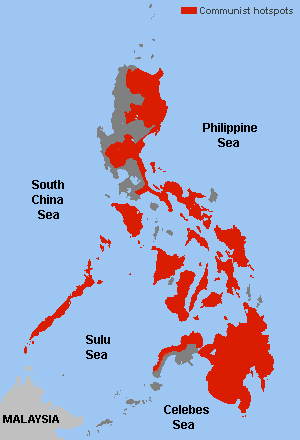
A common mistake was to concentrate on the rural regions even in nations where many people live in cities, including urban congregations in the rural countryside. In the Philippines, the Maoist CPP/NDF/NPA more or less completely missed the urban-centered struggles which brought down the dictatorship of Ferdinand Marcos. Despite being a strong rebel group, the CPP was outflanked by the democratic opposition around Corazon Aquino and the reformist wing of the military. Another strategic mistake was to continue the armed struggle even after democratization. In the Philippines, the CPP guerillas launched a full out offensive against Aquino's democratic government, thereby alienating many potential supporters. It's also obvious from Marks' study that the Maoist rebels frequently terrorized civilians in “liberated” areas. The Peruvian Sendero Luminoso is ill reputed in this regard, but the CPP did pretty much the same thing, including regular blood purges within its own ranks. The Tamil insurgents were the worst, competing rebel groups spending considerable time attacking each other. Due to its nationalist character, the Lankan conflict also involved ethnic cleansing and foreign intervention.

While the Tamil nationalists were at least fighting “on their own turf”, so to speak, the Maoists frequently made things hard for themselves by not being nationalist enough. The Communist Party of Thailand (CPT) was internally split between a pro-Chinese wing and a pro-Vietnamese ditto. This made the party seem like an alien element in Thai society. It also created serious friction within its ranks when Vietnam (backed by the Soviet Union) fell out with China. In 1978-79, Vietnam invaded pro-Chinese Cambodia and Vietnamese troops suddenly reached Thailand's borders. The fact that China's foreign policy had become pro-American created additional trouble for the CPT, since the Thai government they were fighting was also pro-American. Marks further argues that the CPT's attempts to win a mass following were hampered by their verbal attacks on the King, their anti-Buddhism and the fact that many of their leaders were ethnically non-Thai. The CPT eventually bit the bullet and “offered” to form a “united front” with the military regime against the perceived Vietnamese threat. However, this could just as well be seen as an adoption to Chinese foreign policy, rather than a real embrace of Thai patriotism.

The classical response to leftist insurgency is, of course, to repress it with heavy handed methods. More often than not, this simply fans the flames of the resistance. During the Cold War, the American approach was apparently to combine military counterinsurgency with attempts to win people's “hearts and minds” by social reform programs aimed at the village poor. Thus, aid workers protected by the military would dig wells, build roads or open up schools. Another important element was to recruit local villagers to anti-Communist militias armed by the government. This strategy didn't work very well either. To Marks, it has to be combined with democratization and actual economic growth, something the local elites (and US allies) were unwilling or unable to provide. The author argues that it was democratization which broke the back of the Filipino and Thai Maoist insurgencies. In Thailand, the policies of the democratic government also led to economic growth. The ranks of the pro-government militias swelled, and the Maoists were suddenly confronted with a kind of “reverse people's war”: the people were armed, but united against them! Most Maoist recruits were “grievance guerillas”, and with alternative outlets for their grievances, people's war became less attractive. Ordinary peasants, attacked by both unruly security forces and Maoist insurgents, were less willing to put up with the latter if the former disappeared due to political reforms. Instead, they joined the militias to protect their villages from Maoist terror.

Marks' analysis sounds convincing when applied to Thailand and the Philippines, but when he proposes something similar for Sri Lanka, he falls short. The civil war in Sri Lanka was a fierce nationalist conflict between the Sinhalese and the Tamil, and therefore cannot be solved by democratization (Sri Lanka is already a democracy), nor by social reforms (since the poor are split along ethnic lines, they will continue fighting each other over the spoils of the reforms). Theoretically, the conflict could of course be solved by granting the Tamils national independence or autonomy, but since that is precisely what the Sinhala perceive as a threat to their Buddhist holy land, it's not very likely to happen either. Indeed, it hasn't – since the book was written, the Sinhala-dominated Lankan government have solved the conflict by brutally suppressing the Tamil LTTE. The conflict in Sri Lanka has strong resemblances with the Israeli-Palestine ditto, which is notoriously intractable. It's also weirdly similar on a symbolic level: the Sinhala, who were supported by Israel, see Sri Lanka as the chosen land of the Buddha threatened by infidels of an alien race (compare Zionism), while the Tamil groups had contacts with the PLO and apparently learned the tactic of suicide bombing from the Middle East!

Peru is host to yet another species of conflict. The notoriously weird and cultish Sendero Luminoso had very little popular support, and managed to become the scourge of the nation mostly because the central government and its military weren't able to control the entire territory of Peru. Indeed, in many areas, the government hardly even had a physical presence, making it easy for Sendero (or local bandits of various kinds, sometimes allied with the Maoists) to fill the vacuum. Note also that the Peruvian governments which failed to suppress the Senderistas were democratic (albeit presiding over a collapsing economy), while the government which *did* suppress the insurgency was authoritarian but not particularly reformist (Alberto Fujimori presumably didn't dig that many wells in Ayacucho).

It would be interesting to read a follow up study. Since the book was published, a Maoist people's war has been waged in Nepal. Here, the author's perspective was vindicated: the insurgency stopped when Nepal became a democratic republic and the Maoists transformed themselves into a legal political party. Meanwhile, another group of Maoist rebels, the famed Naxalites in India, seem to be growing stronger year after year, despite India being a democracy. I know very little about it, but it seems largely based on “scheduled tribes”, so there could be an ethnic dimension involved. Or too few wells dug? Finally, there is Colombia, where non-Maoist leftist guerillas have fought successive governments in Bogota since time immemorial.

Despite my criticism of some parts of this work, I will nevertheless give “Maoist Insurgency since Vietnam” four stars. It contains interesting facts, did clarify some things I didn't know or suspected before, and is probably indispensable reading if the issues covered interest you.