Showing posts with label Rodents. Show all posts

Tuesday, April 7, 2026

Ape-ril


Easter Bunny time! Guess which household pets you are most closely related to? Yepp, rodents and lagomorphs. As in: mice, rats, hamsters and...rabbits. 

I´m actually not that surprised. 

But OK, if you have a gibbon as a pet, I suppose *that* would be your closest mammalian cousin!

Thursday, March 12, 2026

Beaver Patrol


Credit: The Fourth Way 

The late Winston Churchill is apparently too divisive and controversial, so the Bank of England (sic) will replace his portrait on the five pound note with a beaver. Not sure who would find Churchill controversial in 2026. Neo-Nazis??? 

The trick (of course) won´t work. You can never be Woke enough, and "beaver" is apparently a rather crude sexual/sexist innuendo. Yes, I checked. So the beaver will have to go, too.

Besides, have anyone checked whether the beaver is a "clean" animal, and if so, in which religious communities? Exactly. And aren´t we excluding non-Eurasians by having a *Eurasian* beaver on the five pound bill? Well, at least the next year or so will be entertaining. Until Nigel Farage becomes Prime Minister and puts his Lord & Master Trump on those darn bills. 

Now, *that* might prove a tad bit controversial, methinx!   

Tuesday, February 3, 2026

Singular


Five animals only seen once. OK, quite interesting! Note the implication for cryptozoology: if even species that are extremely rare can become known to science, why can´t we find cryptids which supposedly live in our very backyards? Cuz they´re not real, obviously. 

Unless they´re fairies. As per usual! 

Thursday, January 29, 2026

Amen


This is how a "regular" Christian (or Preterist, for that matter) reacts to Israel Only Full Preterism (see previous blog post). You preach it, boy!

Thursday, January 1, 2026

Saturday, August 30, 2025

A world full of gods


I haven´t double-checked this, I mean, is it even possible to do so? Hinduism has a bewildering array of various different gods and goddesses. That´s polytheism for you, my friend! 

Who is Karni Mata?

Karṇī Māṭā is a highly revered female deity in Rajasthan, India, often called the “Rat Goddess” because of the famous temple in Deshnoke where thousands of rats live freely. She is considered both a human saint and an incarnation of the Divine Mother (Durgā).


🔶 Historical Background

  • Lived in the 14th–15th century in Rajasthan.

  • Born in Deshnoke, she became famous for her spiritual powers, miracles, and protection of her community.

  • Seen as a protector of the Charan community (a caste of poets and warriors).

  • Later, she was deified and worshipped as a goddess.


🌟 Main Legends

  1. Miracle of Reincarnation

    • A story tells of a boy from the Charan community who drowned. Karni Mata prayed to Yama, the god of death, and the boy returned to life as a rat.

    • From then on, rats at her temple are considered reincarnated souls of her devotees.

  2. Protection and Blessings

    • She is said to protect her devotees from harm, famine, and enemies.

    • Devotees believe feeding the rats brings prosperity, health, and spiritual merit.


🕉️ Worship and Temple

  • Karni Mata Temple, Deshnoke

    • Famous for the “kabbas” — thousands of black and white rats freely roaming the temple.

    • Rats are fed, protected, and considered sacred.

    • Touching or killing a rat is considered extremely unlucky; seeing a white rat is especially auspicious.

  • Festivals:

    • Navratri is a major festival for her.

    • Devotees often offer sweets, milk, and grains to the rats as a devotional practice.


🌟 Symbolism

  • Compassion and protection — she elevates all life, including animals.

  • Connection between humans and the divine — rats are seen as living carriers of divine energy.

  • Miracle and devotion — she shows that faith and spiritual power can transcend ordinary life and even death.


In short: Karni Mata is both a historical saint and a goddess figure, worshipped especially for protection, miracles, and reverence for life, with her temple world-famous for sacred rats.


If you like, I can also explain the symbolic connection between Karni Mata’s rats and Gaṇeśa’s mouse, since both embody sacredness in small creatures. Would you like me to do that?

Who is Nrtya Ganapati?

Nṛtya Gaṇapati (the Dancing Gaṇeśa) is one of the 32 classical forms of Gaṇeśa described in the Mudgala Purāṇa and other Gaṇapatya texts. He represents joy, rhythm, creativity, and mastery of the arts, very much like Śiva as Naṭarāja, but expressed through Gaṇeśa’s playful and auspicious nature.


🔶 Iconography of Nṛtya Gaṇapati

  • Depicted in a dance posture (tribhaṅga or slightly bent form), full of movement.

  • Usually has four arms (sometimes more in Tantric iconography).

  • Common attributes:

    • Axe (parashu) → cuts away ignorance and obstacles.

    • Lotus (padma) → purity, blossoming of consciousness.

    • Modaka (sweet) → joy of spiritual practice, bliss of realization.

    • Broken tusk (daṇṭa) or rosary → wisdom and perseverance.

  • His face is radiant and joyous, often with a slightly childlike exuberance.


🔷 Symbolism

  1. Cosmic Dance – Just as Śiva’s dance symbolizes the cycle of creation and destruction, Gaṇeśa’s dance symbolizes the joy and rhythm underlying all creation. He is the vibration (nāda) that sets the universe in motion.

  2. Patron of Arts – Nṛtya Gaṇapati is revered as the lord of dance, music, and performance arts, invoked by classical dancers and musicians for inspiration.

  3. Inner Joy & Freedom – His dancing form teaches that the path is not only discipline but also celebration, the removal of obstacles through joy, spontaneity, and rhythm.


🔶 Worship & Benefits

  • Especially worshiped by artists, musicians, dancers, poets, and those seeking to cultivate creativity.

  • Believed to grant:

    • Mastery in fine arts.

    • Joy in life and freedom from depression or stagnation.

    • Removal of inner obstacles that block self-expression.

Mantra often associated:
“ॐ नमो नृत्य गणपतये नमः” (Om Namo Nrtya Gaṇapataye Namaḥ)


✨ In short: Nṛtya Gaṇapati is the dancing, joy-giving form of Gaṇeśa, patron of the arts and symbol of cosmic rhythm, akin to a more playful and creative expression of his father Śiva as Naṭarāja.


Would you like me to compare Nṛtya Gaṇapati with Naṭarāja Śiva directly, showing how their dances express two complementary aspects of the same cosmic principle?

Can you tell me more about Ucchista Ganapati?

Yes 🙏 — Ucchiṣṭa Gaṇapati is one of the most intriguing and esoteric forms of Gaṇeśa, deeply tied to Tantric practice.


🌑 Name and Symbolism

  • Ucchiṣṭa means leftover, remainder, food remnant, or that which is ritually impure.

  • In orthodox ritual, leftovers (ucchiṣṭa) are avoided as inauspicious. By taking on this name, Gaṇapati is showing that he transcends purity and impurity — he is the lord even of taboo and marginal states.

  • This is classic Tantric reversal: what is normally polluting becomes sacred when approached with mantra and awareness.


🕉️ Iconography

  • Usually depicted with six arms.

  • Seated with his consort (śakti) on his left thigh — one of the few Gaṇeśa forms with explicit erotic symbolism.

  • Hands hold a japa-mālā, blue lotus, pomegranate, sprig of paddy, and sometimes a citron or sugarcane.

  • Often shown with reddish or dark complexion, sitting in relaxed posture, signifying enjoyment (bhoga) united with liberation (mokṣa).


📜 Scriptural Sources

  • Described in the Mudgala Purāṇa and Śrī-Tattva-Nidhi.

  • In Tantric manuals, he is called the giver of siddhis (supernatural powers) and the lord of mantra-shakti.

  • Considered a guardian of secret knowledge.


🌟 Functions and Associations

  • Fulfillment of desires — especially deep, worldly, or taboo desires.

  • Mastery over mantras — initiates invoke him before other Tantric deities to empower mantra practice.

  • Transcending dualities — he dissolves the rigid line between pure and impure, sacred and profane.

  • Union of śakti and śiva — through his posture with consort, he embodies non-duality expressed in love/eros.


⚡ Tantric Context

  • Worship of Ucchiṣṭa Gaṇapati is not part of mainstream temple puja.

  • His practice is usually in left-hand Tantric (vāma-mārga) contexts: mantras, yantras, offerings considered “impure” (like wine, meat, leftovers).

  • The idea: when sanctified by mantra, even what society rejects becomes a doorway to divine truth.


✅ Safer Devotional Approach

For non-initiates or householders who are curious but cautious:

  • Chant his bīja mantra: Gam (simple, universal).

  • Offer fruits, flowers, or sweets with the intention of breaking personal obstacles and inner limitations (instead of actual “taboo” offerings).

  • Meditate on him as the remover of inner impurity — fear, doubt, shame — that keep us from wholeness.


✨ So, Ucchiṣṭa Gaṇapati is less about “dirty leftovers” and more about wholeness — he reminds us that the divine pervades even what we reject.


👉 Would you like me to show you how Ucchiṣṭa Gaṇapati and Tripura Sundarī are sometimes paired in practice — e.g. in certain Śākta–Ganapatya Tantric circles where he is invoked first to empower the Śrī Vidyā sādhana?

Yes, please.

Great 🙏 — this pairing of Ucchiṣṭa Gaṇapati and Tripura Sundarī (Śoḍaśī) is one of those subtle places where Ganapatya and Śākta Tantra overlap. Let me lay it out clearly:


🔶 Ucchiṣṭa Gaṇapati & Tripura Sundarī in Tantra

1. The Role of Gaṇeśa in Śrī Vidyā

  • In almost all Śākta traditions, Gaṇeśa is worshipped first to remove obstacles (vighna) before Śrī Vidyā practice.

  • But in Ucchiṣṭa Gaṇapati’s case, it’s not just a preliminary gesture — he is specifically invoked as the energizer of mantras (mantra-caitanya-prada).

  • Some Śrī Vidyā paddhatis (ritual manuals) explicitly prescribe Ucchiṣṭa Gaṇapati pūjā before approaching the Ṣoḍaśī mantra or the Śrī Cakra.


2. Ucchiṣṭa Gaṇapati as the “Door-Opener”

  • Just as ordinary Ganapati clears worldly obstacles, Ucchiṣṭa Gaṇapati clears inner, Tantric obstacles:

    • mantra not “catching fire,”

    • impurities of the sādhaka,

    • fear of taboos.

  • He becomes the guardian of the threshold into Śākta Tantra.


3. Erotic-Tantric Pairing

  • Ucchiṣṭa Gaṇapati: sits with his śakti (consort) on his lap.

  • Śoḍaśī: often seated on Śiva’s lap as Kāmeśvarī.

  • In practice, the sādhaka is taught to see both as archetypes of union:

    • Gaṇapati = mantra (seed sound, bīja, vibration).

    • Śoḍaśī = yantra (Śrī Cakra, form, radiant beauty).

Union of the two is sound + form, śabda + rūpa.


4. Scriptural Hints

  • Some late Ganapatya Tantras (like the Ucchiṣṭa Gaṇeśa Tantra) link him directly to Śrī Vidyā practice, saying he grants the key to Sodashī’s mantra.

  • In Śākta traditions, the 15-syllable Śrī Vidyā mantra is sometimes said to “blossom fully” only when Ganapati’s seed-syllables are added.

  • This shows a deliberate fusion: Gaṇapati’s power energizes the Goddess’s mantra.


5. Practical Ritual Flow (Safe Householder Version)

A simplified sequence some traditions follow:

  1. Ucchiṣṭa Gaṇapati pūjā (offering flowers, incense, mantra “Ucchiṣṭa Gaṇapataye Namaḥ”).

  2. Request him to empower and awaken the Śrī Vidyā mantra.

  3. Then move to Śrī Cakra or Tripura Sundarī pūjā.

  4. Finally, offer gratitude to both as the union of śabda (sound) and rūpa (form).


🌟 Essence

  • Ucchiṣṭa Gaṇapati = the initiator, who makes mantras “alive” and bridges taboos.

  • Tripura Sundarī = the supreme goal, the goddess of beauty, desire, and liberation.

  • Together, they embody the Tantric path of transforming desire into liberation:

    • Gaṇapati gives the key,

    • Śoḍaśī reveals the palace.


👉 Would you like me to show you a side-by-side symbolic chart (Ucchiṣṭa Gaṇapati vs. Śoḍaśī) — how each attribute of one has a resonance in the other? That way you can see how the pairing was imagined by Tantrics.

Monday, February 24, 2025

It´s a crazy, crazy, crazy world


- Yes, killer squirrels. I mean, come on...

Some random science articles from the site "Live Science".


Did the wildfires drive them mad, I wonder?  

Killer squirrels in California public park


Everything was better before Christianity. No, wait...

Decapitated woman found in Irish bog


This has apparently been debunked. Well, I hope...

Cats caught bird flue from their owners


Do we even know what´s in our very own cosmic backyard?!

Oort cloud finally confirmed?

A second Kuiper belt?


Does the Donald really want Greenland? And how far above the sea is Mar-a-Lago exactly?  

Greenland´s ice shelf will collapse next century


And finally, an old classic...

What if a meteorite had not wiped out the dinosaurs?

Tuesday, January 7, 2025

Our autistic overlords


Some slightly disturbing studies suggest (but don´t definitely prove - yet) a connection between autism or social anxiety disorder and...wait for it...the bacterial biome in our guts! Not only that, bacteria may have caused or at least enhanced our evolution towards intelligence, either by somehow stimulating the intelligence itself, or by doing something to the energy metabolism of our primate ancestors which made it possible for them to develop bigger brains. 

Chapter two of the saga "we are controlled by micro-organisms"... 

Sunday, November 3, 2024

Peanuts


Since when are Trump supporters animal rights activists? Exactly. 

This is probably irony, similar to when the gorilla Harambe became an Alt Right mascot back in 2016.

But who knows, maybe the really hardcore anti-government/militia types are also rabid rabies denialists? Dude, of course you can´t just take an animal from the wild and have it in your house?!

Peanut the squirrel 

Tuesday, October 29, 2024

The advent of the beavers


Do beavers have daylight savings time?  This question is never answered in this curious video, which argues that beavers (yes, the fluffy rodents) keep the Jewish Sabbath day?! 

This has supposedly been scientifically proven. Scientists all over the beaver-inhabited world marvel at the fact that these hard-working Rodentia stop their activities at Friday evening and keep their peace until Sunday morning, roughly corresponding to the Biblical Sabbath. Apparently, honeybees also stop working on Saturdays.

Eh, wut?

Sources please! The provenance of the video might perhaps explain a thing or two. It´s apparently uploaded by a Seventh Day Adventist. The SDA Church keeps the Sabbath on Saturdays, in contrast to most Christians, who argue that Sunday became the new Sabbath when Jesus was resurrected on that particular day. Thus, the argument is that the original Sabbath must be the true and eternal one, since even Nature itself still follows it.

It seems even the person or persons who uploaded the video aren´t entirely convinced, since in the commentary section, they argues that the beavers mentioned are just one specific colony rather than the entire species. Which the video explicitly does *not* say - it claims that all Castor are Sabbath-keepers. Besides, the claim that only one unique beaver colony follows God´s injunctions would be equally sensational!

I suppose this gives an entirely new meaning to the term "natural theology". I´m at loss for words. Yeah, really.      

Thursday, July 18, 2024

Monday, July 8, 2024

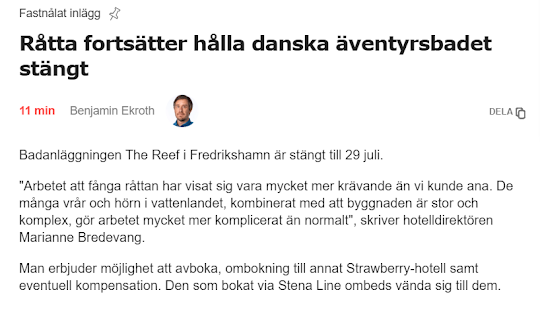
Rika råttors problem


Aftonbladets startsida högst upp kl. 11:22 i förmiddag. Och nej, jag klagar inte på denna sekunda kvällstidning. Det är väl snarast verkligheten som känns...helt jävla kajkå.

Tuesday, March 19, 2024

Massacre on Marion Island


Credit: JJ Harrison


Some really bizarre information in this one. 

The remote Marion Island in the Indian Ocean is scene to a "zombie apocalypse" during which aggressive and hungry mice prey on the seabirds, including large albatrosses, and eventually kill them. Or, not to put too fine spin on it, eat them alive under torture-like forms. 

Homo sapiens has decided to come to the rescue, and in 2026, the plan is to kill off the mice instead. That is, to exterminate millions of them! So our response to the zombie apocalypse is mouse genocide. Not until 2028 will we know whether the pesky rodent is finally gone and our tubenose brethren saved. Oh, and in a previous hominid killing spree on the island, all cats were extirpated?! 

>>>A “zombie apocalypse” has been playing itself out on Marion Island in the Southern Indian Ocean for more than a decade, as flesh-eating mice massacre vulnerable seabirds, having already laid waste to invertebrates and otherwise tenacious vegetation.

>>>In the 20 years up to 2018, the number of mice on Marion increased by about 430%. As a result, says Anderson, “the frequency of mouse attacks is increasing very significantly. It’s exponential, and it’s related to the fact that the invertebrates on which the mice used to prey have been decimated, so the mice are feeding off the seabirds and their eggs as an alternative food source” to replace their diet of weevils, moths and seeds. 

>>>In a 2015 study, mice were found to be killing one in 10 albatross chicks. Not only has this escalated, says Anderson, but “one of our concerns is that the mice are now starting to feed on adult wandering albatrosses as well. “The loss of chicks obviously has a big impact, but once you start killing adult birds of breeding maturity, then the impact on populations increases. And this is a more recent phenomenon.”

Massacre at Marion: Mouse eradication project gathers pace

Monday, March 4, 2024

Heartland


"Excuse me, dear sir,
is this the way to the heartland?"


“Wild Scandinavia” is a three-part BBC series about nature in the Nordic countries. I just glanced at the episode titled “Heartland”. In Sweden, it has been given a somewhat different title: “Sveriges hjärta” or The Heart of Sweden. Which is kind of odd, since some parts of the docu were apparently filmed in Norway and Finland! Cough, cough, cough…

“Heartland” takes us to the Scandinavian and, I suppose, Finnish boreal forests. For some reason, the winter section is more extensive than the summer ditto. Perhaps the Nordic winters are more fascinating for an international audience? Animals featured include lynxes, bears, beavers, reindeer, wolverines and wolves. One high point of the documentary is a struggle between bears and wolves over a reindeer carcass. Another is a similar struggle involving golden eagles and ravens. Ospreys are also shown. We even get to meet human ice-skaters! A strange oversight is that no deer or moose are shown. 

The production ends with the lekking (mating rituals) of the black grouse, a relatively large galliform living in the “heartland” forests. The film team had to spend the night at the lek grounds in freezing winter temperature. Geezus, can´t footage of this kind be obtained with drone technology these days? Or no?

I admit that “Wild Scandinavia: Heartland” could be of some interest to somebody who is completely uninformed about “our” local wildlife. Personally, I tend to avoid the wilder parts of our land, preferring more urban congregations, but I suppose YMMV!


Friday, November 10, 2023

Tuesday, October 24, 2023

The Squirrel Secret


This channel *must* be a troll, there is no way in hell and high water this could be serious.

Did you know that squirrels (yes, squirrels) have mastered the divine secret of secrets, the cosmic art of manifestation? And no, Rhonda Byrne has no idea either!

But what does a damn rodent in the city park manifest anyway? Yes, you guessed it. Nuts...

Turned this off after about three minutes. 

Friday, October 15, 2021

Realm of Mother Volga


"Realm of the Volga" is a two-part German nature documentary, produced by Altay Films. It takes the viewer on a journey from the taiga of northern European Russia all the way down to the steppes surrounding the Caspian Sea. Most of the time, the documentary follows the Volga, the largest river in Europe. With the exception of Astrakhan close to the delta, the cities in the Volga basin are mostly not shown, the most notorious of these being Volgograd (Stalingrad). Instead, we get to see the Russian wilds (and a few Orthodox churches) in mostly pristine condition. 

Many of the animals shown are instantly familiar to a Swedish viewer like myself: moose, beaver, red fox, boar, capercaillie, mallard, tawny owl, black woodpecker, great tit... I even recognized the wisents, since we have them at the Skansen zoo in Stockholm! 

Further south, the fauna becomes more exotic. Large flocks of saiga antelopes roam the desolate landscape and drink the brackish water, while trying to stay clear of the steppe wolfe. Meanwhile, steppe eagles build their nests on the ground, and demoiselle cranes carry out their mating rituals. Corsac foxes, rosy starlings and hoopoes are other characteristic species found around Volga´s southern portions. In the Caspian Sea, cormorants and white-tailed eagles live onboard eerie abandoned ships, while enormous colonies of seals gather at the islands of this peculiar inland sea. And yet, even this feels familiar somehow, obviously because all these animals are included in field guides to European mammals or birds, the geographical border of "Europe" being situated even further east than the Volga river.

It´s a fascinating trip, to be sure, almost aesthetical. And yet, by not showing the great cities, the oil industry and the environmental degradation, I still get the impression that perhaps somehow we are being served the wrong picture here! I can´t help thinking that perhaps Mother Volga has fallen on hard times...