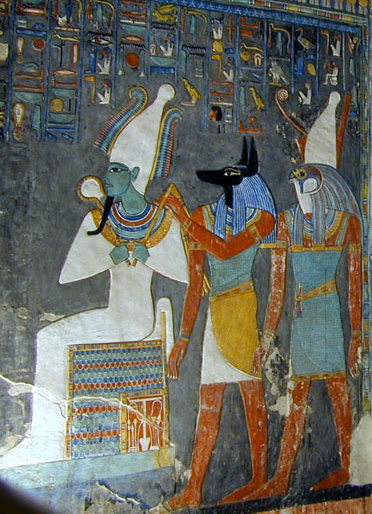
"A World Full of Gods" is John Michael
Greer's personal inquiry into classical polytheism. The book is published by a
neo-pagan group, the "Druid" ADF. Its author is the leader of another
Druid Revival group, the AODA. While the book is interesting, it's line of
argument isn´t entirely convincing.
Greer's main argument in favour of polytheism is religious experience. Another is moral experience. The diversity of both is easily explained by polytheism. People experience the gods differently because there actually *are* many different gods. In the same way, our moral experience points to the existence of many different moral principles which frequently clash with one another. This could be interpreted as different "gods" making divergent demands on humanity. To Greer, monotheism is based on special pleading in favour of one particular subset of religious experience, which is really neither better nor worse than that of anybody else. Greer has a point when he says that polytheism is the default position, in the sense of being the spontaneous or common sense position of most humans throughout the ages. In that sense, the burden of proof lays on monotheism (or atheism) to prove *its* position. Of course, monotheists (or atheists) will argue that they *have* proven polytheism wrong.
In order to make empirical religious experience the paramount criterion of validity, Greer has to reject the standard philosophical arguments for monotheism, including Anselm's ontological argument (which I think he has misunderstood), the cosmological argument or the argument from design. I don't think he is entirely successful in dispensing with them, however. There are also problems with the argument from religious experience itself. Monotheism is also based on religious experience, and so is pantheism. Here, Greer uses an argument from logic to reject monotheism: the various monotheisms can't all be true, so therefore it's logical to assume that the monotheists are simply mistaken when they claim that their religious experiences should be credited above all else. But why do people have monotheist experiences at all? Are some gods liars? Greer doesn't say. Or do humans mistakenly interpret certain gods as monotheist? But if so, religious experience *isn't* a sure guide. If it can be erroneous, why should we trust the polytheists more than the monotheists? Maybe Greer's religious experiences are false, while those of the apostle Paul were true. Greer explicitly says that the Christian apocalypse can't be true, being contradicted by other apocalypses, but the Christian version is based on a religious experience of John at Patmos. Hence, John was mistaken (or lied to by a polytheist, non-apocalyptic god, which amounts to the same thing).
Greer further acknowledges that some mystics experience Unity, but rejects Perennialism anyway, since experiences of Unity being higher than diversity are contradicted by experiences of Unity being lower than diversity or non-existent. But if religious experience can be in error, how can we really know? It's more logical to assume that there *is* some kind of Unity which takes different forms depending on the perceiver. This would explain all religious experiences just as well as Greer's classical polytheism. In fact, it would explain them better, since it would suddenly make sense why certain humans perceive the Divine in a monotheist manner, others in a polytheist, and so on.
Another problem concerns Greer's view of morality. Although Greer believes that different moral principles can clash, he still claims to know which principles are moral. For instance, he presumably wouldn't consider random murder to be moral, not even if decreed by a god. But if so, there is *something* higher than the gods, some kind of unified moral principle. Where does *that* come from? It can't be a brute, naturalistic fact of existence, since morality is comprehensible only to minds, perhaps only to individual minds. This is a philosophical argument that points in the direction of a monotheist god, or some kind of Unity which is at least close to a monotheist god.
Interestingly, Greer says in a footnote that Christian Neo-Platonism and process philosophy have been left out of his study for practical reasons, and so have Pagan Neo-Platonism and panentheism in general. Perhaps he shouldn't have rejected them so rashly? ;-)

No comments:
Post a Comment