A propos the previous blog post: Buddha protected by Alexander the Great and Herakles! Welcome to ancient Gandhara...
A propos the previous blog post: Buddha protected by Alexander the Great and Herakles! Welcome to ancient Gandhara...
An interesting video on ancient Greek influence on various aspects of Asian art and culture (including martial arts).
The Greco-Buddhist kingdoms of Bactria and NW India are of course featured, but it turns out that the Hellenic influence survived far longer. Note that the first depictions of the Hindu gods Krishna and Balarama are Greco-Buddhist, and so are the first anthropomorphic depictions of the Buddha. There are even depictions of the Buddha with two dharma-protectors, who on closer inspection turns out to be Alexander the Great and Herakles!
The content-creator argues that some Asian martial arts might be influenced by ancient Greek Pankration (made famous by the games at Olympia). Thai boxing and Bokator in Cambodia are apparently the main suspects. The video also claims that there are descriptions of fighting techniques in the Hindu epic Mahabharata which resembles Pankration.
Interesting. So here we go again: Ex Occidente lux. Or at least mixed martial arts...

So I amused
myself by trying to decode a very heavy scholarly essay by Jeffrey Kotyk, with
the appealing title “Japanese Buddhist Astrology and Astral Magic: Mikkyo and
Sukuyodo”, published in the “Japanese Journal of Religious Studies” and copyrighted
in 2018. I admit that I hardly got half of it, but it was still a fascinating
read, after a fashion. My man Kotyk might be on to something! Perhaps he has a
good horoscope?
Apparently,
contemporary Japanese astrology is called sukuyo and is attributed to Kukai,
the medieval founder of the esoteric Buddhist sect known as Shingon. However,
this form of astrology is evidently fully modern and has very little to do with
“real” Japanese astrology from the actual Middle Ages (to use European terminology).
Kotyk argues that there were two distinct forms of astrology during the period
in question. He calls them Mikkyo Astrology and Sukuyodo. The former is part
and parcel of esoteric Buddhist practice, while the latter could be regarded as
“standard” astrology, including natal horoscopes, predictions of wealth and
success for prominent individuals, etc.
Mikkyo Astrology, as should be evident by its name (Mikkyo being the Japanese word for Vajrayana or esoteric Tantric Buddhism), was introduced to Japan from China by Shingon and Tendai monks, including the aforementioned Kukai. The two prominent Tendai monks Ennin and Enchin were two other transmitters. Mikkyo Astrology is based on highly complex Chinese manuals which in turn go back to Indian sources. It was necessary to correctly time various esoteric rituals. Of course, “Vedic” astrology in its turn is heavily influenced by Greek astrology. Mikkyo Astrology also includes astral magic, including worship of planetary deities, to ward off disasters forecasted in the horoscopes. Kotyk therefore regards this form of astrology as non-fatalistic.
While the system is Indian in origin, the author
has also identified Iranian elements in the Chinese sources. These in turn can be
traced further back, to Greek or Egyptian sources. The icon of Saturn used in
these texts is “Iranian-Mesopotamian” rather than Indian. During the later Tang
period in China, the cult of Saturn (seen as a malefic planet to be appeased)
became prominent among both Buddhists and Taoists. The main feature of the
astral magic, however, is presumably Indian in origin: the cult of a bodhisattva
referred to by modern scholars as Tejaprabha (a name unattested in any Sanskrit
source). This powerful figure was worshipped when heavenly anomalies disturbed the
peaceful skies, such as comets appearing in the “lunar mansion” associated with
the incumbent ruler. To complicate the criss-crossing lines of cultural influence
even further, Mikkyo Astrology in Japan also interacted with Onmyodo, a school
of divination indebted to Taoism. Its practitioners worshipped the Big Dipper
as yet another example of astral magic.
Sukuyodo
seems to have been originally connected somehow to Onmyodo, but later became an
independent lineage or school (or actually several). It had strong support in
the medieval Japanese aristocracy. What makes Sukuyodo interesting to the
author is that it must be derived from Chinese sources dependent not on any
Indian source, but on Iranian sources the contents of which goes back to the Hellenistic
astrologer Dorotheus. The lore itself can be traced even further back, to Alexandria
or even Babylonia. One intriguing fact is that Sukuyodo used the tropical zodiac
(also used in ancient Greek and modern Western astrology) while “Vedic” astrology
uses the sidereal zodiac. The positions of the star signs are somewhat
different in the two versions. Even Indian traits in Sukuyodo, such as the use
of the imaginary planets Rahu and Ketu (actually the lunar nodes) in horoscopes
could come from Iranian sources, since these had evidently taken up the
practice. What makes all this important is that it could point to a previously
unknown path of cultural diffusion from the Near East to China and Japan
(without passing India). The author wonders aloud whether music or medicine
could have followed this path of transmission, too.
What he doesn´t
mention is the profoundly humbling effect all of this should have on Chinese
and Japanese nationalists. Much of their “unique” cultures really come from “barbarians”,
including the White devils. If they will ever admit it, is another thing
entirely. Ex *Occidente* Lux? White Boy Summer is a thing!

Could an unknown (and gruesome) species of crocodile or monitor lizard be lurking in inland Liberia? Cryptozoology blogger Karl Shuker has some ideas about the problematique.
The existence of this cryptid seems unlikely, but it´s interesting to note that the natives don´t consider the gbahali to be supernatural, but just another dangerous animal. My wild guess, offered from the wilds of my armchair, is that the man-eating beast is a misidentified Nile crocodile of extremely large size (a form that would itself be unknown to science).
If a White man with a herpetology degree survives a gbahali attack while lurking in Liberia, we´ll finally know...
The Gruesome Gbahali: Lurking in Liberia?
"Röda khmererna: Pol Pots revolution i Kambodja" is a Swedish book from 2022 by Peter Fröberg Idling. It´s published by Historiska Media, a press with a wide assortement of popularized but still surprisingly informative books written by various authors. The topic this time: the Khmer Rouge and their reign of terror in Cambodia 1975-79.
The bulk of the story is well known by now: how the Khmer Rouge forcibly evacuated the capital of Phnom Penh after a bloody civil war, how they subsequently turned the entire country into a enormous labor camp, and how the regime was finally overthrown by a Vietnamese invasion. The Khmer Rouge genocide may have claimed the lives of over one million people. Few people would have missed the name of the crazed dictator behind it all: Pol Pot. Since the Khmer Rouge were Communists, their depradations are placed in the same ball park as those of Stalin or Mao.
While none of the above is "wrong", there is also a wider context: a brutal colonial history, constant conflicts between Vietnam and Cambodia that go back centuries, and Richard Nixon´s "secret" war (including carpet bombings). At their peak, a large proprotion of the Cambodian peasant population must have supported the Khmer Rouge. Pol Pot´s bizarre regime was overthrown by another Communist government and his movement kept afloat as a "contra" force by the United States and Thailand. Add to this the constant scheming of Prince (or King) Sihanouk, and the story suddenly gets more complicated...and arguably even more brutal. All of this is covered by the author.
The book also contains more unexpected information. For instance, that Pol Pot (whose real name was Saloth Sar) was something of a dandy and bon vivant in his younger days. Somewhat ironically given later developments, Saloth Sar came from a kulak background and had a family connection to the royal Cambodian court. He seems to have been a charismatic, smiling and jovial man...well, until he wasn´t, although I suppose he kept his charisma. He flunked both high school and college, first due to his bohemian lifestyle, later because of his revolutionary pastimes. In other words: another intellectual mediocrity who fancies himself the Messiah. It´s not even clear if he had any real grounding in Marxism-Leninism. Fröberg Idling believes that his main source of inspiration was the French revolution, including its most radical and terroristic phase. Pol Pot´s source? A work by Peter Kropotkin!
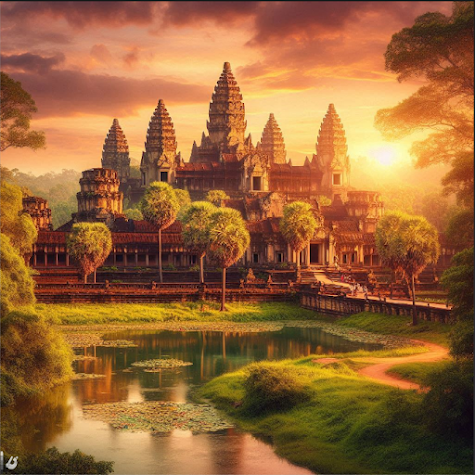
Another new piece of information is that Cambodian nationalism was a by-product of French colonialism. Not just in the trivial sense that colonialism breeds resistance, but also in a more "ideological" sense. It was the French that made the Cambodians interested in Angkor Wat. The old temple complex had been in ruins for centuries and nobody much cared about it (except maybe a few Buddhist monks) before the French became fascinated by it and the ancient Khmer Empire in general. This prompted Cambodians to turn Angkor Wat into a potent symbol of Cambodian nationalism. Indeed, even the ultra-Communist Khmer Rouge had the silhoutte of Angkor Wat on their flag. (If Wikipedia is to be believed, the author makes two factual errors about Cambodian flags. The first flag showing Angkor was adopted in 1863 by the French-dominated puppet kingdom of Cambodia, while the flag used by the nationalist Khmer Issarak was re-used by the pro-Vietnamese Hun Sen regime, not by the Khmer Rouge. Perhaps a vexillology nerd could weigh in on this?) Note also that both the ideals of the French revolution and Marxism are, of course, Western.
A constant theme in the book is Pol Pot´s weird and quasi-Masonic secrecy, unique among Communist parties. The very existence of the Communist Party of Kampuchea was a secret, the party using the cover name "The Organization" (Angkar). Its leadership was just as secret. It took several years after the "revolution" before the Khmer Rouge revealed that the leader of their regime was a certain Pol Pot. But that´s really a pseudonym (the exact meaning of which is unknown) and Brother Number One was given an entirely fictitious biography. At this point, he was paranoid and strongly xenophobic, constantly moving his HQ around Cambodia. It struck me that even this strange obsession with secrecy (including when actually in power!) could be derived from some kind of Jacobin or Blanquist conspiracy during or after the French revolution.
Another thing that shines through (despite the author for unclear reasons not liking Michael Vickery) is the weird blend of authoritarianism and decentralization during the Khmer Rouge´s years in power. The decentralization aspect is emphasized in Vickery´s books. Cambodia or "Democratic Kampuchea" was sub-divided into seven "zones", each under its own effective leadership. The conditions in the various zones varied considerably, with the Eastern zone bordering Vietnam being the most lenient, while other zones were under the control of de facto dacoit warlords who really did "hate the cities". At the center, Pol Pot tried to keep control with semi-regular purges left and right. His commands were often contradictory, the production quotas impossible, and the paranoia rampant (but nevertheless "justified", since Vietnam *did* conspire against the Angkar). Most people who died under the Khmer Rouge probably perished due to famine, malnutrition and overwork. For more on Pol Pot´s utter insanity, see my review of the book "Pol Pot Plans the Future", which contains translations of the few internal Angkar documents that have come to light.
It´s difficult to "explain" any of this in a strictly rational fashion, but the author does point to a few factors. For instance, that violence has long been part and parcel of Cambodian culture. It´s an extreme "honor culture" in which every sleight is punished with over-the-top violence, which in turn leads to new violence. Add to this colonial terror and civil wars. The fact that Cambodia has long been weak and squeezed between its more powerful neighbors Thailand and Vietnam is also part of the picture. Obviously, extreme nationalism can appeal to people in such a situation. As for the Khmer Rouge, the author believes that they are best seen as a kind of cult or sect, which under extraordinary conditions of societal breakdown managed to take power. (The Taliban in Afghanistan could be another example of this.) And yes, the "Communist" mixture of utopian millenarianism and authoritarianism obviously also plays a role here. A trail not explored by the author is that millenarian cults seem to be pretty common in East Asia (and perhaps Southeast Asia?). The Khmer Rouge may be part of a tradition that long pre-dates Communism. Indeed, maybe Communism is seen by many adherents in Asia as a new millenerian cult? The author does speculate that Pol Pot might in some strange sense have been influenced by Buddhism and mysticism.
The book ends with an epilogue, in which it becomes clear that most of the Khmer Rouge were never punished for their crimes. Pol Pot was - somewhat ironically - unseated by his own supporters in 1997 in a remote part of Cambodia after ordering yet another round of purges, this time of fellow guerilla commanders fighting the new Cambodian administration. Pol Pot was placed under house arrest and died of unknown causes in 1998. For some reason, the author strongly dislikes Hun Sen and the pro-Vietnamese ex-Communists, constantly accusing them of being somehow implicated in the genocide, when in fact they were the moderates who tried and succeeded in removing Pol Pot from power.
With those reflections, I end this review.
Is this even true? I admit I had no idea. It seems Dessalines didn´t kill all White people on Haiti...

So the first attested pictures of Balarama and Krishna were Greek, from Greek-controlled Bactria? Same with the Buddha, apparently.
 |
| Credit: Chtrede |
Why is this considered "trolling"? A more reasonable explanation is that the Namibian president really wants the Germans to return to their old colony!
I´m old enough to remember when SWAPO was considered a "leftist" organization, but what the heck do I know...

A "Scandinavianist" propaganda poster from circa 1845. Army officers (?) from Norway, Denmark and Sweden brotherly shaking hands, with their respective national flags flying high.
The poster is well known. However, one thing just struck me the other day. *None of the Scandinavians are blonde*.
The Dane is obviously black-haired, the Swede might have very dark brown hair, and the Norwegian is perhaps red-haired. They all have matching moustaches, to boot. And while they are quite tall, none of them seem to have bulging muscles or so-called stern jaws.
So when did the Blonde Beast á la Dolph Lundgren become a Scandinavian stereotype, I wonder? Can some art historian please weigh in on this?
And hey, don´t tell Bronze Age Pervert!


Azov Battalion behind the scenes. Rare photo from Black Sea resort after Richard Spencer´s White Western Federation took area from Russians circa 2025.

Och här kommer det, äntligen efter alla dessa år! Tobias Hübinette passerar Rubicon och vinner utmärkelsen Veckans Strasser (och dessutom Veckans Shachtman...samtidigt). Slava Ukraini!
>>>Tyvärr är delar av vänstern och kanske också högern fortfarande emot att den f d Azov-bataljonen ser ut att faktiskt vilja strida till siste man i Mariupol och just försvara Azovstal tills ingen av dem längre bokstavligen kan stå upp men oavsett om Mariupols och Azovstals sista aktivt stridande soldater är högerextremt lagda eller ej så är de trots allt hjältar efter att ha hållit ut ända sedan den ryska invasionen inleddes den 24 februari i år (för på samma datum inleddes nämligen belägringen av Mariupol).
>>>Tyvärr var det t ex budskapet från en av talarna på 1 maj-mötet vid La Mano-monumentet på Söder i Stockholm som samlar merparten av den samlade arbetarrörelsen och vänstern i huvudstadsregionen (SAP, V, LO, SAC o s v) – d v s att det är fel att som antifascist stötta Ukraina då nazister försvarar Mariupol och har grävt ned sig under Azovstals fabriksruiner och vägrar ge upp och denne 1 maj-talare fick tyvärr en hel del applåder efter att ha framfört det budskapet.
Welcome to the dark side, my son.
"De sista ukrainska soldaterna som försvarar Mariupol är inget annat än hjältar"

Vad omikron-helvetet har att vänta sig om det mot förmodan vågar sig förbi mina tassemarker.
"Bön in Dolpo" is a 2014 documentary about Dolpo, an area in northern Nepal, apparently part of a larger district somewhat confusingly called Dolpa. Due to its remoteness and traditional Tibetan culture, Dolpo (or was it Dolpa) has apparently become popular among Western film-makers and trekkers who want to visit an area that is still reminescent of ancient Tibet. It´s not clear why they don´t simply visit Bhutan!
The language spoken in Dolpo, Thakali, is related to Tibetan. What really interests foreign visitors seems to be the religion, known as Bon or Bön. The term can refer to two very different things: the pre-Buddhist shamanic religion of Tibet (which may or may not be extinct - I honestly don´t know), and a much later breakaway group from Tibetan Buddhism. That tradition still exists in Dolpo. The problem is that the Buddhist off-shoot claims to be the original Bon (and hence much older than Buddhism), while nevertheless being obviously Vajrayana Buddhist in nature. The monks, the iconography, the philosophy, the Tantric and Dzogchen practice - it´s all the same. In Dolpo, Bonpos and Vajrayana Buddhists even worship together!
The documentary is pro-Bon and therefore uncritically repeats the Bon mythology, according to which Bon is the most ancient religion in the world, and was the state religion of a pre-Tibetan empire called Zhangzhung (of which very little is really known). It also claims that the ethnic groups in Dolpo are the last survivors of Zhangzhung and that some still speak the Zhangzhung language.
It seems Dolpo *is* important within today´s Bonpo community, since the religion can still be practiced freely there, in contrast to Chinese-controlled Tibet. All current "teaching texts" are said to come from Dolpo. I noticed that many Bon monks in this isolated region can speak tolerable English, suggesting of course that they were educated elsewhere, presumably in Kathmandu or even India (this is implied at one point in the documentary). The Dalai Lama has an ecumenical approach towards Bon, and is featured several times in this production as he makes Bon-friendly statements.
Most of "Bön in Dolpo" is ethnography 101. We get to see Himalayan vistas, poor villages, Bon rituals, monks building a stupa, and so on. It´s not always that interesting, unless you are a hardline Tibetophile. The documentary claims that both the monks and the foreign doctors in the area are combining modern medicine with Ayurveda and traditional Tibetan medicine. There is also a school, but it´s unclear to me whether it teaches "real" subjects, or simply Bon religion and Ayurveda. Bizarrely, the school (named after the Bon master Tapriza) was set up with the aid of two Western women, an anthropologist and an conservationist! Another smaller school, started by a monk, also seems exclusively Bon-oriented.
"Bön in Dolpo" ends with expressing fear of Chinese influence in the region, since China wants to build a modern highway through the area. The government of Nepal has good relations with China, which is something of a problem for anti-Chinese Tibetans in Dolpo.
There, the story ends. For now?

Påverkanskampanj eller vad? Enligt diverse nyhetsmedier har forskarna "avfärdat" att de mystiska mumierna i Xinjiang skulle vara indo-europeiska. Med vilket man uppenbarligen menar "vita européer". De sägs istället ha tillhört en grupp som kallas Ancient North Eurasians (ANE), och som var förfäder till dagens amerikanska indianer! Visst, det stämmer. Fast enligt Wiki bidrog ANE genetiskt även till Yamnaya-kulturen, som i sin tur är förfäder till...gissa vem...just det, de förkättrade indo-européerna. Att indo-européer och indianer hade gemensamma förfäder (och anmödrar?) någonstans i Asien om man går tillräckligt långt tillbaka i tiden har ju varit känt sedan länge. Det här är förstås inte de "riktiga" förfäderna/anmödrarna, utan en senare ANE-population, but you do get my point...
En annan sak. Så här står det i artikeln: "Det kanske mest anmärkningsvärda är att gruppen inte tycks ha blandat sig med grannar i Dzungariet i norra Xinjiang. De senare har däremot bland annat västligt ursprung, från herdegruppen afanasievo, genetiskt kopplad till yamnayafolket som för 4 000 år sedan spred sig till Europa, enligt forskarna. Även i andra grupper i området finns en genetisk mix, vilket gör det än mer anmärkningsvärt att den saknas i mumiernas dna. Men trots den genetiska isoleringen var gruppen inte kulturellt avskärmad från omvärlden. Deras kultur baserades på grödor från västra, östra och centrala Asien, visar studien."
Mumierna tillhör alltså, om jag har förstått detta rätt, en arkaisk reliktpopulation av ANE som vägrade rasblanda sig (hoppsan) med de andra folkgrupperna i området (inte ens sina avlägsna kusiner som så att säga återvandrat västerifrån), men ändå kreativt tog efter inslag från främlingarnas kultur.
Make of that what you wish. Fast särskilt "woke" låter det ju inte. Om sanningen ska fram.

This week in crazy...
Even if Beethoven was Black (he wasn´t), his music was White European, not sub-Saharan African. Last time I looked, classical music wasn´t invented by Mansu Musa in Mali. Not that good ol´ Musa didn´t have some interesting features all his own - of course he did (all that gold, and all those slaves) - but as a God-fearing Muslim, I doubt symphony orchestras was one of them!
So the BLM activists (who are really hilarious here) gets it all wrong. But sure, if the only way to avoid a cancellation of Beethoven (a political radical, I believe) is to prove that he was a Moorish Octoroon, I suppose that´s a good thing somehow.
Maybe we can give his skeleton a jab of that COVID vaccine, too?
Black pop star wants Beethoven´s body exhumed for racial DNA test