Showing posts with label Solidarity. Show all posts

Wednesday, September 19, 2018

Just give us a job, dammit


“Trade Unionism or Socialism” is a pamphlet published by the British leftist group Solidarity. Indeed, it's subtitled “Solidarity Pamphlet no 47”. It's undated but the probable publication year is 1975. Solidarity (not to be confused with the American leftist organization of the same name) was a libertarian socialist group. Solidarity's ideas have a family likeness to Council Communism and anarchism (the “constructive” rather than the stone-throwing variety). They were inspired by “Socialisme ou Barbarie” in France, a group headed by Greek-French philosopher Cornelius Castoriadis. A similar group also existed in Sweden, Förbundet Arbetarmakt (FAM). After the FAM's dissolution, many of its activists joined the libertarian socialist SAC. At one of their obscure bookshops, a certain Ashtar Command picked up a representative selection of Solidarity pamphlets already 30 years ago. Time does fly…

“Solidarity Pamphlet no 47” contains two pieces by John Zerzan, an American radical who later developed in an anarcho-primitivist direction and was accused of being too friendly with the Unabomber. One of Zerzan's articles had been published previously by Telos and Black & Red. The other may have been written especially for Solidarity.

Zerzan argues that labor unions collude with management and the government to such a great extent, that they have become the fifth wheel of capitalism. Even strikes are called with the tacit approval of the management, so the workers can “blow off steam” and the union leaders keep control. The unions are so integrated into the system and so bureaucratized that workers should reject them entirely. Indeed, workers already are rejecting them. Zerzan points to the widespread and often large unofficial strikes in the United States, some with national scope. Both Solidarity and Zerzan feel that radicals in the workplace may have to be explicitly anti-union (like the KAPD and the Council Communists). It's not clear, however, what should replace the unions. It's quite common for “alternative” structures outside the traditional unions to develop into dual unions!

Perhaps foreshadowing his later anarcho-primitivist turn, Zerzan talks about a “revolt against work”. Despite pay rises and fringe benefits, workers nevertheless can't stand conditions in a modern industrial plant. From speed-ups at the assembly line to authoritarian bosses, the factory is hell. Workers respond with sabotage, absenteeism, riots or informal attempts to “plan” the production themselves. This is, at least potentially, a revolt against “work” itself, not simply a protest against this or that lousy condition. Zerzan warns that management may try to buy off the discontented workers by fake “worker participation” schemes, “job enrichment” and the like. There probably was some truth to this when the pamphlet was written.

Today, of course, with “permanent temp workers”, union busting and a global economy in which everyone is a replaceable and disposable part, the old economy with its partnership of Capital and Labor suddenly doesn't look so bad anymore – certainly not if you can get “job enrichment”, too! Ironically, even Zerzan's primitivism doesn't sound as farfetched as it did during the Reagan years, when he first seems to have adopted it. While I prefer a clinically clean factory floor to a malaria-infested jungle, the inability of “modern civilization” to become sustainable is rapidly creating the preconditions for the latter…

Oh, are we gonna love GM, Chrysler and George Meany when this is over!

Those are my reflections after reading “Trade Unionism or Socialism: The Revolt against Work” by John Zerzan, published as Solidarity Pamphlet no 47.

The end.

Brilliant but utopian


This is an undated pamphlet published by Solidarity, a small British group of libertarian socialists (the group is now defunct). The pamphlet is undated but probably printed around 1970. It contains an English translation of a text by Cornelius Castoriadis, a French left-wing intellectual of a libertarian socialist bent. Castoriadis, who often wrote under the pen name Paul Cardan, was the leading light of a small group with the dramatic name Socialisme ou Barbarie (Socialism or Barbarism). Solidarity seems to have been the main conduit of Cardan's ideas in Britain.

“From Bolshevism to the Bureaucracy” was originally Cardan's preface to a French edition of Alexandra Kollontai's famous pamphlet “The Workers Opposition”. The so-called Workers' Opposition was a dissident group within the Bolshevik Party, mostly known for its intervention at the tenth party congress in 1921. The opposition argued that the working class was in danger of losing power due to excessive bureaucratization, and that the management of Soviet industry and trade should be handed over to the trade unions rather than being the exclusive preserve of the Party. V I Lenin and Leon Trotsky weren't convinced (nor amused), and the infamous ban on “factions” was to a large extent aimed at silencing Kollontai and her supporters. This episode is important, since it shows that the bureaucratic degeneration of the Russian revolution started already under Lenin and Trotsky as a result of conscious Party decisions. Trotskyists, by contrast, still argue that all bureaucratization under Lenin was the result of strictly “objective” factors (such as the Civil War), that Lenin and Trotsky opposed it, and that it wasn't until Lenin's death and Trotsky's ouster that the bureaucracy finally took power (headed by a certain Joseph Stalin). The irony of Trotsky being hit in the head by the same “ban on factions” used by himself to silence Kollontai is usually lost on these people.

Cardan's text is obviously a polemic against Trotskyism, and is liberally sprinkled with quotations from Trotsky's notorious work “Terrorism and Communism”. Cardan rejects purely “objective” explanations for the bureaucratization of Soviet Russia. The Civil War, the international isolation of the revolution and the economic dislocation were real, to be sure, but they might just as well have led to the fall of Bolshevism and the victory of the White Guards. (I would add other possibilities to the list: a populist regime, a Menshevik government, the division of Russia into a dozen nationalist-controlled republics, foreign occupation or complete chaos.) Instead, the revolution defeated its enemies, only to succumb to bureaucratic degeneration from within. Why did the defeat of the working class take *this specific form* rather than some other? Objective factors alone cannot explain it. There is an additional X factor somewhere. What is it?

The X factor is, Cardan argues, the entire prior practice of Bolshevism. This is really a no-brainer, but trust me, Trotskyists really don't get it! Bolshevism was always an authoritarian movement with the ultimate goal of creating a one-party state, a movement which converged with the revolutionary workers only temporarily. During the revolutionary year 1917, workers and peasants often took radical action without the prior consent of the Party, indeed, sometimes against its wishes. As a libertarian socialist, Cardan puts his emphasis on the Bolsheviks' top-down view of the economy and attendant exclusion of workers' self-management. Somewhat idiosyncratically, he regards Bolshevik practice as “capitalist” since it included the Taylor system and piece work at factory level, appointments rather than elections of plant managers, etc. Why should authoritarian party leadership of this type lead to any other results than the bureaucratization of the revolution? Why expect a party completely beholden to “capitalist” methods to reproduce anything else than “capitalist” social relations? Note also that other civil wars in history didn't lead to one-party states and centralized planning. Perhaps because, ahem, they weren't fought and won by Bolsheviks…

There is much truth in this, and some paragraphs in this pamphlet are simply brilliant. It's simply amazing how much Leninists, including Trotskyists, have managed to mystify these issues. However, there are also some problems with Cardan's analysis. On the one hand, he tends towards a kind of idealism: “In so far as ideas play a role in historical development, and, *in the final analysis*, their role is enormous, Bolshevik ideology (and some aspects of the Marxist ideology underlying it) were decisive factors in the development of the Russian bureaucracy”. On the other hand, when discussing the bureaucracy as such, Cardan treats it as a product of objective material factors, not “ideas”. Thus, he believes that there are two types of bureaucracy in the modern world. The first type is the managerial-administrative stratum made necessary by large scale capitalist production and societal complexity. The other is the type of bureaucracy found in the Third World, which takes political power in place of a weak bourgeoisie, and attempts to modernize society through centralized planning. He mentions China as an example of this. (The Russian bureaucracy is closest to the second type, but is unique since it took power during the degeneration of a working class revolution.) Here, Cardan is clearly talking about objective conditions. So why does he emphasize “ideas” in the Bolshevik case? How “final” is the “final analysis” in which ideas are “decisive”?

I think the problem is Cardan's utopianism. On some level, he probably does believe that Kollontai and the Workers Opposition could have saved the Russian revolution and create some kind of self-managed proletarian utopia. Hence, if the leadership (or non-leadership) of the revolution just had the right ideas, they could presumably have pulled themselves up by their bootstraps. In reality, workers' self-management and libertarian socialism were the least likely outcomes of Red October, but you probably need to break more decisively with leftist dogma to realize that…

The meaning of life


“The Meaning of Socialism” is a pamphlet published by Solidarity, a now defunct British leftist group with a libertarian socialist orientation. The pamphlet was first published in 1961. My copy is from 1969. It was quite popular in its day, and has been translated to a number of foreign languages, including Japanese and Norwegian. It has also been translated into French, which is pretty ironic, since the pamphlet contains an article written by the French leftist intellectual Cornelius Castoriadis. Apparently, “The Meaning of Socialism” was originally an English-language article written by Castoriadis for the magazine International Socialism (associated with Tony Cliff's group in Britain). Castoriadis, who often used the pen name Paul Cardan, was the leader of a small group in France, Socialisme ou Barbarie. Solidarity seems to have been Cardan's foremost admirers in the Anglo-Saxon world.

“The Meaning of Socialism” is a relatively short text, in which Castoriadis alias Cardan explains his basic approach to socialism, revolution and the workers' movement. It has a family likeness to anarcho-syndicalism, anarcho-communism and council communism, although Cardan never uses those terms. The main contradiction within capitalism goes between authoritarian management of production and the attempts of workers to free themselves from such. Capitalist production is fundamentally irrational. At several points, Cardan implies that the kind of large scale production dominated by machines which characterize the modern economy is irrational, too. One cannot therefore simply “take it over”, or hand it over to state planners, and expect workers' paradise to follow. Since the Soviet Union and similar societies are just as marked by the contradiction between workers and irrational production/dead machines/authoritarian management as the Western nations, these supposedly “socialist” systems are fundamentally capitalist, too.

Cardan also attacks the meaninglessness and anomie of modern life, how people despite their higher living standards nevertheless feel alienated, how capitalism tries to “solve” the problem by ever-changing and ever-increasing consumption, which is really just as empty, etc. (Here, he sounds like the later hippies or Situationists!) The task of the revolutionary organization isn't to act as a sectarian vanguard in order to “lead” the proletariat. That will simply reproduce the hierarchic relationship the revolution is supposed to get away from. Instead, revolutionaries should practice direct democracy and local autonomy within their own organizations. They should also concentrate their efforts at factory level and the level of everyday life, since it's there most workers actually are. Abstract slogans or programs of the type beloved by small Trotskyist groups are to be avoided. The “meaning of socialism” and the ultimate goal of the struggle is workers' self-management of production.

There are several problems with Cardan's text. It feels extremely narrow with its almost exclusive orientation towards the shop floor. It's also Euro-centrist. Most workers, of course, never experienced a higher standard of living after World War II. Third World workers, to be exact. Indeed, Cardan says literally *nothing* about the Third World, and this in a text on “the meaning of socialism” published in 1961! Cardan's text is also extremely vague and contradictory once he attempts to describe how workers' self-management should really work. Suddenly, there is central planning with the aid of computers (I assumed the dead labor of the machines was supposed to be abolished?) and a centralized distribution system, with the workers in each factory simply deciding on *how* the plan should be put into effect in their little corners. The plan itself is supposedly the result of a collective decision of the whole working class…and, I suppose, its computers. (Compare the later musings by Murray Bookchin.)

Finally, I must say that the cover of this pamphlet is priceless. At least the 1969 cover. It shows a comics character in the form of a smiling heart, with a tool in one hand and a flower in the other. This funny little guy shows up in several other Solidarity pamphlets, too. The whole thing feels so “love summer”! Perhaps this says something about how this particular group wants us to interpret the meaning of Cornelius Castoriadis?

Saturday, September 1, 2018

Marxism wins, I'm afraid

Marxism meets reality 


Although I'm not a Marxist, I must say that Brian Moseley's "Marxism versus Reality" is extremely bad. The author is otherwise unknown, but seems to have been a member or hang-around of the British libertarian socialist group Solidarity. At the very least, he uses a similar terminology.

The pamphlet was published in 1983 to "commemorate" the centenary of Marx' death. Most of the author's arguments are Anti-Marxism 101: What about Russia? Does the labour theory of value really make sense? Why can't the superstructure influence the base? And, honestly, what about Russia?

Yet, the author nevertheless comes up short in the end. Thus, while dropping Marx' theory of crisis, he never offers an alternative theory of his own. On the contrary, he believes that capitalism has overcome its crises, at least in the "advanced capitalist nations". And this in Britain in 1983! No crisis, huh? He also completely forgets the little detail about, shall we say, the less advanced capitalist nations. They are hardly even featured. Why is there a crisis *there*? "Class struggle" is between order-givers and order-takers, not capitalists and workers, most workers are on the same side as their bosses, and most workers do what they do completely voluntarily?! Well, at least in the advanced capitalist nations. For some reason, however, a revolution is just as impossible in the Third World, making everything look pretty bleak.

Somehow, this all sounds rather familiar. Yepp, it's really a restatement of the theories of Cornelius Castoriadis (a.k.a. Paul Cardan), who at least had the good graces of putting them forward about 20 years earlier, when they seemed to make *some* kind of sense (and even that, only barely). In 1983, they made no sense at all. "Marxism versus Reality" is Castoriadis on downers. In this battle with Reality, I'd say Marxism wins.

And now, sports...

Solidarity with the JVP?


“Ceylon: The JVP Uprising of April 1971” is a pamphlet published by Solidarity, a small libertarian socialist group in Britain. The pamphlet is undated, but was probably published in 1972. The Janatha Vimukthi Peramuna (JVP) was a Maoist-inspired movement which staged a quixotic rebellion against Sri Lanka's left-populist government in 1971. The badly planned and executed uprising was quickly (and bloodily) suppressed by Sirimavo Bandaranaike's administration.

Solidarity didn't support the Maoist, Guevarist and Sinhalese nationalist JVP, but regarded the events as significant for other reasons. Bandaranaike's populist Sri Lanka Freedom Party (SLFP) governed in coalition with the pro-Moscow Communist Party and the ex-Trotskyist LSSP. Both leftist parties supported the suppression of the JVP. The Soviet Union and China also expressed support for Bandaranaike's United Front government, China even offering Sri Lanka a huge, interest-free loan immediately afterwards. To Solidarity, these negative reactions to the JVP uprising starkly proved the bankruptcy of the traditional left and “really existing socialism”, since the JVP (despite their adventurism and erroneous ideology) was reacting against the refusal or inability of the traditional left to carry out meaningful reforms of Lankan society, let alone a real revolution. When the going got tough, the traditional left sided with the bourgeois SLFP and hence capitalism and imperialism (Solidarity's terminology).

Most of the pamphlet describes the history of Sri Lanka, and the various political players on the island. This section is apparently based on Fred Halliday's article “The Ceylon Insurrection”, published in New Left Review issue 69 (September 1971). Of course, the political analysis is Solidarity's own. The pamphlet further contains an interview, made by two Solidarity supporters, with Edmund Samarakkody, a Trotskyist leader who acted as defence counsel for the JVP during the repression, despite political differences with the group. The interview deals more extensively with the JVP itself. A third article, based on material already published by the Spartacist League, chronicles the bizarre Bala Tampoe affair. Tampoe was the leader of LSSP(R), a Trotskyist group, but also an important union official, and apparently a fairly conservative one, at that. At one point, he had a private interview with Robert McNamara in Washington! According to urban legend, the LSSP(R) supported JVP's uprising, but this is obviously incorrect. Tampoe's union, the CMU, hardly even supported strikes called by other unions…

A concluding article, “Third Worldism and Socialism”, explains Solidarity's own perspectives. Solidarity didn't believe that national liberation struggles could weaken capitalism or imperialism. Any kind of support to nationalism is therefore “reactionary”. An unpopular message at the time, no doubt!

I'm not sure how to rate this rare gem, but since it isn't *that* bad, I graciously award it three stars. A final irony: today, the erstwhile revolutionaries of the JVP have entered a coalition with…the SLFP.

Send Maurice Brinton to Zanzibar


"As We Don't See It" is a pamphlet published by Solidarity, a libertarian socialist group in Britain whose heydays were the 1960's and the 1970's. The group is mostly known for its often intriguing pamphlets, such as "The Irrational in Politics" (think Wilhelm Reich) or translated works by Cornelius Castoriadis. "As We Don't See It" is a short summary of Solidarity's political positions, and includes their original platform, "As We See It".

Most of the pamphlet is libertarian socialism 101, but one thing stands out: the complete rejection of Third World struggles, as when the anonymous author waxes ironic about "Karume's anti-imperialist regime in Zanzibar", "Sekou Toure's Guinea" or "The People's Republic of Uzbekistan". Yeah, very funny, guys. Now, please go back and reread Lenin's works on imperialist economism and social-chauvinism, more carefully this time...

Oh, I forgot. The brave Anglo-Saxons of Solidarity don't study Vladimir Ilyich.
Well, my mistake. :P

Strange victories


"Vietnam: Whose Victory?" is a pamphlet published by the now defunct libertarian socialist group Solidarity in Britain. I haven't seen this particular edition. I have the original edition, which hit the streets back in 1973. Solidarity opposed both sides in the Vietnam War, and hence refused to call for a North Vietnamese or NLF victory. This may have been *the* most unpopular position on the far left at the time!

The bulk of the pamphlet contains an analysis of the war by Bob Potter, whom I presume was a member of Solidarity. Despite opposing both the DRV and the Republic of Vietnam, Potter's analysis still sounds "Trotskyist". Thus, he places a strong emphasis on Ho Chi Minh's deadly attacks on Ta Thu Thau's Trotskyist movement in Saigon during the 1940's. He claims that both Stalinists and Trotskyists are class collaborationist and popular frontist, and that Stalinism seeks to betray the revolution in favour of capitalism and imperialism. In many ways, Potter's spin is "more Trotskyist than Trotsky".

As a counter-weight, the editors have appended the official analysis of Solidarity, according to which the Stalinists (and presumably the Trotskyists) aren't betraying anyone. Rather, Stalinism represents the interests of a new, state capitalist class which *actively* attempts to take power by smashing traditional capitalism or colonialism. The editors also argue that Stalinists and nationalists *can* "carry out the tasks of the bourgeois revolution", something Trotskyism (and by implication Potter) considers impossible or unlikely.

I'm not a big fan of North Vietnam myself (nor of South Vietnam, for that matter), but I must say that Solidarity's pamphlet is marred by a kind of (perhaps unconscious) First World chauvinism, probably derived from Cornelius Castoriadis' idea that a genuine socialist revolution is impossible in the Third World. (Castoriadis was a leftist intellectual whose ideas had influenced Solidarity.) Surely, only Solidarity could write something as silly as the following: "It was as if at least some students were learning what workers had instinctively known for years, namely that the jockeying of power between the various Vietnamese bureaucrats, North and South, and their search for `recognition' by and even `partnership' with imperialism (all in the name of `national' revolution) had absolutely nothing to do with the problems of ordinary people".

No? What "ordinary people" are we talking about? Sure, maybe Sunday shoppers in London or jaded intellectuals at a café in Paris didn't care about the Christmas bombings of Hanoi, but please... What about "ordinary people" in, say, Hanoi? Or in Saigon, for that matter? Weren't they at least tangentially interested in "the jockeying for power between the various Vietnamese bureaucrats"? What about ordinary people in the United States, who could be drafted? And why should the "instincts" of "workers" count, especially since Solidarity usually seems to reject them? (See "The Irrational in Politics". No pandering to the working-class instincts there!)

Sometimes, the parochialism of the British libertarian left is simply amazing...

Taken for a ride


A review of "On the Buses" by Penny Fair.

Solidarity is a defunct group of libertarian socialists in Britain, known for their intriguing pamphlets, often illustrated in the style of comics. This one is no exception. Solidarity's informal mascot, the hedgehog, is prominently featured on the front cover, with a whole hedgehog family riding a cloud-like fantasy bus, while three grumpy London commuters wait for the real double-decker in pouring rain! I almost suspect that Solidarity's “mushy” way of illustrating their political pamphlets was some kind of protest against the bombastic sloganeering of the Leninist groups…

The pamphlet itself (dated 1976) is written by Penny Fair, which I assume is a pseudonym, since the author worked as a conductress on the London buses. Fair reports rather straightforwardly on the working conditions of London bus drivers and conductors, their shift system, the conflicts between conductors and passengers, the training courses for new recruits, etc. I admit that it's an interesting read! Of course, “On the buses” have a political agenda. It reprints leaflets from a strike at the Willesden Garage against a new timetable and fare increases. Penny Fair is critical of the labour union (the TGWU). She discusses ways of uniting bus crews and passengers, for instance by organizing “fare strikes” (the bus crews keep working but refuse to collect the fares), and other innovative ways of protest: “In Turin (Italy) the bus company put fares up, the passengers refused to pay them, the *union* printed bus passes and issued them at the old fares, and the bus company was forced to climb down”.

Who knows, maybe this forgotten publication from 1976 is still relevant to the problems of ordinary people today? After all, it still feels like we're being taken for a ride, and not just on the buses…

A real mess


“The Durham Experince: Bureaucrats and Women Cleaners” is an undated pamphlet probably published in 1976. It was brought out by Solidarity, a small group of libertarian socialists based in Britain. The two authors, Lynda Finns and Gavin Williams, were not members of the group, but describe themselves as socialists. The pamphlet deals with a number of disputes at the University of Durham, where the underpaid and overworked cleaners (mostly women) fought for meaningful union representation.

Both Finn (a student) and Williams (a lecturer) aided the politically inexperienced cleaners in making demands on management, affiliate with the most radical union, etc. Occasionally, they sound somewhat patronizing, a bit like anthropologists on a field work. At one point, they jokingly describe themselves as “outside agitators”! The union-centred approach of the authors is roundly criticized in a postscript, appended by Solidarity, who argue in favour of independent organizing outside the union structures. This gives “Bureaucrats and Women Cleaners” a somewhat strange look.

That being said, this is nevertheless a relatively interesting look at the conditions of a group of workers whose problems are usually overlooked.
Therefore, I give it three stars.

Under the nose of Harold Wilson


A review of "Under New Management? The Fisher-Bendix Occupation" 

In 1972, the workers at the Fisher-Bendix factory in the British town of Kirkby (near Liverpool) locked out management and occupied the premises in protest against a proposed close-down. Perhaps ironically, the factory was situated in the constituency of Harold Wilson, the Labour Party leader and on-off Prime Minister (not in 1972, though).

This pamphlet was produced in support of the occupation by a small libertarian socialist group, Solidarity. They were on good terms with the leaders of the occupation. Apart from a somewhat dramatic account of the events themselves, the pamphlet contains political analyses from Solidarity's perspective, and even a kind of “happy ending”, since the Fisher-Bendix workers were eventually able to keep their jobs, when the plant was taken over by a new owner.

My edition of the pamphlet contains an annoying misprint – all of page 2 is blank! As usual, Solidarity's pamphlets are illustrated by curious comics. One shows a kneeling boss praying to God: “And please don't let them sit down in my factory”.

An interesting pamphlet about a probably long forgotten industrial dispute.

Friday, August 31, 2018

Cliff hanger


Cornelius Castoriadis was a Greek-French philosopher, psychoanalyst and political activist. In leftist circles, he is mostly known for having founded the post-Marxist group Socialisme ou Barbarie (“Socialism or Barbarism”), which inspired a similar group in Britain, Solidarity. For some reason, Castoriadis often wrote under pseudonym. His most well known pen name was Paul Cardan.

“History as Creation” has a pretty strange publication history. It consists of two chapters of a larger work called “Marxisme et Théorie Révolutionnaire”, published in instalments between 1961 and 1964 in the journal Socialisme ou Barbarie. In 1975, Castoriadis reused this work as an introduction to an even larger opus, “L'Institution Imaginarie de la Société”. As for Solidarity, they translated the original chapters of “Marxisme et Théorie Révolutionnaire” on an on-off basis as a series of separate pamphlets. One of them, then, is “History as Creation”. Thus, this is simply a small portion of a far larger project, and could therefore be seen as a kind of Castoriadis teaser trailer. While the author poses a lot of interesting questions, he never solves them. I suppose the denouement can be found in “The Imaginary Institution of Society”.

Castoriadis attacks on Marxist philosophy are pretty scathing. He aims his sarcasm at the Hegelian trait, the “closed dialectic” in which everything real is rational, and all of human history can be rationally comprehended, presumably by Marx and Engels writing circa 1859. Not only is human history rationally understandable en toto, its future course can be predicted with certainty, too. Strangest of all, the future course of history conforms perfectly to the value-system held by Marx and Engels circa 1859... The pamphlet contains a series of bizarre apocalyptic imagines from some unfortunate Christian tract, predicting the end of the world in 1908. It's not clear whether these are from Castoriadis' original work, or have been added by the translators. They are, of course, intended as a warning to those who claim to know the exact future of society.

Sarcasm aside, Castoriadis also have a number of serious points. Marxism claims to be materialist, but its philosophy of history sound teleological. But if history has a course and a meaning which can be rationally grasped by human minds in its totality, how can we speak of “materialism”? Castoriadis, ironically or not, calls such a notion mysterious. Of course it's mysterious – but only because Marx and Engels rejected the existence of God. If God exists, then the teleology of history makes perfect sense! To Castoriadis, the difference between Hegel's “idealism” and Marxist “materialism” is negligible. In both cases, we are dealing with a “closed dialectic” which in truly mysterious fashion claims that our (finite) minds are capable of completely grasping a rational whole. Indeed, the idealist position is more logical, since it posits that the world is a product of our minds. If so, its complete intelligibility is less of a mystery than in a “materialist” scenario.

Another problem is that both Hegelian and Marxist teleology seems to be hidden, a “cunning of reason” (Hegel's term) where individual human actors or even whole human societies consciously strive for one goal, only to end up somewhere else entirely. Thus, the Puritans turned to worldly asceticism in the service of God, but ended up accumulating capital and thereby laying the foundations for capitalism, a system anything but ascetic and godly. Of course, it was capitalism that “the cunning of reason” wanted to create in the first place. History used the Puritans as its unconscious tool. But isn't this really the same notion as the Christian idea of Divine Providence, Castoriadis asks? Since Castoriadis is critical of the Bolshevik revolution in Russia, he uses it as a negative example of “the cunning of reason”. Perhaps History used the Bolsheviks and the Petrograd proletariat as its unwitting tools to create a world run by the state bureaucracy?

Castoriadis' project is not merely to “place Hegel on his feet” (Marx' and Engels' description of their philosophy), but to chop off his head. The author wants an “open dialectic”, which recognizes creativity, emergence and contingency, while rejecting strict teleological (and quasi-Christian) determinism. However, these points are merely touched upon in “History as Creation”, making it imperative to read all of “The Imaginary Institution of Society”, or at least the introductory chapters.

Castoriadis does point out an additional mystery in this trailer. He admits that Marx had a point when declaring that humans make their own history, but not in conditions of their own choosing. This is what makes humanity end up somewhere else than were it wants to go. Yet, despite this, human society has a fundamental coherence, not simply in the social or cultural sense, but also as a web of symbolic meanings. How is *this* possible, if we always follow the wrong routes, are subject to contingency, and lack a teleology? Of course, a Hegelian, Marxist or (in his own way) a Christian would presumably argue that this mystery proves teleology. Castoriadis cannot accept this, creating a “cliff hanger” of sorts awaiting solution in his magnum opus…

Womyn in the Spanish Revolution


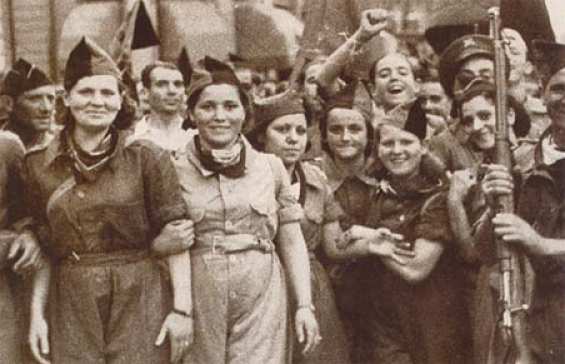
“Women in the Spanish Revolution” is a pamphlet published by Solidarity, a small libertarian socialist group in Britain (now defunct – Solidarity that is). The pamphlet is short and relatively uninteresting, despite the best efforts of the author to mine all English-language sources readily available at the time for nuggets of information.

Her two main conclusions is that although women played an important part during the Spanish Civil War, their roles were scaled down as the emphasis shifted from social revolution to “regular” anti-fascism. For instance, women had played a more prominent part in the original militias than in the more professionalized army of the People's Front government. Another problem was the lack of specific feminist organizing. Yet, the Republic did take measures the author considers pro-woman, such as legalization of abortion or easier divorce proceedings.

All in all, nevertheless a relatively uninspiring text, but perhaps the sources are to blame for this?

Friday, August 3, 2018

The factory committees in the Russian revolution


"The Bolsheviks and Workers' Control" is a classical study of the factory committee movement during the Russian revolution. The author, Maurice Brinton, was a member of a small but relatively well known British leftist group, Solidarity. He is also the author of "The irrational in politics", a rather crude attempt to combine Freud, Reich and Marx in one package. I always assumed that Maurice Brinton was a pen name used by the French philosopher Cornelius Castoriadis (Solidarity translated some of his political writings). Actually, Brinton was another person!

This edition of "The Bolsheviks and Workers' Control" was published in the United States by Black & Red, presumably a small anarchist publisher. Despite its political antecedents, the book is extremely interesting and draws on a large amount of sources, including Soviet books and documents. Conventional historians are also cited, including Carr, Daniels, Shapiro and Deutscher.

After the February revolution in 1917, workers at many factories in Russia created "factory committees", which attempted to wrest control of the plants from the owners. The factory committees were independent of the labour unions, and seems to have been somewhat similar to the soviets formed at the same time. The Bolsheviks initially supported the factory committee movement. After the October revolution, however, their attitude gradually cooled. In the Bolshevik scheme of things, the economy should be controlled by the state, i.e. the Supreme Economic Council and its local organs. Brinton describes the process in painstaking detail. Of course, the Bolsheviks also turned Russia into a one party state. The experiment with "workers' control" of production was a short lived one.

The book does contain a few sloppy errors. Thus, the author places the Lenin Levy in 1923 rather than 1924, making Lenin commenting upon the levy, when actually it took place after his death! Overall, however, this seems to be a well documented work about a usually neglected period in Russian history. "The Bolsheviks and Workers' Control" also cover topics treated more extensively elsewhere, such as the Left Communists and the Workers' Opposition.

Personally, I consider the factory committees to have been utopian. A modern economy cannot be completely decentralized, nor can it be "centralized" on the basis of radical democracy á la the Paris Commune, which I presume is Brinton's position. The Bolsheviks were political realists when they pinioned the factory committees, and any other regime would surely have done the same. Of course, this has made the factory committees a staple of anarchist, anti-statist mythology. While Solidarity weren't anarchists in the strictest sense of that term, they did come pretty close. Nor is it surprising that "The Bolsheviks and Workers' Control" have been reprinted by anarchist groups.

Thursday, August 2, 2018

Cloudbusting with Brinton


"The irrational in politics" by Maurice Brinton is a real underground classic. Originally published in 1970, during the heydays of the sexual revolution, student protests and hippie counter-culture, it's an attempt to combine revolutionary Marxism with the alternative psychoanalysis of Wilhelm Reich.

Brinton wonders why the working class, or people in general, so often act against their real, objective interests, which Brinton takes to be a libertarian socialist program? He reaches the conclusion that people have been socialized into an authoritarian character structure through sexual repression. Therefore, the socialist revolution must go hand in hand with a sexual revolution. Brinton is prescient enough to criticize the phoney "sexual revolution" which simply turns people into consumers of mass produced pornography. However, his text (which is a quite fun read) is nevertheless replete with problems.

For instance, Brinton believes that the phoney sexual revolution is based on sexual repression, otherwise it wouldn't be possible to sell products with titillating pornographic marketing. Today, however, it's safe to assume that at least the younger generation isn't particularly "repressed" anymore (certainly not in Sweden), yet the socialist revolution is nowhere near. Nor can Brinton explain why people acted irrationally in societies where sexuality wasn't completely repressed. For all we know, sexual mores in ancient Egypt or Viking Age Scandinavia were pretty loose, yet these cultures where hardly "libertarian", certainly not Egypt. The author also tends to identify capitalism with hierarchy and authority. This may still have been the case when the pamphlet was written. Today many employers have no problem with "flat organization", yet capitalism remains. Finally, Brinton seems to believe that sexual repression and alienation somehow floats freely, as an independent variable, disconnected from the material conditions. (Presumably, this is more Reich than Marx.)

What Brinton doesn't understand, is that people may behave perfectly "rationally" in the short term, regardless of whether such actions are "irrational" in the long term. Remember: "irrational" to Brinton means that you don't fight for the libertarian socialist program. But why should German workers in 1933 fight for such a program, when they could get a piece of the cake by voting Hitler? Why should poor Hindus fight for libertarian socialism, when their immediate survival depends on joining a Hindu fundamentalist protest, perhaps for money? Why should White workers stop being sexist or racist, since this gives them certain privileges? This kind of analysis is absent from Brinton's booklet. This is no doubt connected to his mushy "anti-authoritarian" perspective, as if the natural state of "the workers" was to rise up against exploitation - as if no worker ever benefited from exploitation, relative privilege, etc.

Humans do act in stunningly irrational ways. Still, a rather large portion of Homo sapiens are eminently practical men. Absent a credible alternative, they tend to bicker for the small crumbs of cash and power that fall from the main table of the establishment. For some reason, Brinton doesn't want to admit that this behaviour is "rational" and might be explained even without reference to the Overself quelling our libido.

Ironically, it feels as if Brinton would have done better studying Marx rather than going cloudbusting with Reich. Just a thought. And no, I'm not a Marxist...

Postmodern capitalism....and still no revolution


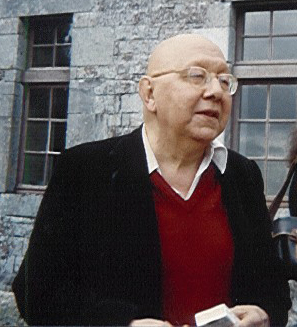
Paul Cardan is a pseudonym for Cornelius Castoriadis, a French intellectual who passed away in 1997. His most important works were written during the 1960's, when he led a small left-wing group called Socialisme ou Barbarie (Socialism or Barbarism). Castoriadis gradually drifted away from Marxism, and his group was dissolved in 1965. Castoriadis later career is somewhat unclear to me, but he seems to have developed an interest in Freudian psychoanalysis and written a curious book about the coming of World War Three. A rather entertaining photo of the old man can be seen at Wikipedia.

"Modern capitalism and revolution" was written in 1960, translated to English in 1965 by another small leftist group, Solidarity, and re-issued in 1974 with a new preface by the author. (My copy doesn't list Black & Red as co-publisher, however, so it's possible that this is another edition than the one I have.)

Castoriadis argues that traditional Marxism has failed and have to be dispensed with. Modern capitalism can overcome its periodic crisis and even raise the real wages of the workers. Indeed, the rise of the wage levels are a necessary part of modern capitalism, since it gives the system the ability to expand through mass consumption. Capitalism can also create near-full employment, and even the unemployment benefits are substantially higher than previously. Meanwhile, the workers' organizations have been co-opted by the system and turned into instruments of capitalism. The working class has become apolitical and passive. Most people have retreated into their own private lives, and become consumers of mass produced trash. The general trend of modern capitalism is bureaucratization of all spheres of life: the factory, labour unions and political parties, recreation, consumption and culture. The state apparatus also expands. The worst example of this bureaucratization are the "Communist" nations, which Castoriadis denounces as capitalist, but the same process is at a fairly advanced stage even in the Western nations.

Still, Castoriadis believes that there is hope for a revolution. The fundamental contradiction within modern capitalism is between order-givers and order-takers. The order-takers are the new working class, and include both traditional blue collar workers, white collar workers, students and women. Traditional economic demands are no longer particularly useful. Instead, workers should fight for self-management at the point of production. (This sounds like an anarchist or anarcho-syndicalist demand.) Also, socialists should work for a revolution of everyday life in an anti-authoritarian direction. The revolt of youth and students against stifling morality and old-fashioned education are seen as a positive development. The goal is a libertarian socialist society with a network of workers' councils.

Today, Paul Cardan's book sounds just as anachronistic as the traditional Marxism it denounces, perhaps more so. The ability of the system to overcome its crises is shaky at best, unemployment figures are rising, and is doubtful whether all workers have gotten real wage increases. Traditional working class struggles were legion during the 1970's, 1980's and early 1990's. Meanwhile, globalization have created a vast, traditional working class in nations such as China, India or Brazil. While China (a weird state capitalist system) is successful, the most bureaucratic systems, such as the Soviet Union, have quite simply collapsed. The Internet and "flat organization" have created a less bureaucratic system. Postmodern capitalism? The only phenomenon correctly described by the author is the increasing tendency of many people to retreat into passive, private existence and become consumers of mass entertainment or useless products.

Castoriadis seems to have drawn all the wrong conclusions from the prolonged postwar boom after World War II. This boom has been somewhat shaky for decades, and might be just about to go bust at any time! Of course, it's always easy to criticize a book in hindsight. Still, it's difficult not to see the shortcomings 50 years later. One shortcoming should have been obvious already when the book was written: Castoriadis says virtually nothing about the Third World. In general, the New Left seems to have been Third Worldist, which is logical if you believe that the proletariat in the rich nations have been "bought off" and rendered passive. At this time, the Third World was teeming with left-wing and nationalist guerrillas (such as the NLF in Vietnam). Also, if the contradiction is between order-giver and order-taker, surely the "African peasants" mentioned in passing by Cardan are the ultimate order-takers or "wretched of the earth". Yet, our author seems to write off the entire Third World as of little interest, giving his book a curiously local feeling, even somewhat claustrophobic!

I don't doubt that Marxism needs to be superseded. However, it feels as if "Modern capitalism and revolution" was a step in the wrong direction...