"Solidarnosc: Acid Test for Trotskyists" is
a publication by the Bolshevik Tendency, later rechristened International
Bolshevik Tendency. The booklet was published in 1988 and deals with the
dramatic events in Poland seven years earlier.
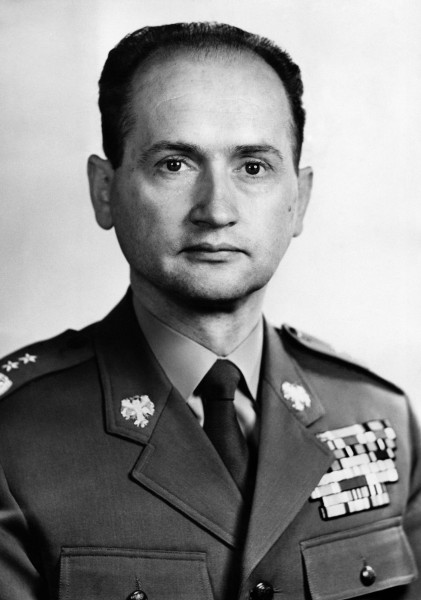
The BT was one of the few Trotskyist groups that supported General Wojciech Jaruzelski's crackdown on the independent labour union Solidarnosc on December 13, 1981. Most other Trotskyists sided with Solidarnosc against the Communist regime, which they regarded as Stalinist. The Fourth International, the LIT, the CWI and other major Trotskyist currents (and many smaller ones) hoped that the mass movement around Solidarnosc would trigger a "political revolution" against the ruling bureaucracy, overthrowing the Stalinist regime in favour of workers' power.
The BT, by contrast, argues that Solidarnosc was a reactionary movement from top to bottom, completely subservient to the interests of the Catholic Church, the United States, kulaks and perhaps even Polish fascists. Its goal was to restore capitalism, and eventually to overthrow the regime by force. Since the defence of collectivized property forms is more important than formal democracy, the BT reasons that Jaruzelski's crackdown was a blow against counter-revolution. If the Stalinists take such action, Trotskyists should support them, even against a mass movement based in the working class!
BT's position is derived from the Spartacist League, another Trotskyist group which sided with Jaruzelski against the Polish workers. The Spartacists were pretty vulgar in their support for the Polish strongman, even to the point of taking "responsibility in advance for whatever idiocies and atrocities" the Stalinists might commit (!). They also blamed the economic crisis in Poland on lazy or striking workers, and put up a portrait of Jaruzelski at their head offices in New York City. In contrast, the BT attempts to strike a more intellectual and sophisticated pose. They don't seem to understand that the vulgar Stalinophilia of the Sparts over Poland was connected to the general "freak out" of this group circa 1979-81. In a very real sense, the BT is trying to rationalize the actions of mad hatters...
That being said, "Acid Test" does raise disturbing questions for Trotskyists, including for the BT-ers themselves. Thus, the BT believes that the "Stalinist" bureaucracy can't as a whole go over to the side of counter-revolution and capitalist restoration. The bureaucracy, after all, derives its privileges from the nationalized economy, and can't be expected to commit voluntary, collective suicide in favour of the bourgeoisie. Therefore, the BT predicts that a large portion of the "Stalinist" apparatus will come to the defence of the collectivized property forms, smashing anyone who attempts to restore a market economy. However, the BT also believes that the working class *as a whole* can go over to the side of the counter-revolution and capitalism. This, according to the BT, is what happened in Poland in 1981. Doesn't this mean that the privileged Stalinist nomenklatura is *more revolutionary* than the workers? In what sense is this different from the "Stalinist" position, not the public one, but the one held back-stage, according to which ordinary workers can't be trusted to defend "really existing socialism", that role being in the hands of the Party, its great leaders, its military and its secret police? An interested outsider might also ask the BT how this squares with Karl Marx' statement that the working class is the only consistently revolutionary class? If nationalized property is somehow "proletarian", how come the workers so often protest against the regimes that abolish capitalism? How come the best defenders of the nationalized property aren't workers, but the "Stalinist" bureaucrats riding on their backs?
In 1989, most of the Communist regimes in "Eastern" Europe simply collapsed. The Stalinist bureaucracy really did commit collective suicide, while the workers were probably even more "capitalist" than they had been in 1981. This time, they hardly even formed labour unions, preferring instead to vote for right-wing parties (or in some cases, "left"-nationalist demagogues). This strikes me as a problem for all Trotskyist groups, both those looking to the workers for a "political revolution", and those like the BT who presumably hoped that some general somewhere would be daring enough to do what Jaruzelski had done in 1981. Sensibly, most Trotskyists decided to support the democratic protests against "Stalinism" anyway.
There was one exception to the rule of collective bureaucratic suicide, however: the Soviet Union. There, a faction of the apparat, led by Gennady Yanayev, attempted to save is power and privileges by a coup against the reformer Gorbachev. Almost uniquely on the non-Stalinist left, the BT sided with Yanayev and his Emergency Committee. Even the vulgar and burlesque "more Soviet than the Soviets" Spartacist League flinched, leaving the small BT alone to take the last stand. At least theoretically - the BT were relatively safe in the SF Bay Area!
In a sense, I suppose you could say that the BT passed the "acid test", and displayed a remarkable degree of political consistency. They will be called upon to take a stand again, I'm sure, in Pyongyang any time now. Still, the questions posed by the Solidarnosc-Jaruzelski confrontation, and the events of 1989-91, remain. If nationalized property is ultimately more important than democracy or independent labour unions, why not break with Trotskyism and go over completely to Stalinism?

No comments:
Post a Comment